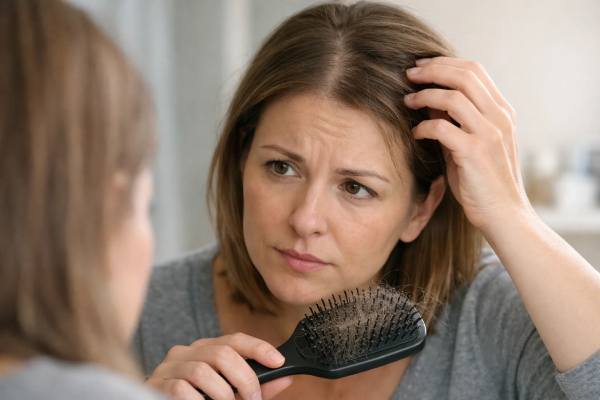
SSRIs are widely used for depression, anxiety disorders, panic disorder, obsessive-compulsive disorder, and related conditions because they can be effective, familiar to prescribers, and safer than many older antidepressants. That is why hair shedding linked to an SSRI can feel especially frustrating: the medication may be helping your mood while raising a new worry about appearance and control. In most cases, this type of shedding is not scarring and does not mean the follicle is permanently damaged. The harder part is timing. Hair follicles react slowly, so the event that triggered shedding may have happened several weeks earlier. A recent SSRI start, a dose increase, a rapid taper, a stressful relapse, an illness, iron deficiency, or weight loss can all overlap. This makes “Is it the medication?” a more nuanced question than it first appears. A clear timeline, a review of other triggers, and a calm plan with your prescriber usually reveal far more than guessing from the shower drain alone.
Key Insights
- SSRI-related hair loss usually shows up as diffuse shedding rather than sudden bald patches or scarring.
- The most useful clue is timing: visible shedding often appears weeks after the actual trigger.
- Hair loss that begins after stopping an SSRI is not always withdrawal itself; overlapping stress, illness, diet change, or prior follicle shift may be the better explanation.
- Do not stop an SSRI abruptly to test the theory; review the timeline, other triggers, and appropriate labs first.
Table of Contents
- Why SSRIs Can Shift the Hair Cycle
- Timeline After Starting, Changing, or Stopping
- Signs It May Be SSRI Related
- What to Check Before Blaming the SSRI
- What to Do Without Stopping Abruptly
- When to Get Help and What Recovery Looks Like
Why SSRIs Can Shift the Hair Cycle
When hair shedding appears after starting an SSRI, the usual mechanism is thought to be telogen effluvium. That means more hairs than usual are pushed out of the active growth phase and into the resting phase, then shed later. It is very different from scarring alopecia, where inflammation damages the follicle itself. With SSRI-related shedding, the follicle is usually still present, which is one reason recovery is often possible once the trigger settles.
This pattern matters because it explains why the change does not always happen immediately. Hair follicles run on a built-in schedule, not on the same clock as side effects like nausea or insomnia. A medication change can nudge that schedule, but the visible result may not show up until weeks later. If you want a deeper primer on the hair growth cycle, it helps make the timing much easier to understand.
The biology is not fully mapped out, but several ideas are plausible. SSRIs alter serotonin signaling, and serotonin is not limited to the brain. Hair follicles also interact with neurochemical signals, immune signals, and stress pathways. In some people, that may be enough to shift more hairs into telogen. Another possibility is that the medication is not the whole story. Starting an SSRI often happens during a period of intense anxiety, depression, poor sleep, reduced appetite, weight change, or a recent illness. Those factors can independently trigger shedding, then get blamed on the prescription that happened to start around the same time.
That is why SSRI-related hair loss is best treated as a diagnosis of context, not a diagnosis of panic. It appears to be uncommon, probably underrecognized, and more often described in case reports and adverse-event reviews than in large, clean trials. Reported cases most often involve diffuse scalp shedding, not sharply defined bald spots. People may notice more hair on the brush, pillow, or shower floor, a wider part, or lower ponytail volume.
The main practical point is this: if hair loss begins around an SSRI change, think in terms of a temporary shift in follicle cycling first. That framing is useful because it guides the next steps. You look for a delayed trigger, screen for competing explanations, protect treatment for the underlying mental health condition, and avoid assuming permanent loss before the timeline has had a chance to declare itself.
Timeline After Starting, Changing, or Stopping
The timeline is where most of the confusion lives. People often expect a medication side effect to begin right away. Hair follicles do not behave that way. In a classic telogen effluvium pattern, the trigger happens first, but visible shedding may not become obvious until roughly two to three months later. That means the SSRI start, the dose increase, the taper, the illness, the breakup, the crash diet, or the iron drop may have happened well before the hair came out.
After starting an SSRI, the most typical pattern is delayed diffuse shedding rather than instant loss. Some published cases report earlier onset, but the more clinically familiar window is several weeks in. In the SSRI case literature, onset ranges widely, which is one reason this side effect is easy to misread. A dose increase can restart the question because hair follicles may respond to the change rather than to the original prescription date.
Stopping an SSRI is even trickier. If shedding starts after discontinuation, there are a few possibilities:
- The hair cycle shift may have happened while you were still taking the medication, and the shedding only became visible later.
- The stop itself may have coincided with another trigger, such as acute stress, appetite change, poor sleep, weight loss, relapse of depression or anxiety, or a switch to another medication.
- The original hair loss may have been improving, but because regrowth is slow, the hair can still look thinner for a while after the drug is gone.
This is why a simple calendar is more useful than memory. Write down the exact date you started the SSRI, any dose changes, the date you tapered or stopped, and the week you first noticed increased shedding. Then add any major events from the prior three months. Many people discover that the most likely trigger is not the one they first assumed. That can also help sort out shedding versus true hair loss, which are related but not identical problems.
A practical way to think about recovery is in phases. First, the excessive shedding slows. Then, after a lag, density begins to return. That is not overnight regrowth. It is gradual. Baby hairs, improved fullness at the part, and a less dramatic wash-day shed often appear before the hair looks “normal” again. For many people, that means improvement over months, not days.
So when someone says, “I stopped the SSRI and my hair is still falling,” that does not automatically disprove the medication link. It may simply reflect how slowly follicles close one chapter and begin the next.
Signs It May Be SSRI Related
Not every hair complaint that shows up during antidepressant treatment is caused by the antidepressant. Still, some patterns make an SSRI connection more plausible.
The most suggestive presentation is diffuse shedding across the scalp. People often describe more hair in the shower, more strands on clothing, or a ponytail that feels thinner. The scalp itself usually looks normal or close to normal. There is not usually a sharply outlined patch, a smooth coin-shaped bald area, heavy scale, pus-filled bumps, or pain with visible inflammation. When those features are present, you have to think beyond medication shedding.
Clues that support an SSRI link include:
- A reasonable delay between starting, increasing, or changing the SSRI and the onset of shedding.
- No obvious competing trigger in the preceding weeks.
- Improvement after dose reduction, discontinuation, or switching to another antidepressant under medical supervision.
- A repeated pattern in the same person after rechallenge, though this is not something to test casually.
Clues that point away from a simple SSRI explanation include:
- Distinct patches, eyebrow loss, or lash loss with other autoimmune clues.
- Broken hairs rather than shed hairs, which raises the possibility of breakage, heat damage, traction, or grooming-related injury.
- Itching, burning, thick scale, or redness.
- Hairline loss concentrated at the temples or edges, which can fit traction or pattern loss more than drug-induced telogen effluvium.
- Continued worsening for many months without any slowing, especially if other symptoms are present.
Another useful question is whether the hair is being shed from the root or snapping mid-shaft. Medication-related telogen effluvium usually causes shedding from the root, not shaft fracture. If the issue is actually breakage, the solution sits in hair care, chemical exposure, heat habits, or traction rather than in psychiatric prescribing. A broader guide to medication-related shedding can also help place SSRIs in context.
There is also a common interpretive trap: someone starts an SSRI during a severe depressive or anxiety episode, then blames the SSRI for hair loss caused by the episode itself. Emotional stress can trigger telogen effluvium. So can sleep loss, restricted eating, and abrupt weight change. That does not mean the SSRI is innocent in every case. It means the surrounding physiology matters.
A good rule is this: SSRI-related hair loss is more believable when the pattern is diffuse, delayed, nonscarring, and temporally linked to the medication, and less believable when the exam suggests patchy, inflammatory, scarring, or structural hair disease. When the pattern does not fit, broaden the search early instead of forcing the medication theory to explain everything.
What to Check Before Blaming the SSRI
Before deciding that an SSRI is the culprit, step back and review the entire three-month window before the shedding began. That single habit prevents a lot of false attribution. Hair follicles respond to many kinds of stress, and several can stack together.
Start with the common overlaps:
- Fever, flu, COVID-19, or another significant illness.
- Surgery, anesthesia, hospitalization, or major blood loss.
- Childbirth, miscarriage, stopping estrogen-containing medication, or other hormonal shifts.
- Rapid weight loss, calorie restriction, low-protein intake, or appetite suppression.
- New medications or supplements.
- High stress, panic, grief, poor sleep, or worsening depression.
Then move to the scalp itself. Look for dandruff, psoriasis, painful bumps, scaling around follicles, or heavy itching. Those findings may point to a scalp disorder rather than a pure medication effect.
Lab work can be useful, but it should be purposeful rather than random. In practice, clinicians often consider a complete blood count, ferritin or iron studies, and thyroid testing, especially when shedding is diffuse, prolonged, or accompanied by fatigue, heavy periods, cold intolerance, or diet change. Depending on history, vitamin B12, vitamin D, zinc, folate, or other tests may be reasonable, but broad supplement-driven panels are not automatically high yield. A focused discussion about hair-loss blood tests is often more helpful than chasing every possible deficiency.
Keep in mind that “low-normal” is not always the same as clinically irrelevant, but it is also not a license to self-treat aggressively. Hair supplements are marketed as if every shedding episode is a vitamin shortage. That is not true. Over-supplementing can create new problems, and treating a lab number without a clear plan does not guarantee regrowth.
A useful checklist to bring to an appointment includes:
- Exact medication dates: start, dose changes, taper, stop, switch.
- Hair timeline: first week you noticed shedding, whether it is worsening or stabilizing, and whether the pattern is diffuse or focal.
- Other triggers in the prior twelve weeks.
- Scalp symptoms: itch, scale, pain, redness, burning, or bumps.
- Nutrition and weight changes.
- Menstrual, postpartum, or perimenopausal changes when relevant.
- Photos of the part, temples, and hairline under similar lighting.
This kind of audit does two things. First, it protects you from stopping a useful SSRI for the wrong reason. Second, it increases the chance that a real, fixable issue such as iron deficiency, thyroid dysfunction, postpartum shedding, or another medication effect is not missed. The best question is rarely “Is it the SSRI or not?” It is “What changed in the relevant window, and what deserves action first?”
What to Do Without Stopping Abruptly
If you suspect an SSRI is contributing to hair shedding, the worst first move is usually to stop it suddenly on your own. Abrupt discontinuation can trigger dizziness, nausea, sleep disruption, anxiety, agitation, electric-shock sensations, and return of the symptoms the drug was treating. It can also muddy the timeline, because now you have introduced a second major variable while the follicles are still lagging behind.
A steadier approach works better.
First, document the pattern for two to four weeks unless the shedding is extreme or the scalp looks inflamed. A simple count is not necessary, but note wash-day shedding, brushing, part width, and any new thin areas. Photos taken weekly in the same lighting are more informative than memory.
Second, talk with the prescribing clinician before changing the medication. Depending on the situation, options may include:
- staying the course a bit longer if the shedding is mild and the SSRI is helping substantially,
- reducing the dose if symptoms and mental-health stability allow,
- switching to another antidepressant with a different adverse-effect profile,
- slowing an existing taper rather than stopping abruptly,
- coordinating with dermatology if the diagnosis is uncertain.
Third, clean up the background variables that make telogen effluvium worse. Aim for steady meals with adequate protein, regular sleep, hydration, and gentler hair care. Avoid aggressive heat, tight styles, harsh chemical processing, and excessive scalp manipulation while the shedding phase is active.
Fourth, be cautious with self-treatment. Starting several hair products at once creates noise. If you and your clinician think the issue is temporary telogen effluvium, the most effective intervention may simply be trigger control and patience. In some cases, a dermatologist may discuss treatments that support regrowth or protect density, but that decision should follow an actual diagnosis rather than fear-based product layering. If the picture is getting more severe or uncertain, this is the stage to review when to see a dermatologist rather than improvising.
There is also a mental-health angle that deserves respect. Hair loss can be distressing enough to make someone want to abandon a medication that is otherwise finally helping. That is understandable. But the goal is not to “push through” blindly or to quit impulsively. The goal is to preserve psychiatric stability while investigating a potentially reversible hair trigger in an organized way.
In short, do less reacting and more sorting. A brief pause for timeline review, targeted labs, clinician input, and careful monitoring often saves both your hair and your treatment plan from unnecessary disruption.
When to Get Help and What Recovery Looks Like
Most SSRI-linked shedding, when it happens, is not an emergency. But some situations deserve prompt medical review. Get evaluated sooner if the hair loss is sudden and dramatic, forms clear patches, involves the brows or lashes, comes with redness or pain, or is paired with major fatigue, heavy bleeding, chest symptoms, rapid weight loss, or new endocrine symptoms. The same is true if the scalp burns, scales heavily, or develops pustules. Those features push the problem outside the simple telogen effluvium lane.
Psychiatric urgency matters too. If concerns about hair loss are making you want to stop an SSRI abruptly, or if tapering has already triggered severe mood symptoms, panic, or suicidal thinking, treat that as a priority. Hair can be addressed alongside mental health, not instead of it.
As for recovery, it is usually gradual. The first sign is often not obvious thickening but less daily shedding. After that, density improves slowly as new hairs cycle back into visible length. The front may show short regrowth first, and the part may narrow before the full volume feels restored. This is why recovery can feel slower than expected even when the trigger has been removed.
Reasonable expectations look like this:
- Shedding may continue for a while even after the suspected trigger is corrected.
- Stabilization often comes before cosmetic improvement.
- Regrowth takes months, not days.
- Full recovery may lag behind symptom relief because hair length itself needs time to catch up.
If shedding lasts beyond the usual temporary window, keeps intensifying, or repeatedly returns, the problem may no longer be a single medication episode. At that stage, the conversation should widen to chronic telogen effluvium, patterned hair loss unmasked by shedding, persistent nutritional issues, thyroid disease, inflammatory scalp disorders, or mixed causes. A page on chronic telogen effluvium can help frame that longer pattern.
The reassuring point is that SSRI-related hair loss is usually discussed as a reversible, nonscarring process. The cautionary point is that recovery is rarely instant and attribution is rarely perfect. The best outcomes tend to come from early pattern recognition, avoidance of abrupt medication changes, and a balanced workup that respects both follicle biology and mental health. When those two are handled together instead of in competition, the path forward is usually much clearer.
References
- Alopecia associated with the use of selective serotonin reuptake inhibitors: Systematic review 2022 (Systematic Review)
- Medication-induced hair loss: An update 2023 (Review)
- Telogen effluvium: a 360 degree review 2023 (Review)
- Telogen effluvium in daily practice: Patient characteristics, laboratory parameters, and treatment modalities of 3028 patients with telogen effluvium 2022 (Observational Study)
- Risk of hair loss with different antidepressants: a comparative retrospective cohort study 2018 (Comparative Cohort Study)
Disclaimer
This article is for educational purposes only and is not a diagnosis or a substitute for medical or psychiatric care. Hair shedding after starting or stopping an SSRI can have several causes, and medication changes should be made only with a qualified clinician. Seek prompt medical attention for patchy or scarring hair loss, scalp inflammation, major systemic symptoms, or worsening mood, self-harm thoughts, or other urgent mental health concerns.
If this article helped, please consider sharing it on Facebook, X, or your preferred platform.