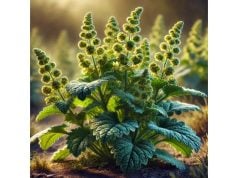
Dysphania ambrosioides, widely known as epazote and listed in older sources as Chenopodium ambrosioides, is a strongly aromatic herb with a long history in food and traditional medicine. It is best known for digestive support, traditional antiparasitic use, and broad antimicrobial and antioxidant activity seen in laboratory research. At the same time, it is a plant that deserves careful handling: the essential oil can contain ascaridole and other potent terpenes, and the safety profile changes sharply depending on whether you are using fresh leaves in cooking, a mild tea, or a concentrated oil. That difference is where many herb guides become misleading. This article focuses on what matters in practice: what is in the plant, what its benefits realistically look like, how people use it, where dosage becomes uncertain, and which side effects and safety limits should shape a safer decision.
Key Insights
- Dysphania ambrosioides shows antimicrobial, antioxidant, and digestive-support potential, but most evidence is still preclinical.
- The essential oil can be high in ascaridole and other active terpenes, so concentrated products carry more risk than culinary leaf use.
- A cautious traditional tea range is about 0.5 to 1 g dried aerial parts in 200 to 250 mL water, used short term, not as a long-term routine.
- Avoid home oral use of the essential oil because toxicity risk is higher and the composition can vary by chemotype.
- Pregnant or breastfeeding people, children, and people with liver disease, anemia, or seizure risk should avoid unsupervised use.
Table of Contents
- What dysphania is and what is in it
- Dysphania benefits and realistic uses
- How to use dysphania in practice
- How much dysphania to use
- Common mistakes with dysphania
- Side effects interactions and who should avoid it
- What the evidence actually says
What dysphania is and what is in it
Dysphania ambrosioides is an aromatic herb in the Amaranthaceae family. It is native to the Americas but now grows widely in warm and temperate regions, and it appears in local traditions under many names, including epazote, paico, Mexican tea, and wormseed. One reason it creates confusion online is naming. Many older herbal texts, studies, and product labels still use the former botanical name Chenopodium ambrosioides. If you compare studies or products, those names usually refer to the same plant.
The herb’s medicinal profile comes from two broad chemical layers:
- Volatile compounds in the essential oil
- Non-volatile phenolics and flavonoids in leaf or aerial-part extracts
The essential oil is the most pharmacologically intense part of the plant. It usually contains a mix of monoterpenes and related compounds, often including:
- Ascaridole
- Alpha-terpinene
- Cymene-type compounds
- Other terpenes that vary by region, season, and extraction method
Ascaridole is the best-known marker compound because it is linked to both the herb’s traditional antiparasitic reputation and its toxicity concerns. That dual role is important. The same chemistry that makes dysphania biologically active also makes concentrated essential oil use more risky than culinary leaf use.
The second chemical layer includes non-volatile compounds such as phenolic acids and flavonoids. These compounds are more relevant to teas and hydroalcoholic extracts than to the essential oil alone. This is one reason a mild tea and an essential oil can feel like two very different products, even though they come from the same plant. The volatile fraction tends to drive the sharp aroma and stronger immediate effects, while the non-volatile fraction contributes more to antioxidant-related activity seen in extract studies.
A practical point that many guides miss is chemotype variability. Different populations of the plant can produce noticeably different essential oil profiles. Soil conditions, climate, harvest timing, and plant genetics can all shift the proportion of key compounds. In real-world terms, two products labeled “Dysphania ambrosioides” may differ in aroma, potency, and side effect risk.
So when people ask, “What is the active ingredient in dysphania?” the most accurate answer is that there is no single ingredient. It is a chemically complex herb with a pattern of active compounds. The essential oil provides concentrated terpene activity, while leaf and aerial extracts contain additional phenolics and flavonoids. That complexity helps explain why the herb has a broad traditional reputation, but it also explains why standardizing dose and safety is difficult.
Dysphania benefits and realistic uses
Dysphania ambrosioides has a wide traditional reputation, but the most useful way to assess its benefits is to separate traditional use, laboratory evidence, and human clinical proof. The plant is clearly bioactive, yet most of the strongest evidence comes from preclinical work rather than modern human treatment trials.
The most realistic benefit areas include the following.
- Digestive support and carminative use
- This is one of the most common culinary and household uses.
- Small amounts of the herb are often added to beans and other foods to improve digestibility and reduce gas.
- This is not the same as “taking a medicinal dose.” The amount is usually lower, and the goal is support rather than treatment.
- Antimicrobial activity
- Essential oil and extract studies show activity against several bacteria and some fungi in laboratory settings.
- This helps explain why the herb appears in traditional remedies for infections and gut complaints.
- Still, test-tube activity does not prove that a home preparation can replace antibiotics or antifungal treatment.
- Antioxidant and anti-inflammatory potential
- Extracts from the plant contain phenolic compounds that show antioxidant effects in lab assays.
- Some essential oil studies also report antioxidant-related activity, but results vary depending on the oil profile and test method.
- This variability is exactly why product form matters when people expect “the same effect” from every preparation.
- Traditional antiparasitic use
- Dysphania has a long history as a vermifuge in many regions.
- This is one of its most famous traditional uses, but it is also the area most closely tied to toxicity concerns, especially when concentrated oil is involved.
- Historical use does not automatically mean modern self-treatment is safe.
- Broad preclinical interest
- Research also explores antifungal, insecticidal, and other pharmacologic properties.
- These findings support biological relevance, but they are not the same as proven human benefits.
The key advantage of dysphania is that it provides several practical pathways in one herb: culinary use, digestive support, aromatic utility, and measurable antimicrobial potential. The limitation is that those benefits depend heavily on how it is used. A few leaves in food and a concentrated oil capsule are not simply different doses of the same thing. They are different exposures with different risk levels.
A realistic approach is to match the preparation to the goal. Culinary use is often the best starting point for digestive support. Short-term traditional tea use may fit mild symptoms. But for severe pain, persistent diarrhea, suspected parasites, or signs of infection, dysphania should not replace diagnosis and standard care.
How to use dysphania in practice
Dysphania can be used in several forms, and the form you choose is the single biggest factor in both effect and safety. Many people search for “how to take epazote,” but the better question is “which form fits my goal.” Fresh herb, tea, extracts, and essential oil are not interchangeable.
The most common use forms are:
- Fresh leaves in cooking
- This is the most familiar and usually the lowest-risk way to use the herb.
- It is traditionally added to bean dishes and savory foods for flavor and digestive comfort.
- Culinary use generally means low exposure and a wider margin of safety than medicinal dosing.
- Dried aerial parts as tea or infusion
- This is a common traditional medicinal style of use.
- A mild infusion may be used short term for digestive discomfort.
- Strength varies a lot based on the plant material, how much is used, and how long it steeps.
- Extracts or tincture-like products
- These are harder to evaluate unless they are standardized.
- The label should identify the plant part and extract ratio.
- If the product is vague, dosing becomes guesswork.
- Essential oil
- This is the most concentrated and highest-risk form.
- Essential oil composition can vary, and ascaridole levels may differ widely.
- Oral self-use of essential oil is not a good safety default.
If you are choosing a commercial product, use a simple quality checklist:
- Scientific name listed as Dysphania ambrosioides or Chenopodium ambrosioides
- Plant part identified clearly
- Preparation type stated (leaf, powder, extract, or oil)
- Lot or batch number
- Storage instructions
- Clear safety warnings
Be cautious with products that rely on marketing language instead of details. Phrases like “all natural,” “traditional,” or “pure” do not tell you the concentration, the plant part, or the risk level.
A practical way to use dysphania safely is to start with the least intensive form that matches your reason for using it. For example:
- If your goal is digestive support with meals, use culinary leaf amounts.
- If your goal is a short-term herbal tea, use a mild infusion and keep the duration brief.
- If your goal involves a serious medical issue, do not jump to stronger forms. Seek proper evaluation first.
One underappreciated point is that dysphania sits at the boundary between food herb and medicinal herb. That makes it easy to misuse. People sometimes assume a concentrated product is just “more of the same” as the fresh leaves. In reality, the chemistry shifts, the risk increases, and the margin for error narrows. Treating the form as the deciding factor is one of the best ways to avoid problems.
How much dysphania to use
Dosage is the hardest part of using dysphania responsibly because there is no standardized, clinically validated human therapeutic dose that applies across all forms. Most published studies use laboratory concentrations or animal doses, and those numbers do not translate neatly into home use. This is especially true for essential oil products.
The safest way to think about dosage is by form, goal, and duration, not by a single “best dose.”
Here are practical, conservative ranges by form.
- Culinary leaf use
- Use small amounts for flavor and digestive support.
- A practical range is about 1 to 3 fresh leaves in a pot of food, or roughly 0.5 to 2 g fresh herb depending on leaf size.
- This is usually the safest entry point for people new to the herb.
- Mild tea or infusion
- A cautious range is about 0.5 to 1 g dried aerial parts in 200 to 250 mL hot water.
- Start once daily.
- Keep use short term, such as a few days, rather than making it a daily long-term routine.
- This is a traditional-style range, not a clinically proven prescription dose.
- Extracts
- Use only products with clear dosing instructions and a defined preparation.
- The label should identify the extract ratio or concentration and the plant part.
- If the product does not provide this information, it is too hard to dose confidently.
- Essential oil
- Do not self-dose orally at home.
- There is no universal safe oral dose for consumers, and the chemical profile can vary by batch and origin.
Timing and spacing matter too:
- Take internal preparations with food if you notice stomach irritation.
- Separate internal dysphania use from iron supplements by several hours.
- Do not keep repeating doses across the day just because the herb is “natural.”
A common mistake is to use animal toxicology or experimental doses as a guide for personal use. That is not a safe shortcut. Animal studies use specific fractions, controlled conditions, and endpoints that do not directly define a home herbal dose. They are useful for screening safety and mechanisms, not for telling you what to take.
The most reliable dosing strategy is conservative and goal-based:
- Choose the mildest form that fits your need.
- Use the smallest reasonable amount.
- Limit duration.
- Stop if irritation or side effects appear.
That approach may sound less exciting than aggressive online claims, but it is far more consistent with the evidence and the plant’s risk profile. With dysphania, careful dosing is not a minor detail. It is the main factor that separates practical use from avoidable harm.
Common mistakes with dysphania
Dysphania is a useful herb in the right context, but it is easy to misuse because it exists in both culinary and medicinal traditions. Most problems happen when people treat all forms the same, rely on vague product claims, or use it for conditions that need medical care.
Here are the mistakes that matter most.
Mistake 1: Treating all forms as equivalent
Fresh leaves, tea, extracts, and essential oil are not just “different strengths” on one line. They can emphasize different chemical fractions.
- Fresh herb use is low-dose and food-based
- Tea provides a mix of water-soluble compounds and some volatiles
- Extracts vary by solvent and concentration
- Essential oil is concentrated and terpene-heavy
This means a stronger product is not automatically a better product. In many situations, it is simply a riskier product.
Mistake 2: Ignoring chemotype and batch variability
Dysphania chemistry changes with growing conditions, geography, and harvest timing. One essential oil may be much richer in certain terpenes than another. If a product gives no batch information, no plant part, and no preparation details, it is harder to use safely.
Mistake 3: Using it to self-treat serious infections or parasites
The herb has real antimicrobial and traditional antiparasitic relevance, but that does not make it a substitute for diagnosis. The danger is not just side effects. It is delay in proper care.
Seek medical evaluation instead of escalating herb use if you have:
- Fever
- Blood in stool
- Severe abdominal pain
- Persistent vomiting
- Ongoing diarrhea
- Unexplained weight loss
These are not “try more herb” situations.
Mistake 4: Long-term daily internal use
Even herbs with food uses can cause trouble when taken daily in medicinal amounts for long periods. Dysphania is better suited to occasional culinary use or short-term, cautious use than to indefinite internal routines.
Mistake 5: Trusting marketing language over labeling
“Natural” and “traditional” do not tell you the concentration, the dose, or the safety profile. Better signals include:
- Clear botanical name
- Plant part listed
- Dosing instructions
- Batch number
- Preparation type
- Safety warnings
Mistake 6: Assuming no side effects means it is working better
Some users interpret throat burning, nausea, or dizziness as proof the herb is “strong.” Those are warning signs, not quality signals.
The best troubleshooting rule is simple: if dysphania is not helping quickly for a mild issue, do not just increase the amount. Reassess the form, the reason you are using it, and whether the problem needs conventional care. That single decision prevents many avoidable side effects and delays in treatment.
Side effects interactions and who should avoid it
Safety is where dysphania deserves the most attention. The herb’s risk profile changes sharply by preparation type. Small culinary use is very different from concentrated extract or essential oil exposure. The biggest concern is the essential oil, especially because ascaridole and related compounds are linked to toxic effects in laboratory and toxicology research.
Common side effects from internal use can include:
- Nausea
- Stomach cramping
- Burning or irritation in the throat
- Dizziness
- Loose stool
- In some people, constipation or loss of appetite
These effects are more likely when the dose is too high, the preparation is concentrated, or use is repeated too often. If symptoms appear, stop using the herb rather than trying to “push through” discomfort.
A key distinction is leaf use versus oil use.
- Leaf use in food usually involves lower amounts and lower risk.
- Tea use can still cause irritation if too strong or used too often.
- Essential oil is concentrated and far less forgiving. Its composition varies, and self-dosing orally carries a much higher chance of harm.
Interaction data in humans are limited, but practical cautions are still warranted.
Possible interactions and spacing concerns
- Iron supplements and iron-rich meals
- Separate internal dysphania use by several hours.
- This is a conservative step to avoid possible interference with absorption.
- Oral medications
- Take medications and dysphania at different times.
- This reduces the chance of absorption problems and makes reactions easier to track.
- Liver-sensitive situations
- Avoid concentrated oil and high-dose extracts if you have liver disease or take medicines with known liver stress.
Who should avoid unsupervised medicinal use
The following groups should avoid self-directed internal use, especially concentrated products:
- Pregnant people
- Breastfeeding people
- Children
- People with liver disease
- People with anemia or iron deficiency
- People with a seizure history
- People who are sensitive to essential oils
- Anyone taking multiple prescription medicines daily
When to stop and seek urgent care
Stop use and seek prompt medical help if you develop:
- Severe abdominal pain
- Persistent vomiting
- Confusion, fainting, or unusual weakness
- Rash, swelling, or trouble breathing
- Worsening symptoms after a concentrated product
Dysphania can be used more safely when the form is matched to the purpose and the dose stays conservative. Most serious problems happen when people move too quickly to concentrated products or treat a medically significant condition at home. With this herb, safety depends less on tradition and more on preparation choice and dose control.
What the evidence actually says
Dysphania ambrosioides has strong evidence for bioactivity and much weaker evidence for standardized clinical use in humans. That distinction is the most accurate way to summarize the herb and the best way to avoid overpromising what it can do.
What is well supported:
- It is chemically active
- Multiple studies confirm a complex profile of volatile terpenes and non-volatile phenolic compounds.
- The essential oil composition is well studied, and chemotype variation is a real and important issue.
- It shows antimicrobial and antioxidant activity in preclinical research
- In vitro studies repeatedly show antibacterial and antioxidant effects.
- These findings help explain the herb’s long-standing place in traditional medicine and food use.
- Toxicity concerns are credible
- Safety concerns are not only anecdotal.
- Toxicology and mechanistic studies support caution with concentrated preparations, especially essential oil and ascaridole-rich products.
What remains uncertain:
- Standardized medicinal dosing for humans
- There is no widely accepted clinical dose for oral medicinal use.
- Product differences make the dosing problem even harder.
- Clinical effectiveness for specific conditions
- Human trials are not strong enough to recommend dysphania as a primary treatment for infections, parasites, ulcers, or chronic inflammatory conditions.
- Long-term safety
- Toxicology data are improving, but long-term human data remain limited and product-specific.
Why the evidence can feel confusing:
- Older papers often use the name Chenopodium ambrosioides
- Newer papers often use Dysphania ambrosioides
- Different studies use different plant parts
- Preparation types vary widely
- Chemical profiles shift with geography and chemotype
- Lab concentrations are often mistaken for consumer dosing guidance
The most practical interpretation is this: dysphania is a traditional medicinal and culinary herb with credible preclinical support, but it is not a clinically standardized herbal medicine in the way many consumers assume. That does not make it useless. It simply means the best evidence-aligned uses are modest and careful.
The safest and most realistic use pattern is:
- Prefer culinary use when the goal is flavor or mild digestive support.
- Use short-term, mild internal preparations only when the reason is limited and symptoms are mild.
- Avoid oral essential oil self-dosing.
- Seek diagnosis for persistent or severe symptoms.
This conservative interpretation is what makes dysphania genuinely useful. It respects both sides of the evidence: the plant is active and interesting, and the clinical limits are real. People usually get the best outcome when they treat it as a potent traditional herb, not a cure-all.
References
- Essential Oils and Extracts from Epazote (Dysphania ambrosioides): A Phytochemical Treasure with Multiple Applications – PMC 2025 (Review)
- Impact of Soil Nutrients on Chemical Composition and Antioxidant Activities of Dysphania ambrosioides Essential Oil in Southern Ecuador – PMC 2026 (Research Article)
- Antibacterial and Antioxidant Activity of Dysphania ambrosioides (L.) Mosyakin and Clemants Essential Oils: Experimental and Computational Approaches – PMC 2022 (Experimental Study)
- Comprehensive phytochemical and toxicological analysis of Chenopodium ambrosioides (L.) fractions – PMC 2024 (Toxicology Study)
- Toxicity of ascaridole from Chenopodium ambrosioides in mammalian mitochondria – PMC 2010 (Seminal Toxicology Study)
Disclaimer
This article is for educational purposes only and does not replace medical advice, diagnosis, or treatment. Dysphania ambrosioides can be pharmacologically active, and concentrated preparations, especially essential oil, may cause harm if used incorrectly. There is no universally established human medicinal dose, and safety depends on the form used, the amount, and your health status. If you are pregnant, breastfeeding, taking prescription medications, managing a chronic condition, or considering internal use for a medical problem, consult a qualified healthcare professional before use.
If this article helped you, please share it on Facebook, X, or another platform you prefer so others can find reliable, safety-first herbal guidance.