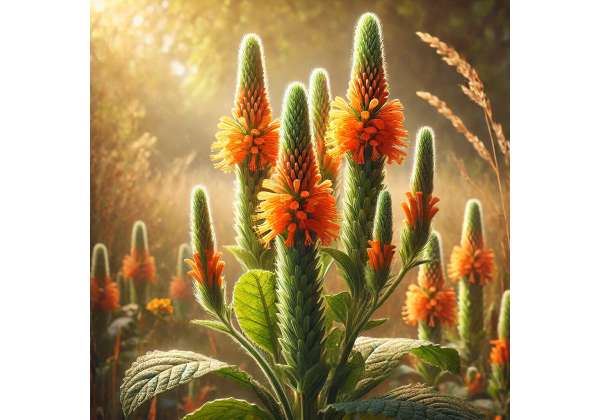
Freedom Flower, Leonotis leonurus, is a striking member of the mint family best known for its bright orange whorled flowers and its long history in southern African traditional medicine. It is also called wild dagga and lion’s tail, names that hint at both its cultural importance and the confusion that sometimes surrounds it online. Modern interest in this herb usually centers on three questions: whether it can promote calm, whether it has meaningful anti-inflammatory or topical benefits, and whether its reputed mild psychoactive effects are real.
The most honest answer is mixed but interesting. Freedom Flower contains labdane diterpenes, flavonoids, and other secondary compounds that show promising biological activity in preclinical research. Traditional use also points to roles in calming, skin support, mild pain, and respiratory complaints. At the same time, good human evidence is still limited, product quality varies, and the most sensational claims often run ahead of the science. That makes this herb worth understanding carefully. Used with realistic expectations, Freedom Flower may be a valuable traditional botanical, but it belongs in the category of cautious, evidence-aware herbal use rather than broad, casual self-medication.
Core Points
- Freedom Flower shows the most plausible potential for mild calming support, topical soothing, and inflammation-related uses, but human evidence remains limited.
- Marrubiin and related labdane diterpenes appear more important than the often-repeated leonurine claim.
- A traditional tea range is about 1 to 2 g dried aerial parts per cup, taken 1 to 2 times daily for short-term use.
- Smoking or inhaling the herb is less predictable and may irritate the lungs even when traditional use mentions it.
- Pregnant or breastfeeding people, children, and anyone taking sedatives or using cannabis should avoid unsupervised use.
Table of Contents
- What is Freedom Flower
- Key ingredients and what they do
- What benefits are most plausible
- How is Freedom Flower used
- How much should you take
- Safety, side effects, and interactions
- What does the evidence show
What is Freedom Flower
Freedom Flower is the common name used here for Leonotis leonurus, a shrub-like medicinal plant native to southern Africa. Botanically, it belongs to the Lamiaceae family, the same broad family that includes mint, sage, basil, and other aromatic herbs. The plant grows upright, often reaching several feet in height, with serrated leaves and very distinctive orange tubular flowers arranged in rounded tiers along the stem. That unusual shape explains another common name, lion’s tail.
In traditional practice, Freedom Flower has never been just an ornamental plant. Ethnobotanical records describe it as a multipurpose herb used for skin complaints, headaches, coughs, fever, cramps, and nervous-system related conditions. Preparations have included teas, decoctions, topical washes, and in some settings inhaled smoke from dried aerial parts. Modern readers often encounter it online through a different lens: as “wild dagga,” “wild cannabis,” or a legal herb with mild psychoactive properties. That branding has helped spread awareness of the plant, but it has also distorted the discussion.
A useful way to understand Freedom Flower is to separate three different identities that often get blended together:
- a traditional medicinal herb,
- a culturally important southern African botanical,
- and a commercially marketed “cannabis-like” novelty.
The first two are well grounded. The third is where confusion grows. Freedom Flower is not cannabis, and it should not be judged by cannabis expectations. Some users report mild calming or altered-sensation effects, especially when the herb is smoked, but the plant’s chemistry is different and its pharmacology is still incompletely mapped.
Another important point is that Freedom Flower is usually used for its aerial parts rather than as a food. This is not a nutritional seed, tonic fruit, or culinary spice. It is a medicinal herb whose relevance comes from secondary compounds rather than calories, vitamins, or macronutrients. That means dosage, preparation, and context matter more than they would for an ordinary kitchen ingredient.
Its traditional use patterns also suggest that it was treated as a practical everyday plant, not as an exotic miracle. Herbal systems often value such plants precisely because they are flexible: one herb may be steeped for internal use, washed over irritated skin, or added to mixed formulas. That does not prove clinical effectiveness, but it does help explain why Leonotis leonurus remained important across generations.
So what is Freedom Flower, in modern terms? It is a historically respected medicinal herb with intriguing chemistry, scattered but meaningful preclinical data, and a commercial reputation that is often louder than the evidence. Understanding that balance is the best place to start.
Key ingredients and what they do
Freedom Flower’s medicinal interest comes from its phytochemistry, especially its terpenoid and phenolic profile. The most important chemical family identified in Leonotis leonurus is the labdane diterpenes. Among these, marrubiin is the best-known compound and one of the strongest candidates for the plant’s reported antispasmodic, anti-inflammatory, and metabolic effects in preclinical work. Other diterpenes, including leonurenones and the smoke-associated leoleorin compounds, have also drawn attention.
The plant also contains flavonoids such as luteolin-related compounds and other phenolic constituents that likely contribute antioxidant activity and may help explain some of the herb’s traditional topical and inflammatory uses. These flavonoids do not work in isolation. In herbs like Freedom Flower, the overall effect likely comes from the combined action of multiple constituents rather than a single “star” molecule.
A particularly important point for readers is what the plant may not contain. Online articles often repeat that Freedom Flower contains leonurine, an alkaloid known from other plants and frequently linked to the herb’s supposed psychoactive reputation. The problem is that the better review literature on Leonotis leonurus does not confirm leonurine as an established constituent of this species. In other words, leonurine has become part of the online myth of the plant more than part of its securely documented chemistry. That matters because people often build very specific claims on a compound that may not actually explain the herb’s effects.
The main active groups are best understood like this:
- Labdane diterpenes: likely central to the herb’s biological activity, especially marrubiin and related compounds.
- Flavonoids and phenolics: may support antioxidant, membrane-protective, and anti-inflammatory actions.
- Volatile and smoke-derived constituents: relevant to traditional inhaled use, but far less predictable and less clinically standardized.
- Other minor constituents: may contribute synergy, but their exact importance is still being clarified.
Recent profiling work also suggests that Freedom Flower’s chemical output can vary by plant part, extraction solvent, and even how the material is used. Leaves, flowers, and smoke condensates are not chemically interchangeable. A tea made from dried aerial parts and a smoked preparation may expose the body to very different compounds.
This is why the herb should not be flattened into one simplistic identity. It is not just “a calming herb,” not just “an anti-inflammatory herb,” and not just “an herbal smoke.” Its effects likely shift with form and chemistry.
For readers comparing it with more established calming herbs, that variability is worth remembering. A better-characterized botanical such as scullcap for gentle calming support tends to be discussed in more predictable nervous-system terms. Freedom Flower is more chemically intriguing, but also less settled in both dosing and expected outcome.
The big takeaway is that Freedom Flower’s chemistry supports interest, not certainty. Marrubiin and related diterpenes are more credible anchors than internet folklore, and the plant’s pharmacology should be judged by that evidence rather than by marketing language.
What benefits are most plausible
When the hype is stripped away, Freedom Flower still has several plausible benefit areas. The strongest possibilities are not dramatic cures. They are modest, symptom-oriented uses that fit both traditional practice and early pharmacology.
The first is mild calming support. Traditional use includes nervous-system complaints, and recent preclinical work on smoke constituents suggests anxiolytic and anticonvulsant potential. That does not prove it treats anxiety disorders in humans, but it does make the old calming reputation more credible than many online herb myths. A realistic expectation would be a subtle calming or easing effect in some preparations, not a reliable substitute for prescribed anxiety treatment.
The second plausible area is inflammation and discomfort. Older animal and in vitro work, together with the known activities of compounds like marrubiin, suggest Freedom Flower may have anti-inflammatory and antinociceptive potential. Again, this is not proof that drinking the tea will meaningfully reduce chronic pain, but it does help explain why the herb was used traditionally for aches, cramps, and irritation.
The third is topical support for irritated skin. Ethnomedical use includes rashes, boils, itching, and other skin complaints. This is one of the more sensible traditional uses because topical herbal application often needs less systemic absorption to be helpful. A soothing wash or compress is still not a replacement for wound care or infection management, but it is one of the more realistic application areas.
The fourth is metabolic interest, especially in glucose-related research. Marrubiin and whole-plant extracts have been explored in animal and cellular models for anti-diabetic and tissue-signaling effects. These findings are scientifically interesting, but they are not strong enough to justify routine self-treatment for diabetes.
A realistic benefit hierarchy looks like this:
- short-term, mild calming or easing support,
- topical soothing use,
- possible anti-inflammatory support,
- exploratory metabolic interest.
What is less convincing?
- strong claims of cannabis-like psychoactivity,
- claims that it is a proven anticonvulsant for people,
- claims that it reliably treats depression or anxiety disorders,
- and claims that it can manage diabetes, infections, or chronic inflammatory disease on its own.
That matters because this herb often attracts readers searching for something unusual or semi-legal rather than something well studied. In practice, the most grounded uses are quieter and more traditional than the marketing suggests.
There is also a good reason not to overextend the respiratory claims sometimes attached to the plant. Freedom Flower has been used traditionally for chest complaints, but modern readers looking for simple herbal respiratory support would usually find more focused options such as great mullein for respiratory support easier to justify. That does not erase Freedom Flower’s history; it simply places it in context.
So what benefits are most plausible? Mild calming, topical soothing, and some inflammation-related support rise to the top. Everything stronger should be read as preliminary. That may sound conservative, but with herbs like this, conservative is often what keeps the information useful.
How is Freedom Flower used
Freedom Flower has been used in several forms, and the form matters a great deal. Traditional use includes infusions or decoctions, topical washes, and smoked dried material. Modern commercial products may also include tinctures, powdered herb, loose dried leaf and flower, and occasionally resin-like extracts.
For most adults who are interested in traditional herbal use rather than experimentation, the most sensible forms are these:
- Tea or infusion: made from dried aerial parts for short-term internal use.
- Tincture: easier to standardize by drops or milliliters if the product is reputable.
- Topical wash or compress: prepared from an infusion for minor skin irritation.
- Herbal blend: sometimes paired with other calming or topical herbs.
The smoked route deserves special caution. It is historically documented, and newer research has even looked at smoke constituents directly, but that does not make it a practical or advisable wellness method. Combustion changes plant chemistry, makes dosing unpredictable, and adds respiratory irritation that can easily outweigh any subtle benefit. Traditional use is worth acknowledging. Recommending inhalation as a routine modern strategy is another matter.
Topical use is easier to place. A strained infusion can be used as a wash or compress for minor irritated areas, although it should never be used as a substitute for medical care when infection, deep wounds, spreading redness, or significant pain are present. In that topical category, Freedom Flower sits closer to the logic of calendula in skin-focused herbal care than to the logic of a strongly systemic herb. The difference is that calendula is usually discussed with more topical confidence, while Freedom Flower remains more tradition-led.
A practical use approach might look like this:
- Choose a clearly labeled dried herb or tincture rather than a novelty product.
- Prefer oral tea or topical wash over inhaled use.
- Use it for a defined, short-term purpose, such as mild restlessness or simple topical soothing.
- Keep expectations modest and stop if you feel unpleasant sedation, dizziness, or stomach irritation.
Freedom Flower is also sometimes described as a recreational herb. That framing is not especially helpful for someone trying to understand medicinal use. Recreational expectations push people toward stronger dosing, smoking, or mixed use with alcohol or cannabis, which increases uncertainty and risk. Medicinal use works better when the plant is treated as a plant, not as a legal shortcut to another drug category.
Another practical issue is product quality. Because the plant has a niche reputation, some products are sold more for mystique than for consistency. That makes sourcing important. With herbs like this, a low-information label is usually a warning sign.
In plain terms, Freedom Flower is best used in the most traditional and least sensational ways: tea, tincture, or topical preparation, taken conservatively and for a clear reason. That is where the plant is most likely to be helpful and least likely to become misleading.
How much should you take
There is no universally established clinical dose for Freedom Flower. That is the first point to keep clear. The plant has traditional dosing patterns, but it does not have the kind of standardized, human-trial-backed dosage framework that would support precise modern prescribing.
For traditional tea use, a conservative adult range is often placed around:
- 1 to 2 g dried aerial parts per cup, taken 1 to 2 times daily for short-term use.
For tinctures, the appropriate amount depends on extract ratio and alcohol strength, so label guidance matters more than any generic number. If the product does not clearly state its concentration, it is difficult to dose responsibly.
For topical use, a simple infusion can be prepared and used as a wash or compress on intact skin. Topical use is often easier to tolerate than internal use, but it should still begin cautiously because plant sensitivity reactions can occur.
Several dosing principles are more useful than a single number:
- Start low. This herb is variable, and individual sensitivity may differ.
- Stay short-term. It makes more sense for limited symptom support than for indefinite daily use.
- Avoid layering effects. Do not combine it casually with sedatives, alcohol, cannabis, or other herbs with calming or psychoactive reputations.
- Do not chase intensity. If the effect feels weak, that is not a signal to keep escalating the dose.
This last point matters because Freedom Flower’s reputation attracts some people who are looking for noticeable psychoactive effects. That is precisely the situation where safe herbal practice breaks down. More is not necessarily better, and with inhaled or concentrated preparations, more can simply mean harsher, less predictable, and more unpleasant.
Timing depends on the goal. If someone uses a tea for mild calming support, evening use may be the most logical. If the goal is topical soothing, timing matters less than consistency. For short-term internal use, a few days to a week is a more reasonable self-care window than prolonged use.
Who should not guess at a dose?
- children,
- pregnant or breastfeeding people,
- anyone with a seizure disorder,
- people taking psychoactive or sedating medicines,
- and anyone using inhaled forms.
The reason is not that all use is known to be dangerous. The reason is that the evidence is too thin to justify confident dosing in higher-risk groups.
One useful comparison is that herbs with a stronger anti-inflammatory evidence base, such as boswellia with stronger human evidence, allow more confident dose discussions. Freedom Flower does not yet offer that level of clarity.
So the practical dose message is simple: if used at all, keep it modest, traditional, and short-term. A mild tea range is more defensible than concentrated experimentation, and product transparency matters as much as the number on the spoon.
Safety, side effects, and interactions
Freedom Flower is not well enough studied to be called broadly safe in the modern evidence-based sense. That does not mean it is highly toxic in all normal use. It means the safety picture is incomplete, and the herb’s reputation often leads people into forms of use that are less predictable than standard herbal tea practice.
The most plausible side effects include:
- drowsiness or mental slowing,
- dizziness or light-headedness,
- stomach upset,
- dry mouth,
- headache,
- and skin irritation with topical use in sensitive individuals.
These effects may be more likely with concentrated preparations, inhaled use, or combinations with alcohol or other psychoactive substances.
There is also a more important safety point: the route of use changes the risk. Smoking or inhaling Freedom Flower is harder on the lungs than drinking it, and the dose is far harder to estimate. Even if traditional use includes inhalation, modern readers should not assume that historical use equals modern safety.
Animal safety data also suggest caution. Repeated oral extract exposure has produced dose-related changes in some liver, kidney, and blood-related markers in rat studies. Animal studies do not automatically predict human harm at ordinary tea doses, but they do argue against treating the herb as carefree or harmless.
Who should avoid it unless specifically advised by a knowledgeable clinician?
- Pregnant or breastfeeding people, because there is not enough reliable safety data.
- Children and adolescents, because nervous-system and dose-response data are too limited.
- People taking sedatives, sleep aids, anti-anxiety drugs, or antipsychotics, due to possible additive central nervous system effects.
- Anyone using cannabis, alcohol, or other intoxicating substances, because the combined effect may be less predictable.
- People with respiratory disease, especially if considering smoked use.
- People with liver or kidney concerns, because the safety picture is not strong enough to assume low risk.
Interaction data are thin, but caution is still appropriate. In herbal safety, “not well studied” does not mean “interaction-free.” With Freedom Flower, the most likely interaction concerns are additive sedation, impaired alertness, and enhanced unwanted effects when mixed with psychoactive or CNS-active agents.
Another underappreciated safety issue is product adulteration or poor quality. Because the herb is sometimes marketed through the “wild cannabis” angle, quality control may not be as disciplined as it is for mainstream botanical products. A weak product may be disappointing. A contaminated or misrepresented product is a more serious issue.
The best safety mindset is to treat Freedom Flower as a niche medicinal herb with incomplete human data. Use it conservatively, avoid inhaled and high-intensity approaches, and stop early if the experience feels unpleasant or odd. That kind of restraint is not anti-herbal. It is what responsible herbal practice looks like when the evidence is still emerging.
What does the evidence show
The evidence for Freedom Flower is intriguing, but it remains mostly preclinical and ethnopharmacological. That means the plant has enough scientific support to justify interest, but not enough to justify strong medical claims.
The strongest parts of the evidence base are:
- ethnobotanical records showing repeated traditional use across several symptom categories,
- phytochemical studies identifying diterpenes, flavonoids, and other active compounds,
- animal and cellular studies suggesting anti-inflammatory, antinociceptive, metabolic, and nervous-system effects,
- and recent work on smoke constituents showing anxiolytic and anticonvulsant signals in zebrafish models.
Those are meaningful findings. They help explain why the herb has persisted in traditional medicine and why it still attracts research attention. But they are not the same as strong human evidence.
What is still missing?
- well-designed human clinical trials,
- consistent product standardization,
- better dose-response clarity,
- and a clearer map of interaction and long-term safety risk.
This gap is why so many claims around Freedom Flower remain speculative. For example, it is reasonable to say the plant has compounds with calming potential. It is not reasonable to say it is a proven natural treatment for anxiety. It is reasonable to say marrubiin and related diterpenes deserve attention. It is not reasonable to say the herb reliably reproduces cannabis-like effects in a predictable way.
The evidence also helps correct internet mythology. One of the most useful corrections is that the plant’s reputation has outpaced its chemistry in public discussion. The better-supported story is about labdane diterpenes, topical and inflammatory traditions, and modest calming potential. The less-supported story is about a clearly identified cannabis-like active principle driving a reproducible psychoactive effect.
That does not make the herb unimportant. In fact, it makes it more interesting. Freedom Flower is exactly the kind of plant that deserves careful, species-specific, preparation-aware study. It sits in the space where traditional knowledge has pointed researchers toward something real, but the modern clinical work has not yet caught up.
So what should readers conclude?
- The herb has legitimate traditional roots.
- Its chemistry is real and nontrivial.
- The most plausible benefits are modest and symptom-oriented.
- Strong claims still outrun the evidence.
- Safety deserves more respect than many online summaries give it.
That is a satisfying place to land, even if it is less dramatic than marketing copy. Freedom Flower is not empty folklore, and it is not established medicine. It is a promising traditional herb with genuine pharmacological interest, limited human evidence, and a clear need for more careful study before firm therapeutic conclusions can be made.
References
- “Wild cannabis”: A review of the traditional use and phytochemistry of Leonotis leonurus 2015 (Review)
- Chemical profiling, anticonvulsant and anxiolytic effects of the smoke constituents isolated from Leonotis leonurus (L.) R.Br 2024
- Phytochemical Profiles, Micromorphology, and Elemental Composition of Gomphocarpus fruticosus (L.) W.T. Aiton and Leonotis leonurus (L.) R.Br., Plants Used for Managing Antidepressant-like Conditions in Folk Medicine 2024
- Leonotis Leonurus improves the crosstalk between peripheral tissues both in vivo and in vitro 2021
- Effect of aqueous extract of Leonotis leonurus (L.) R. Br. leaves in male Wistar rats 2010
Disclaimer
This article is for educational purposes only and is not a substitute for medical advice, diagnosis, or treatment. Freedom Flower is a traditional medicinal herb with limited direct human research, and many reported effects still rely on laboratory, animal, or ethnobotanical evidence rather than strong clinical trials. Seek medical advice before using it if you are pregnant, breastfeeding, have a chronic health condition, take prescription medicines, or are considering it for anxiety, seizures, pain, or any ongoing medical concern.
If you found this article helpful, please share it on Facebook, X, or your preferred platform.