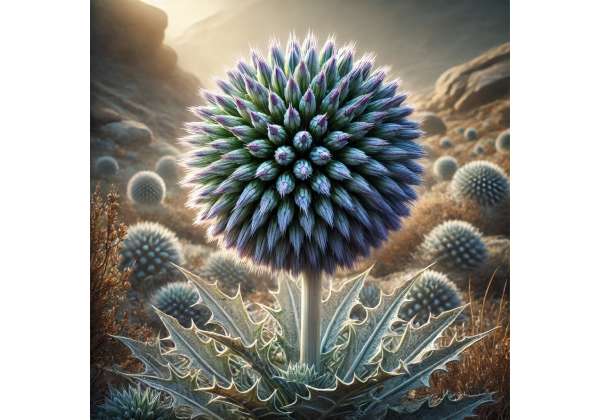
Globe thistle, or Echinops ritro, is a spiny, blue-flowered herb best known as an ornamental plant, yet it also has a quieter medicinal history in parts of Europe and Asia. Traditional uses have included support for respiratory complaints, minor infections, pain, inflammation, and certain heart-related or circulatory concerns. Modern interest comes from a different angle. Researchers now focus on the plant’s thiophenes, flavonoids, coumarins, caffeoylquinic acids, and other secondary metabolites that may help explain its antimicrobial, antioxidant, hepatoprotective, and anti-inflammatory activity.
What makes globe thistle worth discussing is not strong clinical proof, but the combination of old folk use and increasingly detailed phytochemical research. At the same time, it is not a mainstream herbal remedy with established human dosing standards. Most benefit claims still come from cell studies, animal research, and compound-isolation work rather than large clinical trials. That means it should be approached with interest, but also with restraint. This guide explains what globe thistle contains, what it may realistically help with, how it has been used, what dosage questions remain unresolved, and where the main safety limits begin.
Quick Overview
- Globe thistle shows the most plausible promise for antimicrobial, antioxidant, and liver-protective support in preclinical research.
- Its roots, flowering heads, and aerial parts have been used traditionally for inflammation, minor infections, and respiratory complaints.
- No validated human dose exists; published activity data rely mostly on experimental extract doses, including 250 mg/kg in animal work rather than self-care dosing.
- People with Asteraceae plant sensitivity should be cautious, especially with concentrated extracts.
- Pregnant or breastfeeding people, children, and anyone taking multiple chronic medicines should avoid medicinal use without professional guidance.
Table of Contents
- What is globe thistle?
- Globe thistle active compounds
- Does globe thistle have benefits?
- How to use globe thistle
- How much globe thistle per day?
- Globe thistle safety and interactions
- What the evidence says
What is globe thistle?
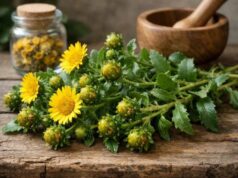
Globe thistle, Echinops ritro, is a perennial herb in the Asteraceae family. It grows upright, carries narrow spiny leaves, and produces the round steel-blue flower heads that make it popular in dry gardens and pollinator plantings. In the wild, it favors sunny, rocky, and grassy terrain and is found across parts of southern and eastern Europe and western Asia. The plant is striking to look at, but its medicinal identity is much less familiar than its ornamental one.
Traditional medicine has used different parts of globe thistle rather than treating the plant as a single uniform remedy. Roots have received the most attention in older phytochemical and antimicrobial work, while leaves and flowering heads have appeared in more recent antioxidant and hepatoprotective studies. Folk traditions have linked the herb with bacterial or fungal complaints, respiratory discomfort, mild inflammatory pain, and certain circulatory or heart-related uses. Some regional traditions also mention root infusion and the use of dried flower heads for localized pain or nerve-related complaints.
A practical point matters here: globe thistle is not the same as edible fennel, culinary thistle, or immune herbs that happen to belong to the same broad botanical family. Despite its name, it should not be confused with kitchen thistles or treated like the edible globe artichoke. Nor does it occupy the same evidence level as better-known Asteraceae herbs. It is much closer to a research-stage medicinal plant than to a standardized over-the-counter herbal staple.
That difference affects how readers should think about it. Globe thistle is interesting primarily because it sits at the intersection of traditional use and modern natural-products chemistry. It contains a wide range of secondary metabolites, especially thiophenes and phenolic compounds, that give it a credible pharmacological profile. But credibility is not the same as proof. A plant can be chemically active and still remain under-validated for routine human use.
For most readers, the safest way to understand globe thistle is as a specialized herbal species with emerging medicinal potential. It may be relevant to future antimicrobial, liver-support, or inflammation research. It is not yet a herb that most people should self-prescribe casually. That balanced framing matters because the plant’s promise comes from its chemistry, while its main limitation comes from the lack of robust human trials and standardized dosing. In that sense, globe thistle is a useful example of how traditional reputation and modern evidence do not always move at the same speed.
Globe thistle active compounds
The medicinal interest in globe thistle comes from a chemically rich profile rather than from one dominant “active ingredient.” Studies on Echinops ritro and the broader Echinops genus repeatedly point to thiophenes, flavonoids, coumarins, phenolic acids, acylquinic acids, alkaloids, terpenoids, and essential-oil constituents as the main groups that shape biological activity.
Among these, thiophenes stand out most clearly. Reviews of the genus describe thiophenes as the primary bioactive components across many Echinops species. In globe thistle, roots are especially important here. Root and whole-plant extracts have yielded multiple substituted bithiophenes and related compounds, several of which showed antibacterial or antifungal effects in laboratory testing. This is one reason globe thistle is discussed more often in antimicrobial natural-products research than in mainstream herbal practice.
A second major group is polyphenols, especially flavonoids and caffeoylquinic-type compounds. In a 2023 study on globe thistle leaves and flowering heads, researchers identified a broad secondary-metabolite profile that included chlorogenic acid, dicaffeoylquinic acids, apigenin derivatives, hyperoside, cirsiliol, and related compounds. These molecules help explain why newer work often frames globe thistle as an antioxidant or liver-protective botanical rather than only as an antimicrobial one.
A third group is coumarins and related minor constituents. These appear in more recent analytical work and likely contribute to the plant’s broader biological profile, although they are not as central to globe thistle’s identity as thiophenes and phenolic compounds.
A fourth group includes alkaloids and sesquiterpenoid-type constituents reported from older phytochemical investigations. These are relevant because they show that globe thistle is not chemically narrow. It is a plant with multiple classes of secondary metabolites, which may partly explain why traditional uses have been so varied.
Plant part matters a great deal. Root chemistry has often been tied to thiophene-rich antimicrobial activity, while leaves and flowering heads have been explored more for antioxidant and hepatoprotective potential. That means a root extract and a flowering-head extract should not be assumed to do the same thing.
This distinction is helpful when comparing globe thistle with other Asteraceae herbs. A plant such as burdock is usually discussed in terms of root-based nutritive or skin-related support. Globe thistle, by contrast, is more often framed through specialized secondary metabolites and experimental antimicrobial or oxidative-stress pathways. It is a subtler, more research-driven phytochemical story.
For a reader, the key insight is simple: globe thistle is interesting because it is chemically complex. Its value does not come from vitamins or food-like nutrition. It comes from specialized metabolites that may influence microbes, oxidative stress, inflammation, and tissue protection. That gives the plant scientific relevance, but it also means preparation, plant part, and extract type matter far more than they would for a gentler everyday herb.
Does globe thistle have benefits?
Globe thistle may have meaningful health benefits, but the most responsible way to describe them is to separate preclinical promise from clinically proven outcomes. Right now, the plant belongs much more to the first category than the second.
The strongest case for benefit lies in antimicrobial activity. Root extracts and isolated thiophenes from Echinops ritro have shown antibacterial and antifungal effects in laboratory studies. Several isolated thiophenes have demonstrated activity against Staphylococcus aureus, Escherichia coli, Candida albicans, and a range of plant-pathogenic fungi. This is one of the plant’s clearest pharmacological themes and the area where its chemistry lines up most neatly with its traditional use for infection-related complaints. Even so, lab inhibition of microbes does not automatically translate into safe or effective treatment in humans.
A second credible area is antioxidant and hepatoprotective support. Leaf and flowering-head extracts have shown strong antioxidant activity in multiple assay systems, and animal or tissue studies suggest protective effects against induced oxidative stress in the liver. This is promising because it gives globe thistle a broader medicinal identity than “just antimicrobial.” Still, the evidence remains preclinical. It supports further research, not casual self-treatment for liver disease.
A third area is anti-inflammatory potential. Traditional use has long associated Echinops species with pain, fever, and inflammation. Reviews of the genus support the idea that some extracts and isolated compounds influence inflammatory pathways. For globe thistle specifically, the strongest human-style evidence is still missing, but the experimental signal is plausible enough to justify careful interest.
A fourth possible area is anti-proliferative or cytotoxic research. Some globe thistle extracts and constituents have shown activity against cancer cell lines or enzyme targets involved in proliferation. This is scientifically important, but it is also the easiest area to exaggerate. Cytotoxicity in cells is not the same as proven anticancer benefit in people.
So what benefits are realistic to discuss now?
- Experimental antimicrobial activity, especially from thiophenes
- Antioxidant support from leaves and flowering heads
- Preclinical liver-protective effects
- Possible anti-inflammatory and anti-proliferative activity
What is not established?
- A validated internal use for treating infections
- A proven liver therapy for human disease
- Standardized anti-inflammatory use in chronic pain
- A clinically accepted cancer-support role
That makes globe thistle very different from better-studied immune or infection herbs such as echinacea, where multiple human trials help anchor expectations. Globe thistle has enough research to be taken seriously, but not enough to be used casually as a substitute for established care.
The best conclusion is that globe thistle appears biologically active in meaningful ways, especially against microbes and oxidative stress. Yet most of its benefits remain potential benefits, not settled clinical facts. Readers should see it as a plant with an intriguing pharmacological profile rather than a proven multitasking remedy.
How to use globe thistle
Globe thistle has been used in several forms traditionally, but this is not a plant with a well-standardized modern self-care routine. That means “how to use it” has to begin with a distinction between folk use, research use, and responsible real-world use today.
Traditional use has involved roots, flowering heads, and aerial parts. Older regional practices mention root infusion, root powder, and the use of dried flower heads for certain inflammatory or nerve-related complaints. More recent research, however, often works with laboratory-prepared extracts rather than household preparations. In current pharmacological studies, leaves and flowering heads are typically extracted with ethanol or hydroalcoholic solvents, while older antimicrobial work has focused heavily on root extracts and isolated thiophenes.
That leads to a practical rule: the plant part and extract type matter as much as the plant name. A root extract rich in thiophenes is not the same as a mild aerial-parts tea. A leaf extract studied for antioxidant activity is not the same as a whole-plant tincture made without standardization. With globe thistle, the chemistry shifts enough that preparation really changes the product.
The main use contexts can be grouped like this:
- Traditional infusion or decoction
This is the most likely form in folk practice. It is simple, but it is also the least standardized and the hardest to dose predictably. - Research extracts
These are the most meaningful from an evidence standpoint. Most modern findings come from characterized extracts rather than home-prepared herbs. - Topical or localized folk use
Historical mention of dry flower heads and other plant parts suggests localized use in some traditions, though this is not a standardized modern practice. - Compound-isolation research
Many of the most interesting findings come not from the whole herb, but from isolated thiophenes or phenolic fractions.
For a modern reader, the safest approach is conservative. If globe thistle is used at all, it should be approached as a niche herb, preferably through authenticated material and within professional herbal guidance. It is not a kitchen herb, not a casual daily tonic, and not a good candidate for improvised extract-making. In that sense, it differs from familiar bitter roots or food-like herbs such as dandelion, which have much clearer traditions of low-risk home preparation.
A few practical principles help:
- Use only correctly identified material.
- Do not assume all plant parts are interchangeable.
- Avoid concentrated extracts unless their composition is known.
- Treat any use as time-limited and goal-specific rather than open-ended.
- Do not use the plant as a replacement for treatment of infections, liver disease, or cardiovascular symptoms.
The central message is that globe thistle is better suited to research and specialized herbal discussion than to casual home medicine. It can be used, but only with a level of caution that matches its limited human evidence and variable preparation methods.
How much globe thistle per day?
This is the point where globe thistle’s evidence base becomes most limited. There is no validated human dosing standard for Echinops ritro in general wellness use or in any clearly established medical use. That is not a minor gap. It is one of the main reasons the plant should not be self-dosed casually.
Most published dose information comes from one of three places:
- Traditional use descriptions without reliable modern standardization
- Experimental extract doses in animals
- In vitro concentrations used in antimicrobial or antioxidant testing
These are useful for understanding activity, but they do not translate cleanly into a safe home regimen. For example, a 2023 hepatoprotective study reported meaningful activity from ethanolic extracts in experimental models and also noted no toxicity in the acute toxicity evaluation of one flowering-head extract. But that still does not create a consumer-ready oral dose for humans.
The most honest practical guidance is:
- No evidence-based daily human dose has been established
- Animal extract doses and cell-study concentrations should not be converted into home use
- Any commercial product should be followed only according to its own label and composition
- Whole-herb self-dosing should remain cautious, modest, and professionally guided
If a traditional tea-style preparation is used under guidance, the safest approach is to keep it clearly conservative rather than assert a false precision. That means small, short-term preparations rather than strong concentrated extracts or prolonged use. Since reliable human trial data are absent, it is more accurate to recommend minimal exposure and careful observation than to present a confident gram-based schedule.
This is especially important because globe thistle has been studied in very different forms. Roots, aerial parts, leaves, and flowering heads do not necessarily deliver the same secondary metabolites in the same proportions. Even the same part may behave differently depending on the solvent used. A laboratory ethanolic extract is not equivalent to a simple hot-water infusion.
A reasonable framework for readers is:
- Do not copy research doses from animal studies
- Avoid concentrated extracts without clear composition
- Use professional or product-specific guidance only
- Reassess early rather than assuming more is better
- Stop immediately if unexpected symptoms develop
In practical terms, this herb belongs in the category of plants where dose uncertainty is part of the risk profile. Some herbs are well enough studied that a range can be stated with confidence. Globe thistle is not one of them. Its usefulness lies in preclinical promise, not in a settled human dosage tradition.
For an article like this, the most responsible answer is therefore simple: there is no standard self-care dose for globe thistle, and that fact should be taken seriously rather than worked around. A plant can be pharmacologically interesting and still remain unsuitable for routine self-prescription until better human data exist.
Globe thistle safety and interactions
Globe thistle does not have the same kind of well-known dramatic toxicity as some high-risk medicinal plants, but that does not make it well-established as safe. The central safety issue is insufficient human evidence, especially for repeated oral use, concentrated extracts, and interaction potential.
The first concern is Asteraceae sensitivity. Globe thistle belongs to the same broad family as ragweed, chamomile, burdock, artichoke, and many other herbs that can trigger reactions in sensitive people. Anyone with a history of allergy to Asteraceae plants should approach globe thistle cautiously, especially in concentrated form. That does not mean every person with seasonal allergies will react, but it is a reasonable warning sign.
The second concern is extract uncertainty. Much of the plant’s activity appears to depend on thiophenes and other specialized compounds. This means concentrated extracts may behave quite differently from mild traditional preparations. When a product does not clearly identify plant part, extraction method, or standardization, it becomes harder to predict both benefit and tolerance.
The third concern is limited interaction data. Globe thistle has been investigated for antimicrobial, antioxidant, hepatoprotective, and anti-inflammatory actions. In theory, that creates room for overlap with drugs that affect liver metabolism, inflammatory pathways, or infection management. But because human interaction data are sparse, the safer position is caution rather than confident reassurance.
The fourth concern is special populations. There is not enough reliable evidence to support medicinal use in:
- Pregnant people
- Breastfeeding people
- Children
- People with major liver disease
- People with complicated medication regimens
- People with known plant allergies
A fifth point is that even encouraging toxicity findings need context. Some recent experimental work suggests certain globe thistle extracts may show low acute toxicity in specific models, which is encouraging. But acute safety in animals is not the same as long-term safety in humans. It does not answer questions about repeated dosing, interactions, pregnancy, allergy, or chronic use.
A practical safety checklist looks like this:
- Do not treat globe thistle as a routine daily supplement.
- Avoid concentrated extracts with unclear composition.
- Use extra caution if you have pollen or Asteraceae sensitivity.
- Do not combine it casually with prescription treatment for liver disease, infection, or cardiovascular problems.
- Stop use if rash, stomach upset, dizziness, breathing difficulty, or unusual symptoms appear.
In comparison with familiar medicinal roots and leaves, globe thistle is still too under-studied to deserve a relaxed safety profile. It may eventually prove fairly well tolerated in specific preparations, but the current evidence does not support broad assumptions. For now, it is best treated as a specialist herb whose potential is real, but whose safety boundaries are still being defined.
What the evidence says
The evidence on globe thistle is strongest in phytochemistry and preclinical pharmacology and weakest in human clinical validation. That is the most important summary point in the entire article.
On the positive side, the research pattern is consistent. Reviews of Echinops species repeatedly describe antimicrobial, antioxidant, anti-inflammatory, hepatoprotective, cytotoxic, and enzyme-related activities across extracts and isolated compounds. For Echinops ritro in particular, root thiophenes have shown notable antimicrobial and antifungal activity, while leaf and flowering-head extracts have shown antioxidant and liver-protective effects in experimental systems. This is not random or one-off data. The plant has a coherent preclinical profile.
The evidence is also stronger than usual at the chemical level. Investigators have identified multiple active constituents rather than relying only on crude extracts. That gives globe thistle a more credible scientific foundation than herbs that are discussed only through vague traditional claims. The recurrent appearance of thiophenes, acylquinic acids, flavonoids, and coumarins suggests the plant deserves continued pharmacological attention.
The problem is translation. Most of the published work still sits in one of these categories:
- Compound isolation and structural chemistry
- Cell studies
- Antimicrobial assays
- Animal studies
- Genus-level reviews
That means several key clinical questions remain open:
- Which preparation is best for which goal?
- What dose is appropriate for humans?
- How safe is repeated use?
- Which benefits survive when tested in controlled human trials?
- Which interaction risks matter in real-world care?
Right now, there are not enough answers. A 2025 systematic review of the genus concludes that most studies remain at the in vitro or in vivo stage and that clinical validation is limited. That is exactly how globe thistle should be positioned for readers: interesting, promising, but not clinically settled.
So where does that leave the plant?
It is most credible as:
- A source of bioactive thiophenes and polyphenols
- A candidate antimicrobial and antioxidant research plant
- A possible hepatoprotective botanical in preclinical settings
- A specialized herb with ethnomedical importance
It is less credible as:
- A self-care herb with established oral dosing
- A validated treatment for infections
- A proven liver remedy in people
- A first-line anti-inflammatory botanical for routine use
That balanced conclusion matters. Globe thistle does not deserve dismissal, because its chemistry and repeated experimental activity are real. But it also does not deserve inflated claims. The evidence supports scientific interest and cautious herbal discussion, not certainty. For most readers, that means appreciating the plant for what it is now: a compelling medicinal species still waiting for the human data that would turn promise into practice.
References
- Echinops as a Source of Bioactive Compounds—A Systematic Review 2025 (Systematic Review)
- Echinops Asteraceae extract guards against malathion-induced liver damage via minimizing oxidative stress, inflammation, and apoptosis 2024 (Preclinical Study)
- Antioxidant and Hepatoprotective Potential of Echinops ritro L. Extracts on Induced Oxidative Stress In Vitro/In Vivo 2023 (Preclinical Study)
- Novel Substituted Thiophenes and Sulf-Polyacetylene Ester from Echinops ritro L 2019 (Phytochemistry Study)
- The Genus Echinops: Phytochemistry and Biological Activities: A Review 2019 (Review)
Disclaimer
This article is for educational purposes only and does not replace medical advice, diagnosis, or treatment. Globe thistle remains an under-studied medicinal herb with limited human safety and dosing data. Speak with a qualified clinician before using it medicinally, especially if you are pregnant, breastfeeding, have plant allergies, liver disease, or use prescription medicines.
If this article helped you, please share it on Facebook, X, or your preferred platform so others can find balanced, evidence-aware herbal information.