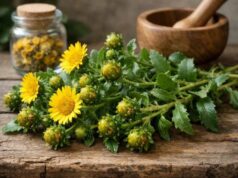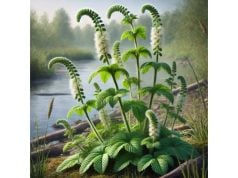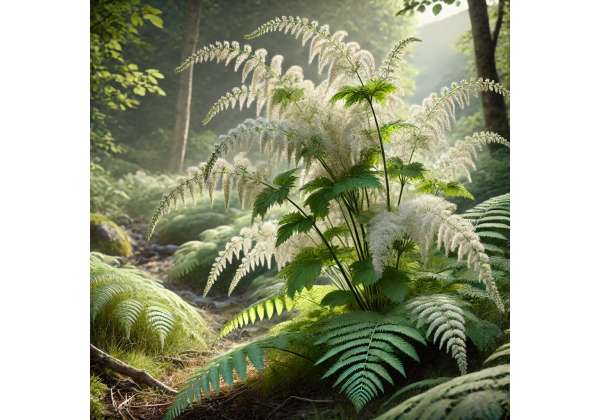
Goat’s beard, Aruncus dioicus, is a tall woodland perennial best known for its feathery white flower plumes, but it also has a quieter history as a traditional food and medicinal plant. In North America, parts of Europe, and East Asia, different communities have used the plant for sore throats, feverish illness, sores, swelling, and seasonal spring foods. Modern research has added another layer to that story by identifying phenolic acids, flavonoids, monoterpenoids, carotenoids, and cyanogenic glycosides in the plant. These compounds help explain why goat’s beard attracts interest for antioxidant, anti-inflammatory, cytotoxic, and metabolic effects.
The most important qualifier is that modern evidence is still limited and uneven. Much of the recent research focuses on Aruncus dioicus var. kamtschaticus, an East Asian variant used in Korean research and food studies, and most of that evidence comes from cell or animal work rather than human clinical trials. That makes goat’s beard an intriguing herb, but not a well-established self-care remedy with a reliable human dosing framework.
Key Takeaways
- Early research points to anti-inflammatory and antioxidant activity, especially in skin, metabolic, and cell-based models.
- Goat’s beard contains phenolic acids, flavonoids, monoterpenoids, carotenoids, and cyanogenic glycosides that shape both its promise and its limits.
- Animal studies have used 20 to 40 mg/kg body weight of extract, but no validated human medicinal dose exists.
- Mature shoots contain prunasin, so goat’s beard should not be treated as a casual raw wild edible.
- Pregnant or breastfeeding people, children, and anyone considering concentrated extracts should avoid self-prescribed medicinal use.
Table of Contents
- What is goat’s beard
- Key ingredients and medicinal properties
- What benefits is it known for
- How goat’s beard is used
- Is there a safe goat’s beard dose
- Side effects, interactions, and who should avoid it
- What the evidence actually says
What is goat’s beard
Goat’s beard is a perennial herbaceous plant in the rose family, Rosaceae. Botanically, it is Aruncus dioicus, though some modern studies focus specifically on Aruncus dioicus var. kamtschaticus, an East Asian variant that appears often in Korean food and medicinal research. The plant grows in moist woodlands and mountain habitats and is easy to recognize once mature: it forms large leafy clumps topped by soft, plume-like flowering panicles. That ornamental look explains why many people know it first as a garden or native landscape plant rather than as a medicinal herb.
What makes goat’s beard especially interesting is that it sits at the intersection of three different traditions. First, it is a wild edible in some regions. In northern Italy, for example, young shoots have long been gathered and eaten as a spring vegetable. Second, it has a folk medicinal history. Ethnobotanical records and government plant notes describe root poultices and infusions for sores, rheumatism, sore throats, fevers, and related complaints. Third, it has become a research plant in East Asia, where extracts from the aerial parts have been studied for metabolic, inflammatory, neuroprotective, and skin-related activity.
That three-part identity is useful because it keeps expectations realistic. Goat’s beard is not a famous everyday herbal tea like chamomile or mint, and it is not a standardized supplement with a long clinical record. Much of what is written about “goat’s beard benefits” is really a mix of traditional use, regional food practice, and preclinical research. Those are meaningful sources of information, but they are not interchangeable.
Another important point is plant-part specificity. Young shoots, aerial parts, and roots are not used for the same reasons and do not carry the same chemistry. Recent phytochemical work shows that shoots contain polyphenols and the cyanogenic compound prunasin, while other studies on aerial parts have isolated unusual monoterpenoids and additional bioactive constituents. This matters because the form of the plant changes both the likely benefit and the likely risk.
The most accurate modern description is that goat’s beard is a traditional woodland herb and seasonal food with interesting phytochemistry and encouraging early research, especially in East Asian variants. It deserves attention, but also restraint. A plant can be culturally valuable and scientifically promising without yet being a proven self-care remedy, and goat’s beard fits that description well.
Key ingredients and medicinal properties
Goat’s beard has a broader phytochemical profile than its quiet reputation might suggest. Recent work on Aruncus dioicus var. kamtschaticus reports several major compound groups: cyanogenic glycosides such as prunasin and sambunigrin; phenolic acids such as caffeic acid, chlorogenic acid, ferulic acid, and caffeoylglucose derivatives; flavonoids such as hyperoside, isoquercetin, and kaempferol derivatives; sterol-triterpenes including beta-sitosterol; tocopherols; and unusual monoterpenoids known as aruncins and aruncides. A 2024 metabolite study also identified carotenoids, including lactucaxanthin, in the foliage.
These constituents help explain why the plant keeps reappearing in pharmacology papers. The phenolic acids and flavonoids give goat’s beard a strong antioxidant profile in laboratory assays. The monoterpenoids isolated from aerial parts have shown antioxidant and cytotoxic activity in older chemistry work. The cyanogenic glycosides are the opposite side of the story: they are a reminder that this is not a carefree wild herb, especially when young shoots mature and chemical balance changes.
Taken together, the plant’s medicinal properties are usually described in a few broad categories:
- Antioxidant activity, linked mainly to polyphenols, tocopherols, and carotenoids.
- Anti-inflammatory activity, supported by modern extract studies in skin and ocular cell models.
- Cytotoxic and antiproliferative potential, largely from isolated compounds and cell-line work.
- Metabolic and enzyme-related activity, including anti-adipogenic, insulin-resistance, and diabetes-related enzyme inhibition in preclinical models.
- Traditional topical and throat-related use, based on ethnobotanical practice rather than clinical trials.
A particularly useful insight is that much of the recent evidence is tied to East Asian research on var. kamtschaticus rather than to every population of Aruncus dioicus worldwide. That may seem like a small botanical detail, but it changes how confidently findings can be generalized. A species with regional variants, different food traditions, and different growing conditions may not produce interchangeable chemistry across all samples.
Another point that helps readers avoid overclaiming is the difference between whole-plant tradition and isolated-compound science. When researchers isolate aruncin B, beta-sitosterol glycosides, or chlorogenic-acid-rich fractions, they are studying pharmacology at a very targeted level. That is not the same as drinking a root infusion or eating a cooked shoot. It can still teach us what the plant is capable of, but it should not be mistaken for direct proof of everyday therapeutic effect.
In simple terms, goat’s beard has a chemistry profile rich enough to justify scientific interest, especially for inflammation, oxidation, and cell-signaling research. At the same time, its chemistry is one reason the plant should be approached with more care than its soft, ornamental appearance suggests.
What benefits is it known for
Goat’s beard is most often associated with benefits in four areas: traditional soothing use for sore throats and minor inflammatory complaints, antioxidant potential, skin-related anti-inflammatory activity, and broader metabolic or neuroprotective potential in preclinical models. The key word across all four is potential. Human evidence is still too limited to turn those signals into strong health claims.
The traditional benefit profile is the oldest and probably the easiest to understand. North American ethnobotanical records describe root-based preparations and poultices for sores, rheumatism, sore throats, fevers, and related discomforts. That pattern fits the plant’s folk identity as a corrective herb for irritation and recovery rather than as a daily tonic. It also hints that people historically used the plant in targeted ways, not casually.
The best modern anti-inflammatory evidence comes from skin-focused and cell-based studies. A 2022 murine psoriasis model found that Aruncus dioicus var. kamtschaticus extract reduced inflammatory signs, improved skin integrity, and downregulated Akt/mTOR and JAK2/STAT3 signaling. A 2025 in vitro study reported that the extract reduced ocular endoplasmic reticulum stress, inflammatory signaling, and oxidative stress markers in retinal cells. These findings do not prove that goat’s beard treats human psoriasis or eye disease, but they do support the idea that anti-inflammatory signaling is one of the plant’s more credible research directions.
There is also a meaningful metabolic and neuroprotective signal. In a 2019 mouse study, an ethyl acetate fraction improved body-weight gain, glucose tolerance, oxidative stress, and several markers tied to obesity-related cognitive dysfunction. That kind of result is promising because it links metabolic and brain outcomes in one model. It is still animal evidence, not a human supplement recommendation.
As for digestive or everyday wellness use, the evidence is much thinner. Goat’s beard has edible young shoots in some regional food traditions, but it is not as clinically established for digestion as peppermint or other classic carminative herbs. Its value here is more cultural and culinary than evidence-driven.
The most realistic benefit summary is this: goat’s beard may offer antioxidant and inflammation-modulating effects, and certain extracts show promising activity in skin, metabolic, and neurodegeneration-related models. Traditional use adds historical depth, but it does not fill the gap left by missing human trials. Readers will get more value from this herb by seeing it as an emerging medicinal plant with focused uses, not as a proven all-purpose remedy.
How goat’s beard is used
Goat’s beard has been used in at least three clearly different ways: as a seasonal cooked wild food, as a traditional folk remedy, and as a modern research extract. Keeping those categories separate is one of the best ways to avoid confusion.
In food traditions, the plant is valued mainly for its very young shoots. In northern Italy, buck’s beard shoots have been collected as a spring vegetable, but the timing matters. Food-chemistry work found prunasin in shoots at all tested stages and showed that its content rises as the plant develops, which supports the traditional idea that shoots should only be used very early and should not remain a casual culinary plant once the first green leaves advance. This is a subtle but important lesson: edible does not mean equally safe at every growth stage.
In folk medicine, the roots and aerial parts show up more often than the young shoots. Root poultices and infusions have been described for sores, sore throats, rheumatic complaints, and feverish illness. These uses reflect a classic herbal pattern in which one plant serves both topical and internal roles, depending on the part and the context. What is missing is a modern body of clinical work telling us how effective, how repeatable, and how safe those methods are by current standards.
In research settings, goat’s beard is rarely used in those old household forms. Scientists tend to work with solvent fractions, purified extracts, or isolated compounds. That is especially true in the Korean literature, where ethyl acetate fractions and topical extract preparations are used in metabolic, neurodegeneration, and psoriasis models. These are useful studies, but they make a practical point too: modern research does not treat goat’s beard as a simple kitchen herb. It treats it as a chemically active plant worthy of controlled extraction.
For modern readers, that leads to a cautious use hierarchy:
- Food use, if any, belongs to informed spring-foraging traditions, not casual year-round harvesting.
- Traditional medicinal use belongs more to historical knowledge than to a validated modern self-care routine.
- Extract use belongs to research contexts or practitioner-led discussion, not guesswork.
That does not mean goat’s beard has no place in modern herbal interest. It means the place is narrower than the plant’s reputation might suggest. If the goal is gentle topical support, a more familiar herb such as calendula usually has a wider comfort margin. Goat’s beard becomes more interesting when the goal is understanding plant chemistry and emerging research, not when the goal is finding an easy home remedy.
The most practical modern use of goat’s beard may therefore be educational: it shows how a plant can move from ethnobotany to food chemistry to preclinical pharmacology without yet becoming a well-standardized clinical herb. That is a more honest story, and a more useful one, than pretending the plant already has an established modern protocol.
Is there a safe goat’s beard dose
There is no validated modern human medicinal dose for goat’s beard. That is the most important sentence in this section. The plant has traditional uses and a growing research profile, but those do not yet add up to a reliable capsule, tincture, or tea dosage that can be responsibly recommended for the general public.
What we do have are experimental dose signals and food-use boundaries. In the 2019 high-fat-diet mouse study, researchers fed an ethyl acetate fraction of Aruncus dioicus var. kamtschaticus at 20 and 40 mg/kg body weight for four weeks after obesity had been induced. In the 2022 psoriasis study, topical application used 1 mg/mouse and 2 mg/mouse in a murine model. Those numbers are useful for understanding research intensity, but they are not human self-care doses and should not be translated directly into supplement advice.
The closest thing to a real-world “dose rule” comes from the food literature rather than from medicine. The 2016 shoot study showed that edible shoots contain prunasin at all studied stages and that its level increases with development. In practice, this means the plant’s traditional culinary use depends more on timing and stage of growth than on grams or capsules. The safest interpretation is that goat’s beard is not a plant for casual foraging beyond very early shoot stages, and not a plant for improvising medicinal doses from mature material.
A cautious framework therefore looks like this:
- For medicinal internal use: no evidence-based dose can currently be recommended.
- For research-style extracts: only the study doses are known, and those are not consumer instructions.
- For culinary use: only traditional early-spring shoot use has a meaningful context, and even that requires plant-stage awareness.
This is also where form matters. A spring shoot eaten as a regional vegetable is not equivalent to a root infusion. A root infusion is not equivalent to an ethyl acetate fraction. A fraction is not equivalent to a purified monoterpenoid or glycoside. Because the plant’s chemistry changes by part and preparation, a single dose answer would be misleading even if the evidence were stronger than it is.
The most helpful dosage advice is therefore not a number but a boundary. Goat’s beard is a plant where lack of a dose is itself important information. Some herbs have enough human history and trial data to justify careful home use. Goat’s beard has enough complexity, enough stage-dependent chemistry, and enough unresolved clinical uncertainty that restraint is the wiser choice.
For readers who want a concise takeaway, here it is: the only quantified doses belong to animal or cell research, and the only practical traditional-use boundary belongs to very early edible shoots. That is not the same thing as a safe human medicinal dosing schedule.
Side effects, interactions, and who should avoid it
Goat’s beard does not have the kind of well-mapped adverse-effect profile seen with heavily used commercial herbs. The main safety issue is not a long list of documented side effects. It is the combination of limited human safety data, plant-part variability, and the presence of cyanogenic glycosides such as prunasin and sambunigrin in at least some edible and aerial materials.
That chemistry matters most in the context of wild food use. The 2016 shoot study found prunasin throughout development and concluded that increasing levels later in growth justify the traditional belief that the plant should no longer be used for culinary purposes after early development. This is one of the clearest and most practical safety findings available for goat’s beard. It does not prove that every preparation is dangerous. It does show that maturity stage can change risk enough that the plant should not be treated as a casual raw green.
Beyond that, the main risks are about uncertainty and concentration. Because most benefit data come from extracts, not ordinary teas, concentrated use could expose someone to a very different chemical profile than traditional food use. That is especially relevant if a product emphasizes ethyl acetate fractions or other solvent extracts. A plant that looks mild in the garden may behave very differently once concentrated.
People who should avoid self-prescribed medicinal use include:
- Pregnant or breastfeeding people.
- Children and adolescents.
- Anyone trying to self-medicate with concentrated extracts.
- Anyone with a chronic illness who takes multiple prescription medicines.
- Anyone planning to forage and use mature shoots without expert identification and stage awareness.
Caution is also sensible for people with metabolic disorders or diabetes, not because a harmful interaction is proven, but because some research points toward glucose and insulin-related effects in preclinical models. When a plant shows enzyme inhibition or metabolic activity in research, it makes sense not to layer it casually on top of complex medication regimens.
Another overlooked safety point is botanical overconfidence. Goat’s beard has an ornamental reputation, and ornamental plants are often assumed to be harmless. That is not a sound herbal rule. In this case, the chemistry argues for the opposite approach: treat the plant with more care than its appearance suggests.
A good comparison is that goat’s beard is much less straightforward for everyday use than ginger or similar food-medicine herbs with better-defined human use patterns. With goat’s beard, the safest stance is not fear, but restraint. Avoid guessing, avoid mature wild-food experimentation, and avoid assuming that a promising extract study automatically creates a safe home remedy.
What the evidence actually says
The evidence for goat’s beard is strongest in phytochemistry and preclinical pharmacology, weaker in human clinical medicine, and more useful when read cautiously than when turned into marketing language. That is the central reality of the plant.
On the strong side, researchers have clearly identified a wide range of relevant compounds, including phenolic acids, flavonoids, carotenoids, tocopherols, cyanogenic glycosides, and unusual monoterpenoids. These findings are not vague or speculative. They provide a solid biochemical foundation for why the plant shows antioxidant, cytotoxic, and inflammation-related effects in experiments.
The preclinical data are also meaningful. Mouse and cell studies suggest that goat’s beard extracts can influence metabolic dysfunction, oxidative stress, neurodegeneration-related markers, psoriasis-like skin inflammation, and ocular inflammatory signaling. Those are not trivial findings. They show that the plant is biologically active in ways worth further study. What they do not show is that goat’s beard is already a validated treatment for obesity-related cognitive decline, psoriasis, eye disease, or generalized inflammation in humans.
Another important limit is the research population of the plant itself. A large share of modern studies use Aruncus dioicus var. kamtschaticus, not every geographic population of Aruncus dioicus. That means some claims attached to “goat’s beard” are really claims about one researched variant under controlled extraction conditions. For readers, this is more than a botanical footnote. It is one of the main reasons translation into general supplement advice remains premature.
The human evidence gap is the part that matters most for decision-making. At present, there are no major randomized controlled trials establishing goat’s beard as a standard medicinal herb for sore throat, skin inflammation, cognition, or metabolic syndrome. Compared with better-studied herbs, goat’s beard remains closer to the research bench than to the clinic.
So the clearest evidence summary looks like this:
- Traditional use: real and historically varied.
- Phytochemistry: strong and increasingly detailed.
- Preclinical benefit signals: promising, especially for inflammation, oxidation, and metabolic stress.
- Human clinical proof: sparse.
- Practical self-care guidance: still limited and conservative.
That balance leads to a grounded conclusion. Goat’s beard is not unimportant because clinical trials are limited. It is important for a different reason: it shows how a traditional plant can have real biochemical depth and real research promise without yet earning broad self-treatment claims. In other words, it is an herb worth watching and understanding, but not one worth overselling.
References
- Aruncus Dioicus Var. Kamtschaticus Extract Prevents Ocular Endoplasmic Reticulum Stress, Inflammation, and Oxidative Stress In Vitro 2025
- Aruncus dioicus var. kamtschaticu: A Newly Identified Source of Lactucaxanthin (ε,ε-Carotene-3,3′-diol) 2024
- Aruncus dioicus var. kamtschaticus Extract Ameliorates Psoriasis-like Skin Inflammation via Akt/mTOR and JAK2/STAT3 Signaling Pathways in a Murine Model 2022
- Effect of Aruncus dioicus var. kamtschaticus Extract on Neurodegeneration Improvement: Ameliorating Role in Cognitive Disorder Caused by High-Fat Diet Induced Obesity 2019
- Seasonal variation in secondary metabolites of edible shoots of Buck’s beard [Aruncus dioicus (Walter) Fernald (Rosaceae)] 2016
Disclaimer
This article is for educational purposes only and is not a substitute for medical advice, diagnosis, or treatment. Goat’s beard is not a well-standardized medicinal herb, and its extracts should not be used to self-treat skin disease, cognitive symptoms, metabolic disorders, sore throat, or any chronic condition. Because the plant contains cyanogenic constituents and lacks a validated human dosing framework, speak with a qualified healthcare professional before using medicinal preparations, especially during pregnancy or breastfeeding, if you take prescription medicines, or if you plan to forage and consume the plant.
If this article helped you, please share it on Facebook, X, or any other platform you prefer.