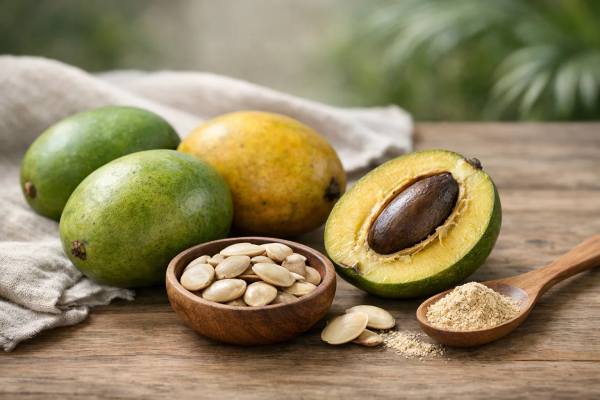
African mango (Irvingia gabonensis) is a West and Central African tree whose fruit, seed, and seed kernel have long been used as both food and traditional medicine. The fresh fruit pulp is eaten locally, but most modern interest centers on the seed kernel—often called dika nut or ogbono—which is used to thicken soups and stews and is also processed into concentrated supplements. In wellness circles, African mango is best known for weight management claims, including appetite control, waist reduction, and support for cholesterol and blood sugar balance.
What makes African mango unusual is that its “active” part is not a stimulant or harsh laxative. Instead, the kernel contains viscous soluble fiber, fats, and plant compounds that may influence satiety, digestion, and metabolic markers when used consistently. At the same time, the evidence base is mixed: early trials showed dramatic results, while newer research suggests more modest effects and highlights the importance of product quality, dosage, and realistic expectations.
This article explains what African mango is, what is in it, what it may help with, how to use it in food or supplement form, how to dose it safely, and who should avoid it.
Key Takeaways
- May support modest reductions in appetite and waist measures when paired with consistent diet habits.
- Some studies suggest improvements in LDL cholesterol and fasting markers, but results vary by product and trial quality.
- Typical supplement ranges are about 150–300 mg once or twice daily, often taken 30–60 minutes before meals.
- Avoid during pregnancy and breastfeeding due to limited safety data for concentrated extracts.
- Avoid if you have a known tree-seed allergy, or use extra caution if you take diabetes medications.
Table of Contents
- What is African mango, exactly?
- Key ingredients and medicinal properties
- What African mango may help with
- How to use African mango
- How much African mango per day?
- Side effects, interactions, and who should avoid it
- What the evidence actually says
What is African mango, exactly?
African mango is the common name for Irvingia gabonensis, a tropical tree native to West and Central Africa. It is sometimes called bush mango or wild mango, but it is not the same species as the familiar mango (Mangifera indica). The confusion matters because the parts used and the claims made are different: with African mango, most “supplement” products focus on the seed kernel, not the sweet fruit flesh.
The plant is valued in several ways:
- Fruit pulp: Eaten fresh or processed locally. It has traditional uses for digestive and general wellness purposes, but it is not the primary form sold as a weight supplement.
- Seed kernel (dika nut or ogbono): Used as a soup thickener because it forms a rich, viscous texture when heated and stirred into liquid. This culinary use is important because it hints at one of the main mechanisms discussed for supplements: viscosity and satiety.
- Oil and flour from the kernel: In some regions, the kernel is also pressed for oil or ground into flour-like forms for cooking.
When you see “African mango extract” in capsules, it is usually a processed kernel extract designed to be easier to dose than a spoonful of ground dika. Some products use proprietary names or claim standardization, but the category still varies widely in purity and composition.
In practice, readers tend to arrive with one of three goals:
- Weight management support (reduced appetite, smaller waist, or easier adherence to a calorie plan)
- Cardiometabolic support (cholesterol, triglycerides, and blood sugar markers)
- A food-based thickener that is more satisfying than starch-only thickeners
A useful way to think about African mango is as a fiber-forward kernel ingredient that may help with appetite and metabolic markers when used consistently—rather than as a fast-acting “fat burner.” If you approach it like a supportive tool (not a miracle), you are more likely to choose an appropriate form, dose it sensibly, and judge results based on real outcomes like cravings, portion size, lab values, and waist measurements over time.
Key ingredients and medicinal properties
African mango’s kernel is chemically complex, but the most practical “active” themes fall into three buckets: viscous fiber, lipids (fats), and polyphenol-like plant compounds. Different products emphasize different fractions, which is one reason results can vary so much across brands.
Viscous soluble fiber and thickening polysaccharides
The kernel is known for forming a gel-like texture in soups. That texture reflects soluble fibers and polysaccharides that can increase viscosity in the digestive tract. Viscous fibers tend to support:
- Slower gastric emptying (staying full longer)
- Gentler post-meal blood sugar rises for some people
- Binding of bile acids, which may modestly influence cholesterol patterns
This is the same broad “fiber logic” used when people take psyllium husk for cholesterol and appetite support, though the exact fibers and dose forms are different.
Kernel fats and fatty acid profile
Dika kernels contain a meaningful amount of fat. In whole-food use, this fat contributes to satiety and palatability, which can indirectly help with portion control. In supplements, the fat content depends on how the extract is made—some products are more fiber-forward, while others retain more lipid fractions.
Polyphenols and related compounds
African mango has been studied for plant compounds that may influence oxidative stress and cellular signaling. In the supplement context, these compounds are often discussed in relation to metabolic pathways (such as adipocyte signaling and glucose handling). One identified component, terminalin, has been explored in laboratory settings for its influence on glucose-related pathways. While lab findings do not guarantee clinical effects, they help map plausible directions for research.
Minerals and micronutrient context
As a whole food, the kernel can contribute minerals and trace nutrients, but supplements are rarely used at a dose that meaningfully changes micronutrient intake. The “medicinal” framing is therefore less about meeting nutrient requirements and more about how fiber and plant compounds may influence appetite and metabolic markers.
A practical caution: because African mango supplements can be marketed as “seed extract,” “kernel extract,” “powder,” or “standardized extract,” the ingredient list may not tell you how much of the product is actually active fiber versus filler. If a label is vague (no plant part specified, no extract ratio, no standardization claims, no third-party testing), treat the product as unpredictable and judge it by tolerance first rather than expecting consistent results.
What African mango may help with
African mango is primarily used for weight and metabolic support, but the most honest way to describe its potential is “possibly helpful for some people, modest on average, and highly dependent on context.” If you want clear expectations, focus on the outcomes that match its likely mechanisms: satiety, cravings, waist measures, and certain cardiometabolic markers.
Weight management and appetite control
The kernel’s viscous fiber profile may help people feel full sooner and stay satisfied longer. In real life, the most noticeable change—if it happens—often looks like:
- Fewer “between-meal” cravings
- Smaller portions feeling adequate
- Less urgency for late-night snacks
This matters because many weight plans fail on adherence rather than knowledge. A supplement that helps you stick to a consistent meal rhythm can be meaningful even if the scale changes slowly.
That said, you should be cautious about dramatic claims. If a product promises rapid, large weight loss without diet changes, treat that as marketing rather than physiology.
Waist circumference and body composition signals
Some studies have reported reductions in waist measures. Waist change is often a better “behavioral signal” than scale weight alone because it can reflect improved eating consistency and reduced abdominal bloating in addition to fat changes. A practical approach is to measure waist at the same time of day, 1–2 times per week, for 8–12 weeks.
Cholesterol and lipid markers
Vicious soluble fiber can influence cholesterol patterns, especially LDL cholesterol, by binding bile acids and changing lipid handling. Improvements are most likely when African mango is used as part of a broader replacement strategy—for example, when it supports reduced snacking or replaces saturated-fat-heavy foods.
If cholesterol and glucose management are your main goals, it can be helpful to compare options that have stronger evidence bases in the supplement world. For example, berberine has a larger clinical literature for glucose and lipid markers, though it also has important interaction and tolerability considerations. African mango may be gentler for some people, but the evidence is not as deep.
Blood sugar steadiness
Because viscous fibers can slow carbohydrate absorption, some users report smoother post-meal energy. This is more likely when the supplement is taken before meals and paired with a consistent eating pattern (balanced meals, fewer liquid sugars, adequate protein).
In summary, African mango may be most useful for people who benefit from satiety support and want a non-stimulant approach. It is less likely to help if you are already eating a high-fiber diet with stable portions, or if your main barrier is not hunger but stress-driven eating, poor sleep, or a highly irregular schedule.
How to use African mango
You can use African mango as a food ingredient, a single-ingredient supplement, or as part of a multi-ingredient formula. The best choice depends on your goal, your tolerance for fiber, and how much you value product consistency.
Food use: dika nut and ogbono-style thickening
In traditional cooking, ground kernel thickens soups and stews into a rich, satisfying texture. If you enjoy the cuisine, food use can be a smart entry point because it is naturally portion-limited and easier to evaluate for tolerance. Food use is most practical when you want satiety support as part of a meal rather than a “dose” you take separately.
Practical tip: because dika thickening is powerful, start with a small amount in a full pot rather than adding it aggressively. Texture changes quickly, and too much can feel heavy.
Supplement use: capsule or tablet extracts
Supplements are the common choice for people who want standardized timing before meals. When choosing a product, look for clarity on:
- Plant part (seed kernel, not vague “mango extract”)
- Extract type (powder vs extract, and any standardization details)
- Batch testing for contaminants and label accuracy
- A realistic dose per serving (not micro-doses hidden in blends)
Avoid products that hide African mango in a “proprietary blend” where you cannot tell the actual dose.
Combination formulas and stacking strategy
Many weight supplements combine African mango with stimulants, diuretics, or additional fibers. Combination products make it harder to know what helped (or what caused side effects). If you are trying African mango for the first time, single-ingredient products are usually the cleanest experiment.
If you are considering “stacking,” be cautious with stimulant-heavy blends and liver-stressing ingredients. For example, concentrated green tea extract may be useful for some goals, but it can be a poor fit for people prone to jitteriness, insomnia, or those who do not tolerate concentrated extracts well. Stacking can also multiply side effects even when each ingredient seems mild on its own.
How to run a fair personal trial
- Keep diet and activity steady for 2 weeks (baseline).
- Add African mango consistently for 8–12 weeks.
- Track one or two outcomes: waist, appetite ratings, snack frequency, and optional fasting labs if you have them.
- Stop early if you develop worsening insomnia, persistent headaches, or significant GI distress.
The best results usually come from treating African mango as a support tool for meal consistency, not as a substitute for diet quality.
How much African mango per day?
African mango dosing depends on whether you are using whole kernel food forms or standardized supplements. Because products differ, it is more useful to think in dose ranges and timing principles than in one universal number.
Common supplement ranges used in studies and practice
Clinical research has used a few patterns that show up repeatedly:
- 150 mg twice daily, often taken 30–60 minutes before lunch and dinner
- 300 mg once daily, typically taken before a main meal
- Larger amounts of seed-based preparations in older studies, sometimes measured in grams per day
A practical, conservative starting range for many adults is 150 mg once daily before the largest meal for 3–7 days, then increasing to 150 mg twice daily if well tolerated. Some people prefer 300 mg once daily for simplicity, especially if they do not eat two structured meals.
Timing, water, and meal context
Because many proposed benefits rely on fiber-like viscosity, timing matters:
- Take with a full glass of water.
- Take before meals rather than after meals.
- Pair with meals that include protein and vegetables for the most stable appetite effect.
If you are sensitive to fiber, taking it too close to bedtime may cause bloating that disrupts sleep. In that case, earlier dosing (before breakfast or lunch) may work better.
How long to try it
A reasonable trial window is 8–12 weeks, since waist and metabolic markers rarely shift meaningfully in a few days. If nothing changes after a consistent trial—no appetite shift, no waist trend, no change in snacking—more is not automatically better. It may simply not be the right tool for your physiology or product quality may be an issue.
Spacing from medications and supplements
Viscous fibers can interfere with absorption of some medications and nutrients. A safe general practice is to separate African mango supplements from prescription medications by at least 2 hours unless your clinician advises otherwise.
When to use a lower dose
Reduce dose or stop if you experience:
- Persistent diarrhea, severe bloating, or cramping
- Worsening heartburn or nausea
- New or worsening insomnia (some users report sleep disruption)
The best “dose” is the smallest amount that improves appetite control without causing GI issues. Consistency and tolerability matter more than pushing to the top end of a range.
Side effects, interactions, and who should avoid it
African mango is often described as well tolerated, but most side effects and safety concerns come down to three themes: fiber-related GI effects, metabolic interactions, and product quality variability.
Common side effects
These are typically mild but can be bothersome:
- Gas, bloating, or changes in stool consistency
- Headache
- Sleep disturbance (often reported as difficulty falling asleep)
- Nausea, especially if taken without enough water
Many of these improve by lowering the dose, taking it earlier in the day, or ensuring adequate hydration.
Potential interactions
Because African mango is used for glucose and lipid-related goals, be cautious if you take:
- Diabetes medications (risk of low blood sugar if multiple glucose-lowering tools are combined)
- Cholesterol-lowering medications (not because the combination is known to be dangerous, but because the goal overlaps and monitoring is wise)
- Medications with narrow absorption windows (fiber can reduce absorption when taken too close together)
A practical safeguard is to separate dosing from medications by at least 2 hours and to monitor blood sugar more frequently when starting if you use glucose-lowering drugs.
Who should avoid African mango supplements
- Pregnancy and breastfeeding: Avoid concentrated extracts due to limited safety data.
- Known allergy: Avoid if you have a confirmed allergy to African mango or related tree-seed sensitivities.
- History of severe GI sensitivity to fibers: Proceed cautiously, start low, or avoid if you reliably flare with viscous fibers.
- Before surgery: Consider stopping supplements 1–2 weeks prior unless your clinician advises otherwise.
Quality and adulteration considerations
Weight-loss supplements are a category where quality problems are more common than most consumers expect. Choose products that provide third-party testing and transparent labeling. Be especially cautious with multi-ingredient blends that promise rapid fat loss.
If you have ever reacted poorly to aggressive “diet pills,” do not assume African mango will behave the same way—but do use the same caution mindset. For comparison, some weight-focused supplements such as garcinia cambogia have raised stronger safety concerns in certain contexts, illustrating why product selection and conservative dosing matter.
If you develop severe symptoms—wheezing, facial swelling, faintness, persistent vomiting, black stools, or signs of a serious allergic reaction—stop immediately and seek medical care.
What the evidence actually says
African mango has an evidence base that is best described as suggestive but not definitive. The key issue is not that research is absent—it is that early studies were small and sometimes poorly reported, while more recent work points to more modest, variable effects.
What clinical trials suggest
Randomized trials have explored African mango seed or kernel extracts for outcomes such as weight, waist circumference, lipids, glucose markers, inflammatory signals, and appetite-related hormones. Some earlier studies reported large weight losses over relatively short periods. Later analyses and newer trials have raised important questions about methodology, reporting quality, and whether results generalize beyond specific products and populations.
A more recent randomized trial design has examined metabolic markers and related measures over a longer window, finding that some changes (such as certain antioxidant or adipokine signals) may improve while many core outcomes remain similar to placebo. This pattern is common in nutrition-adjacent supplements: the signal may be subtle, and the biggest real-world benefit may come from how the supplement supports adherence rather than from a dramatic biological effect.
Why results can look inconsistent
Several factors can shift outcomes:
- Product differences: “Kernel extract” is not a single standardized ingredient across brands.
- Short trial durations: Many trials run 4–10 weeks, which is short for stable fat-loss conclusions.
- Baseline diet and behavior: If participants change eating patterns during a trial, it becomes hard to attribute results to the supplement.
- Combination products: Some trials and real-world products mix African mango with other botanicals, which clouds interpretation.
This is especially relevant because some weight formulas combine multiple plant extracts. For example, African mango has been studied historically alongside other ingredients used for weight goals, including cissus quadrangularis, making it difficult to isolate which component drove changes.
What you can conclude safely
- African mango is not a guaranteed weight-loss supplement.
- It may support modest improvements in appetite control and some metabolic markers for some people, especially when taken consistently before meals.
- The magnitude of effect likely depends on product quality and on whether it helps you maintain a sustainable eating pattern.
If you decide to use it, the most evidence-aligned approach is a structured trial: choose a transparent product, start with conservative dosing, track waist and appetite outcomes over 8–12 weeks, and judge success by repeatable habits and measurable trends—not by marketing promises.
References
- Irvingia gabonensis baill. (African Mango): A comprehensive review of its ethnopharmacological significance, unveiling its long-standing history and therapeutic potential 2024 (Review)
- Effects of Irvingia gabonensis Extract on Metabolism, Antioxidants, Adipocytokines, Telomere Length, and Aerobic Capacity in Overweight/Obese Individuals 2022 (RCT)
- A comprehensive review on clinically proven medicinal plants in the treatment of overweight and obesity, with mechanistic insights 2023 (Systematic Review)
- The Effects of Irvingia gabonensis Seed Extract Supplementation on Anthropometric and Cardiovascular Outcomes: A Systematic Review and Meta-Analysis 2020 (Systematic Review and Meta-Analysis)
- Terminalin from African Mango (Irvingia gabonensis) Stimulates Glucose Uptake through Inhibition of Protein Tyrosine Phosphatases 2022 (Mechanistic Study)
Disclaimer
This article is for educational purposes only and does not provide medical advice, diagnosis, or treatment. Dietary supplements can vary in quality and strength, and African mango extracts are not equivalent to eating traditional dika-based foods. If you are pregnant, breastfeeding, managing diabetes, taking prescription medicines, preparing for surgery, or living with a chronic medical condition, consult a qualified clinician before using African mango supplements. Stop use and seek medical care for severe allergic symptoms, fainting, trouble breathing, or persistent gastrointestinal symptoms.
If you found this article helpful, please share it on Facebook, X (formerly Twitter), or any platform you prefer so others can make informed, safe choices.