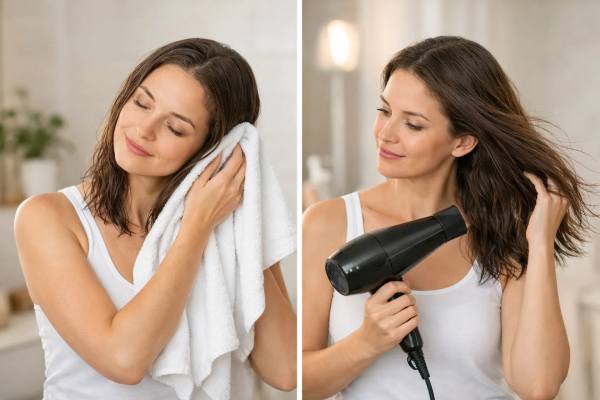
Drying your hair seems like the quiet, forgettable end of a wash day—until frizz multiplies, ends start snapping, or your scalp feels uncomfortable for hours. The truth is that “damage” during drying rarely comes from one single factor. It’s usually the combination of how long hair stays wet, how much friction and tension you put on softened strands, and how much heat and airflow you concentrate in one place. Air-drying can be gentle when it’s low-touch and reasonably quick. Blow-drying can be gentle when the heat is controlled and the technique is efficient. The safest choice depends on your hair’s porosity, thickness, chemical history, and even your scalp’s preferences. With a few practical adjustments, most people can get the benefits of both methods—faster drying, smoother cuticles, and fewer split ends—without turning daily care into a high-risk routine.
Essential Insights
- Minimize friction and tension while hair is wet; that’s when strands are most stretch-prone.
- Use heat strategically: lower temperatures with steady airflow typically reduce risk compared with high heat held close.
- Prolonged dampness can worsen frizz and scalp discomfort; aim for hair to be mostly dry within a reasonable window.
- Apply heat protectant evenly through mid-lengths and ends before any warm airflow touches the hair.
- Choose the method by hair type and context: quick low-heat blow-drying can be safer than hours of hands-on air-drying for some routines.
Table of Contents
- The real physics of drying damage
- Air-drying with less frizz and breakage
- Blow-drying with lower heat and lower risk
- How hair type and porosity change the answer
- Products and tools that protect during drying
- A safer drying routine you can repeat
The real physics of drying damage
Hair is strongest when it’s dry, lubricated, and handled with minimal friction. Drying turns that simple idea into a balancing act because water temporarily changes hair’s behavior. When hair is wet, it absorbs water into the fiber and swells slightly. That swelling can lift the cuticle edges, increase friction between strands, and make tangles more likely. Wet hair is also more elastic—meaning it stretches farther under force—so vigorous brushing, towel rubbing, or tight styling while wet can push strands past their limit and cause snapping.
Heat adds a separate set of risks. Excessive heat can roughen cuticles, increase surface dryness, and make ends more prone to splitting. The highest-risk moments tend to be high heat plus high tension, like pulling a brush through resistant, wet sections while blasting hot air at close range. That combination concentrates stress in one zone, especially on already fragile areas: the front hairline, crown, and lightened or color-treated lengths.
Air-drying is not automatically “no damage.” If air-drying means repeatedly touching, scrunching, re-parting, and re-combing hair for an hour—or leaving dense hair damp for a long time—damage can still accumulate through friction and swelling cycles. Blow-drying is not automatically “high damage.” If blow-drying is brief, controlled, and paired with protectants, it can reduce the time hair spends in its most vulnerable state (very wet) and can smooth the cuticle by directing airflow in an orderly way.
A useful way to think about drying is a three-variable equation:
- Time wet: Longer wet time increases swelling, tangling, and the temptation to “fix” hair repeatedly.
- Handling: More rubbing, tugging, or brushing—especially when wet—raises breakage risk.
- Heat intensity and concentration: Hotter air, closer distance, and staying in one spot amplifies thermal stress.
If you’re trying to reduce breakage but aren’t sure whether the problem is shedding or snapping, it helps to understand the difference between a fallen hair and a broken hair fiber: how to tell breakage from hair loss. Once you identify which you’re dealing with, it becomes much easier to pick the drying approach that actually solves your problem instead of masking it.
Air-drying with less frizz and breakage
Air-drying can be an excellent choice when your goal is to avoid thermal stress, preserve curl pattern, or keep a simple routine. The key is to make air-drying low-friction and time-efficient, because the most common “air-dry damage” comes from rough towel habits and too much manipulation during the slow, damp phase.
Start with what happens immediately after rinsing: hair is heavy with water, cuticles are lifted, and tangles form easily. The safest first step is blotting, not rubbing. Use a microfiber towel or a soft cotton T-shirt to squeeze water out in sections. Think press-and-release rather than twisting into a tight turban that bends the same areas repeatedly. If your hair is fine or breakage-prone, keep the “wrapped” phase short (often 5–10 minutes) to prevent creasing and knotting.
Next, add slip before you detangle. If you detangle at all, do it once, gently, and with purpose—ideally with a wide-tooth comb or your fingers while hair is still very damp and coated with conditioner or a leave-in. Then leave it alone. The repeated cycle of “touch, fluff, separate, fix” is where air-drying turns into a friction marathon. For wavy and curly hair, it often helps to apply styling product with a smooth, downward motion first (to reduce cuticle roughness), then scrunch lightly only at the end.
The biggest overlooked risk with air-drying is prolonged dampness. If hair stays wet for hours—especially at the roots—some people notice scalp discomfort, itch, odor, or flaking. Dense hair, tight curls, and cool environments make this more likely. If you routinely go to bed with damp hair, you’re also adding nighttime friction and compression, which can increase tangles and breakage. If that’s a habit you want to change, what happens when you sleep with wet hair offers a practical roadmap.
A safer air-dry routine usually looks like this:
- Blot gently until water is no longer dripping.
- Apply leave-in conditioner through mid-lengths and ends; keep heavy product off the scalp if you’re oil-prone.
- Detangle once with minimal tension.
- Set your part and shape early, then stop touching it.
- If hair is still very damp after 30–45 minutes, consider switching to a brief, low-heat root dry (even if you air-dry the lengths).
Air-drying is at its best when it’s intentional and hands-off—not when it stretches the vulnerable wet phase into the whole afternoon.
Blow-drying with lower heat and lower risk
Blow-drying gets blamed for damage because it’s easy to do in the most stressful way: very hot air, held close, while pulling hard on a brush. The safer version looks almost opposite: moderate heat, steady airflow, smart sectioning, and less tension. Done well, blow-drying can shorten the vulnerable wet window and reduce tangling—two big wins for breakage-prone hair.
The first rule is not a temperature number—it’s distance and movement. Holding a dryer too close concentrates heat and dries the cuticle unevenly. A practical starting point is about 15–20 cm (6–8 inches) away, keeping airflow moving so one spot isn’t constantly blasted. The second rule is sequencing: rough-dry first with your hands (or a wide-tooth comb) until hair is roughly 60–80% dry, then bring in a brush only if you need smoothing or shape. Brushing soaking-wet hair while drying forces the hair fiber to stretch at the exact moment it’s most vulnerable.
Use airflow direction on purpose. When you aim air from roots down toward ends, you help cuticles lie flatter. That can improve shine and reduce frizz, especially when paired with a concentrator nozzle. If you prefer volume, lift at the roots but keep the nozzle angled so airflow still travels down the hair shaft rather than blasting upward against the cuticle.
Heat settings matter, but “hot” is not always necessary. Many people get better results using medium heat with higher airflow, especially if they section hair and keep the dryer moving. Reserve the hottest setting for short bursts on very wet roots—if you use it at all—and avoid concentrating high heat on ends, which are older, drier, and more porous.
Heat protection is non-negotiable if you blow-dry often. A good protectant reduces friction, improves glide, and forms a thin film that slows rapid moisture loss and heat transfer. If you want a deeper explanation of what to look for and how to apply it evenly, see how heat protectants work and how to use them. The most important application detail is coverage: protectants help most when they’re distributed through mid-lengths and ends, not just misted on the surface.
Technique adjustments for different styles:
- Straight or smooth finish: Concentrator nozzle, medium heat, steady tension (not extreme), and a final cool shot if you like the feel.
- Waves and curls: Diffuser, lower heat, lower handling. Hover-diffuse at the roots first, then diffuse lengths with minimal scrunching.
- Fragile or lightened hair: Prioritize speed with lower heat: section, rough-dry gently, and keep brush work limited.
Blow-drying is safest when it’s efficient and controlled—shorter time, less tugging, and fewer “hot spots.”
How hair type and porosity change the answer
The question isn’t only “air-dry or blow-dry?” It’s “what does my hair tolerate best?” Hair differs in diameter, curl pattern, porosity, and chemical history, and those factors change the risk profile of both methods.
Porosity is one of the biggest drivers. High-porosity hair (often from bleaching, frequent coloring, or heavy weathering) absorbs water quickly and loses it quickly. That can make air-drying feel frizzy and rough because the fiber cycles through swelling and drying fast, and tangles form easily. Low-porosity hair absorbs water more slowly but can hold onto surface water longer; it may feel damp for a long time, increasing the “wet window” where friction causes breakage. If you’re unsure where you fall, low versus high porosity care basics can help you connect the dots between your drying experience and your hair’s behavior.
Curl pattern also matters. Tight curls and coils often benefit from reduced brushing and reduced friction. Air-drying can preserve pattern, but it can also lead to shrinkage tangles if hair is disturbed while drying. Diffusing with low heat can be a helpful middle path: less handling than traditional blowouts, less prolonged dampness than pure air-drying.
Density and thickness influence time. Very dense hair that stays wet for hours may do better with partial blow-drying at the roots (even if lengths air-dry) to reduce scalp dampness and tension from heavy, wet hair. Fine hair can dry quickly but is often more prone to snapping under tension; it may benefit from air-drying when you can keep handling minimal, or from blow-drying that avoids aggressive brushing.
Your scalp has preferences, too. If you’re prone to itch, flaking, or odor when roots stay damp, you may feel better when you dry the scalp area sooner. If you’re sensitive to heat or experience redness and discomfort with warm airflow, air-drying or a cooler setting may be more comfortable.
A quick matching guide:
- High-porosity or chemically lightened hair: Shorten the wet phase, reduce friction, use protectants and conditioning films; consider gentle blow-drying for control.
- Low-porosity hair that stays damp forever: Focus on efficient water removal (blotting, sectioning) and partial root drying.
- Curly or coily hair that frizzes when touched: Minimize manipulation; consider low-heat diffusing instead of extended hands-on air-drying.
- Very fine, fragile hair: Avoid high tension; choose whichever method lets you touch it less and detangle with the most slip.
The “safer” method is the one that reduces your personal combination of prolonged wetness, friction, and concentrated heat.
Products and tools that protect during drying
Technique is the foundation, but the right tools and formulas can dramatically lower friction—especially during the wet phase. Think of protective products as lubrication and film formation, not as magic repair. Hair is not living tissue; once the fiber is damaged, you can only reduce further wear and temporarily improve how it behaves.
Start with the simplest tool: your towel. Rough terry cloth and vigorous rubbing create micro-tangles and lift cuticles. Microfiber towels and soft cotton T-shirts reduce snagging because the surface is smoother and absorbs water without requiring aggressive motion. The goal is to remove excess water so you can spend less time drying and less time manipulating.
Then consider what touches the hair while it’s wet. Wide-tooth combs, flexible detangling brushes, and finger-detangling all work, but only when paired with enough slip. If you feel resistance, stop and add more conditioner or leave-in; forcing through a knot is one of the fastest routes to breakage.
For blow-drying, attachments matter more than people expect. A concentrator nozzle helps keep airflow aligned, which can reduce frizz and shorten drying time. A diffuser spreads airflow and lowers the intensity hitting any one point—useful for curls and for anyone trying to dry gently without disturbing shape.
Now products. A practical, layered approach often works best:
- Leave-in conditioner (damp hair): Adds slip and reduces combing friction.
- Heat protectant (before warm airflow): Forms a thin protective film and improves glide.
- Finishing serum or cream (after drying): Controls static and adds surface smoothing.
Many of the most effective smoothing and friction-reducing ingredients are film-formers, including silicones. If you’ve avoided them because you’ve heard they are automatically “bad,” it may help to understand where they help most and where they can cause buildup: what silicones do in hair products and who benefits. Used thoughtfully, these films can reduce mechanical wear from brushing and drying—especially on porous, color-treated hair.
Two common mistakes to avoid:
- Overloading product at the roots: It can weigh hair down and make the scalp feel greasy, encouraging more washing and more drying cycles.
- Spot-application only: Heat protectants and leave-ins work best when evenly distributed, not sprayed in a halo over the top layer.
Finally, remember that “more tools” is not always safer. The safest routine is often the simplest one that reduces friction and keeps drying time reasonable.
A safer drying routine you can repeat
If you want a practical answer to “air-dry or blow-dry,” this is it: choose the method that lets you touch your hair less, keep it wet for less time, and avoid high heat concentration. Most people do best with a hybrid routine that changes based on the day—because hair, schedules, weather, and scalp needs are not the same every time.
A repeatable, low-damage routine can look like this:
- After rinsing: Gently squeeze water out in sections with your hands.
- Blot (do not rub): Use microfiber or cotton to remove dripping water.
- Add slip: Apply leave-in conditioner through mid-lengths and ends.
- Detangle once: Use a wide-tooth comb or fingers; stop if you feel resistance.
- Decide on drying strategy:
- If hair dries within 30–90 minutes without constant touching, air-dry is often fine.
- If hair stays damp for hours, or your scalp dislikes prolonged wetness, do a brief root dry on low to medium heat.
- If you need a polished finish, blow-dry with protectant, distance, and movement.
For weekly frequency, a useful guideline is to treat high-heat styling (flat ironing, curling) as the “rare” event, and keep routine drying gentle. If you blow-dry often, keep it lower heat and shorter time, and limit high-tension brush work. If you air-dry often, keep it hands-off, and avoid going to bed with damp hair whenever you can.
Pay attention to early warning signs, because they tell you which lever to pull:
- More mid-length snapping, short flyaways, and tangles: Too much friction while wet, too much brushing, or too much tension during drying.
- Rough texture, dullness, and ends that “catch” easily: Cuticle wear; reduce heat intensity, add more slip, and trim splits sooner.
- Persistent frizz that worsens as hair dries: Often a mix of porosity and handling; reduce touching, add a light film-former, and try partial blow-drying for control.
- Scalp discomfort after wash days: Roots staying damp too long, or heat sensitivity; adjust by drying roots sooner with cooler airflow, or shorten total wet time.
When splits have already started, prevention still matters more than any product claim. Addressing split ends early can stop them from traveling upward, which is why understanding what split ends are and how to prevent them is part of a truly low-damage drying plan.
If you notice sudden patchy hair loss, significant scalp pain, burning, or heavy shedding that doesn’t match your usual pattern, it’s worth getting professional evaluation rather than changing drying methods and hoping for the best.
References
- Hair Shaft Damage from Heat and Drying Time of Hair Dryer – PMC 2011 (Clinical Study)
- On Hair Care Physicochemistry: From Structure and Degradation to Novel Biobased Conditioning Agents – PMC 2023 (Review)
- A review of bubble hair deformity – PubMed 2023 (Review)
- Establishment of Heat‐Damaged Model for Hair – PMC 2025 (Research Study)
- With or without Silicones? A Comprehensive Review of Their Role in Hair Care – PMC 2025 (Review)
Disclaimer
This article is for educational purposes only and does not replace medical advice, diagnosis, or treatment. Hair and scalp concerns can have multiple causes, including dermatologic conditions, nutrient issues, medications, and hormonal changes. If you have persistent scalp pain, redness, burning, sudden or patchy hair loss, or shedding that is severe or rapidly worsening, seek evaluation from a licensed clinician or dermatologist. If you use heat tools, follow manufacturer safety guidance, avoid contact burns, and stop immediately if you feel pain or notice singeing or an unusual odor.
If you found this helpful, consider sharing it with a friend or posting it on Facebook, X (formerly Twitter), or your favorite platform so others can dry their hair more safely.