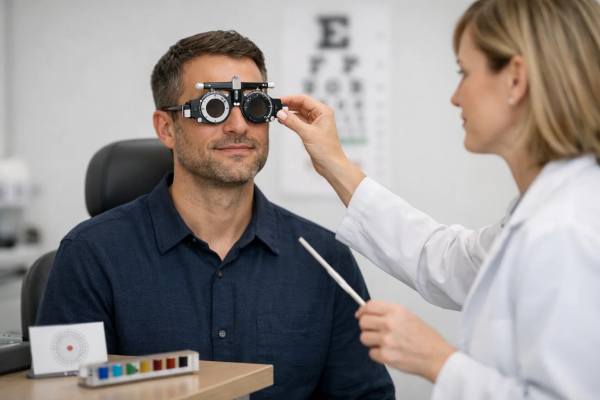
Amblyopia—often called “lazy eye”—is usually discussed as a childhood condition, which can leave adults feeling stuck with a diagnosis they were told was “too late” to treat. The reality is more nuanced. Adult amblyopia is not simply an eye problem; it is a brain–eye communication problem shaped by years of unequal input from the two eyes. That history matters, but it does not mean improvement is impossible. Modern research on neuroplasticity (the brain’s ability to adapt) has opened the door to measurable gains for some adults, especially when treatment is well-matched to the type of amblyopia and done consistently.
This article explains what adult treatment can realistically achieve, what helps most, how to build a practical plan, and where the limits are—so you can focus your effort on strategies with the best odds of meaningful change.
Essential Insights
- Adults can sometimes improve visual acuity and contrast sensitivity, but changes are usually gradual and vary widely by person.
- The most useful gains often include better “visual clarity in real life” and reduced eye strain, not just a better chart score.
- Progress is less likely if the weaker eye is untreated for decades, has severe baseline blur, or there is significant uncorrected strabismus.
- Start with a full assessment and optimal glasses or contacts, then add structured training that targets your specific deficits.
- Consistency matters more than intensity; most protocols work best when practiced several days per week for weeks to months.
Table of Contents
- What adult amblyopia is and why it persists
- Can adults improve vision and what to expect
- First steps that make treatment work better
- Training options that actually target the brain
- Does patching help adults and when is it risky
- Surgery and other add-ons that can support progress
What adult amblyopia is and why it persists
Amblyopia is a neurodevelopmental vision disorder: one eye (or sometimes both) sees less clearly even when the eye itself is healthy and fully corrected with glasses or contacts. In childhood, the brain learns to rely on the clearer input. Over time, it down-weights or suppresses the blurrier eye, and the “weak eye” never develops normal visual processing.
In adults, amblyopia usually falls into one of these patterns:
- Anisometropic amblyopia: the two eyes had different prescriptions growing up (for example, one eye was much more farsighted or nearsighted).
- Strabismic amblyopia: an eye turn (misalignment) led the brain to ignore one eye to avoid double vision.
- Deprivation amblyopia: something blocked clear vision early on (like a congenital cataract).
- Mixed amblyopia: a combination, such as an eye turn plus unequal prescriptions.
The “lazy” part is a misleading label. The eye is not refusing to work; the brain is using a survival strategy it learned early: prioritize one input to reduce confusion. That strategy can affect more than visual acuity. Many adults also have:
- Reduced contrast sensitivity (trouble seeing subtle shades)
- Poorer stereo vision (depth perception)
- Crowding (letters look jumbled in clusters)
- Slower visual processing speed and less stable fixation
- Eye fatigue, headaches, and difficulty with night driving or screens
Why does it persist? Because the brain’s wiring became efficient at a certain solution. The good news is that adult brains still change—just more slowly and often less dramatically than during childhood. Treatment in adulthood is best thought of as retraining a long-standing habit, not “fixing an eye.”
A helpful mindset is to aim for functional wins: clearer reading in the weaker eye, better comfort with both eyes open, improved contrast, or better hand–eye coordination. Visual acuity matters, but it is not the only outcome that can improve your daily life.
Can adults improve vision and what to expect
Yes—some adults improve. The more important question is how much, in what ways, and under what conditions.
What “success” looks like in adults
Adult treatment tends to produce one (or more) of these outcomes:
- Modest visual acuity gains in the amblyopic eye (often measured as a small but meaningful change on a chart)
- Better contrast sensitivity and “sharpness” in everyday scenes
- Reduced suppression (the brain ignoring the weaker eye), which can make binocular vision feel steadier
- Improvements in stereoacuity (depth perception), especially when binocular training is used and alignment is reasonable
- Less eye strain, fewer headaches, and improved endurance for reading or screens
Why results vary so much
A few factors strongly influence what’s realistic:
- Cause and severity: Mild-to-moderate anisometropic amblyopia often responds better than severe deprivation amblyopia.
- Baseline visual acuity: The worse the starting point, the harder it is to reach normal levels—though functional improvement may still occur.
- Eye alignment: If you have a constant eye turn or significant double vision risk, binocular training may require careful supervision.
- Optical clarity: If you have uncorrected astigmatism, outdated prescriptions, early cataract changes, or dry eye blur, training is like practicing piano with sticky keys.
- Consistency: Most studies that show benefit involve repeated practice over weeks to months.
A realistic timeline
Adults typically notice changes gradually. A common pattern is:
- Weeks 2–4: subtle improvements in clarity, comfort, or awareness of the weaker eye
- Weeks 6–12: measurable changes on specific tasks (contrast, crowding, or acuity)
- Months 3–6: the clearest picture of whether your plan is working and whether it is worth continuing
What adult treatment usually cannot do
It is important to be direct about limits:
- It may not produce “perfect” vision or fully normal depth perception, especially in long-standing severe cases.
- It does not replace treating an underlying eye disease. If blur is coming from cataract, keratoconus, or retinal problems, amblyopia therapy is not the first fix.
- It is not a quick hack. If a program promises dramatic results in a few days, be cautious.
A strong plan aims for measurable improvement and meaningful function, with safety and sustainability built in.
First steps that make treatment work better
Before you spend money or time on training, the highest-yield step is a thorough evaluation. Many adults labeled “lazy eye” have treatable contributors to blur that limit progress if ignored.
Get the diagnosis and type right
A comprehensive exam typically includes:
- Best-corrected visual acuity in each eye (with your most accurate prescription)
- Refraction (often including cycloplegic refraction if needed) to uncover hidden farsightedness
- Eye alignment testing (cover test, measurements at distance and near)
- Assessment of suppression and binocular function (stereo tests, sensory fusion tests)
- Ocular health evaluation (cornea, lens, retina, optic nerve), plus dry eye screening if symptoms suggest it
Ask your clinician to name the likely driver: anisometropia, strabismus, deprivation, or mixed. The treatment strategy changes depending on the answer.
Optimize optical correction first
Even in adults, “just wearing the right prescription” can reveal potential. Useful steps include:
- Updating glasses or contacts and wearing them consistently for several weeks
- Correcting astigmatism accurately (small errors can matter a lot in an amblyopic eye)
- Considering contact lenses if anisometropia is high (contacts can reduce image-size differences between eyes)
- Treating ocular surface issues (dry eye, blepharitis) so vision is stable during training
If you have never worn your full correction because it felt “too strong,” that is worth discussing—sometimes adaptation can be guided rather than avoided.
Decide what to track
Adult treatment is easier when progress is visible. Consider tracking:
- A weekly home log of perceived clarity (0–10), comfort, and screen endurance
- Periodic standardized measures in clinic (acuity, contrast, stereo)
- A single real-life task you care about (night driving comfort, reading speed, sports performance)
Build a plan that fits adult life
A plan is more likely to succeed if it is:
- Small enough to repeat: 20–40 minutes per session beats a two-hour plan you quit in a week
- Specific: days per week, session length, and checkpoints (for example, reassess at 8–12 weeks)
- Safe: clear rules for stopping if you get new double vision, severe headaches, or nausea with VR
Once optics and diagnosis are solid, training becomes far more efficient—because you are training the brain on a clean, stable signal.
Training options that actually target the brain
Adult amblyopia therapy has shifted from “force the weak eye to work” toward methods that directly address how the brain processes information—especially suppression and inefficient visual decoding.
Perceptual learning
Perceptual learning is structured practice on visual tasks that gradually increase difficulty. Tasks often involve:
- Detecting faint contrast differences
- Identifying patterns or orientations
- Reducing crowding (distinguishing a target among nearby shapes)
- Improving spatial precision and reaction time
Why it helps: repeated practice can strengthen visual processing pathways and improve how the brain extracts detail from the amblyopic eye. Adults often respond best when training is adaptive (it adjusts difficulty based on performance) and done regularly over multiple weeks.
Practical tip: if a program is not adaptive or does not clearly target a visual skill (contrast, crowding, fixation stability), it may feel engaging without being therapeutic.
Dichoptic and binocular training
Dichoptic training presents different images to each eye—often lowering contrast to the stronger eye and boosting the weaker eye—so the brain is encouraged to combine input rather than suppress it. These approaches are commonly delivered through:
- Specialized digital platforms
- VR headsets or stereoscopic displays
- Game-like tasks that require both eyes to succeed (for example, each eye sees different elements needed to complete the task)
The goal is not just “sharper weak-eye vision,” but better cooperation between the eyes. This can be especially relevant if you care about depth perception or comfort with both eyes open.
Video game–based approaches
Some protocols use carefully designed games because they can:
- Keep attention high (a big factor in adult adherence)
- Provide many repetitions without feeling monotonous
- Blend speed, contrast, and binocular demands
However, “any video game” is not treatment. Therapeutic designs typically control contrast, spatial frequency, and binocular balance.
How to choose an approach
A practical way to decide is to match the tool to your main limitation:
- If your issue is blur and fine detail: perceptual learning tasks may be a good foundation.
- If your issue is suppression or poor stereo: binocular or dichoptic approaches are often more directly targeted.
- If your main barrier is motivation and consistency: a structured, engaging platform may be better than a “pure” task that you avoid.
A sensible minimum plan
Many adult protocols cluster around a similar commitment:
- 3–5 days per week
- 20–60 minutes per session
- 8–12 weeks before judging effectiveness
If you are not seeing any measurable change by 12 weeks—either in clinic metrics or in a meaningful daily function—it is reasonable to reassess the diagnosis, the optics, and whether the training is truly targeting your deficit.
Does patching help adults and when is it risky
Patching (occlusion) and penalization (blurring the stronger eye with drops or filters) are classic treatments in children. In adults, the picture is more complicated: they can help some people, but they are not the default solution for everyone—and they can create problems if used without a plan.
When patching might help an adult
Patching may be considered when:
- The amblyopic eye needs “forced use” to practice clarity tasks
- There is significant suppression and binocular training is not yet tolerated
- You are doing structured training and patching is used as a controlled “booster,” not as a standalone tactic
Adults who do well with patching usually combine it with active near tasks, such as reading, visual search exercises, or supervised therapy drills. Passive patching (wearing a patch while doing little visually demanding work) is less likely to pay off.
Common pitfalls
Patching can backfire when:
- It is used at high doses without monitoring, leading to severe strain or functional impairment
- It triggers or worsens double vision in adults with certain binocular adaptations
- It becomes a compliance battle—socially awkward, uncomfortable, and easy to abandon
Some adults also report that patching increases headaches or dizziness. That does not automatically mean it is “dangerous,” but it does mean the dosage and context need adjustment.
Filters and partial penalization
Alternatives like Bangerter filters (a translucent filter applied to the stronger-eye lens) can reduce dominance without fully removing binocular input. For adults who cannot tolerate a patch at work or who need to stay functional, partial methods may be more realistic.
Safety rules adults should take seriously
Stop and contact an eye care professional if you develop:
- New or persistent double vision
- A sudden change in alignment (eye turn becoming more noticeable)
- Severe headaches, nausea, or disorientation that does not settle quickly after stopping
- Any rapid drop in the stronger eye’s clarity that does not recover
A measured, adult-friendly way to use patching
If patching is part of your plan, it is often best approached as:
- A time-limited trial (for example, several weeks)
- A lower daily dose than pediatric regimens, unless supervised otherwise
- Paired with active visual tasks or structured therapy
- Followed by reassessment to confirm it is helping—not just feeling effortful
For many adults, binocular-focused strategies are ultimately more functional, but patching can still have a role when used precisely and safely.
Surgery and other add-ons that can support progress
Amblyopia treatment is often presented as a single “thing” (patching, games, exercises). In real adult care, progress is frequently best with a combined plan—especially when alignment or optical issues are holding you back.
Strabismus surgery
If you have a significant eye turn, surgery can:
- Improve eye alignment and appearance
- Reduce abnormal head posture
- Sometimes expand the range of comfortable binocular single vision
What it usually does not do on its own: cure amblyopia. But alignment can create better conditions for binocular therapy by making it easier for the brain to combine inputs.
A practical point: some adults seek surgery primarily for cosmesis and comfort, then add therapy afterward to improve function. Others benefit from therapy first, then surgery, depending on how stable the deviation is. This sequencing is individualized.
Refractive surgery and lens-based options
In carefully selected cases, refractive surgery (or lens-based correction strategies) may help by:
- Reducing large anisometropia that makes glasses uncomfortable
- Improving optical clarity when contact lenses are not tolerated
- Making consistent correction easier (which supports therapy)
However, surgery does not “treat amblyopia” directly; it removes an optical barrier so the brain can train on a clearer signal. A detailed corneal and ocular health assessment is essential before considering this route.
Vision therapy as a structured, supervised program
Some adults do best with guided therapy because it:
- Sets the right difficulty level and adjusts it as you improve
- Addresses fixation control, tracking, vergence, and binocular cooperation when relevant
- Improves adherence through coaching and accountability
If you choose professional therapy, ask how they measure outcomes, how they decide your dosage, and what their stopping rules are if you plateau.
Lifestyle supports that make therapy more effective
These do not replace treatment, but they improve the “soil” your therapy grows in:
- Sleep and fatigue management: visual learning is harder when you are exhausted
- Consistent practice time: a routine reduces decision fatigue
- Short breaks during sessions: many adults do better with two 15–20 minute blocks than one long grind
- Dry eye care and screen ergonomics: stable vision reduces “noise” during training
Building a combined plan that makes sense
A simple framework is:
- Clear the optics (best correction, stable ocular surface)
- Address alignment if it prevents binocular use or causes symptoms
- Add structured training matched to your deficits
- Reassess at set intervals (often 8–12 weeks) and adjust rather than pushing blindly
Adult amblyopia care is rarely about one magic method. It is about removing the biggest bottleneck first, then practicing the right skill long enough for the brain to adopt a better default.
References
- A Systematic Review and Meta-Analysis of Perceptual Learning and Video Game Training for Adults with Monocular Amblyopia 2025 (Systematic Review and Meta-Analysis)
- Current Developments in the Management of Amblyopia with the Use of Perceptual Learning Techniques 2023 (Review)
- A pilot non-randomized trial of smartphone-based anaglyph system for treatment of adult amblyopia through VR (Virtual Reality) 2023 (Clinical Study)
- Amblyopia Preferred Practice Pattern 2023 (Guideline)
Disclaimer
This article is for educational purposes only and does not provide medical advice, diagnosis, or treatment. Amblyopia in adults can overlap with other causes of reduced vision, and the safest plan depends on your eye health, prescription, and binocular status. If you have new symptoms—especially double vision, sudden vision changes, severe headaches, or eye pain—seek prompt evaluation from an eye care professional. Always discuss treatment options, expected benefits, and risks with your ophthalmologist or optometrist before starting patching, digital therapies, or VR-based programs.
If you found this article helpful, please consider sharing it on Facebook, X (formerly Twitter), or any platform you prefer. Your support helps our team continue producing reliable, high-quality health content.