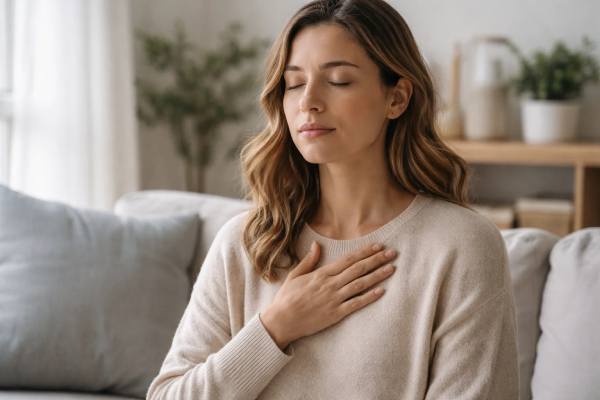
Chest tightness can be one of the most alarming anxiety symptoms because it sits in the same place as many serious medical conditions. For some people it arrives like a band around the ribs; for others it feels like pressure behind the breastbone, a “stuck” inhale, or a chest that will not fully expand. The good news is that anxiety-related chest tightness is common, explainable, and often responsive to practical skills that calm the nervous system and relax the breathing muscles.
This article will help you recognize typical patterns, understand what is happening in your body during stress and panic, and use fast, evidence-informed techniques to settle the sensation. It will also cover clear safety boundaries—when chest symptoms should be treated as urgent—and how to reduce recurrence with longer-term strategies that support both mind and body.
Essential Insights
- Anxiety chest tightness often improves when you slow breathing, lengthen the exhale, and relax the chest and shoulder muscles.
- Understanding the “panic loop” can reduce fear of the sensation and shorten episodes over time.
- New, severe, or unfamiliar chest symptoms should be evaluated urgently, especially with red-flag features or risk factors.
- Practice a 10-minute calming routine daily for 2–3 weeks to make skills easier to use during a surge of anxiety.
Table of Contents
- What anxiety chest tightness feels like
- Why anxiety can tighten your chest
- When to treat chest tightness as urgent
- How to calm chest tightness fast
- Reducing recurrence and building resilience
- Common questions and special situations
What anxiety chest tightness feels like
Anxiety chest tightness is not one single sensation. It is a cluster of body signals that can change minute to minute, which is part of what makes it so unsettling. Many people describe it as a band-like pressure across the chest or a feeling of “restricted expansion,” as if the lungs cannot fully fill. Others feel a dull ache behind the breastbone, a heavy chest, or a pinched sensation near the collarbones where stress often parks itself.
Common patterns include:
- Tightness that rises with worry, stress, conflict, or overstimulation, and eases when attention shifts or the body settles
- A sensation that gets worse when you repeatedly “test” your breathing by taking big inhales
- Symptoms that peak within minutes during a panic surge, then taper in waves
- A mix of chest tightness with throat tightness, a lump-in-throat feeling, or frequent sighing
- Tenderness in the chest wall, neck, or shoulders from muscle clenching
People are often surprised by how physical anxiety can be. During a panic episode, you may also notice a racing heart, shaking, sweating, dizziness, nausea, tingling in fingers or lips, or a sense of unreality. These symptoms can be intense and still be driven by stress physiology rather than danger. Anxiety can also cause chest discomfort that lasts longer than a typical panic attack if the body stays braced for hours—especially after multiple stressors, poor sleep, or too much caffeine.
One practical way to reduce fear is to name what you are feeling with specificity. Instead of “something is wrong with my heart,” try: “My upper chest feels tight, my shoulders are raised, and my breaths are shallow.” That shift matters because anxiety feeds on vague threat. Clear labels turn a mystery into a pattern.
If it is safe to do so, keep a short symptom log for a week: time of day, what you were doing, caffeine and alcohol intake, sleep quality, and what helped. Patterns often appear quickly—late afternoon energy crashes, after stressful messages, after scrolling in bed, or after large meals. Recognizing your pattern is not dismissing your symptoms; it is building a map that helps you respond calmly and effectively.
Why anxiety can tighten your chest
Anxiety changes the body on purpose. When your brain detects threat—real or perceived—it activates the stress response to help you react quickly. That response increases alertness, speeds the heart, and shifts breathing so oxygen can move fast. The problem is that the same system can trigger when the threat is emotional, uncertain, or internal, such as worry about health, work, relationships, or feeling trapped.
Several mechanisms can create chest tightness during anxiety:
- Chest and shoulder muscle bracing: Stress commonly tightens the pectoral muscles, intercostal muscles between the ribs, neck muscles, and the upper back. This “armor” can make the chest feel compressed and can create soreness afterward.
- Breathing pattern changes: Many people switch to shallow, upper-chest breathing during anxiety. That can feel like air hunger, even when oxygen levels are normal. Trying to fix it with repeated deep breaths can lead to over-breathing.
- Carbon dioxide drop with over-breathing: When you breathe faster or deeper than your body needs, carbon dioxide can fall. This can cause lightheadedness, tingling, and a sense of tightness or shortness of breath that feels like you need more air—despite breathing more than enough.
- Autonomic “volume turned up”: The nervous system becomes more sensitive to normal body sensations. Small changes—like a skipped beat, mild reflux, or a tight bra strap—can feel amplified and alarming.
- Reflux and esophageal sensitivity: Stress can increase reflux symptoms and esophageal spasm in some people, which can mimic chest pressure. Anxiety also makes it easier to notice and catastrophize these sensations.
- The panic loop: Chest tightness triggers fear (“What if it is serious?”). Fear increases adrenaline. Adrenaline intensifies tightness and breathing changes. The loop strengthens until you interrupt it.
It helps to know that anxiety-related chest tightness often has a “mechanical” component you can influence. If your shoulders are raised, your jaw is clenched, and your breathing is short, your chest will feel tighter. The sensation is real. The cause is often a reversible combination of muscle tension and altered breathing, plus an anxious mind interpreting the sensation as danger.
A useful question in the moment is: “Am I breathing to live, or breathing to check?” Checking—taking repeated big breaths, scanning for symptoms, monitoring your pulse—teaches the brain that the sensation is a threat. Calming skills do the opposite: they tell the brain you are safe enough to downshift.
When to treat chest tightness as urgent
Because chest symptoms can signal serious conditions, it is important to have clear safety rules. Anxiety can cause chest tightness, but anxiety does not protect you from other problems. If you are unsure, it is safer to get evaluated—especially if symptoms are new, severe, or different from your usual pattern.
Seek urgent medical evaluation right away if chest tightness comes with any of the following:
- New or severe pressure, squeezing, or heaviness that does not ease with rest
- Pain spreading to the jaw, left arm, back, or shoulder, especially with sweating or nausea
- Shortness of breath at rest, fainting, confusion, or a sense you might pass out
- A rapid, irregular heartbeat that persists, or a new feeling of “fluttering” with weakness
- Coughing up blood, severe one-sided leg swelling, or sudden sharp pain with breathing
- Blue lips or severe wheezing, or trouble speaking full sentences due to breathlessness
Also treat symptoms as urgent if you have higher risk factors such as known heart disease, diabetes, chronic kidney disease, uncontrolled high blood pressure, or you are older and this is a new symptom. Pregnancy and the weeks after delivery also warrant a lower threshold for evaluation because clot risk changes during that period.
If your chest tightness is familiar and has been medically assessed before, you can still use a “pause and check” approach:
- Assess intensity and change: Is this clearly worse or different than usual?
- Look for red flags: Any of the warning signs above?
- Try a brief calming test: If safe, do 3–5 minutes of slow, exhale-focused breathing and relax your shoulders. Anxiety-driven tightness often softens at least slightly when the body downshifts.
- Decide based on safety, not reassurance: If you cannot confidently say it resembles your prior anxiety episodes and you feel unsafe, seek evaluation.
A common trap is assuming that anxiety must be the cause because you feel scared. Serious medical symptoms can also cause fear. The goal is not to diagnose yourself in the moment; it is to act appropriately. Getting checked when symptoms are concerning is not “overreacting.” It is a responsible way to protect your health and, paradoxically, it can make future anxiety episodes easier to manage because you are not carrying unresolved doubt.
How to calm chest tightness fast
Fast relief usually comes from two targets: breathing mechanics and muscle bracing. You are aiming to send your nervous system a clear message: “We are not in immediate danger.” The techniques below are designed to be simple and repeatable.
A 10-minute reset you can use anywhere
Minute 1–2: Drop the armor
- Unclench your jaw and place your tongue softly on the roof of your mouth.
- Lower your shoulders away from your ears.
- If standing, soften your knees and let your ribs move freely.
Minute 3–7: Exhale-led breathing (the most important step)
- Breathe in gently through the nose for about 3–4 seconds.
- Breathe out slowly for about 6–8 seconds, as if fogging a mirror with your mouth closed or barely open.
- Keep the inhale smaller than you think you “need.” Overfilling can worsen tightness.
- If you feel lightheaded, shorten the exhale slightly and slow the overall pace.
This style works because lengthening the exhale encourages the body’s calming branch of the nervous system and reduces the urge to gasp.
Minute 8–10: Release chest-wall tension
Try one of these options:
- Pectoral doorway stretch: Forearm against a doorframe, gently turn the chest away, hold 20–30 seconds each side.
- Self-hug release: Cross arms and give a gentle hug, breathe slowly for 5–6 breaths, then roll shoulders down and back.
- Warmth: A warm shower or heating pad over upper back and chest (if appropriate for you) can reduce muscle guarding.
Grounding for the “fear spike”
If the tightness triggers a wave of “something is wrong,” use a short grounding sequence:
- Name 5 things you see, 4 you feel, 3 you hear, 2 you smell, 1 you taste.
- Then say, silently or out loud: “This is anxiety physiology. Uncomfortable does not mean unsafe.”
This is not positive thinking. It is accurate reorientation.
Avoid these common mistakes
- Repeated deep breaths: This often increases over-breathing and can worsen tingling, dizziness, and tightness.
- Checking behaviors: Constant pulse checking, googling symptoms, or forcing “perfect breaths” keeps the nervous system activated.
- Fighting the sensation: Bracing against tightness makes muscles tighten more. Aim for “allow and soften.”
Practice matters. In the middle of anxiety, the brain has less access to new skills. If you rehearse this routine once daily when calm, it becomes easier to use when symptoms surge.
Reducing recurrence and building resilience
If anxiety chest tightness shows up repeatedly, the goal shifts from quick relief to changing the conditions that keep the body on high alert. Think of this as turning down sensitivity rather than “eliminating symptoms forever.” Many people improve by combining nervous system skills with targeted treatment for anxiety.
Break the panic loop at its source
For panic-driven chest tightness, avoidance is often the fuel. When you fear the sensation, your brain treats it like a threat and triggers more stress. A structured approach can help:
- Learn your pattern: What starts first—tight chest, racing heart, dizziness, or fear?
- Reduce safety behaviors: Gradually reduce checking and reassurance seeking, which keep symptoms “important.”
- Use interoceptive exposure (with guidance): Under professional guidance, you intentionally practice safe body sensations (like mild breathlessness from stairs) to teach the brain they are tolerable and not dangerous.
- Reframe the meaning: “My body is revving up” is less frightening than “My body is failing.”
Cognitive behavioral therapy is especially useful for this, and it often includes both cognitive skills and body-based exposure.
Support the body so it alarms less
Small daily habits can reduce baseline activation:
- Caffeine timing: If you rely on caffeine, consider limiting it after late morning and notice whether chest tightness decreases.
- Sleep regularity: Even a consistent wake time can improve nervous system stability.
- Movement: Regular walking, cycling, or strength training helps metabolize stress hormones and can reduce physical anxiety symptoms over time.
- Meal patterns: Skipped meals and blood sugar crashes can mimic anxiety sensations and make the body feel shaky or tight.
- Alcohol and nicotine: Both can worsen sleep and autonomic instability, making chest symptoms more likely.
Consider medical and therapeutic supports
If symptoms are frequent or disabling, professional care can shorten the road. Options may include psychotherapy, skills-based programs, and—when appropriate—medications such as certain antidepressants used for anxiety. Short-term medications are sometimes used in specific situations, but they must be weighed carefully due to tolerance and dependency risks.
A realistic practice plan
Consistency beats intensity. Try this for three weeks:
- 10 minutes of exhale-led breathing practice daily
- 2 brief shoulder and chest releases per day (30–60 seconds each)
- One exposure-style activity you usually avoid due to symptoms, done gradually and safely (for example, a short walk, then a longer walk)
- A weekly check-in with a clinician or therapist if symptoms are recurring
The aim is not to prove you can “control” your body. It is to teach your nervous system that it can rev up and still return to baseline—without fear driving the process.
Common questions and special situations
Why is chest tightness worse at night?
Nighttime is quiet, which makes body sensations louder. Fatigue also lowers stress tolerance. If you lie down and notice tightness, try: elevate the head slightly, place a hand on the lower ribs, and use a smaller inhale with a longer exhale for 5–10 minutes. If reflux is part of the picture, late meals, alcohol, and lying flat can worsen chest discomfort.
Can anxiety cause chest pain every day?
Yes, especially if your baseline stress is high and your muscles stay braced. Daily symptoms also increase worry, which reinforces the loop. If symptoms are daily, it is worth discussing both anxiety treatment and possible overlapping contributors such as reflux, asthma, anemia, thyroid issues, or medication effects.
How can I tell anxiety tightness from asthma or breathing disease?
Asthma often includes wheezing, cough, and difficulty getting air out. Anxiety often feels like difficulty getting air in, frequent sighing, and a tight upper chest with raised shoulders. People can have both. If you have asthma, follow your action plan and seek care if breathing is worsening, you are using rescue medication more, or you cannot speak comfortably.
What about tightness during exercise?
Exercise increases heart rate and breathing, which can feel similar to panic sensations. If you avoid exercise due to fear, sensitivity often increases. If you have been medically cleared, gradual exposure is helpful: warm up longer, keep intensity moderate, and practice exhale-led breathing during recovery. New chest pressure with exertion—especially if it is heavy, persistent, or associated with faintness—should be evaluated promptly.
What should I say to a clinician?
Clear descriptions help. Consider sharing:
- Onset: sudden or gradual, first occurrence or recurring
- Location and quality: pressure, band-like tightness, sharp, burning
- Triggers: stress, caffeine, after meals, lying down, exertion
- Associated symptoms: dizziness, tingling, palpitations, reflux, wheeze
- What helps: slow breathing, stretching, antacids, inhaler, rest
You can also ask directly: “What warning signs should make me seek urgent care in the future?” That question often reduces uncertainty.
A final note on safety and self-trust
Many people with anxiety feel torn between “I do not want to ignore something serious” and “I do not want to live in fear.” You do not have to choose. Use medical evaluation when symptoms are concerning, and use skills practice to reduce the frequency and intensity of anxiety-driven episodes. Over time, the goal is a calmer body and a clearer decision-making process—even when sensations show up.
References
- 2021 AHA/ACC/ASE/CHEST/SAEM/SCCT/SCMR Guideline for the Evaluation and Diagnosis of Chest Pain: A Report of the American College of Cardiology/American Heart Association Joint Committee on Clinical Practice Guidelines 2021 (Guideline)
- The Role of Psychological Factors in Noncardiac Chest Pain of Esophageal Origin 2024 (Review)
- Breathing Practices for Stress and Anxiety Reduction: Conceptual Framework of Implementation Guidelines Based on a Systematic Review of the Published Literature 2023 (Systematic Review)
- Clinical Practice Guidelines for Assessment and Management of Anxiety and Panic Disorders in Emergency Setting 2023 (Guideline)
- Breathwork Interventions for Adults with Clinically Diagnosed Anxiety Disorders: A Scoping Review 2023 (Scoping Review)
Disclaimer
This article is for educational purposes and does not provide medical advice, diagnosis, or treatment. Chest tightness can have many causes, including serious heart and lung conditions. If you have new, severe, unusual, or worsening chest symptoms—especially with shortness of breath, fainting, sweating, nausea, pain spreading to the arm or jaw, or any symptom that makes you feel unsafe—seek urgent medical care immediately. If you have ongoing anxiety symptoms or recurring panic episodes, a licensed healthcare professional can help you confirm safety, identify contributing factors, and build an effective treatment plan.
If this article helped you, consider sharing it on Facebook, X (formerly Twitter), or any platform you prefer.