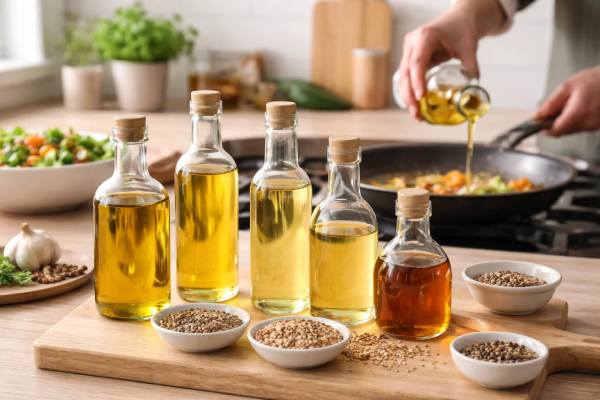
If you feel whiplash about seed oils, you are not alone. One week they are framed as “heart-healthy,” the next they are called “toxic,” “inflammatory,” or “brain-fog fuel.” The truth is more practical and more nuanced: seed oils are a broad group, their health impact depends on what they replace in your diet, and many concerns come from mixing real chemistry (oxidation) with overconfident internet shortcuts.
Used well, certain seed oils can help you cook more at home, keep saturated fat moderate, and make meals taste good enough to repeat. Used poorly—overheated, repeatedly reused, or mainly consumed through ultra-processed foods—they can become part of a dietary pattern linked with worse cardiometabolic and mental health outcomes. This guide unpacks what the evidence actually points to, why the debate went viral, and how to choose and cook with oils in a way that supports both long-term health and day-to-day peace of mind.
Quick Overview
- For most people, common seed oils are not uniquely harmful when used in normal cooking and as part of a balanced diet.
- The biggest real-world risk is not the oil itself, but frequent intake of ultra-processed foods where oils, refined carbs, and additives travel together.
- Very high-heat cooking and repeated oil reuse can increase oxidation byproducts, so technique and storage matter.
- A simple approach is to keep one neutral oil for heat, one flavorful oil for finishing, and limit deep-fried and packaged foods.
Table of Contents
- What seed oils actually are
- Why the seed oil debate went viral
- Omega-6 and inflammation what matters
- What health outcomes studies suggest
- Brain and mental health the hidden connection
- Best oil choices and smart cooking tips
What seed oils actually are
“Seed oils” is a social-media label, not a scientific category. In everyday use, it usually means liquid plant oils extracted from seeds and similar crops—often refined for neutral flavor and higher heat stability. Common examples include soybean, corn, canola (rapeseed), sunflower, safflower, grapeseed, cottonseed, and rice bran oil. People sometimes lump peanut oil in as well, even though peanuts are legumes.
Two details change the conversation immediately:
- How the oil is made. Many seed oils on supermarket shelves are refined (filtered, deodorized, and processed to remove impurities). Refining can make an oil more neutral and often more stable for cooking. Cold-pressed or expeller-pressed oils keep more flavor compounds but may have lower heat tolerance and shorter shelf life.
- What the fatty-acid profile looks like. Oils vary widely in how much polyunsaturated fat (PUFA), monounsaturated fat (MUFA), and saturated fat they contain. That profile affects both health outcomes and how the oil behaves under heat. High-PUFA oils are generally more prone to oxidation during high-heat cooking than higher-MUFA oils.
It also helps to separate culinary use from dietary pattern. Most people do not drink seed oils straight. They mainly consume them in:
- Restaurant fryers and fast food
- Packaged snacks, baked goods, and frozen meals
- Salad dressings, mayonnaise, and sauces
So when someone says, “Seed oils made me feel better when I cut them out,” it may reflect a broader change: less fried food, fewer packaged snacks, more home cooking, and fewer refined carbs. That can genuinely improve energy, mood, digestion, and weight regulation—without proving that the oils themselves were uniquely harmful.
A grounded question is: What role is the oil playing in your life?
- If it helps you cook vegetables, beans, eggs, or fish at home, it may be a net positive.
- If most intake comes from deep-fried or packaged foods, the oil is a marker of a highly processed pattern that is harder on cardiometabolic health and, for some, mental well-being.
Why the seed oil debate went viral
Viral nutrition debates usually have three ingredients: a real mechanism, a clear villain, and a personal transformation story. The seed oil discourse checks all three.
1) A real mechanism: oxidation.
Oils can oxidize—especially with heat, oxygen, and time. Oxidation is not a conspiracy; it is basic chemistry. When oils are repeatedly heated (particularly in deep frying), they can form breakdown products that affect flavor and may be undesirable for health. This is the strongest “steelman” point in the anti-seed-oil argument, and it deserves respect. The leap happens when that reality is turned into “any amount is poison,” which is not how risk works in nutrition.
2) A clear villain: “industrial” processing.
The phrase “industrial seed oils” signals something modern and manufactured, which makes it emotionally compelling. Processing can matter, but it is not automatically bad. Pasteurization is processing. Freezing is processing. Refining oils is processing. The useful question is whether the processing meaningfully changes health outcomes in the amounts people typically eat.
3) A satisfying story: remove one thing, feel better.
Many people feel better when they cut seed oils—because the change often removes fried food, ultra-processed snacks, and calorie-dense convenience meals. This is a powerful lived experience, and it can be true without proving a single ingredient caused every symptom.
The debate also gets muddied by category confusion. “Seed oils” covers oils with very different properties, used in very different ways:
- A small amount of canola oil used to sauté vegetables is not the same as regular deep-fried fast food.
- A high-oleic sunflower oil used in home cooking is not the same as months-old oil in a frequently reused fryer.
Finally, there is an online tendency to treat biology like math: “omega-6 is inflammatory, therefore seed oils are inflammatory.” In reality, inflammation is shaped by the whole diet (fiber, micronutrients, protein quality, omega-3 intake, alcohol, sleep, stress) and by individual physiology. Nutrition is rarely a single-switch system.
A calmer way to frame the question is: Where are seed oils coming from in my diet, and what are they replacing? That turns a viral argument into a practical decision.
Omega-6 and inflammation what matters
Most seed oils are higher in omega-6 polyunsaturated fats, especially linoleic acid. The fear-based claim is simple: omega-6 becomes “pro-inflammatory” compounds, so higher omega-6 intake must increase inflammation. The reality is more conditional.
Here is what matters in practice:
Omega-6 is essential.
Linoleic acid is an essential fatty acid, meaning your body needs it and cannot make it. “Essential” does not mean “more is always better,” but it does mean “inherently toxic” is not a biologically coherent claim.
Pathways are not outcomes.
Yes, linoleic acid can be converted into arachidonic acid, which can be used to create inflammatory signaling molecules. But the body regulates these pathways tightly. In many real-world diets, higher linoleic acid intake does not automatically translate to higher chronic inflammation markers. Mechanisms are clues, not verdicts.
The omega-6 to omega-3 balance is where the conversation becomes more useful.
Instead of trying to crush omega-6 to zero, focus on raising omega-3 intake and improving overall diet quality. A diet can be high in omega-6 and still be health-supportive if it is rich in whole foods, fiber, and omega-3 sources. Conversely, a low-seed-oil diet can still be poor if it is heavy in refined carbs and low in micronutrients.
Inflammation is often a pattern problem, not an oil problem.
Diets high in ultra-processed foods tend to combine: refined starches, added sugars, low fiber, low micronutrients, and often high omega-6 oils. In that context, it is easy to blame the oil for what is really a broader dietary load.
If you want a clean, behavior-based framework, use this:
- If you are adding oils on top of an already energy-dense diet, your results may worsen regardless of oil type.
- If you are replacing some saturated fat with unsaturated oils while also eating more plants and fiber, risk markers often improve.
A common worry is that “omega-6 makes me anxious or foggy.” Sometimes people do feel a noticeable difference when they reduce fried and packaged foods, and that can improve mental clarity. But the more plausible drivers are steadier blood sugar, better sleep, fewer additives, and less reliance on highly palatable snack foods—rather than a direct “seed oil equals anxiety” pathway in isolation.
The simplest inflammation-lowering strategy is not chasing purity. It is building a steady foundation: vegetables, fruit, legumes, whole grains, adequate protein, omega-3 sources, and cooking fats that help you sustain the pattern.
What health outcomes studies suggest
The internet loves a single villain. Public health works more like substitution math: what happens when you replace one thing with another? With oils, that replacement question is crucial.
When unsaturated oils replace saturated fats, many cardiometabolic markers tend to move in a favorable direction.
This is one reason many clinical guidelines encourage “liquid plant oils” over tropical oils and high-saturated-fat choices. The benefit is not magic; it is the combination of fatty-acid profile and what it displaces in the overall diet.
Observational studies have limits, but they can still inform common-sense decisions.
Long-term outcome studies cannot perfectly isolate “seed oils” because people do not consume oils in isolation. However, patterns often emerge when looking at linoleic acid intake or blood biomarkers: higher omega-6 levels are not consistently linked to worse outcomes, and in several analyses they track with lower risk in general populations. That does not mean everyone should chase high omega-6 intake; it means “omega-6 equals harm” is too simple.
The strongest legitimate caution is about high-heat, repeated-use scenarios.
Frequent deep frying, oil reuse, or overheating can degrade oils, especially those high in polyunsaturated fats. If your primary exposure to seed oils is restaurant frying and packaged snack foods, the concern is less “omega-6” and more the combination of:
- degraded fats from repeated heating
- high calorie density
- low fiber and high refined carbs
- high sodium and additives
This pattern can worsen blood pressure, lipid profiles, glucose regulation, and weight trajectory—each of which also influences mood and energy.
Personal sensitivity is real, but it is often about the food vehicle.
People sometimes notice skin changes, digestive changes, or energy changes when they reduce foods containing seed oils. In many cases, the oil is a passenger in a food that also includes refined flour, sugar, emulsifiers, and a high reward profile that encourages overeating. Removing those foods can feel like removing the problem—even if the root cause is broader.
A practical takeaway: treat “seed oils” as a tool, not a food group. If an oil helps you cook at home and improves adherence to a whole-food pattern, it may support health. If most oil comes from fried and packaged foods, reducing it is still a smart move—but the win is largely from shifting the pattern, not from cleansing a single ingredient.
Brain and mental health the hidden connection
Seed oils enter mental health discussions because people connect them to inflammation, and inflammation is often discussed in relation to depression and anxiety. The more important—and more evidence-aligned—link is usually indirect: where seed oils show up in modern diets.
For many people, high seed-oil intake is a proxy for higher intake of ultra-processed foods. Ultra-processed diets tend to be lower in fiber, magnesium, folate, and polyphenols, and higher in refined carbs and added sugars. That combination can influence mood through several plausible pathways:
- blood-sugar swings that affect irritability and fatigue
- sleep disruption from late-night snacking or heavy meals
- gut-brain signaling changes when fiber is low
- reduced intake of omega-3 rich foods (fatty fish, certain plant sources)
- higher chronic stress load when meals are irregular and highly palatable
Another useful lens is fat quality balance, not fear of omega-6. Many people are low in omega-3 intake and high in omega-6 intake, creating a wide omega-6 to omega-3 ratio. That imbalance is not automatically “toxic,” but it can be a sign the diet is light on omega-3 sources and heavy on convenience foods. Improving omega-3 intake and overall diet quality is typically more productive than chasing an unrealistically low omega-6 intake.
If you are trying to make food choices that support mood and cognition, focus on what reliably helps:
- regular meals with adequate protein
- fiber-rich carbs that support steady energy
- omega-3 sources several times per week (or as advised)
- minimally processed meals most of the time
- cooking fats that make home food enjoyable
If you notice mental changes after changing oils, interpret them thoughtfully. Ask:
- Did I also reduce fast food, sweets, and packaged snacks?
- Am I eating more consistently and sleeping better?
- Did my overall calorie intake or alcohol intake change?
- Did I increase fish, nuts, vegetables, or legumes?
These shifts can meaningfully affect anxiety and mood. The oil may be part of that story, but it is rarely the lone author.
A steady, non-obsessive approach also protects mental health. When “perfect eating” becomes the goal, stress rises and food becomes a daily test. The healthiest plan is the one that reduces friction: a few good oils, simple cooking habits, and fewer ultra-processed defaults—without turning meals into moral decisions.
Best oil choices and smart cooking tips
If you want the benefits of cooking oils without getting trapped in internet extremes, build a small, practical “oil system.” The goal is stability, flavor, and technique—not purity.
Step 1: Keep two oils with clear jobs.
- A neutral cooking oil for heat: good for sautéing, roasting, and moderate-to-higher heat cooking. Examples many people tolerate well include refined canola, refined olive oil, avocado oil, peanut oil, and high-oleic sunflower or safflower oil.
- A flavorful finishing oil: used after cooking for taste and aroma, not for high heat. Extra-virgin olive oil is the classic. Some people also enjoy toasted sesame oil (in tiny amounts) or walnut oil for salads.
Step 2: Match the oil to the cooking method.
Smoke point matters, but it is not the only factor. Stability also depends on fatty-acid profile and how fresh the oil is. Use this as a workable guideline:
- High heat (stir-fry, searing, roasting at higher temps): choose more stable oils, avoid pushing a delicate oil until it smokes.
- Medium heat (most sautéing): many oils work well; prioritize what you enjoy and will use consistently.
- No heat (dressings, drizzles): use oils with flavor and antioxidants, and keep portions sensible.
Step 3: Reduce the scenarios that create the biggest downside.
The most defensible “anti-seed-oil” advice is about context:
- Limit deep-fried foods and frequent restaurant frying.
- Avoid repeatedly reusing oil at home.
- Reduce packaged snacks and ultra-processed baked goods where oils are part of a larger low-nutrient pattern.
Step 4: Use portions that fit real life.
Oil is calorie-dense, regardless of type. If weight management is a goal, measure occasionally to recalibrate. Many home cooks underestimate pours. A simple practice is to start with a small amount, then add only if needed.
Step 5: Do not turn oil choice into a stress ritual.
If you feel anxious around food rules, pick an approach you can follow without constant scanning and fear. The nervous system cost of rigid eating can outweigh small theoretical differences between oils. Consistency beats perfection: cook at home more often, use reasonable heat, store oils well, and focus on the overall pattern.
References
- 2021 Dietary Guidance to Improve Cardiovascular Health: A Scientific Statement From the American Heart Association 2021 (Scientific Statement)
- Dietary intake, biomarkers and supplementation of fatty acids and risk of coronary events: a systematic review and dose-response meta-analysis of randomized controlled trials and prospective observational studies 2024 (Systematic Review and Meta-Analysis)
- Dietary and circulating omega-6 fatty acids and their impact on cardiovascular disease, cancer risk, and mortality: a global meta-analysis of 150 cohorts and meta-regression 2025 (Systematic Review and Meta-Analysis)
- Ultra-Processed Food Consumption and Mental Health: A Systematic Review and Meta-Analysis of Observational Studies 2022 (Systematic Review and Meta-Analysis)
- Effect of High Ratio of n-6/n-3 PUFAs on Depression: A Meta-Analysis of Prospective Studies 2022 (Meta-Analysis)
Disclaimer
This article is for educational purposes and does not provide medical advice, diagnosis, or treatment. Nutrition needs are individual, and the effects of dietary fats can vary based on medical history, medications, metabolic health, and overall dietary pattern. If you have cardiovascular disease, diabetes, digestive conditions, a history of disordered eating, or persistent anxiety or depression symptoms, consider discussing diet changes with a licensed clinician or registered dietitian who can tailor guidance to you. Seek urgent help if you experience severe mood changes, thoughts of self-harm, or feel unsafe.
If you found this article useful, please consider sharing it on Facebook, X (formerly Twitter), or any platform you prefer.