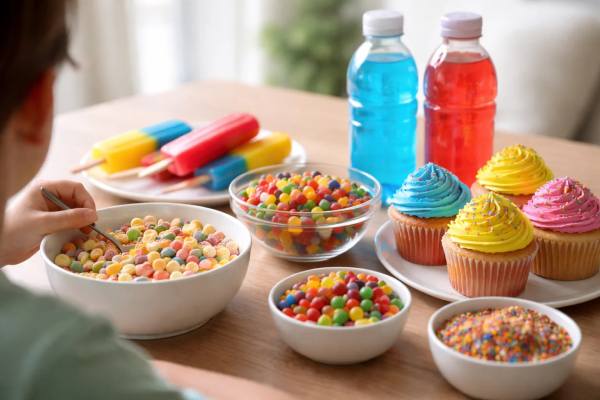
Artificial food colors are designed to do one job exceptionally well: make foods look brighter, fresher, and more fun to eat. For busy families, they also help packaged foods stay visually consistent from batch to batch. The controversy begins when color stops being “just cosmetic” and becomes part of a bigger question: can dyes influence the brain—especially sleep, mood, and behavior? The evidence does not support panic, but it also does not support dismissal. For most people, occasional exposure is unlikely to be a major driver of mental health. For a smaller subset—often children with higher sensitivity, existing attention challenges, or allergy-like reactions—certain dyes may worsen restlessness, irritability, or attention in ways that are noticeable in daily life. This article explains what dyes are, what research can and cannot tell us, and how to make practical choices without turning food into a source of stress.
Essential Insights
- Most research finds small average behavioral effects, with larger changes more likely in a sensitive subset rather than in everyone.
- Sleep effects are less studied, but some children appear to have more restlessness or trouble settling after higher-dye exposures, especially in the evening.
- The biggest real-world “dye load” often comes from ultra-processed snacks and drinks that also contain sugar, refined starches, and stimulants.
- A simple, low-stress approach is a 2–3 week trial of swapping the top dye sources, then reintroducing one category at a time to see what actually changes.
Table of Contents
- What counts as artificial food colors
- What the evidence really says
- Behavior and attention in kids
- Sleep and evening wind-down
- Mood irritability and the food context
- Smart reductions without food anxiety
What counts as artificial food colors
“Artificial food colors” usually refers to synthetic dyes added to foods and drinks to create vivid, uniform color. They are most common in products marketed for visual appeal: candies, frosted baked goods, neon sports drinks, flavored syrups, brightly colored cereals, gelatin desserts, and some medications or chewable vitamins. You may also see them in “fun” versions of otherwise ordinary foods, like colored pasta shapes, flavored yogurts, or novelty sauces.
A helpful distinction is synthetic dyes versus naturally derived colors. Natural colors (such as beet juice, turmeric, paprika, or spirulina extracts) can still be processed and still affect the body in rare cases, but they are chemically different from petroleum-based synthetic dyes and often behave differently in the body and under heat or light. “Natural” is not automatically healthier, yet the current debate is largely about synthetic dyes.
You may see dyes listed by different naming systems:
- U.S. labeling often uses “FD and C” names (for example, Red No. 40, Yellow No. 5, Blue No. 1).
- European labeling often uses “E numbers” for approved additives.
- Some labels describe them more generally as “artificial colors” or “color added,” which can make it harder to know what is included without checking the ingredient list.
It also matters how exposure clusters. Dyes rarely show up alone. A “dye-heavy” day for a child often includes: sweet drinks, candy, packaged pastries, and snack foods—items that also push blood sugar up and down and can disrupt appetite, bedtime routines, and emotional regulation. That does not prove dyes are harmless; it means the real-world question is usually about a package of inputs.
A practical way to think about dye exposure is a “top sources” lens rather than perfection. If a family reduces just a few high-impact items—bright drinks, candy, and heavily colored frosting—total dye intake often drops substantially without needing to change the entire diet overnight.
What the evidence really says
The research on artificial food colors is easy to misinterpret because it contains two truths that feel contradictory:
- Average effects across large groups are usually small.
- Some individuals appear to have noticeable effects.
Many studies use “challenge” designs: participants follow a dye-reduced diet for a period, then receive a dye mixture or placebo under controlled conditions. These trials are useful because they test short-term behavioral changes, not long-term diagnoses. They also show why online claims diverge. If you are in the sensitive subset, the change can feel obvious. If you are not, it can feel like nothing at all.
Several factors make the evidence hard to summarize:
- Different dyes and mixtures. Trials often test combinations (dye mixtures with preservatives), so a positive result does not always identify which ingredient is responsible.
- Different outcome measures. Some studies rely on parent reports, others use teacher reports or attention tests. Parent reports can capture real day-to-day behavior, but they are also vulnerable to expectation effects.
- Baseline differences. Children with ADHD symptoms, sleep problems, allergic tendencies, or sensory sensitivity may respond differently than children without these traits.
- Dose and timing. A small amount of dye in a single food may do little. A large dose from drinks and candy, especially late in the day, may be more likely to affect restlessness or sleep onset in susceptible children.
A balanced reading is this: synthetic dyes are unlikely to be a primary cause of ADHD, anxiety, or depression. But they may act as symptom amplifiers—a factor that nudges attention, irritability, or settling skills in the wrong direction for some people, especially when combined with irregular meals, high sugar, and insufficient sleep.
The most useful question is not “Are dyes toxic?” but “Are dyes a controllable trigger for this person?” That is where structured experiments—short, simple, and calm—can outperform arguments. If changing dyes produces a meaningful difference in sleep or behavior without adding stress to family life, it is a reasonable tool. If it creates fear, rigidity, or conflict at meals, the mental cost may outweigh the benefit.
Behavior and attention in kids
When families worry about dyes, they are usually worried about one thing: behavior—more fidgeting, impulsivity, meltdowns, or “wired” energy that seems out of proportion to the situation. Research suggests that artificial food colors can worsen behavior-related symptoms in some children, but the effects are typically modest and not universal.
A clear pattern seen in both research and real life is that effects—when they occur—often look like:
- Increased restlessness or “motor” activity
- Shorter attention span or more distractibility
- Irritability or quick emotional escalation
- More arguing, defiance, or intensity around transitions
It helps to separate three overlapping scenarios:
- A true sensitivity response. A child consistently becomes more restless or irritable after higher-dye foods, even when sugar and routine are kept similar.
- A context effect. Dyes appear mostly in party foods, special treats, or highly stimulating environments. The child’s behavior changes, but the driver may be novelty, excitement, screen time, bedtime drift, or social overload.
- A combined load. Dyes come with sugar, refined starch, and sometimes caffeine (energy drinks, some sodas, chocolate-heavy desserts). The combined physiologic impact may be bigger than any one ingredient.
If you suspect dyes are a contributor, the strongest approach is a targeted trial, not a lifetime ban. Keep it practical:
- Pick two high-impact categories first (often bright drinks and candy).
- Keep everything else as stable as possible for 2–3 weeks: bedtime, morning routine, and meal timing.
- Track only a few outcomes (for example, “time to settle at night,” “teacher notes,” “after-school mood,” “number of major meltdowns”).
- If there is improvement, reintroduce one category (such as a dyed drink at lunch for 3 days) and watch for a consistent pattern.
This approach prevents a common trap: attributing every good or bad day to dyes. It also supports emotional health by avoiding rigid “forbidden food” messaging that can increase anxiety or secrecy around eating. The goal is to learn a child’s personal triggers while protecting their relationship with food and their sense of normalcy.
Sleep and evening wind-down
Sleep is the newest and least settled part of the dye conversation. Compared with attention and hyperactivity, there are fewer high-quality studies specifically measuring sleep outcomes after dye exposure. Still, there are plausible pathways and consistent family observations that make sleep worth discussing carefully.
Sleep problems linked to dyed foods often present as:
- Difficulty winding down or “second wind” energy
- More bedtime resistance or emotional intensity in the evening
- Longer time to fall asleep
- More night waking in some children
- A “tired but wired” pattern that shows up after parties, sports events, or sugary drinks
The challenge is that dyed foods often show up late in the day and rarely show up alone. A neon drink after practice, candy at a birthday party, or a brightly frosted dessert after dinner can combine:
- Rapid-digesting carbohydrates
- Excitement and stimulation
- Later bedtimes and more screen time
- Less protein and fiber at dinner (leading to a quick rise and fall in energy)
In a sensitive child, that mix can make the nervous system more reactive. Even if dyes are only a small part of the effect, reducing them can still improve sleep by improving the overall “evening load.”
If you want a clean way to test the sleep question, use a “bedtime-protection” rule for two weeks:
- No brightly colored drinks, candy, or dyed desserts within 4–6 hours of bedtime.
- Keep dinner predictable with protein and a slow-digesting carbohydrate.
- Keep bedtime and wake time steady.
Then watch for measurable change: time-to-sleep, number of night wakings, and morning mood. If sleep improves, you have a practical lever—whether the key driver is dyes, sugar timing, or overstimulation.
A final note: if a child’s sleep difficulty is severe, persistent, or paired with snoring, breathing pauses, restless legs symptoms, or major daytime impairment, dyes should not be treated as the primary explanation. Sleep disorders and anxiety deserve direct evaluation, and dietary tweaks should be supportive rather than substitutive.
Mood irritability and the food context
Mood is where the dye debate is most likely to become confusing. People report feeling “more anxious,” “more down,” or “more emotionally edgy” when they consume heavily dyed foods. The evidence for a direct dye-to-mood pathway is less established than the evidence for short-term behavior changes in some children. But mood can still shift meaningfully through indirect mechanisms.
Three indirect mechanisms explain many real-world experiences:
1) Blood sugar and nervous system volatility.
Dyed foods are often sweets and sweet drinks. If a child (or adult) is prone to blood-sugar dips, the crash can look like irritability, tearfulness, or anger. In that case, removing dyed foods may help because it removes a common trigger food category, not because color itself is acting like a mood drug.
2) The ultra-processed pattern effect.
Dyes frequently appear in diets that are lower in fiber, lower in micronutrients, and higher in refined starch and additives. That pattern is linked with worse sleep and worse emotional regulation for many people. When someone “cuts dyes,” they often cook more, snack less, and eat more regular meals—changes that can stabilize mood quickly.
3) Expectation effects and stress around food.
If a parent believes a dye will cause a meltdown, everyone is on alert. That tension can change interactions, discipline, and how a child interprets their own feelings. Expectation does not mean symptoms are imaginary; it means the social environment can amplify or reduce symptoms. This is one reason a calm, structured trial works better than constant vigilance.
If you want a brain-friendly way to interpret mood changes, treat dyes as a signal to examine the whole moment:
- What time was it eaten?
- Was the person hungry, tired, or overstimulated already?
- Was there caffeine, chocolate, or a very sugary drink involved?
- Did the day include skipped meals or a late bedtime?
When dyes genuinely matter for a person, the pattern tends to be consistent: similar exposures produce similar restlessness or irritability, even when the setting changes. When the pattern is inconsistent, the likely drivers are sleep debt, stress, meal timing, or the emotional “charge” around treat foods. Addressing those drivers often improves mood more than chasing perfect ingredient lists.
Smart reductions without food anxiety
If you decide to reduce artificial food colors, the healthiest approach is selective and sustainable. The goal is fewer dyes with minimal disruption to family life and minimal risk of turning food into a battleground.
Start with the highest-yield moves:
- Swap dyed drinks first. Bright sports drinks, slush-style beverages, and neon juices can deliver a lot of dye quickly. Replace with water, flavored sparkling water, or “no artificial colors” versions.
- Pick two “treat defaults.” Choose one candy and one dessert option that is dye-free (or naturally colored) so celebrations do not feel restrictive.
- Simplify lunchbox staples. Yogurts, fruit snacks, gummies, and granola bars are common dye sources. Swap one item at a time to avoid pushback.
- Use a “home versus out” rule. Many families do best with “mostly dye-free at home” and flexibility outside the home. This protects mental health and reduces secrecy or rebellion.
If you are troubleshooting behavior or sleep, use a brief plan that respects reality:
- Baseline week: do not change much, just observe and note patterns.
- Trial phase (2–3 weeks): reduce the top dye sources and keep sleep routines stable.
- Reintroduction phase: bring back one category for a few days to test whether symptoms return consistently.
You can also make changes without framing dyes as dangerous. For kids, language matters:
- Prefer: “We’re testing what helps your body feel calm and sleep well.”
- Avoid: “This food is bad,” or “This will make you crazy.”
Finally, be aware that dye policy is changing in some regions, and labeling rules differ. In parts of Europe, certain colors require a warning statement about activity and attention in children. In the United States, recent regulatory actions have focused on phasing out some petroleum-based synthetic dyes and revoking authorization for specific color additives. Practical takeaway: labels and ingredient lists are becoming more informative, which can make selective reduction easier over time.
If dye reduction is making someone anxious, rigid, or socially avoidant, that is a sign to loosen the approach. Mental health is part of nutrition. The best plan is the one that improves daily function without increasing fear.
References
- Potential impacts of synthetic food dyes on activity and attention in children: a review of the human and animal evidence 2022 (Review) ([PMC][1])
- Health Effects Assessment: Potential Neurobehavioral Effects of Synthetic Food Dyes in Children 2021 (Government Report) ([OEHHA][2])
- HHS, FDA to Phase Out Petroleum-Based Synthetic Dyes in Nation’s Food Supply | FDA 2025 (Regulatory Announcement) ([U.S. Food and Drug Administration][3])
- FDA to Revoke Authorization for the Use of Red No. 3 in Food and Ingested Drugs | FDA 2025 (Regulatory Update) ([U.S. Food and Drug Administration][4])
- Additives in food products – EU labelling rules – Your Europe 2025 (Official Guidance) ([European Union][5])
Disclaimer
This article is for educational purposes and does not provide medical advice, diagnosis, or treatment. Responses to food additives vary by individual, and changes in sleep, mood, or behavior can have many causes, including stress, sleep disorders, neurodevelopmental conditions, allergies, and medication effects. If you are concerned about significant behavior changes, persistent insomnia, anxiety or depression symptoms, or suspected food reactions—especially in a child—consider discussing next steps with a licensed clinician or a registered dietitian. Seek urgent help if anyone experiences severe symptoms or thoughts of self-harm, or if safety is at risk.
If you found this helpful, please consider sharing it on Facebook, X (formerly Twitter), or any platform you prefer.