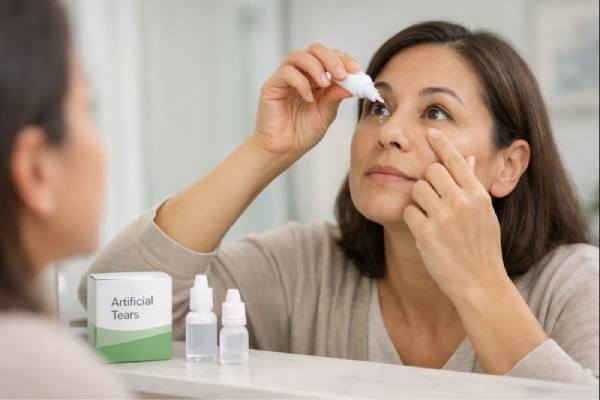
Artificial tears are one of the simplest ways to relieve dry, irritated eyes—yet many people are unsure how often they can use them safely. The answer depends less on “how bad your eyes feel” and more on what kind of drop you are using and why you need it. Some formulas are designed for occasional comfort during screen time or windy days. Others are meant for frequent, ongoing use in chronic dry eye disease, contact lens discomfort, or medication-related dryness.
Used correctly, artificial tears can smooth the tear film, reduce stinging and grittiness, and protect the corneal surface from friction. Used too frequently in the wrong form—especially preserved drops—they can irritate the ocular surface and create a cycle of burning that feels like worsening dryness. This guide explains safe frequency ranges, preservative considerations, how to choose the best type for your symptoms, and when frequent use is a sign you need a different strategy.
Top Highlights
- Preservative-free artificial tears can usually be used as often as needed, while preserved drops are best limited when frequent dosing is required.
- If you need artificial tears more than 4 times a day for several days, switching to preservative-free is often the safest next step.
- Persistent reliance on drops without lasting relief can signal an underlying issue like meibomian gland dysfunction, allergy, or medication side effects.
- Thicker gels and ointments last longer but can blur vision, making them better for evenings, nighttime, or at-home use.
- Use proper drop technique and avoid touching the bottle tip to reduce contamination and irritation.
Table of Contents
- What artificial tears actually do
- Safe frequency guidelines by drop type
- Preservatives and why they change the rules
- Best artificial tear types for common symptoms
- How to build a simple dosing plan
- Common mistakes that make dry eye worse
- When artificial tears are not enough
What artificial tears actually do
Artificial tears are lubricating eye drops designed to supplement or stabilize your natural tear film. They do not “create new tears” in the way your lacrimal glands do, and they do not permanently cure dry eye. What they can do—often very effectively—is reduce friction, dilute inflammatory tear-film components, and improve the optical smoothness of the eye’s surface.
To understand why the right drop and the right frequency matters, it helps to know the tear film has layers that work together:
- A watery layer that provides moisture and carries nutrients.
- A mucin layer that helps tears spread evenly across the eye’s surface.
- An oil layer (from the meibomian glands) that slows evaporation.
Different artificial tears target different pieces of that system. Some are primarily “watery” and replace volume. Others are thicker and cling longer to the surface. Some are lipid-based and strengthen the oil layer for evaporative dry eye. The best product is usually the one that matches the reason your eyes feel dry.
Artificial tears also help in situations where the surface is simply stressed, not diseased. Long screen sessions reduce blinking and can create tear-film breakup. Air conditioning, heating, altitude, smoke, and wind can increase evaporation. Certain medications (including antihistamines, antidepressants, acne medications, and some blood pressure drugs) can reduce tear quality or quantity. In these cases, artificial tears can be a practical tool—especially when paired with behavior changes like blink breaks and humidity control.
A key point is that burning, gritty eyes are not always “not enough tears.” Many people have evaporative dry eye from meibomian gland dysfunction, where oil output is poor and tears evaporate quickly. In that situation, watery drops can provide short relief but may not last. Others have allergy-driven irritation, where lubricants soothe but do not address itching and inflammation.
So, when people ask how often they can use artificial tears, the more precise question is: how often can you use this type of artificial tear, for this reason, without creating additional surface irritation or masking a treatable cause? The sections that follow make that practical.
Safe frequency guidelines by drop type
There is no single universal limit for artificial tears, but there are widely used safety guardrails that help you choose frequency without harming the ocular surface. The most important divider is preserved vs preservative-free.
A practical frequency framework
Occasional comfort use (situational dryness)
If your eyes feel dry from screens, travel, or air conditioning, many people do well with:
- 1–2 drops per eye as needed, often 1–4 times per day.
If that level of use solves the problem and symptoms do not return quickly, it is a good sign the issue is mostly environmental or behavioral.
Regular daily use (ongoing dry eye symptoms)
If you need drops daily, aim to match the drop type to your pattern:
- Preserved drops: often best kept to up to 4 times per day.
- Preservative-free drops: can be used more frequently, including every 1–2 hours during flares, depending on comfort and clinician guidance.
Very frequent use (severe dryness or surface disease)
If you find yourself reaching for drops hourly or more than 8–10 times per day, two things are usually true:
- preservative-free drops are the safer choice, and
- you likely need an evaluation or a broader plan (for example, treating meibomian gland dysfunction, allergy, or inflammation).
Very frequent dosing is not inherently dangerous when the product is preservative-free and used correctly, but it can be a sign that lubrication alone is not addressing the root cause.
Frequency by thickness
How long a drop lasts depends on viscosity:
- Thin drops: shorter relief, easier to use during the day, minimal blur.
- Gels: longer relief, more blur; often used in the evening or before bed.
- Ointments: longest-lasting, typically for nighttime; can significantly blur vision.
Many people get better results by combining a thinner daytime drop with a thicker evening product rather than simply increasing the number of thin-drop applications.
The “more often” red flags
Consider reassessing your approach if:
- Relief lasts less than 10–15 minutes even with preservative-free drops.
- You need drops to function at work every day, but symptoms keep escalating.
- You have increasing light sensitivity, sharp pain, or a persistent foreign-body sensation in one eye.
In those scenarios, frequent lubrication may be masking a corneal surface issue, allergy flare, eyelid inflammation, or a contact lens problem that needs targeted care.
Frequency is safest when it is intentional: pick the right formulation, use it often enough to keep the surface comfortable, and treat “constant dosing” as a signal to upgrade the plan rather than a sign to simply add more drops.
Preservatives and why they change the rules
Preservatives are added to many multi-dose eye drop bottles to prevent bacterial growth after opening. That protection is useful, but it comes with a tradeoff: repeated exposure to certain preservatives can irritate the ocular surface, destabilize the tear film, and worsen the very symptoms you are trying to treat.
Why preserved drops can become a problem
Preserved artificial tears are often well tolerated when used occasionally. The risk rises when they are used frequently because:
- The ocular surface is exposed repeatedly to chemical agents intended to disrupt microbes.
- In dry eye, the surface barrier is often already compromised, making it more vulnerable.
- Some preservatives can act like detergents over time, increasing stinging and surface staining.
This is why many clinicians use a simple rule: if you need artificial tears more than 4 times a day, switch to preservative-free. It is not a moral rule; it is a risk-management rule.
Not all preservatives behave the same
Some formulas use traditional preservatives that may be more irritating with frequent use. Others use “vanishing” or oxidative preservatives that break down after instillation, or packaging systems that reduce contamination risk. Even so, sensitivity varies widely. One person can tolerate a preserved drop for years; another feels burning after two days.
If you notice that your drops initially help but then start to sting more over time, ask yourself:
- Did my dosing frequency increase?
- Did I switch brands or formulations?
- Did my environment change (winter heating, allergy season, more screen time)?
- Am I using other preserved drops, like glaucoma medications, that add to total preservative exposure?
The cumulative load matters.
Preservative-free does not mean “no rules”
Preservative-free drops are generally safer for frequent use, but they still require good habits:
- Single-use vials can be contaminated if the tip touches lashes or skin.
- Some multi-dose preservative-free bottles rely on special valves; they still need clean technique.
- “More is better” is not always true if your symptoms are driven by eyelid oil problems, inflammation, or allergy.
A helpful decision point
If you are unsure whether preservatives are affecting you, try this structured approach for a week:
- Switch to a preservative-free drop.
- Keep your usage similar to your normal pattern.
- Track two things: how long relief lasts and whether burning improves.
If burning and redness improve without changing anything else, preservatives may have been part of the problem. If you still need constant drops, the issue is likely more about tear-film instability, meibomian gland dysfunction, or inflammation than about the preservative alone.
Preservatives are not “bad” in all contexts, but they change the safe-frequency conversation. When use becomes frequent, preservative-free options are usually the safer default.
Best artificial tear types for common symptoms
Artificial tears are not one category. Choosing the best type becomes much easier when you match the formulation to how your eyes feel and when symptoms occur. Think of it as selecting the right “tear-film support,” not just grabbing the most familiar brand.
If your eyes feel dry and scratchy all day
Start with a preservative-free, moderate-viscosity drop designed for frequent use. Look for formulas built around lubricants such as hyaluronic acid or cellulose-based polymers. These tend to spread smoothly and provide a balance of comfort and clarity.
Best fit:
- Frequent dosing needs
- Sensitive eyes
- Dryness with mild burning
If your eyes water yet still feel dry
Paradoxical tearing often happens when the surface is irritated and tears are unstable. In this scenario, a watery drop may help briefly, but longer-lasting stabilization is usually better.
Best fit:
- Moderate-viscosity drops
- Consider a gel in the evening if symptoms spike late day
If dryness is worse during screens, driving, or air flow
This pattern often suggests evaporative dry eye. You may benefit from lipid-based or emulsion drops that support the oil layer and slow evaporation.
Best fit:
- Symptoms worse with low blink rate
- Dryness that returns quickly after watery drops
- Morning dryness plus gritty feeling that worsens through the day
If you wake up with very dry, sticky eyes
Nighttime exposure and incomplete eyelid closure can amplify dryness. A daytime drop may not be enough because the problem happens while you sleep.
Best fit:
- Gel drops before bedtime
- Nighttime ointment if recommended (expect blurred vision)
If your eyes itch and feel gritty
Itching strongly suggests allergy. Artificial tears can dilute allergens and soothe the surface, but they may not address the cause.
Best fit:
- Preservative-free tears used after outdoor exposure
- Consider targeted allergy management if itching is prominent
If you wear contact lenses
Use drops specifically labeled as compatible with contact lenses or rewetting drops designed for lenses. Avoid oil-heavy emulsions while lenses are in place unless the product is designed for that purpose.
Best fit:
- Lens-safe rewetting drops
- Preservative-free options for frequent use
Avoid these common “not really artificial tears”
Some redness-relief products contain vasoconstrictors that temporarily shrink surface vessels. They can reduce redness but often worsen dryness over time and can cause rebound redness when stopped. If your main problem is dryness, these are rarely the best long-term tool.
The “best” artificial tear is the one that gives longer relief with fewer doses and minimal burning. If you need to use a thin drop every 20 minutes, you often need a different formulation—or a different diagnosis.
How to build a simple dosing plan
A dosing plan turns artificial tears from a reactive habit into a preventive tool. The goal is to keep the tear film stable enough that you do not wait for symptoms to spike. Most people do best when they align dosing with predictable triggers: morning dryness, screen sessions, commuting, or late-day fatigue.
Step 1: Choose a “base” drop
Pick one preservative-free drop you can tolerate well. If your symptoms are mostly evaporative, consider a lipid-based preservative-free option as the base. If you blur easily or need drops at work, choose a thinner formulation and reserve thicker options for evenings.
Step 2: Set a baseline schedule for 7 days
Use a schedule that fits your current severity:
Mild symptoms
- 1 drop per eye morning and mid-afternoon, plus as-needed doses
Moderate symptoms
- 1 drop per eye 3–4 times daily (for example: morning, lunch, late afternoon, bedtime)
Severe symptoms or flares
- Preservative-free drops every 1–2 hours while awake for a short period
- Add gel at bedtime if nighttime dryness is prominent
If you are using preserved drops, keep baseline dosing lower and treat “more than 4 times daily” as a reason to switch to preservative-free.
Step 3: Add a “longer-lasting” layer if needed
If you need frequent daytime dosing, you may do better by adding thickness rather than adding frequency:
- Use a gel drop in the evening when blur is less disruptive.
- Use a nighttime product if you wake up dry.
This approach often reduces total daily doses.
Step 4: Protect the plan with two simple habits
- Blink breaks: every 20 minutes of screen time, look far away and blink slowly 10 times.
- Air control: direct vents away from your face; consider a humidifier in dry rooms.
These changes can reduce drop dependence by improving tear stability.
Step 5: Reassess after one week
Ask three practical questions:
- Is relief lasting longer between doses?
- Am I using fewer total drops?
- Are burning and redness improving?
If the answer is no—and you are still using drops constantly—do not assume you simply need more. That pattern often means you need to address the driver: eyelid oil dysfunction, allergy, inflammatory dry eye, medication effects, or contact lens fit and wear time.
A dosing plan should feel like it gives you back control. If it feels like chasing symptoms all day, that is useful information—and a reason to adjust the strategy.
Common mistakes that make dry eye worse
Many artificial tear “failures” are not because the drops are weak. They happen because the wrong product is used too often, the technique contaminates or irritates the eye, or the drop is masking a condition that needs a different treatment.
Mistake 1: Using preserved drops frequently
This is the most common frequency-related issue. If you use preserved drops more than 4 times a day, you may develop more burning and redness, then respond by using even more drops. Switching to preservative-free often breaks that cycle.
Mistake 2: Treating watery tearing as proof you are not dry
Watery tearing can be a reflex response to surface irritation and tear-film instability. In many people, the eye is “wet” but not well lubricated. If watery tearing is paired with gritty discomfort, you may still have dry eye—often evaporative.
Mistake 3: Touching the bottle tip to lashes or skin
This can contaminate the dropper tip and introduce bacteria into the bottle. It can also scratch the ocular surface. Keep the tip a small distance from the eye and aim for the inner lower lid pocket.
Mistake 4: Using drops without spacing other eye medications
If you use prescription drops (for glaucoma, allergy, or infection), spacing matters. As a general habit, leave 5–10 minutes between different eye drops so the first drop is not immediately washed out.
Mistake 5: Relying on redness relievers
Redness relievers can make eyes look whiter temporarily but often worsen dryness and can cause rebound redness. If dryness is the problem, choose lubricants rather than vasoconstrictors.
Mistake 6: Expecting instant, permanent relief
Dry eye is often chronic and influenced by environment, blinking, eyelid health, and inflammation. Artificial tears are a support tool. If you need them constantly, it is not a personal failure—it is a cue that the plan needs more than lubrication.
Mistake 7: Ignoring one-eye symptoms
Dry eye often affects both eyes similarly. If one eye is dramatically worse—especially with pain, light sensitivity, or a persistent foreign-body sensation—seek evaluation. A corneal abrasion, infection, foreign body, or inflammation can mimic dry eye but requires different care.
The best way to use artificial tears safely is to treat them like any other medication: choose the right formulation, use clean technique, and upgrade the plan when the pattern suggests something more is going on.
When artificial tears are not enough
Artificial tears are a first-line tool, but they are not meant to carry the entire burden of persistent symptoms. If you are using them frequently and still struggling, the most helpful next step is to ask why your tear film is unstable.
Signs you should schedule an eye evaluation
Arrange an eye exam if you have any of the following:
- You need preservative-free tears more than 6–8 times a day for more than two weeks without meaningful improvement
- You have blurred vision that does not clear after blinking or drops
- You have light sensitivity or sharp pain (not just mild irritation)
- You wake up with significant dryness despite nighttime support
- Your symptoms are interfering with reading, driving, or work performance
- One eye is consistently worse than the other
Common underlying drivers that need targeted treatment
Frequent drops can be a clue to specific problems:
- Meibomian gland dysfunction: often needs lid hygiene, warm compresses, and sometimes in-office treatments.
- Allergic eye disease: often needs allergy-specific therapy, not just lubrication.
- Inflammatory dry eye: may require anti-inflammatory prescription therapy and a structured plan.
- Medication-related dryness: may improve with adjustments, timing changes, or added protective strategies.
- Contact lens intolerance: may require changes in lens material, wear time, cleaning systems, or a shift away from lenses during flares.
- Incomplete lid closure at night: may require nighttime protection beyond standard drops.
Urgent symptoms that should not wait
Seek urgent care if you have:
- Sudden vision loss or a new blind spot
- A painful red eye with significant light sensitivity
- A sensation of something stuck in the eye that is worsening
- Thick discharge or rapidly increasing swelling
A reassuring perspective
Needing artificial tears does not mean you are doing something wrong. It means your ocular surface needs support. The key is to use that support in a way that is safe and strategic:
- Preserve occasional use with preserved drops if you tolerate them.
- Prefer preservative-free when dosing becomes frequent.
- Use thickness to reduce frequency.
- Treat frequent reliance as data that points to the underlying cause.
When artificial tears become a constant companion, it is often the right time to stop improvising and move to a diagnosis-driven plan. That is how you protect comfort now and eye health over the long term.
References
- Dry Eye Syndrome Preferred Practice Pattern® 2024 (Guideline)
- Artificial Tears: A Systematic Review 2023 (Systematic Review)
- Ocular benzalkonium chloride exposure: problems and solutions 2021 (Review)
- TFOS DEWS III: Digest 2025 (Consensus Review)
Disclaimer
This article is for educational purposes only and does not provide medical advice, diagnosis, or treatment. Artificial tears are generally safe when used as directed, but persistent eye irritation can have many causes, including infection, allergy, corneal injury, inflammatory dry eye disease, and medication effects. Seek urgent medical evaluation for sudden vision loss, severe eye pain, marked light sensitivity, a painful red eye, significant swelling, or symptoms after contact lens wear or eye trauma. For personalized recommendations on drop type, dosing frequency, and treatment options, consult a licensed eye care professional.
If you found this article helpful, please consider sharing it on Facebook, X (formerly Twitter), or any platform you prefer.