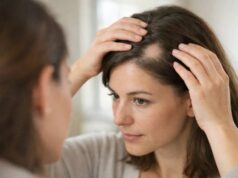
Stress-related hair shedding can feel unfairly delayed: you get through the stressful season, and only weeks later your shower drain starts telling the story. That timing is not imaginary. Many stress sheds follow a lagged cycle shift, where more follicles move into a resting phase and then release hair later. Ashwagandha (Withania somnifera) is often suggested as a “stress herb” because it may lower perceived stress and anxiety and support sleep quality in some people. If those effects are real for you, it can indirectly help hair by lowering the signals that keep follicles in a churned-up state.
But ashwagandha is not a hair-growth drug, and it is not risk-free. Quality varies widely across supplements, benefits are usually modest, and certain people should avoid it entirely—especially those who are pregnant, have thyroid disease, or have liver vulnerability. This guide explains where ashwagandha fits in a stress-shedding plan, how to use it cautiously, what to watch for, and when it is smarter to choose a different approach.
Quick Overview
- Stress shedding often reflects a delayed follicle shift; calming sleep and stress signals may help over months, not days.
- Ashwagandha may reduce perceived stress and anxiety and improve sleep in some adults, which can indirectly support recovery from stress-related shedding.
- Liver injury is rare but reported; stop immediately if you develop jaundice, dark urine, severe itching, or right-sided abdominal pain.
- A conservative trial is typically 8–12 weeks with a standardized product, starting low and monitoring for side effects.
- Avoid ashwagandha if you are pregnant, trying to conceive without medical guidance, have significant thyroid disease, or have liver disease.
Table of Contents
- Stress shedding and the cortisol connection
- What ashwagandha can and cannot do
- Dosing and product quality basics
- Timeline and tracking results
- Side effects and interaction risks
- Who should avoid it and better options
Stress shedding and the cortisol connection
Stress hair loss is usually not “balding” in the classic sense. The most common pattern is diffuse shedding—more hair coming out across the scalp—often with a normal-looking scalp surface. Many cases fit telogen effluvium, where a higher-than-usual percentage of follicles transition from the growth phase into a resting phase. After a rest period, those hairs shed, which is why the mirror can worsen after the stressful event is already over.
Two details matter for realistic expectations:
- The lag is built in. A trigger (psychological stress, illness, major sleep disruption, rapid weight loss) can show up as shedding 6–12 weeks later.
- The follicle is usually still alive. The goal is to restore stable cycling, not to “revive dead follicles.”
Cortisol is not the only hormone involved, but it is a useful marker of physiological stress. In high-stress periods, cortisol patterns can shift alongside sleep fragmentation, appetite changes, inflammation, and changes in grooming habits. Any one of those can make shedding feel worse. If you want a clearer picture of how prolonged stress signaling can show up in hair patterns, how high cortisol patterns show up in shedding can help you connect symptoms with timelines.
It also helps to separate stress shedding from other conditions that need different urgency:
- Patchy loss (smooth circular areas, eyebrows/beard involvement) raises concern for alopecia areata.
- Widening part or temple recession suggests pattern thinning, which can overlap with stress shedding but does not resolve from stress reduction alone.
- Burning, heavy scaling, or scarring-like change suggests inflammatory scalp disease that deserves evaluation.
Where does ashwagandha fit? It is best viewed as a tool that may lower perceived stress and anxiety and support sleep quality. If it helps you sleep more consistently, reduces rumination, or makes recovery feel smoother, it can support the environment follicles need to return to normal cycling. The key word is “support.” Hair recovery still depends on time, nutrition, and removing ongoing triggers—especially chronic sleep disruption and under-eating, which can keep shedding active even when life feels calmer.
What ashwagandha can and cannot do
Ashwagandha is often described as an adaptogen—an herb used traditionally to support resilience under stress. Modern studies mostly evaluate outcomes like perceived stress, anxiety scores, sleep quality, and sometimes cortisol markers. That focus is important: most evidence for ashwagandha is about stress systems, not hair follicles directly.
What a realistic benefit looks like
If ashwagandha works for you, the benefits are typically felt in daily function first:
- Less “wired but tired” feeling in the evening
- Better sleep continuity or easier sleep onset
- Lower perceived stress or fewer anxiety spikes
- Improved ability to recover from demanding weeks
Those effects can indirectly support hair recovery because stress shedding often persists when the trigger stays active—especially when sleep remains broken. Think of ashwagandha as potentially helping you turn down the volume on a system that keeps follicles in a stop-start rhythm.
What it will not do
Ashwagandha is not a shortcut for regrowth, and it is not a replacement for diagnosis. It is unlikely to:
- Reverse genetic pattern thinning on its own
- Treat autoimmune patchy loss
- Fix shedding caused by thyroid dysfunction, iron deficiency, or medication effects
- “Repair” breakage from heat, bleach, or traction
If your shedding is heavy, prolonged, or paired with symptoms like fatigue, shortness of breath, menstrual changes, or cold intolerance, it is more efficient to look for a contributing driver rather than hoping a supplement covers it.
How it might support hair specifically
Stress shedding improves when the follicle receives consistent signals that conditions are stable: adequate calories and protein, regular sleep, lower inflammation, and fewer abrupt hormonal swings. Ashwagandha may help some people achieve that stability by:
- Supporting stress perception and stress reactivity
- Improving sleep duration or sleep quality in certain groups
- Reducing stress-related behaviors that worsen hair care (skipped meals, late-night alcohol, harsh “fixing” routines)
If you suspect your shedding has become prolonged rather than time-limited, it may help to understand the difference between a short-lived shed and a lingering one; when shedding becomes chronic telogen effluvium explains what “chronic” can mean and which next steps are most productive.
The bottom line: ashwagandha is best used as part of a stress-shedding plan, not as the plan. When it helps, it tends to help the upstream systems—sleep and stress load—that allow the follicle to settle back into a steadier rhythm.
Dosing and product quality basics
Most “ashwagandha didn’t work” stories are not about the herb in theory—they are about mismatch: dose, extract type, inconsistent use, or a product with unclear potency. If you choose to try it, a cautious, structured approach makes it safer and easier to evaluate.
Forms you will see and why they matter
Common supplement forms include:
- Root extract (often standardized to withanolides)
- Root and leaf extract (can differ in withanolide profile)
- Powdered root (larger gram-level doses, less standardized)
Standardization matters because “ashwagandha” on a label does not guarantee comparable potency. Two products with the same milligram dose can deliver very different active compound amounts.
A conservative dosing approach
Many stress-focused trials use daily doses in the few-hundred-milligram range for standardized extracts, often over 6–12 weeks. A practical, cautious strategy is:
- Start low for tolerance: 125–300 mg daily with food for 7–10 days.
- Increase only if needed: If you feel no benefit and no side effects, consider moving toward a commonly used range such as 300–600 mg daily, split or once daily depending on the product.
- Commit to a fair trial window: 8 weeks minimum is often needed for sleep and stress patterns to become obvious.
- Do not stack multiple products: Avoid taking two ashwagandha products or combining it with multi-ingredient “stress blends” during the trial.
Timing can be individualized. Some people prefer evening dosing if the effect feels calming; others prefer morning dosing if it supports daytime steadiness. If it makes you sleepy, do not take it before driving or safety-sensitive tasks until you know your response.
How to choose a safer product
Because supplements are not regulated like medications, product quality is part of safety. Look for:
- Clear labeling of extract type and standardization
- Single-ingredient or minimal-ingredient formulas (easier to troubleshoot)
- Third-party testing for identity and contaminants when available
- Conservative dosing that matches how it was studied, not “megadose” marketing
If you want a practical filter for marketing claims and risky formulations, supplement red flags that matter for hair can help you avoid common traps like overlapping high-dose vitamins, proprietary blends, and unclear sourcing.
The goal is a product you can evaluate cleanly: known dose, consistent daily use, and minimal confounders. That approach protects both your scalp and your ability to tell what is actually helping.
Timeline and tracking results
Stress shedding tempts people into daily checking: counting hairs, scanning the hairline, changing products weekly. Unfortunately, that behavior can keep stress high and makes it harder to interpret real progress. A better strategy is to track a few stable signals on a realistic timeline.
What timeline makes sense
A useful way to think about progress is in phases:
- Weeks 1–2: You are mostly assessing tolerance—sleepiness, stomach upset, headaches, or any “off” feeling.
- Weeks 3–6: Sleep continuity and perceived stress changes become clearer if the supplement helps you.
- Weeks 8–12: If your shedding was primarily stress-driven and the trigger is now controlled, you may notice the shed slowing.
- Months 3–6: New growth becomes more noticeable, especially around the hairline and part, but density recovery is gradual.
One crucial nuance: if your stress trigger occurred recently, shedding may still ramp up for a while even if you start improving habits today. That does not mean the plan failed—it often means you are living through the lag.
How to track without spiraling
Choose one or two measures and keep them consistent:
- Wash-day shed check: On one consistent wash day per week, note whether the shed looks “lighter, same, or heavier” compared with the prior month. Avoid daily counting.
- Monthly photos: Take photos every 4 weeks in the same lighting, same angles, with hair parted the same way.
- Scalp comfort and sleep notes: Record bedtime, wake time, and whether you wake during the night. Hair recovery is tightly linked to sleep stability.
Make sure you are tracking the right problem
Many people say “hair loss” when the dominant issue is breakage. Breakage improves with gentler handling and can change faster than follicle-driven shedding. If you are unsure which you are dealing with, how to tell breakage from true shedding can help you interpret what you see on your brush and in the shower.
When to stop the experiment
Stop the supplement and seek guidance if you develop:
- Yellowing of skin or eyes, dark urine, severe itching, or persistent nausea
- New palpitations, tremor, heat intolerance, or unexplained weight loss
- Rash, facial swelling, or breathing symptoms
- Worsening anxiety, agitation, or unusual mood shifts
A structured plan is not just about giving ashwagandha a chance—it is also about recognizing quickly when it is not the right fit.
Side effects and interaction risks
Ashwagandha is often presented as “natural, therefore gentle,” but the body does not sort by origin. It sorts by effects. Most people tolerate it well, yet meaningful side effects and rare serious reactions have been reported. The safest approach is to know the risks that matter most for hair-and-scalp readers.
Common, usually mild side effects
These tend to be dose-related and often improve by lowering the dose or taking it with food:
- Stomach upset, nausea, diarrhea
- Sleepiness or a “heavy” feeling
- Headache or dizziness
- Vivid dreams in some people
If sedation is noticeable, avoid combining it with alcohol or other sedating products.
Liver injury is the red-flag risk
Clinically apparent liver injury linked to ashwagandha appears to be uncommon, but it is serious enough to treat as a stop-signal. Seek urgent medical evaluation if you develop:
- Yellowing of eyes or skin
- Dark urine or pale stools
- Severe itching
- Right-upper abdominal pain
- Persistent nausea, loss of appetite, or profound fatigue
Do not “wait it out” and do not restart the supplement to test whether it was the cause.
Thyroid effects and why they matter for hair
Some people report thyroid-related shifts with ashwagandha, and hair is sensitive to both high and low thyroid activity. If you have a thyroid condition, are taking thyroid medication, or have symptoms like palpitations, tremor, heat intolerance, or unexplained weight change, treat this as a supervision-needed zone. If thyroid questions are already part of your hair story, thyroid-related hair thinning signs and lab clues can help you identify patterns worth discussing with a clinician.
Medication interactions to take seriously
Ashwagandha may not be appropriate, or may require monitoring, if you take:
- Thyroid hormone or anti-thyroid medications
- Diabetes medications (risk of lower blood sugar)
- Blood pressure medications (risk of lower blood pressure)
- Sedatives, sleep medications, or other calming herbs (additive sedation)
- Immunosuppressive therapies (because immune effects may be relevant)
Quality is part of safety here. Multi-ingredient products make it harder to identify what caused a reaction and increase the chance of contaminants or unexpected dosing.
The practical takeaway: treat ashwagandha like a real intervention. Start low, avoid stacking, and stop quickly if warning signs appear.
Who should avoid it and better options
Some people can try ashwagandha cautiously and benefit from better sleep and lower stress reactivity. Others should skip it—not because it is “bad,” but because the downside risk is not worth the potential upside.
Groups that should avoid ashwagandha
Avoid use unless a clinician specifically advises otherwise if you are:
- Pregnant or breastfeeding: safety is not established, and pregnancy is not the place for uncertain risk.
- Trying to conceive with a complex medical history: especially if you have thyroid disease, autoimmune disease, or are taking multiple medications.
- Living with liver disease or a history of unexplained elevated liver enzymes: the margin of safety is smaller.
- Diagnosed with hyperthyroidism or experiencing symptoms of excess thyroid activity: palpitations, tremor, heat intolerance, unexplained weight loss.
- On immunosuppressive medication or managing autoimmune disease that is active: individual context matters, and “immune support” marketing is not the same as appropriate immune modulation.
- Preparing for surgery: sedative effects and perioperative medication interactions are reasons to disclose all supplements and often to stop them ahead of time.
When it is smarter to prioritize evaluation
If your shedding is heavy, lasts beyond 3 months, or is paired with systemic symptoms (fatigue, shortness of breath, dizziness, menstrual changes, feverish illness, scalp pain), supplement experiments can delay the real fix. In those cases, it helps to consider whether your pattern fits persistent shedding rather than a single stress event. when shedding becomes chronic telogen effluvium can help you decide when to shift from self-care to targeted workup.
Better options that often move the needle more
For stress shedding, the most reliable “treatments” are the boring ones that restore stability:
- Sleep repair: consistent wake time, a realistic sleep window, and a buffer between stimulants and bedtime.
- Food stability: protein at two to three meals daily, plus enough total calories to signal safety to the body.
- Stress downshifts that are measurable: walking, strength training with recovery, therapy skills (especially CBT-style tools), and reduced alcohol on weeknights.
- Hair handling that reduces visible loss: gentle detangling, low traction styling, and minimizing aggressive brushing when hair is wet.
If you still want a supplement-based approach, consider using one change at a time, for a defined window, while tracking a small set of outcomes. That structure protects you from “stacking” your way into side effects and confusion.
References
- Effects of Ashwagandha (Withania Somnifera) on stress and anxiety: A systematic review and meta-analysis 2024 (Systematic Review and Meta-analysis)
- Ashwagandha: Is it helpful for stress, anxiety, or sleep? – Health Professional Fact Sheet 2025 (NIH Fact Sheet)
- Ashwagandha – LiverTox – NCBI Bookshelf 2024 (Safety Review)
- Ashwagandha-induced liver injury—A case series from India and literature review – PMC 2023 (Case Series)
Disclaimer
This article is for educational purposes only and does not provide medical advice, diagnosis, or treatment. Stress-related shedding can overlap with other causes of hair loss, including thyroid disease, iron deficiency, inflammatory scalp conditions, autoimmune disorders, medication effects, and pattern thinning. Ashwagandha is a biologically active supplement that may cause side effects and can interact with medications; rare but serious liver injury has been reported. Avoid self-treating with supplements if you are pregnant, breastfeeding, have liver or thyroid disease, take prescription medications, or have significant or rapidly worsening hair loss. If you develop jaundice, dark urine, severe itching, abdominal pain, rash, swelling, palpitations, or other concerning symptoms, stop the supplement and seek medical care promptly.
If you found this helpful, consider sharing it on Facebook, X (formerly Twitter), or your favorite platform so others can make safer, more informed decisions about stress shedding and supplements.