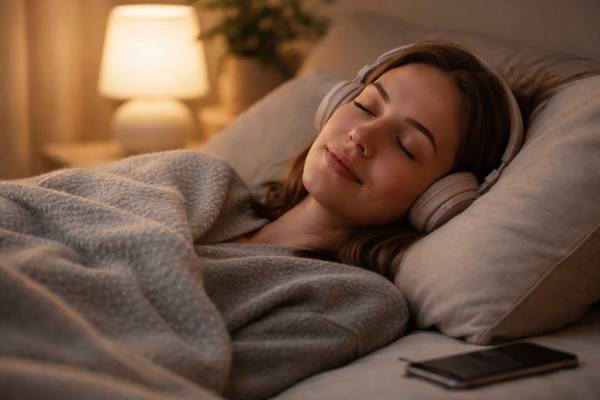
For some people, ASMR is the gentlest switch from “on” to “off” they have found: a soft voice, steady tapping, careful hand movements, and a warm wave of calm that makes sleep feel reachable again. For others, the same sounds are neutral or even irritating. That split is not a mystery flaw in the research—it is the point. ASMR is a highly individualized sensory and attention response, shaped by personal triggers, nervous-system sensitivity, and context (especially bedtime habits and stress load).
When it works, ASMR can function like a low-stakes relaxation ritual: it gives your brain something predictable to follow, lowers arousal, and replaces rumination with a narrow, soothing focus. This article explains what ASMR is, what the science suggests, why certain people respond strongly, and how to use it for sleep and anxiety without becoming dependent on a screen.
Top Highlights
- ASMR can reduce perceived stress and help some people downshift into a calmer, sleep-ready state.
- Benefits are most consistent in people who reliably experience tingles or deep relaxation from specific triggers.
- If ASMR becomes a nightly requirement or pushes bedtime later, it can worsen sleep quality over time.
- A practical routine is 15–30 minutes of curated audio-only triggers, paired with a fixed lights-out time.
Table of Contents
- What ASMR is and is not
- Why some brains respond strongly
- How ASMR may calm anxiety
- ASMR and sleep what research shows
- How to build an ASMR bedtime routine
- When ASMR backfires and what to do
What ASMR is and is not
ASMR stands for autonomous sensory meridian response. People who experience it describe a pleasant tingling sensation (often starting on the scalp or neck) plus a distinct emotional shift: calm, comfort, and a quieting of mental noise. Not everyone gets tingles, and not everyone needs tingles to benefit. Some people simply feel relaxed or sleepy.
Common triggers and why they matter
ASMR triggers tend to share a few features: softness, repetition, predictability, and a sense of careful attention. Common examples include whispering, slow speaking, tapping, brushing sounds, page turning, gentle hand movements, and role-play scenes like “haircut,” “medical check,” or “personal attention.” Many triggers are socially flavored without being socially demanding, which is part of the appeal for anxious minds.
What ASMR is not
ASMR is often confused with other experiences that can look similar from the outside:
- Relaxing audio: Nature sounds or white noise can be calming without producing ASMR.
- Frisson: The chills some people get from music are usually more intense and energizing than ASMR.
- Meditation: ASMR can overlap with meditative focus, but it is usually stimulus-driven rather than self-generated.
- A cure for insomnia or anxiety: ASMR can support symptoms, but it does not replace treatment for clinical insomnia, panic disorder, or depression.
Why the “internet format” fits the experience
ASMR is unusually compatible with video platforms: creators can deliver close-up sound detail, slow pacing, and a consistent style. Viewers can also tailor exposure with precision—choosing a voice, trigger, and length. That tailoring is not a minor detail; it often determines whether ASMR works at all.
A useful way to frame ASMR is as a personalized relaxation cue. For some nervous systems, it reliably signals safety and predictability. For others, it is simply background content. This difference is normal, and it is why ASMR should be approached as an experiment, not a rule.
Why some brains respond strongly
The most important fact about ASMR is that response varies dramatically. In surveys, a meaningful minority of adults report being able to experience ASMR, while many do not. Even among responders, triggers are highly specific: one person relaxes to tapping, another finds it unbearable. That variation suggests ASMR is less like a universal sedative and more like a sensory key that fits only certain locks.
1) Sensory processing differences
Some people naturally notice fine-grained sensory details: subtle shifts in tone, micro-pauses in speech, the texture of a brush sound. If your brain has a lower threshold for detecting small sensory changes, ASMR triggers may “grab” attention more easily. That can be beneficial for sleep and anxiety because it reduces room for rumination. It can also backfire if you are sensitive to specific mouth sounds or abrupt noises.
2) Attention style and the relief of narrow focus
Anxiety often comes with an over-broad attention spotlight. Your mind monitors many channels at once: tomorrow’s tasks, bodily sensations, social worries, and worst-case scenarios. ASMR can narrow that spotlight by offering a slow, structured stream of cues. When your attention is gently occupied, anxious forecasting loses fuel.
3) Social safety without social pressure
Many ASMR scenarios mimic safe caregiving signals: soft voice, patient pace, and careful “checking in.” For some people, this lands as comfort. For others, it feels intrusive or uncanny. Personal history matters here. If certain interpersonal cues are associated with safety, ASMR may calm. If they are associated with discomfort, ASMR may irritate.
4) Learned associations and consistency
ASMR often becomes stronger when it is paired with a consistent context. If you only use ASMR in bed, at the same time, with dim light and a familiar routine, your brain may begin to treat it as a sleep cue. That learning effect can be powerful, but it is also why you want to avoid accidental conditioning that requires a screen to fall asleep.
The takeaway is straightforward: ASMR works best when it matches your sensory preferences, attention style, and comfort signals. If it does not, there is nothing “wrong” with you—your nervous system is simply tuned differently.
How ASMR may calm anxiety
ASMR is not just a pleasant sensation. For many people, it is a shift in physiological state: from activated to settled. Anxiety is often described as a mental problem, but it is also a body state marked by elevated arousal, muscle tension, and threat-monitoring. ASMR can interrupt that loop through several practical mechanisms.
Downshifting arousal
Controlled studies suggest ASMR can be associated with relaxation markers such as reduced heart rate in responders during or after exposure. In plain terms, the body receives a “safe enough” signal. This does not mean anxiety disappears. It means the intensity can drop from a nine to a six, which is often the difference between coping and spiraling.
Replacing rumination with structured input
Rumination is sticky because it is internally generated and self-reinforcing. ASMR gives the brain an external sequence to follow. The sequence is slow, predictable, and low-demand. This matters for anxious minds because it reduces decision-making and reduces open loops. You do not need to solve anything; you only need to listen.
Micro-predictability and control
Anxiety rises when the brain predicts uncertainty. ASMR content is built on predictable micro-events: tap, pause, brush, repeat. That rhythm can be soothing because the brain keeps correctly predicting what comes next. When prediction becomes accurate again, the system often calms.
Comfort cues and “safe attention”
Many ASMR videos simulate attentive care: someone focuses on you, speaks gently, moves slowly, and maintains a calm tone. For some people, this reduces vigilance. Importantly, the viewer controls the interaction: you can stop, change triggers, or lower volume. That control reduces the sense of being trapped, which is a major anxiety amplifier.
Where ASMR fits in an anxiety plan
ASMR works best as a short-term state tool, not as your only coping strategy. Use it to support:
- winding down at night
- decompression after work
- reducing body tension before a difficult task
If you rely on ASMR to avoid feelings entirely, anxiety can grow in the background. The healthiest pattern is “ASMR helps me settle, then I still practice coping skills during the day.” That balance protects both nervous-system stability and long-term resilience.
ASMR and sleep what research shows
Sleep is the most common reason people seek ASMR, and it is also where careful expectations matter. ASMR does not behave like a sleeping pill. It is closer to a wind-down ritual that reduces arousal and makes sleep more likely—especially when insomnia is driven by stress, mood, or difficulty “switching off.”
What outcomes look most plausible
Across experimental work and self-report studies, the most consistent sleep-adjacent outcomes are:
- reduced subjective arousal in the evening
- improved mood state after viewing in responders
- easier transition from wakefulness to drowsiness
- perceived improvement in sleep quality for some users
These outcomes make sense. Sleep requires low arousal, stable attention, and reduced threat-monitoring. ASMR can support all three.
Why results are mixed
Sleep research becomes messy quickly because insomnia is not one condition. Some people cannot sleep because of circadian timing issues. Others have sleep apnea, restless legs symptoms, pain, or medication effects. ASMR is unlikely to help those root causes directly. It may still feel comforting, but comfort is not the same as treatment.
Another reason results vary is that ASMR is not one stimulus. A video with mouth sounds may relax one person and trigger irritation in another. Studies that do not match content to personal preference may underestimate the potential benefit.
ASMR is most helpful for “cognitive and emotional insomnia”
If your insomnia is driven by racing thoughts, worry, and body tension, ASMR can be an effective bridge into sleep. It gives you a focus target that is calmer than your own mind. Many people report that it reduces the urge to check the clock, replay conversations, or plan tomorrow’s tasks.
But screens can sabotage sleep
The main sleep risk is not ASMR itself. It is the device. Bright light, autoplay recommendations, and “one more video” can delay bedtime and fragment sleep. This is why audio-only ASMR often works better than video for insomnia, even for people who enjoy visual triggers.
A realistic, evidence-aligned stance is: ASMR can improve sleep onset and perceived sleep quality for some people, especially responders with stress-related insomnia, but it works best when paired with strong sleep habits and minimal screen exposure.
How to build an ASMR bedtime routine
If you want ASMR to help sleep rather than compete with it, treat it like a structured wind-down tool. The goal is to lower arousal while protecting a consistent bedtime.
Step 1: Curate your triggers
Spend 15 minutes during the daytime choosing two or three triggers you reliably enjoy. Keep the list small. A large library increases decision-making at bedtime, which can raise arousal.
Common “sleep-friendly” categories include:
- soft-spoken voice (not intense whispering if it irritates you)
- slow tapping or brushing with steady rhythm
- page turning, writing sounds, or gentle fabric sounds
- calm role-play with minimal plot and no sudden sounds
If mouth sounds trigger disgust or irritation, do not force them. Irritation is the opposite of sleep readiness.
Step 2: Use audio-first whenever possible
Audio-only reduces light exposure and reduces the temptation to visually track the content. If you prefer video, dim the screen fully, use night-mode settings, and position the device so you are not staring directly at it.
Step 3: Set a time boundary
A reliable pattern is 15–30 minutes, then lights out. If you routinely need 90 minutes of ASMR, your brain may be learning that sleep requires entertainment. Keep the dose small enough that your nervous system learns to continue the descent without constant input.
Step 4: Pair ASMR with one non-digital cue
To avoid becoming dependent on ASMR, add a second cue that can stand alone:
- a warm shower
- light stretching for 5 minutes
- a single calming breathing pattern
- a consistent bedtime scent, such as unscented lotion you only use at night
This creates redundancy. If your phone dies, you can still sleep.
Step 5: Track results without obsessing
For one week, note:
- time to fall asleep (rough estimate)
- number of awakenings
- morning grogginess
- anxiety level at bedtime
If ASMR helps, you should see a clearer wind-down and less bedtime struggle. If it does not help, adjust triggers, reduce screen use, or try a different relaxation tool instead of forcing it.
When ASMR backfires and what to do
ASMR is often framed as harmless, and for many people it is. But any soothing tool can backfire if it increases dependence, avoidance, or overstimulation. The solution is not to quit immediately. It is to refine how you use it.
Backfire pattern 1: You cannot sleep without it
If ASMR becomes mandatory, sleep can feel fragile. That fragility increases performance anxiety, which worsens insomnia. To correct this, alternate nights:
- Night A: ASMR for 15 minutes, then lights out
- Night B: a non-digital wind-down (breathing, progressive muscle relaxation, or reading)
Over time, the goal is to keep ASMR as an option, not a requirement.
Backfire pattern 2: It delays bedtime
If you intend to sleep at 11:00 but end up scrolling until 12:30, ASMR is functioning as entertainment. Fix this with a boundary:
- set a fixed “start ASMR” time
- choose one track only
- disable autoplay
- place the phone out of reach after starting audio
Sleep improves when bedtime is protected more than when any single relaxation method is perfect.
Backfire pattern 3: Triggers become irritating
Some people develop “trigger fatigue,” where a once-calming sound becomes annoying. This can happen when stress is high and sensory tolerance is low. Rotate between two different trigger styles and lower volume. If irritation persists, stop for a week and return later.
Backfire pattern 4: It becomes emotional avoidance
ASMR can be a healthy comfort, but if it is used to avoid all difficult feelings, anxiety can strengthen. A balanced approach is:
- use ASMR to settle the body
- during the day, practice one coping skill that builds tolerance (structured worry time, therapy skills, or gradual exposure to stressors)
When to seek help beyond ASMR
Consider professional support if you have:
- insomnia most nights for weeks with daytime impairment
- panic attacks, severe anxiety, or depression symptoms
- snoring, gasping, or extreme daytime sleepiness
- reliance on alcohol or sedatives to sleep
ASMR can be a helpful layer, but persistent sleep and anxiety problems deserve a comprehensive plan.
References
- Brain circuits in autonomous sensory meridian response and related phenomena 2024 (Review)
- The effects of autonomous sensory meridian response (ASMR) on mood, attention, heart rate, skin conductance and EEG in healthy young adults 2022 (Experimental Study)
- Comparison of autonomous sensory meridian response and binaural auditory beats effects on stress reduction: a pilot study 2022 (Randomized Trial)
- The effects of Autonomous Sensory Meridian Response (ASMR) videos on arousal and mood in adults with and without depression and insomnia 2022 (Controlled Study)
- The relaxation effect of autonomous sensory meridian response depends on personal preference 2023 (Neuroimaging Study)
Disclaimer
This article is for educational purposes and does not provide medical advice, diagnosis, or treatment. ASMR responses vary widely, and sleep and anxiety symptoms can have many causes, including stress, medical conditions, sleep disorders, medication effects, and mental health conditions that benefit from professional care. If you have persistent insomnia, significant anxiety or depression symptoms, panic attacks, thoughts of self-harm, or signs of a sleep disorder such as loud snoring or breathing pauses, seek guidance from a qualified clinician.
If you found this article helpful, please consider sharing it on Facebook, X (formerly Twitter), or any platform you prefer.