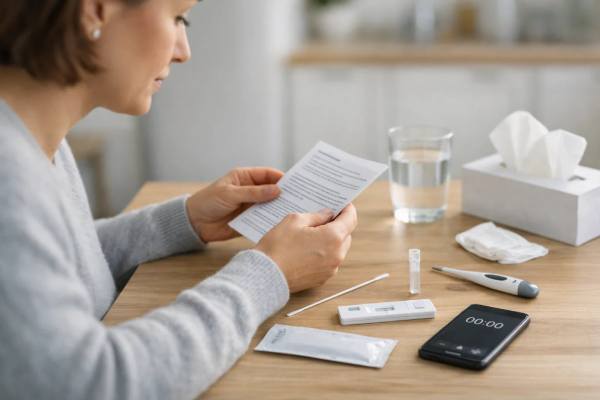
At-home combo tests can take some of the guesswork out of “Is this COVID-19 or the flu?”—a question that matters because timing affects what you do next. When you can test quickly at home, you can make safer decisions about work, school, travel, and visiting higher-risk people. You may also be able to seek treatment sooner, since some antiviral medicines work best when started early. The tradeoff is that home tests are not perfect: accuracy depends on the kind of test (antigen vs molecular), how well you collect the sample, and where you are in the illness timeline. A single negative result—especially early—does not always mean “no infection.” This guide explains what combo tests measure, what accuracy really means in day-to-day use, and the exact habits that most often cause false results, so you can trust your outcome as much as the technology allows.
Quick Overview
- Combo tests can quickly differentiate COVID-19 from influenza A and influenza B, which helps guide isolation decisions and time-sensitive treatment conversations.
- Accuracy improves when you test at the right moment in the illness and repeat testing when symptoms persist after an initial negative result.
- A negative result does not fully rule out infection, especially in the first 1–2 days of symptoms or if swabbing technique is weak.
- Treat any valid positive result as actionable: protect others right away and consider contacting a clinician promptly if you are high risk.
- Use the same “small routine” every time—timer, clean hands, correct swab depth and rotations, and reading results only within the instructed window.
Table of Contents
- What combo tests detect
- Accuracy in real life
- When to test for best signal
- Swabbing and setup done right
- Reading results without second-guessing
- Next steps after results
What combo tests detect
“COVID + flu combo test” sounds like one product category, but the label can cover more than one technology. Most combo tests are designed to identify SARS-CoV-2 (the virus that causes COVID-19) and influenza A and influenza B from a single nasal sample. The output is usually “positive” or “negative” for each virus, and it is possible—though not common—to have more than one positive result if you have a co-infection.
Two broad test approaches matter because they behave differently:
- Antigen tests look for viral proteins. They are fast, affordable, and simple, but they generally need a higher amount of virus in the nose to turn positive. That makes them more likely to miss very early infection or low-level viral shedding.
- Molecular tests (often described as NAAT) look for viral genetic material. They typically detect infection earlier than antigen tests, and they can be more sensitive when symptoms have just started. They may take a bit longer to run and can be more expensive.
Combo tests also have clear limits. A typical home combo test:
- Does not diagnose “a cold” or identify every respiratory virus (for example, RSV is usually not included).
- Does not tell you how contagious you are, how severe your illness will be, or whether symptoms are due to bacteria such as strep throat.
- Does not replace clinical assessment when warning signs appear (severe shortness of breath, chest pain, confusion, dehydration, or rapidly worsening symptoms).
One more practical point: combo tests are built and authorized around a specific sample type and specific steps. If the instructions say “anterior nasal swab,” that means the front part of the nostril, not throat swabbing, not saliva, and not “a quick tickle.” The test’s performance claims apply only when you use it exactly as directed. Think of it less like a general science experiment and more like a recipe: the result depends on following the method closely.
Accuracy in real life
Accuracy is often discussed as a single number, but at home it is better understood as a set of tradeoffs. Three concepts explain most of what people experience with combo tests:
Sensitivity is the ability to catch true infections. If sensitivity is lower, false negatives become more likely—especially early in the illness or when sampling is weak.
Specificity is the ability to stay negative when you are not infected. High specificity means false positives are uncommon, which is why a clear positive result on a properly run test is usually actionable.
Predictive value is what you actually care about at home: “Given my result today, how likely is it to be correct?” Predictive value changes with context. When COVID-19 or flu are spreading widely in your community, a positive result is more likely to reflect a true infection. When activity is low, a positive result is still important, but confirmation (especially if you have no symptoms) may be more useful.
Why do false negatives happen so often in real life?
- Timing: Viral levels in the nose rise and fall. Testing too early is a common reason for an initial negative.
- Technique: Shallow swabbing, too few rotations, or rushing the process can collect too little material.
- Dry nose or heavy congestion: Both can reduce how much viral material ends up in the sample. (That does not mean you should change the sample site—follow the instructions—but it is a reason to repeat.)
- Test handling: Using an expired kit, storing it in a hot car, opening components too early, or reading results outside the instructed time window can distort results.
False positives are less common, but they can happen. Typical causes include:
- Contamination: Touching the swab tip, letting it contact a surface, or splashing sample fluid.
- Mix-ups: Swapping caps, mislabeling if multiple people test at once, or reading the wrong person’s device.
- Misreading faint lines: Some tests count any visible test line as positive; others have a specific appearance. The instructions matter.
A helpful mindset is “one result, one decision.” If the test is positive and valid (control line present when required), treat it as real in the short term: protect others, and consider whether you need medical advice. If the test is negative but you feel convincingly ill, treat the negative as “not proven yet,” not as a guarantee.
When to test for best signal
If you only remember one rule about at-home combo testing, make it this: timing and repetition matter more than brand debates. A perfectly manufactured test can still miss infection if you test before viral levels are high enough or if you stop after one negative result when symptoms are evolving.
Here is a practical way to time testing for the most common situations.
If you have symptoms right now
- Test as soon as you reasonably can once symptoms start, especially if you may need early treatment or you live with someone at higher risk.
- If the result is negative but symptoms feel compatible with COVID-19 or flu, repeat testing according to your test’s instructions. For many antigen-based self-tests, repeating about 48 hours later is the usual pattern. This catches infections that were still “ramping up” on day one.
- If symptoms are worsening, you have significant risk factors, or you need a definitive answer quickly (for work, caregiving, or treatment timing), consider a molecular test if available, or seek clinical testing.
If you were exposed but feel fine
- Testing immediately after an exposure often produces a false negative because the virus has not reached detectable levels yet.
- If you decide to test, do it in a series spaced out over several days. This increases the chance of catching infection near the time it becomes detectable.
- If you develop any symptoms, shift to the “symptoms” strategy above.
If you are testing before visiting someone high risk
A single negative test is a snapshot, not a promise. For a safer approach:
- Test close to the visit (same day is ideal) and avoid high-risk exposures in the days before.
- If you can, add a second test earlier in the week (or about two days before) to reduce the chance you are catching infection too early.
- Pair testing with practical risk reducers: staying home if you feel unwell, improving ventilation, and masking if needed.
If you recently had COVID-19
Some people continue to test positive for a while. A positive test can reflect ongoing viral detection, and it does not always match how infectious someone is. Because this can be complicated—and because guidance may differ by situation—people who are immunocompromised or who have repeated positives after recovery should discuss a personalized plan with a clinician.
The goal of testing is not to “win certainty.” It is to make better decisions with the information you can gather today, and to repeat testing when today’s answer may still be early.
Swabbing and setup done right
Most home-test mistakes are small, repeatable, and fixable. If you build a consistent routine, you reduce the chance that a negative result is simply a poor sample.
Before you start
Use this short checklist:
- Wash or sanitize hands and set up a clean, dry surface.
- Check the expiration date and confirm the packaging is intact.
- Make sure the kit has been stored within the temperature range listed in the instructions (extreme heat or freezing can damage components).
- Set a timer you can hear. Guessing time is a classic failure point.
Swabbing: where accuracy is often won or lost
For most at-home combo tests, the sample is an anterior nasal swab. That means:
- Insert the swab only as far as the instructions show (usually not deep), but far enough to make firm contact with the nasal walls.
- Rotate the swab for the full number of rotations and the full duration instructed.
- Repeat in the other nostril if instructed (often required).
- If your nose is very dry, gently blowing your nose once before swabbing can help, unless your test instructions say otherwise.
Common errors to avoid:
- Touching the soft swab tip with fingers.
- Swabbing only the very front of the nostril.
- Rushing the rotations, especially when it feels uncomfortable.
- Letting the swab tip touch the counter, sink, or tissue after collection.
Running the test: treat it like a precise recipe
Steps vary by product, but the principles are consistent:
- Add the sample to the solution or device exactly as directed.
- Mix or stir only as instructed (too vigorous can splash; too gentle can fail to release material).
- Keep the device level if the instructions require it.
- Start the timer immediately when the instructions tell you to.
If multiple people test at once:
- Label each device before sampling begins.
- Open only one kit at a time.
- Keep swabs and tubes separated to avoid mix-ups.
A note on kids and older adults
Children often need an adult to collect the sample correctly. If the child pulls away or the swab barely touches the nostril, treat the result as lower-confidence—especially if symptoms are clear—and plan to repeat or seek clinical testing. For older adults, the key risk is not swabbing discomfort; it is delaying care. If symptoms are significant or the person is high risk, prioritize accurate testing and timely medical advice over “waiting to see.”
A well-collected sample is the single biggest factor you control. When people say home tests are “inaccurate,” they are often describing technique problems, not the technology itself.
Reading results without second-guessing
Interpreting results correctly is as important as collecting the sample. The two most common interpretation problems are reading too late and discounting faint positives.
First: confirm the test is valid
Most at-home tests include a control indicator. If the control does not appear, the result is invalid even if you see something in the test area. When a test is invalid:
- Do not try to “interpret” it.
- Repeat with a new kit, paying attention to steps that could affect validity (timer, sample volume, mixing, and device position).
Positive results: treat them as actionable
For many tests, any visible positive marker in the correct window counts as positive, even if it is faint. People are often tempted to rationalize a faint line as “probably nothing,” especially when they are busy or when symptoms are mild. A safer approach:
- Assume a valid positive is real in the short term.
- Protect others immediately (especially higher-risk people).
- Consider whether you need clinical advice, especially if you are pregnant, older, immunocompromised, or have chronic medical conditions.
Because combo tests report multiple viruses, you might see:
- COVID-19 positive only
- Influenza A positive only
- Influenza B positive only
- More than one positive (less common, but possible)
Co-infections can occur and may be associated with more severe illness in some groups. If you have multiple positives and you feel significantly ill, it is reasonable to seek medical guidance sooner rather than later.
Negative results: think “not detected today”
A negative result can mean:
- You are not infected.
- You are infected, but viral levels are still below the test’s detection threshold.
- The sample was weak or the process was imperfect.
If your symptoms are mild and improving, a negative result may be reassuring. If you feel distinctly unwell—fever, body aches, significant cough, abrupt fatigue, or worsening over a day—treat a negative test as incomplete information and plan to repeat.
The timing window matters
Most devices have a strict read time (for example, “read at 15 minutes” and “do not read after 30 minutes”). Reading late can create evaporation artifacts that look like faint positives. Reading early can miss a true positive that has not fully developed. Use a timer, read once, and avoid “checking again” later.
A simple documentation habit
Take a quick photo of the result at the proper read time and note the date and symptom day. This is useful if you need to talk with a clinician, notify a workplace, or track changes across repeat tests. It also reduces anxiety-driven re-reading, which is a common source of confusion.
Next steps after results
A home combo test is most valuable when it changes what you do next. The right next steps depend on the result, your risk level, and how sick you feel.
If your test is positive for COVID-19, influenza, or both
- Limit contact with others right away. If you must be around people, take added precautions (distance, ventilation, and masking when appropriate).
- Let close contacts know if they are at higher risk or if they were around you during the early symptomatic period.
- Consider treatment timing. Flu antivirals are most effective when started early, and some COVID-19 treatments are time-sensitive as well. If you are high risk, do not “wait it out” without considering a prompt medical conversation.
- Monitor for worsening symptoms, especially breathing difficulty, chest pain, severe weakness, dehydration, confusion, or persistent high fever.
- Be careful with return-to-activity decisions. Even if symptoms are mild, returning too quickly can prolong recovery. In general, staying home until you are improving and fever-free for a full day (without fever reducers) is a common threshold, then using extra precautions for several days afterward can reduce spread.
If your test is negative but you feel sick
Use a structured plan:
- Repeat the test per the instructions (often about 48 hours later for antigen tests).
- If you need a definitive answer quickly, consider molecular testing or clinical evaluation.
- Treat symptoms supportively: fluids, rest, and fever control as appropriate for your situation and medical history.
If you have a classic “flu-like” onset—sudden fever, chills, body aches, and fatigue—a negative test on the first day does not rule out flu. Similarly, a negative COVID-19 result early in symptoms does not guarantee you are not infected.
If you are negative and mostly well, but had exposure
A single negative test is most useful when paired with behavior:
- Pay attention for symptoms over the next few days.
- Consider serial testing rather than a one-and-done approach.
- Avoid visiting high-risk people if you are unsure, especially during peak respiratory virus season.
When to seek urgent or immediate care
Regardless of test result, seek urgent evaluation if you have:
- Trouble breathing, bluish lips or face, or severe shortness of breath at rest
- Chest pain or pressure that is severe or persistent
- Confusion, fainting, or inability to stay awake
- Signs of dehydration (very low urine output, dizziness, inability to keep fluids down)
- A child with fast or labored breathing, poor feeding, or unusual lethargy
Finally, remember what combo tests do not cover. If you repeatedly test negative and symptoms are significant, another illness may be responsible (including RSV, pneumonia, strep throat, or a non-infectious cause). Persisting or worsening symptoms deserve medical assessment, even when home tests look reassuring.
References
- At-Home OTC COVID-19 Diagnostic Tests | FDA 2025 (Guidance)
- Testing for COVID-19 | Covid | CDC 2025 (Guidance)
- Preventing Spread of Respiratory Viruses When You’re Sick | Respiratory Illnesses | CDC 2025 (Guidance)
- How accurate are rapid antigen tests for diagnosing COVID-19? | Cochrane 2025 (Systematic Review)
- Diagnostic Accuracy of an At-Home, Rapid Self-test for Influenza: Prospective Comparative Accuracy Study – PMC 2022 (Accuracy Study)
Disclaimer
This article is for general educational purposes and is not a substitute for medical advice, diagnosis, or treatment. At-home COVID-19 and flu combo tests can support decisions, but no home test is perfect; results depend on timing, correct sample collection, and following the manufacturer’s instructions. If you are at higher risk for severe illness (for example, older age, pregnancy, chronic medical conditions, or immune suppression), contact a qualified clinician promptly if you develop symptoms, even if an initial home test is negative. Seek urgent or emergency care for severe or worsening symptoms such as difficulty breathing, chest pain, confusion, fainting, dehydration, or bluish lips or face.
If you found this guide useful, please consider sharing it on Facebook, X (formerly Twitter), or any platform you prefer so others can test more effectively and act sooner when it matters.