Severe dry eye is not just “dryness.” It can feel like burning, stabbing grit, light sensitivity, and fluctuating vision that makes screens and driving exhausting. When standard options—preservative-free lubricants, eyelid care, anti-inflammatory drops, punctal plugs, and in-office therapies—still leave the surface inflamed and fragile, clinicians often consider blood-derived tear substitutes: autologous serum tears (AST) and platelet-rich plasma (PRP) drops.
Both are made from your own blood and can deliver biologically active components that resemble natural tears more closely than typical artificial tears. The practical question is not only “Which is stronger?” but which better matches your dry eye’s pattern—inflammation, epithelial breakdown, nerve-related pain, autoimmune disease, or post-surgical instability—and what you can realistically store, use, and sustain. This guide compares AST and PRP in the ways that matter most for severe, stubborn dry eye.
Essential insights for severe dry eye decisions
- PRP drops often aim for faster epithelial recovery and symptom relief when corneal staining or surface damage is prominent.
- Autologous serum tears are widely used for tear-film deficiency patterns and can be a steady, long-term biologic “base layer.”
- Sterile preparation and cold-chain storage are non-negotiable; contamination risk is the key limitation for both.
- Many severe cases do best with a combined plan (anti-inflammatory control plus AST or PRP), not a single drop switch.
Table of Contents
- What autologous serum tears and prp drops are
- How these drops support healing
- What evidence says in severe cases
- Practical use dosing and storage
- Safety and realistic limitations
- How to choose between serum and prp
What autologous serum tears and prp drops are
Autologous serum tears (AST) and platelet-rich plasma (PRP) drops are both “blood-derived” eye drops—custom biologic tear substitutes prepared from your own blood. They are typically considered when severe dry eye is driven by more than simple lubrication failure: persistent inflammation, epithelial injury, poor wound healing, or painful surface sensitivity.
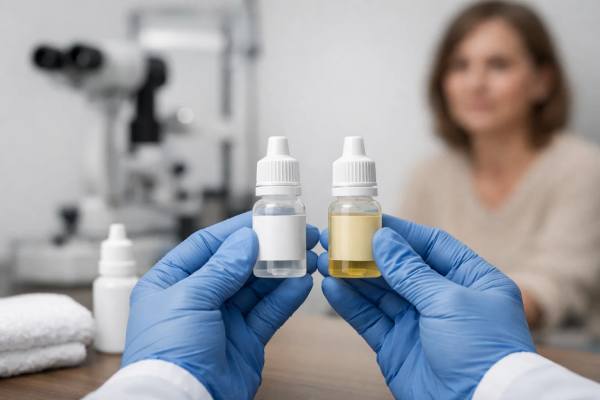
Autologous serum tears (AST) are made from the serum portion of blood—the liquid that remains after blood clots and cells are separated out. Because serum shares many components with natural tears, AST is often used as a “physiologic” drop: it can support the ocular surface in a way that mimics baseline tear biology. Many protocols dilute serum (commonly to concentrations such as 20% to 50%), aiming to balance comfort, safety, and biologic activity. Some centers also use 100% serum in select situations, depending on local protocols and clinician preference.
Platelet-rich plasma (PRP) drops are made by concentrating platelets from blood plasma. Platelets contain granules rich in growth factors and signaling molecules involved in tissue repair. In eye drop form, PRP is often used when the priority is healing a damaged surface—for example, significant corneal staining, recurrent epithelial defects, or severe surface compromise. Different preparation methods exist, and PRP may be used as “pure PRP,” “plasma rich in growth factors,” or other platelet-derived preparations depending on the lab and region.
A key practical distinction: AST tends to be more standardized across many eye centers, while PRP preparation can vary widely (how platelets are concentrated, whether leukocytes are included, activation methods, and final platelet counts). That variability can influence both outcomes and tolerability.
Finally, these drops are not a replacement for diagnosing the root cause. Severe dry eye can be aqueous-deficient, evaporative (meibomian gland dysfunction), autoimmune-related, medication-induced, post-surgical, nerve-related, or mixed. Blood-derived drops are best viewed as a biologic support layer that is paired with targeted treatment of the drivers already identified in your exam.
How these drops support healing
Severe dry eye is often a problem of surface homeostasis: the tear film becomes unstable, inflammation rises, epithelial cells suffer, and corneal nerves may become hypersensitive or dysfunctional. AST and PRP can help because they provide a biologically active environment—not just lubrication.
What ast is trying to replace
Natural tears are not saline. They contain proteins, electrolytes, lipids, mucins, and protective factors that support the corneal epithelium and regulate inflammation. AST supplies a tear-like “biologic soup” that can:
- Improve epithelial integrity by supporting cell migration and barrier repair
- Dilute inflammatory mediators on the surface when used regularly
- Support tear film stability by improving the quality of the surface layer the tear film spreads across
- Soothe neuro-sensory irritation in some patients, especially when surface injury is part of the pain cycle
Clinically, AST is often used as a steady foundation—especially when dryness is persistent throughout the day, staining is present but not rapidly worsening, and the goal is long-term stabilization.
What prp is trying to accelerate
PRP is built around platelets, which act like “first responders” in wound healing. In eye drop form, PRP is typically used when the exam shows a surface that needs active repair—more staining, erosions, fragile epithelium, or slow healing after an insult. PRP can:
- Enhance epithelial healing signals, supporting faster closure of micro-defects
- Calm inflammation indirectly by shifting the surface environment toward repair rather than chronic injury
- Support nerve recovery pathways, which may matter when discomfort is disproportionate to visible findings
That said, “more growth factors” does not automatically mean “better for everyone.” Some patients primarily need inflammation control (for example, autoimmune-related dry eye) or meibomian gland rehabilitation, and biologic drops work best when those drivers are treated in parallel.
A useful mental model
If you want a simple framework: AST is often chosen for steady physiologic support, while PRP is often chosen when healing and epithelial recovery are urgent priorities. Many clinicians see them as neighboring tools—sometimes sequential, sometimes interchangeable, sometimes combined with other therapies—rather than strict competitors.
What evidence says in severe cases
People searching “AST vs PRP for severe dry eye” usually want one clear winner. The reality is more nuanced: studies suggest both can help, differences are often modest, and outcomes depend heavily on which severe dry eye phenotype you have and how the drops are prepared and used.
What improves most reliably
Across clinical studies, the most consistent improvements with blood-derived drops tend to be:
- Symptoms (burning, dryness, foreign-body sensation, and pain scores)
- Surface staining (corneal and conjunctival staining often decreases)
- Tear film stability (tear breakup time may improve, though not always dramatically)
In severe disease, symptom relief sometimes appears earlier than objective changes. That does not mean the drops “aren’t working”—it may reflect reduced surface irritation while epithelial remodeling takes longer.
PRP versus serum: common patterns
When PRP and serum are compared directly, many trials show similar overall symptom improvements, with some suggesting PRP may have an edge in surface healing markers in subsets of patients—especially where epithelial breakdown is prominent. Other studies find PRP not clearly superior to serum for symptom indices when both are used consistently and prepared well. In practical terms, a difference that looks meaningful on paper may not feel dramatic for an individual patient, while for another person it can be life-changing.
Why results vary so much
Three issues explain the “mixed verdict”:
- Preparation variability
Serum concentration (20% vs 50% vs 100%), PRP platelet concentration, leukocyte content, and processing methods differ. Two patients “on PRP” may be using biologically different products. - Severe dry eye is not one disease
Sjögren’s-related aqueous deficiency, graft-versus-host disease, post-LASIK neuropathic pain, and evaporative dry eye from meibomian gland dysfunction can all be “severe,” but they behave differently. A therapy that excels at epithelial repair may not be enough if the main driver is active inflammation or lid disease. - What counts as success differs
Some people need fewer flare-ups and less staining; others need better vision stability, longer contact lens tolerance (when medically appropriate), or reduced neuropathic pain. Trials often measure a narrow set of outcomes.
What to take from the evidence
For many clinicians, the evidence supports a practical stance: both AST and PRP are reasonable for severe dry eye, and PRP may be favored when the corneal surface is more compromised. The best choice is often the one that fits your clinical pattern and that you can store, handle, and use reliably—because consistency is a major predictor of results.
Practical use dosing and storage
Blood-derived drops can be extremely effective in real life—but only when they are used in a way that protects sterility and matches the biology of healing. The “how” matters as much as the “which.”
Typical dosing patterns
Protocols vary, but severe dry eye regimens commonly fall into these ranges:
- 4 times daily: often used for maintenance or when combined with multiple other therapies
- 6 to 8 times daily: common when symptoms are intense or staining is significant
- Every 1 to 2 hours while awake: sometimes used short-term for severe epithelial compromise under close supervision
More frequent use may be recommended early on, then tapered to a stable maintenance schedule once staining and symptoms improve. A realistic goal is a schedule you can sustain for weeks—not just for three intense days.
Storage and handling: the non-negotiables
These drops are usually preservative-free. That is good for the ocular surface, but it makes handling critical.
Common real-world rules many clinics use:
- Keep unopened vials frozen until needed.
- Thaw one vial at a time and store it refrigerated while in use.
- Avoid touching the tip to lashes, fingers, or the eye.
- Follow your lab’s discard window for opened vials (often measured in days).
If your lifestyle makes cold-chain routines difficult—frequent travel, long commutes without refrigeration, irregular schedules—mention this early. The “best” biologic drop is the one you can use safely and consistently.
What improvement can feel like
Severe dry eye often improves in layers:
- Days to 2 weeks: less burning and gritty pain, slightly steadier vision for short tasks
- 2 to 6 weeks: fewer flare-ups, less light sensitivity, improved tolerance for screens
- 6 to 12 weeks: more durable stability on staining and a calmer baseline day-to-day
If you have significant nerve-related pain, symptom changes may lag behind surface healing—or occasionally improve faster than the staining would predict.
How these drops fit with the rest of your plan
Blood-derived drops rarely replace everything else. They often work best when paired with:
- lid and meibomian gland treatment (if evaporative disease is present)
- anti-inflammatory therapy (when inflammation is active)
- punctal occlusion strategies (when appropriate)
- environmental changes (humidity, blink routines, screen hygiene)
If you want to revisit how the “stack” fits together, jump back to How these drops support healing and use it as a checklist for what your eyes may still be missing.
Safety and realistic limitations
AST and PRP are made from your own blood, which lowers the risk of allergy and makes them appealing for sensitive eyes. But “natural” does not mean risk-free. The main safety issue is sterility and contamination control, followed by whether your overall health and medications make you a good candidate.
Contamination risk and why it matters
Because these drops are usually preservative-free, bacteria or fungi introduced during preparation or use can multiply. The risk is still generally low when prepared by a qualified facility and handled correctly, but consequences can be serious.
Red flags that should prompt urgent clinical advice include:
- rapidly increasing pain, redness, or light sensitivity
- thick discharge or eyelids stuck shut
- sudden drop in vision
- a new, focal “white spot” on the cornea
If you are prone to infections, have severe blepharitis, or struggle with drop technique, your clinician may emphasize hygiene steps or adjust your plan.
Who may need extra screening
Because these are autologous blood products, clinicians may evaluate:
- Active systemic infection or fever (often a reason to postpone collection)
- Blood-borne infection screening policies (varies by facility and region)
- Severe anemia or unstable medical conditions that make blood draws inadvisable
- Anticoagulant or antiplatelet therapy, which may influence PRP preparation or platelet function
- Autoimmune disease activity, where controlling systemic inflammation can be as important as ocular drops
None of these automatically excludes you, but they change the safety conversation and the likelihood of predictable results.
Local side effects and tolerability
Typical side effects are usually mild and may include:
- transient stinging (often worse if the surface is very inflamed)
- blurred vision immediately after instillation (more noticeable with thicker preparations)
- irritation if the drop is cold straight from the refrigerator
If drops consistently sting, it may reflect ongoing epithelial compromise, an overly concentrated preparation for your current state, or a need for better inflammation control alongside the biologic drops.
Realistic limitations
These therapies can be powerful, but they do not fix every driver of severe dry eye. If meibomian glands are severely obstructed, if there is significant exposure (incomplete blinking or eyelid closure), or if neuropathic pain dominates, blood-derived drops may be necessary but not sufficient. Success often means reducing symptom intensity and flare frequency, not achieving “never dry again.”
How to choose between serum and prp
If you are deciding between AST and PRP, the most useful question is: What is the main bottleneck preventing your surface from stabilizing? Your exam findings usually point to the answer.
Situations that often favor prp
PRP is frequently considered when the cornea looks like it needs active repair support:
- prominent corneal staining or recurrent epithelial breakdown
- slow-healing micro-defects after surgery or an ocular surface insult
- severe surface fragility where clinicians want a “repair-forward” environment
- mixed severe dry eye where the corneal epithelium is clearly failing despite standard care
In these cases, PRP may be used as an intensive phase, then transitioned to a maintenance strategy once the surface is calmer.
Situations that often favor autologous serum tears
AST is often chosen when the goal is steady tear-like support:
- marked aqueous deficiency patterns with chronic symptoms
- long-term maintenance needs where a more standardized approach is preferred
- patients who have previously responded to serum-based drops or need a predictable routine
- severe dry eye where inflammation is being treated and the surface needs ongoing biologic “baseline” support
AST can also be a practical first biologic option because many centers have established serum protocols and patient education pathways.
What to ask your clinician before you commit
Bring these questions to your visit and write the answers down:
- What is the primary driver of my severe dry eye: aqueous deficiency, evaporation, inflammation, exposure, or nerve pain?
- Which findings on my exam make you recommend PRP or serum?
- What concentration or formulation will I receive, and how often should I use it?
- How are sterility, screening, and quality control handled in your facility?
- What is the expected timeline for reassessment, and what outcome will define “working”?
A practical decision rule that often holds up
If your surface is actively breaking down, PRP is often considered sooner. If your surface is chronically unstable and needs ongoing biologic support, AST is often a strong starting point. But many severe patients do not fit neatly into one box—and the best outcomes often come from adjusting the plan after 4 to 12 weeks based on staining, comfort, and daily function.
If you are still unsure, revisit What evidence says in severe cases and use it as permission to choose the option you can reliably access and use safely—because adherence is a treatment effect in itself.
References
- TFOS DEWS III: Management and Therapy 2025 (Guideline)
- Autologous Serum Eye Drops for Dry Eye: Systematic Review 2023 (Systematic Review)
- Blood component therapy for dry eye disease: a systematic review and network meta-analysis 2024 (Systematic Review)
- Comparative Efficacy of Platelet-Rich Plasma, Autologous Serum, and Artificial Tears in Dry Eye Disease: A Systematic Review and Meta-Analysis 2025 (Systematic Review and Meta-Analysis)
Disclaimer
This article is for educational purposes only and does not provide medical advice, diagnosis, or treatment. Autologous serum tears and platelet-rich plasma eye drops require individualized prescribing, sterile preparation, and specific storage and handling instructions. If you have severe eye pain, sudden vision changes, increasing redness, discharge, or light sensitivity—especially while using preservative-free biologic drops—seek urgent in-person eye care. Always follow your clinician’s guidance and the dispensing facility’s safety protocols, particularly regarding refrigeration, freezing, and vial discard timing.
If you found this helpful, consider sharing it on Facebook, X (formerly Twitter), or any platform you prefer so others dealing with severe dry eye can have a clearer starting point.