
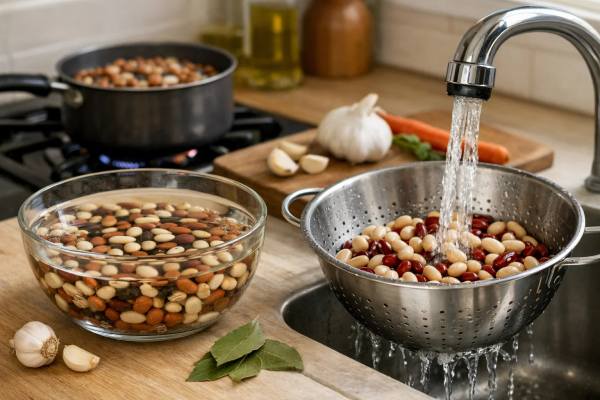
Beans are one of the most practical “gut health” foods: affordable, filling, and naturally rich in fiber, plant protein, potassium, and compounds that feed beneficial gut microbes. The same traits that make beans so valuable—especially their fermentable carbohydrates—are also why many people associate them with uncomfortable bloating, gas, or cramping. The good news is that bean-related symptoms are often less about “your body can’t handle beans” and more about preparation, portion size, and the pace at which you increase your intake.
This guide focuses on what actually makes a measurable difference: soaking approaches that reduce water-soluble sugars, cooking methods that soften fibers and improve digestibility, and simple canned-bean habits that remove the most common triggers. You will also learn how to build tolerance over time and when persistent symptoms deserve a different plan.
Core Points for Comfortable Beans
- Draining and rinsing beans removes a meaningful amount of the sugars and starches most likely to ferment quickly.
- Proper soaking and thorough cooking improve texture and can reduce the “fast-fermenting” load that drives gas.
- Starting with small portions for 2–3 weeks often works better than changing everything at once.
- If beans consistently trigger pain, urgent diarrhea, or weight loss, treat that as a signal to reassess—not a willpower problem.
- A practical default: choose canned, rinse well, start with 1/4 cup servings, and increase slowly as tolerated.
Table of Contents
- Why beans trigger gas and cramps
- Pick the right beans and portions
- Soaking strategies that reduce bloating
- Cooking methods that make beans gentler
- Canned beans and rinse rules
- When beans still cause symptoms
Why beans trigger gas and cramps
Beans cause symptoms for two main reasons: what reaches your colon and how quickly it gets fermented.
The best-known culprits are raffinose-family oligosaccharides (often shortened to “GOS”). Humans do not produce enough of the enzyme needed to break these sugars down in the small intestine, so they travel onward. When gut bacteria ferment them, they produce gas (hydrogen, methane, and carbon dioxide). Gas itself is not harmful, but rapid gas production can stretch the intestine and feel like pressure, bloating, or cramps—especially if your gut is sensitive.
Beans are also rich in resistant starch and certain fibers that your body cannot fully digest. That is part of why beans support gut microbial diversity, but it also means more material is available for fermentation. The pace matters: slower fermentation tends to be more comfortable than a sudden “dump” of fermentable carbs.
Another factor is how well the beans are cooked. Under-cooked beans can be tough, harder to break down mechanically, and more likely to irritate. Some beans—especially red kidney beans—also contain lectins that are deactivated by proper boiling and thorough cooking. With adequate heat, this is a non-issue. With inadequate cooking, it can be a very unpleasant issue.
Finally, there is the “training effect.” Your microbiome adapts to what you eat regularly. If you rarely eat beans and suddenly have a large serving, the fermentation pattern can be intense. If you introduce beans gradually, many people notice that symptoms decrease over 2–4 weeks as the gut ecosystem and intestinal handling of fiber adjusts.
The practical takeaway is reassuring: bean symptoms are often adjustable. You can reduce the most gas-forming fraction (by soaking, draining, and rinsing), improve digestibility (with thorough cooking), and improve tolerance (with pacing and portions).
Pick the right beans and portions
If your goal is “beans with benefits, without regret,” your first win is simply choosing a bean style that matches your current tolerance.
Start with beans that tend to be easier
Many people do best with:
- Lentils and split peas: smaller size, softer texture, and often easier to portion precisely.
- Canned beans: already cooked, and the canning liquid holds some of the water-soluble sugars that otherwise stay with the bean.
- Well-cooked chickpeas and black beans: when cooked until very soft, they can be gentler than firmer, under-cooked beans.
You do not need to avoid higher-fiber beans forever. Think of this as a “start here” strategy, not a permanent restriction.
Portion size is the most underused tool
For sensitive digestion, the difference between comfort and discomfort is often dose, not the bean itself. A useful progression:
- Start at 1/4 cup cooked beans once daily (or even 2–3 tablespoons if you are very reactive).
- Hold that level for 3–4 days.
- Increase by 1–2 tablespoons every few days as tolerated.
- Aim for 1/2 cup servings only after your gut has shown it can handle smaller amounts.
Also consider splitting portions. Two 1/4-cup servings at different meals often feel better than a single 1/2-cup serving, even though the total is the same.
Pairing and pacing matters
Simple habits can reduce symptoms:
- Chew thoroughly. Bigger particles ferment differently than smaller ones.
- Combine beans with a mixed meal (rice, quinoa, potatoes, eggs, fish, tofu, or vegetables) instead of eating a large bean-heavy bowl on an empty stomach.
- Stay consistent. Eating beans once every two weeks does not build tolerance as reliably as small amounts a few times per week.
If you treat beans like a skill you build—rather than a test you pass—you will usually get better results.
Soaking strategies that reduce bloating
Soaking is not just about faster cooking. It also targets what tends to ferment fastest: water-soluble sugars. The key principle is straightforward: when beans sit in water, some soluble compounds move out of the bean and into the liquid. When you discard that liquid, you discard part of what would otherwise ferment.
The “best default” soak
For most dried beans:
- Rinse and sort.
- Add 3–4 cups of water per 1 cup dried beans.
- Soak 8–12 hours at cool room temperature (or in the refrigerator if your kitchen is warm).
- Drain and rinse well before cooking in fresh water.
If you do one thing consistently, do this: always drain and rinse after soaking. Cooking in the soak water keeps much of what you were trying to remove.
Quick soak when you did not plan ahead
Quick soak can work surprisingly well for texture and time:
- Cover beans with water by several inches.
- Bring to a full boil for 2 minutes.
- Turn off heat, cover, and soak 1 hour.
- Drain, rinse, and cook in fresh water.
Quick soak is not identical to overnight soaking, but it is often “good enough” and dramatically better than skipping soaking altogether for many bean types.
Salted soak and baking soda: when to use them
A salted soak (for example, about 1 tablespoon salt per quart/liter of water) can improve texture and reduce split skins. It is not a magic anti-bloat trick, but better texture often means better digestion because the bean cooks more evenly.
Baking soda can soften skins, but it can also make beans mushy and increases sodium exposure. If you use it, keep it minimal (a small pinch) and prioritize thorough rinsing. It is more of a texture rescue than a first-line gut strategy.
Do you need to change the soak water?
If you are very sensitive, changing the soak water once halfway through (and rinsing) can reduce the soluble load further. This is optional. Many people do well with a single soak and a good rinse.
Soaking is a simple step with a disproportionate payoff. It lowers cooking time, improves texture, and is one of the few kitchen methods that consistently aligns with “less fermentation pressure later.”
Cooking methods that make beans gentler
Cooking affects bloating in two ways: it changes structure (softening cell walls and starch) and it changes safety (especially for certain beans). If your beans are frequently “gassy,” check whether they are actually cooked until soft enough.
Cook until truly tender
A bean can look cooked and still be firm in the center. For digestion, aim for “creamy” rather than “al dente.” A practical test: when you press a bean between your fingers or against a spoon, it should mash easily.
Firm beans resist breakdown in the small intestine and arrive in the colon as bigger particles, where bacteria ferment them aggressively. Tender beans are not a guarantee of zero gas, but they are consistently easier to tolerate.
Kidney beans need special respect
Red kidney beans contain higher levels of lectins that must be inactivated by adequate boiling and cooking. The safest approach is simple: soak, discard soak water, then boil and simmer until fully cooked. Avoid undercooking, and be cautious with low-temperature slow cooking methods unless you know the beans reach a proper boil early on.
Pressure cooking can help
Pressure cookers shorten cooking time and can produce very soft beans with less fuss. For many people, pressure-cooked beans are easier to digest because they reach a uniformly tender texture. If you use a pressure cooker:
- Soak first when possible.
- Cook in fresh water.
- Allow a full natural release or sufficient resting time so beans finish softening.
Acid timing and add-ins
Acidic ingredients (tomatoes, vinegar, lemon) can toughen skins if added too early. For more tender beans, add acidic ingredients after the beans are mostly soft.
Popular add-ins like bay leaf, cumin, ginger, and fennel can make beans feel “lighter” for some people, mainly by improving palatability and meal satisfaction. They are fine to use, but do not rely on them as your primary strategy.
Foam and “bean broth” choices
Skimming foam is mostly about appearance, but some people find that discarding the first foamy boil and cooking in fresh water makes the beans taste cleaner. If you tolerate bean broth well, you can keep it. If you are sensitive, you may do better when you drain and rinse cooked beans before adding them to a recipe—especially during the first weeks of building tolerance.
Well-cooked beans should feel like comfort food, not a gamble. If texture is inconsistent, symptoms usually are too.
Canned beans and rinse rules
Canned beans can be one of the most gut-friendly options because the beans are fully cooked and some soluble compounds move into the canning liquid. The trick is to treat the liquid as optional—sometimes useful for recipes, but often not ideal for sensitive digestion.
Rinsing is not only about sodium
Rinsing does reduce surface sodium and can remove a noticeable amount of starches and sugars clinging to the bean surface. For people who bloat easily, that matters. A practical rinse:
- Pour beans into a colander.
- Rinse under running water for 10–20 seconds.
- Shake well and let drain for 1–2 minutes.
If you want an extra-gentle version, rinse, let sit for a minute, and rinse again briefly. This is especially helpful if you are using beans in a cold salad or a quick meal where they are not simmered further.
Choose simple ingredient lists
For day-to-day digestion, the best canned beans are boring:
- Beans
- Water
- Salt (or “no salt added”)
Watch for additions that can drive symptoms in sensitive people:
- Garlic and onion powders (common in “seasoned” beans)
- Added sweeteners
- Thickening gums (more common in flavored bean products)
- “Chili-style” mixes that contain multiple fermentable ingredients
Warm them gently and consider a second drain
If you heat beans directly in a soup or sauce, they will release more soluble material into the dish. That is not always bad, but if you are troubleshooting bloating, consider this sequence:
- Rinse and drain.
- Warm in a small pan with water or broth for a few minutes.
- Drain again.
- Add to the final recipe.
This is not necessary for everyone, but it can be a useful short-term step while you build tolerance.
Convenience with control
Canned beans help you keep portions consistent. They also let you spread intake across the week. If you are trying to make beans a regular part of your diet, convenience is not a minor detail—it is how consistency happens.
If you do not want to soak and cook from scratch, you can still improve comfort significantly with one habit: drain and rinse every time.
When beans still cause symptoms
If you have optimized soaking, rinsing, and cooking, and beans still reliably cause discomfort, do not assume you have “failed.” Persistent symptoms often mean you need a different angle.
Check the symptom pattern
These patterns suggest fermentation sensitivity rather than “bean intolerance”:
- Bloating that builds 2–6 hours after eating
- Increased gas without severe pain
- Symptoms that improve when you reduce portion size
These patterns suggest you should rule out other issues:
- Pain that is sharp, severe, or localized
- Diarrhea that is urgent or persistent
- Blood in stool, unexplained weight loss, fever, or nighttime symptoms
- Symptoms that worsen steadily over time regardless of portion
If any red flags are present, it is worth discussing with a clinician rather than continuing dietary experiments alone.
If you suspect IBS or FODMAP sensitivity
Some people have a lower threshold for fermentable carbohydrates. In that case, the best strategy is often precision rather than avoidance:
- Use canned, well-rinsed beans more often than dried.
- Keep servings small (1/4 cup) and pair with low-trigger foods.
- Increase slowly and track what actually happens, not what you fear will happen.
A common mistake is going from “no beans” to “big bowl of beans.” The gut often responds better to repeat exposure at a lower dose.
Enzyme options and how to use them
Over-the-counter alpha-galactosidase enzymes are designed to help break down GOS before they reach the colon. Evidence is mixed, but many people find them useful as a situational tool—especially during the “reintroduction” phase. Practical use:
- Take with the first bites of the meal.
- Use it when the meal is clearly bean-heavy, not for tiny amounts.
- If you notice no benefit after several attempts, it may not be the right tool for your symptom pattern.
A two-week tolerance plan that is realistic
If you want a structured approach:
- Week 1: 1/4 cup canned, rinsed beans once daily, preferably at lunch.
- Week 2: Increase by 1–2 tablespoons every 3–4 days if symptoms stay mild.
- Keep everything else stable so you can interpret results.
- If symptoms spike, step back to the previous portion for 4–5 days before trying again.
If you can comfortably reach 1/2 cup servings a few times per week, you have usually done enough to enjoy beans regularly without overthinking.
Beans should support your gut, not dominate your decisions. If your symptoms remain intense despite careful preparation and dosing, that is information—and it deserves a broader evaluation.
References
- Sustainable Strategies for Increasing Legume Consumption: Culinary and Educational Approaches – PMC 2023 (Review)
- Chickpeas’ and Lentils’ Soaking and Cooking Wastewaters Repurposed for Growing Lactic Acid Bacteria – PMC 2023 (Experimental Study)
- A randomized double-blind placebo-controlled crossover pilot study: Acute effects of the enzyme α-galactosidase on gastrointestinal symptoms in irritable bowel syndrome patients – PubMed 2021 (RCT)
- ACG Clinical Guideline: Management of Irritable Bowel Syndrome – PubMed 2021 (Guideline)
- Effect of thermal and non-thermal processing on fermentable oligo-di-monosaccharides and polyols (FODMAPs) content in millet, sorghum, soybean and sesame varieties – PMC 2025 (Food Composition Study)
Disclaimer
This article is for general educational purposes and does not replace personalized medical advice, diagnosis, or treatment. Digestive symptoms can have many causes, and what is “normal” for one person may be a sign to investigate further for another. If you have persistent or severe abdominal pain, ongoing diarrhea, blood in stool, unexplained weight loss, fever, nighttime symptoms, or symptoms that interfere with daily life, seek medical care promptly. If you have kidney disease, heart failure, or other conditions requiring sodium or potassium restrictions, discuss dietary changes and bean intake with your clinician or dietitian.
If you found this guide useful, consider sharing it on Facebook, X (formerly Twitter), or any platform you prefer so others can benefit too.





