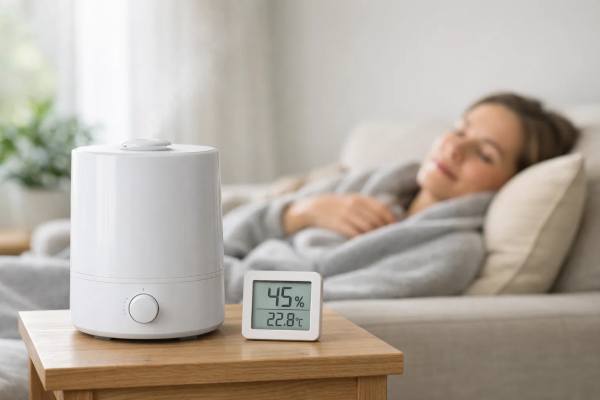
When you have a cold, the air in your home can make symptoms feel either manageable or relentless. Dry indoor air can thicken mucus, irritate an already inflamed throat, and leave the nose feeling raw—often worsening nighttime cough and fragmented sleep. Moderate humidity, on the other hand, can support the body’s natural airway defenses and make breathing feel less “scratchy,” especially in heated winter rooms where moisture levels drop quickly. The challenge is that humidity has a narrow “helpful zone.” Too low may aggravate dryness and congestion, while too high can encourage mold, dust mites, and musty irritants that can prolong coughing and trigger wheezing. This guide explains the indoor humidity range that most often helps cold symptoms, how to measure and adjust it accurately, and the practical warning signs that tell you when a humidifier is doing more harm than good.
Key Insights
- Keeping indoor humidity in a moderate range can reduce throat and nasal dryness and make mucus easier to clear during a cold.
- The most practical target is often 40 to 50 percent relative humidity, adjusted downward in very cold weather to prevent window and wall condensation.
- Humidifiers can backfire when humidity rises too high or the device is not cleaned well, increasing exposure to mold, bacteria, or mineral dust.
- Use a hygrometer and make small adjustments (5 percent at a time) rather than guessing by “how the room feels.”
- For cold relief, running a humidifier overnight in the bedroom is often enough when settings and cleaning are consistent.
Table of Contents
- Why humidity changes cold symptoms
- Best humidity range for airway comfort
- Measure humidity like a clinician
- Humidifier types and smart selection
- Use a humidifier without mistakes
- When humidifiers backfire
- If you cannot humidify safely
Why humidity changes cold symptoms
A cold inflames the lining of your nose, throat, and upper airways. That lining is not just “skin”—it is a working surface that traps viruses and debris in mucus and then moves that mucus outward with tiny hairs called cilia. When the air is very dry, the moisture layer on that surface can shrink. Mucus becomes stickier, and clearing it can feel harder and more irritating. This is one reason dry rooms can make you feel congested and “tight” even when you are not producing much mucus.
What dry air tends to do during a cold
Dry indoor air can intensify symptoms in a few predictable ways:
- Nasal irritation and swelling: The nose may react to dryness with inflammation, which can create the paradox of “dry but blocked.”
- Thicker secretions: When mucus loses water, it can become harder to move, leading to more throat clearing and cough.
- Sore throat and hoarseness: Dryness increases friction when you swallow, talk, or breathe through the mouth at night.
- Sleep disruption: Mouth breathing and a dry throat often trigger wake-ups, especially in the early morning when indoor humidity is lowest.
What moderate humidity can help
Adding moisture to the air does not kill a cold virus or shorten the illness on its own. What it can do is change how your airways feel and function:
- Gentler airflow: Inhaling moderately humid air tends to sting less, which can reduce the urge to cough from throat irritation.
- Easier mucus clearance: When mucus holds onto more water, it often moves more easily, making nose blowing and coughing more productive and less painful.
- More comfortable breathing at night: Many people notice fewer “dry wake-ups” when the bedroom humidity is kept in a moderate band.
Humidity is also linked to how respiratory droplets behave in the air and how some microbes survive in indoor environments. In everyday terms, that means the indoor moisture level is part of the larger “air quality” picture during cold season. Still, the most immediate benefit most people feel is symptom comfort: less dryness, less throat scratch, and a more tolerable cough.
Best humidity range for airway comfort
For most homes, the best indoor humidity range for cold comfort is moderate, not high. A practical target is 40 to 50 percent relative humidity in the rooms where you sleep and spend the most time. This range is often moist enough to reduce throat and nasal dryness, while still low enough to reduce the chance of mold growth and dust mite blooms in many environments.
Why 40 to 50 percent works well for many people
This middle range is often a “sweet spot” because it balances several competing issues:
- Comfort: Many people feel less nasal burning and fewer dry, cracked lips and hands when humidity is not extremely low.
- Airway function: Moderate moisture supports a healthier-feeling airway surface, which can make mucus easier to move during a cold.
- Home safety: Staying out of the high-humidity zone reduces condensation on windows and cold exterior walls, which is where mold often begins.
When the best range shifts lower
Relative humidity depends on temperature. When it is very cold outside, indoor surfaces (windows, exterior corners, poorly insulated walls) can be cold enough that moisture condenses even at humidity levels that would be harmless in milder weather. Condensation is not just “a little foggy window.” It is a signal that moisture is landing on surfaces long enough to feed mold.
A simple rule of thumb:
- If you see regular window condensation, aim closer to 30 to 40 percent until surfaces stay dry.
- If you never see condensation and the home is very dry, moving toward 45 to 50 percent can be reasonable.
When it should not go higher
Once indoor humidity consistently climbs above 50 to 60 percent, the “cold relief” benefits often flatten, while risks rise:
- Mold and mildew become more likely in bathrooms, closets, basements, and behind furniture on exterior walls.
- Dust mites thrive in persistently humid environments, which can worsen allergies and asthma symptoms that mimic or prolong a “cold cough.”
- Humidifiers themselves can become microbial reservoirs if maintenance is inconsistent.
If you are trying to help a cold, think of humidity like a medication dose: more is not automatically better. The goal is a steady, moderate range that helps your airways without creating a damp indoor ecosystem.
Measure humidity like a clinician
If you adjust humidity based on feel alone, you will almost always overshoot or undershoot. The most effective upgrade is a simple digital hygrometer (humidity gauge). It turns “I think it’s dry” into a number you can manage, and it helps you avoid the most common humidifier mistake: unintentionally pushing a bedroom into the mold-friendly zone.
Where and how to measure
Measure in the places that matter most for cold symptoms:
- Bedroom (nighttime): Put the hygrometer near the bed but not directly in the humidifier’s mist path.
- Living area (daytime): Comfort and cough control often depend on where you spend the most hours.
- Problem zones: Bathrooms, basements, and closets can be humid even when the rest of the home is dry.
For a reliable reading:
- Keep it away from vents, radiators, direct sun, and direct humidifier output.
- Give it 15–30 minutes to stabilize after moving rooms.
Why one home has many humidity levels
Indoor humidity is rarely uniform. It changes with:
- Heating: Warmed air lowers relative humidity unless you add moisture.
- Ventilation: Fresh outdoor air can dry a home in winter or add moisture in humid climates.
- Activities: Showers, cooking, drying laundry indoors, and large groups of people can raise humidity quickly.
- Building features: Single-pane windows, poor insulation, and cold exterior corners are condensation magnets.
How to adjust safely in small steps
Aim for steady control rather than dramatic swings:
- Pick a target range (often 40 to 50 percent, or 30 to 40 percent if condensation is an issue).
- Adjust the humidifier or whole-house humidistat by about 5 percent at a time.
- Recheck after a few hours, then again the next morning (overnight is when condensation often appears).
- If you see moisture on windows or musty odors, reduce the setting and focus on drying the space.
Recognize “too dry” and “too humid” quickly
Signs humidity is likely too low include frequent static shocks, dry nosebleeds, cracked lips, and waking with a sandpaper throat. Signs it is too high include window sweating, damp-smelling closets, and visible mildew spots. Your hygrometer helps you confirm what your senses suspect—and helps you correct the problem before symptoms or mold take hold.
Humidifier types and smart selection
Not all humidifiers behave the same, and the “best” one for colds is often the one you will clean and control consistently. Choosing the right type can also reduce common side effects like white mineral dust or overly wet rooms.
Cool mist ultrasonic and impeller models
These are popular because they are quiet and effective. They can raise humidity quickly, which is helpful when the bedroom is very dry. The downside is that they may disperse fine mineral particles (“white dust”) if you use hard tap water. That dust can irritate sensitive airways and coat surfaces. If you choose this type, using low-mineral water and cleaning on schedule matters more.
Evaporative (wick or filter) humidifiers
Evaporative models blow air through a wet wick or filter. They tend to be more self-limiting because evaporation slows as humidity rises. Many people find them easier to keep in the moderate zone without accidentally creating a swampy room. They can be louder, and wicks need replacement. For cold season, this type is often a practical “set it and forget it” option when you want steady humidity rather than fast spikes.
Warm mist and steam vaporizers
Warm mist units heat water to produce steam, which can feel soothing for some people at bedtime. They may disperse fewer minerals than some cool mist devices. The main caution is burn risk, especially around children and pets, and the need to place the unit where it cannot be tipped.
Whole-house humidifiers
These attach to HVAC systems and humidify across rooms. They can be helpful in very dry climates, but they can also create hidden moisture problems if set too high, especially in older homes with less insulation. They work best when you have a reliable humidistat and you watch for condensation on windows during cold snaps.
Choosing based on your situation
Consider these practical match-ups:
- If you want less overshooting: evaporative models are often easier to control.
- If you have asthma, allergies, or mineral dust sensitivity: prioritize low-mineral water and diligent cleaning, and avoid visible “white dust.”
- If you have small children: avoid placing warm mist models within reach or near bedding.
- If you see condensation often: a device with a built-in humidistat can help you avoid pushing humidity too high.
A humidifier is not a one-time purchase. It is a small maintenance routine. The best device is the one that fits your space, water quality, and tolerance for cleaning.
Use a humidifier without mistakes
Humidifiers help most when you treat them like a controlled therapy: correct placement, a measurable target, and consistent cleaning. If you do those three things, you reduce the chance of backfire while keeping the symptom benefits.
Set a goal and limit the “dose”
For cold comfort, you usually do not need to humidify the entire home. A focused approach is often safer and more effective:
- Target 40 to 50 percent relative humidity in the bedroom at night.
- In very cold weather or in homes prone to condensation, target 30 to 40 percent.
- If humidity rises above your target, reduce output rather than letting the room “coast” at high levels.
Many people feel the benefit most at night because mouth breathing and dry heat are strongest then. Running the humidifier overnight and turning it down or off during the day is often enough.
Placement that avoids wet zones
Place the unit so moisture disperses, not soaks:
- Keep it several feet from the bed, walls, curtains, and upholstered furniture.
- Avoid pointing mist directly at a wall or window.
- Elevate it on a stable surface so mist can mix with room air, but not where it can be knocked over.
If you notice a damp patch on a wall or a wet window nearby, that location is too close or the output is too high.
Water choice and daily habits
The simplest habits reduce both irritation and germs:
- Empty and refill water regularly rather than “topping off.”
- Let components dry when not in use, if the device design allows.
- If mineral dust has been an issue, consider using distilled or otherwise low-mineral water.
Cleaning rhythm that prevents problems
A workable routine is better than an ideal routine you never follow. Many households do well with:
- A quick daily reset (empty, rinse, dry the tank exterior, refill) during active use.
- A deeper clean on a predictable schedule (for example, every few days), following the manufacturer’s instructions and rinsing thoroughly so cleaning agents are not aerosolized.
Cold-specific comfort tips
To make humidification more noticeable:
- Pair it with warm fluids and gentle saline nasal care, which helps keep mucus hydrated from the inside and outside.
- Keep bedroom temperature moderate. Overheating a room can drop relative humidity and increase mouth breathing.
Used correctly, a humidifier is a supportive tool—like a warm shower for congestion. Used carelessly, it becomes an indoor air quality problem. Control and consistency make the difference.
When humidifiers backfire
Humidifiers backfire in two main ways: too much moisture in the environment and too much contamination in the device. Both can prolong coughing, aggravate allergies, and create symptoms that are easy to mistake for “a cold that will not go away.”
Backfire pattern one: over-humidification
When humidity climbs and stays high, your home starts acting like a greenhouse. Watch for these early clues:
- Condensation on windows most mornings
- Musty smells in closets, bathrooms, or basements
- Damp patches on walls, especially behind furniture on exterior walls
- New or worsening allergy symptoms (sneezing, itchy eyes) alongside the cold
High humidity can also increase dust mite growth. If your “cold cough” is accompanied by wheeze, chest tightness, or a flare of eczema or nasal allergies, consider whether the room has become too humid rather than assuming the virus is worsening.
Backfire pattern two: dirty humidifier exposure
Humidifiers can harbor microbes and then spread them into the air in the mist. Risk rises when water sits for long periods, the tank is topped off instead of emptied, or biofilm builds up inside the unit. Warning signs include:
- A sour or “pond-like” odor from the device
- Visible slime, film, or scale inside the tank
- Worsening cough or chest irritation shortly after turning the humidifier on
- Symptoms that improve when you spend time away from the device or room
Some people are also sensitive to mineral particles from hard water, especially with ultrasonic units. If you notice a fine white dust on furniture or around vents, your lungs may be getting a share of it too.
When to stop using the humidifier immediately
Pause humidifier use and reassess if:
- You see mold spots, persistent condensation, or damp walls.
- Anyone in the home develops new wheezing, unusual shortness of breath, or chest tightness that is not typical for them.
- A child’s cough becomes markedly worse overnight after humidifier use.
- You suspect the unit cannot be cleaned thoroughly or has internal parts you cannot access.
If respiratory symptoms become severe, rapidly worsen, or include fever with shortness of breath, chest pain, confusion, or bluish lips or face, seek urgent medical care rather than trying to “fix the air.”
The simplest correction plan
If you think humidification has backfired:
- Turn the device off and empty it.
- Dry the room (ventilation, exhaust fans, and dehumidification if needed).
- Clean or replace the humidifier components as instructed by the manufacturer.
- Restart only when you can keep the room in a measured, moderate range.
Humidifiers are helpful tools, but only when they are clean and controlled. When they are not, they can become part of the problem you are trying to solve.
If you cannot humidify safely
Sometimes the safest choice is to avoid humidifiers—at least temporarily—because the home is prone to dampness, someone in the household is highly mold-sensitive, or cleaning cannot be done reliably. The good news is that you can still support airway comfort during a cold without raising whole-room humidity.
Target the airway instead of the room
These options add moisture where you need it most while keeping the home drier:
- Warm showers or steam in the bathroom: Short sessions can loosen mucus and soothe throat irritation. Ventilate afterward so the rest of the home does not stay damp.
- Saline nasal sprays or rinses: These can reduce nasal dryness and help clear thick mucus. Use safe water practices for any rinse method and keep devices clean.
- Hydration and warm fluids: Fluids do not “cure” a cold, but they help keep secretions less sticky and easier to clear.
- Throat comfort measures: Honey (for older children and adults), lozenges, and warm salt-water gargles can reduce the “raw throat” feeling that drives coughing.
Reduce dryness drivers
If your home is extremely dry, small environmental changes can help even without a humidifier:
- Avoid overheating bedrooms; a slightly cooler room often reduces mouth breathing and throat dryness.
- Use kitchen and bathroom exhaust fans only as needed; constant high ventilation can dry the house further in winter.
- Seal obvious drafts if cold air is drying a specific room.
Know when symptoms are not “just a cold”
Humidity adjustments are for comfort. They are not a substitute for evaluation when illness changes character. Seek medical advice promptly if you notice:
- Severe sore throat with persistent high fever
- Shortness of breath, wheeze, or chest pain
- Dehydration (especially in children)
- Symptoms that worsen after a week, or improve then sharply return
- Ear pain, severe sinus pain, or one-sided facial swelling
A balanced bottom line
For many people, moderate indoor humidity makes colds easier to tolerate—especially at night. But if humidity control is difficult or triggers dampness, you will often get more benefit from targeted airway moisture (showers, saline, hydration) than from trying to humidify a whole space. The goal is comfort with safety, not chasing a perfect number at the expense of indoor air quality.
References
- Care for Your Air: A Guide to Indoor Air Quality | US EPA 2025 (Guidance)
- Use and Care of Home Humidifiers | US EPA 2025 (Guidance)
- Preventing Waterborne Germs at Home | Drinking Water | CDC 2024 (Guidance)
- Relative Humidity and Its Impact on the Immune System and Infections – PMC 2023 (Review)
- INDOOR HUMIDITY LEVELS AND ASSOCIATIONS WITH REPORTED SYMPTOMS IN OFFICE BUILDINGS 2022 (Research Report)
Disclaimer
This article is for general educational purposes and does not provide medical advice, diagnosis, or treatment. Indoor humidity changes can ease discomfort from colds, but they do not cure viral infections and they may worsen symptoms in some people, especially when humidity becomes high or humidifiers are poorly maintained. If you or your child has trouble breathing, bluish lips or face, chest pain, confusion, severe dehydration, or rapidly worsening symptoms, seek urgent medical care. People with asthma, COPD, immune conditions, significant allergies, or a history of mold sensitivity should consider individualized guidance from a qualified clinician for symptom management and humidifier use.
If you found this guide helpful, please consider sharing it on Facebook, X (formerly Twitter), or any platform you prefer so others can manage cold-season comfort more safely.