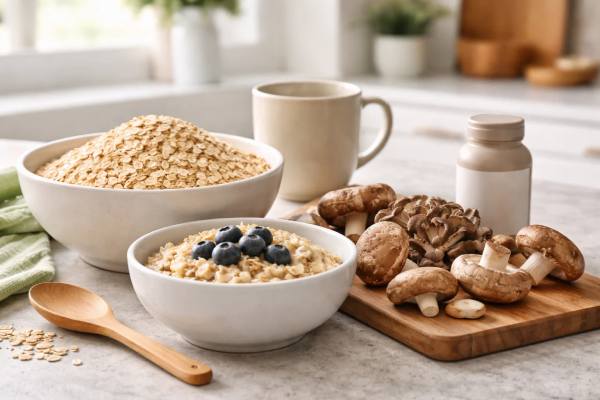
Beta-glucans sit in a rare sweet spot: they are both “food”—a type of fiber—and a biologically active pattern your immune system can recognize. That dual identity explains why some beta-glucans show up in heart-health cereals, while others are marketed for immune support during cold season. The challenge is that “beta-glucan” is not one ingredient. Structure, source, and processing change how it behaves in the gut, how it dissolves, and whether immune receptors are likely to interact with it.
This guide will help you separate reliable expectations from hype. You will learn how oat and barley beta-glucans differ from yeast and mushroom beta-glucans, what accuracy limits exist in the research, and how to use food and supplements in a way that is practical, safe, and consistent with what we know about respiratory infections and recovery.
Core Points
- Not all beta-glucans act the same; cereal beta-glucans mainly support gut and metabolic health, while many immune-focused studies use yeast or mushroom beta-glucans.
- Evidence suggests modest benefits for some people (fewer or milder upper respiratory symptoms), but results vary by product quality, dose, and baseline stress, sleep, and exposure risk.
- Beta-glucans support—not replace—vaccines, medical care, and proven prevention steps; they are not a treatment for severe infection.
- If you try a supplement, use it consistently for several weeks, choose products that specify source and standardization, and stop if you develop unusual symptoms or worsening autoimmune issues.
Table of Contents
- Beta-glucans and why they differ
- How beta-glucans support immune defenses
- Oats and barley: food-first beta-glucans
- Mushrooms and yeast: evidence for colds
- Choosing supplements and dosing wisely
- Safety, side effects, and red flags
Beta-glucans and why they differ
If you remember one thing, make it this: beta-glucans are a family of glucose chains, not a single substance. They share a name because they are built from glucose units linked in “beta” configurations, but the linkage pattern (and how the chain branches) changes what the molecule does in the body.
Why the source matters more than the buzzword
Beta-glucans come from several places, and the source often predicts the main benefit:
- Oats and barley (cereals): These beta-glucans are largely known for viscosity—they form a gel-like texture in the gut. That gel can slow digestion and help lower LDL cholesterol when consumed consistently. Immune effects, when present, are typically indirect (through the gut barrier and microbiome).
- Yeast (such as baker’s yeast): These beta-glucans tend to be structured in a way that immune receptors recognize more directly. Many studies focused on “immune support” use yeast beta-glucans.
- Mushrooms (fungi): Mushroom beta-glucans often come packaged with other polysaccharides and compounds, which can be a plus (broader biological activity) or a limitation (harder to standardize).
Linkages: the “shape” your body responds to
You may see products mention patterns such as 1,3/1,6 or 1,3/1,4. Think of these as the “architecture” of the beta-glucan:
- Cereal beta-glucans commonly have mixed 1,3 and 1,4 linkages that influence thickness and viscosity.
- Many yeast and mushroom beta-glucans have a 1,3 backbone with 1,6 branches, a pattern frequently discussed in immune research.
This matters because immune cells have receptors that behave like locks looking for a certain key shape. When the shape fits, it can “prime” parts of innate immunity.
Processing changes function
Even within the same source, processing can shift how beta-glucans behave:
- Molecular weight and solubility influence whether a beta-glucan forms a gel, ferments easily, or interacts with immune cells.
- Extraction method (hot water, enzymatic, alcohol) can change what ends up in the final powder—sometimes you get a cleaner beta-glucan, sometimes you get a blend.
A practical takeaway: two products can both say “beta-glucan,” yet behave like completely different ingredients. Your goal is to match the type to your goal: metabolic support (often cereals) versus immune-focused support (often yeast or mushrooms).
How beta-glucans support immune defenses
The immune system is not a single dial you turn “up.” A better goal is immune readiness: balanced defenses that respond quickly to threats without overreacting. Beta-glucans are studied because they can influence innate immune pathways that sit at the front line of respiratory infections.
Two main routes: gut training and receptor signaling
Most beta-glucans work through one (or both) of these routes:
- Gut-mediated effects (especially cereal beta-glucans):
Beta-glucans are not fully broken down in the small intestine. They reach the colon, where gut microbes can ferment them. Fermentation products (including short-chain fatty acids) help maintain the gut barrier and can influence inflammatory tone throughout the body. A steadier barrier and healthier microbiome are not “cold-proof,” but they may reduce the chance that a stressful week and poor sleep turns into prolonged symptoms. - Direct immune recognition (more often yeast and some mushroom beta-glucans):
Certain beta-glucans can bind to receptors on immune cells involved in early defense—cells such as macrophages, neutrophils, and dendritic cells. This can shift signaling patterns that influence how quickly the body recognizes and responds to pathogens.
What “trained immunity” means in real life
A modern concept you may see is trained immunity. It describes how innate immune cells can become “better prepared” after certain exposures. Beta-glucans are one of the natural compounds studied in this space. In everyday terms, trained immunity is less like “boosting” immunity and more like improving the start-up speed of early defense.
What it does not mean:
- It does not guarantee you will not get sick.
- It does not replace vaccination.
- It does not prevent exposure in crowded indoor settings.
What it might mean for some people:
- Milder symptoms, shorter duration, or fewer missed-work days during peak season—especially when combined with basics like sleep, hydration, and staying home when febrile.
Why results vary so much
When studies disagree, it often comes down to differences in:
- Product identity: “Beta-glucan” on a label may not match the beta-glucan tested in research.
- Dose and duration: Many interventions run for weeks to months, not days.
- Baseline stress and sleep: People under high stress or heavy training loads often show different immune patterns than well-rested individuals.
- Outcome choice: Some studies look at infection incidence, others at severity or days of symptoms. A supplement could plausibly affect severity without changing incidence.
This is why the best way to think about beta-glucans is as a supportive layer—most meaningful for people who are repeatedly exposed, chronically sleep-deprived, under stress, or prone to long symptom courses.
Oats and barley: food-first beta-glucans
Oats and barley are the most practical way to get beta-glucans consistently, because they fit into breakfast, soups, and baking without feeling like a “protocol.” Their strongest evidence base is metabolic, but there are still immune-relevant reasons to use them—especially if your goal is better airway comfort during colds through hydration, gut stability, and inflammation control.
What cereal beta-glucans do best
Cereal beta-glucans are famous for viscosity—that thick, soothing texture you notice in oatmeal. In the gut, viscosity can:
- Slow absorption and smooth post-meal blood sugar swings
- Support healthier lipid profiles (especially LDL cholesterol) with consistent intake
- Promote satiety, which indirectly helps immune readiness by supporting stable nutrition
While those outcomes are not “immune support” in the marketing sense, they matter because immune function is energy-intensive. When diet is chaotic, the immune system tends to be, too.
How to build a realistic “beta-glucan base” with food
If you want to make oats and barley part of an immune-supportive routine, think in patterns, not perfection:
- Most days: A bowl of oatmeal, overnight oats, or oat bran mixed into yogurt.
- Several times per week: Barley in soups, stews, or grain bowls.
- Add-ons that matter: Protein (eggs, Greek yogurt, tofu), fruit, and a fat source help steady appetite and reduce the “snack crash” that undermines recovery when you are sick.
Many heart-health recommendations target roughly 3 grams per day of oat or barley beta-glucan for cholesterol support. You do not need to hit an exact number to benefit—especially if your primary goal is consistency and gut support—but it gives you a useful benchmark when reading labels for oat bran or beta-glucan–fortified foods.
What cereal beta-glucans probably will not do
It is important to set limits so you do not misread normal winter illness as “failure”:
- Cereal beta-glucans are unlikely to act like a rapid-onset immune stimulant.
- They are not a treatment for fever, severe sore throat, shortness of breath, or pneumonia.
- If you are already eating a high-fiber diet, adding more beta-glucan may help, but the change may feel subtle.
When food-first can backfire
During a cold, more fiber is not always better:
- If you are nauseated or not eating much, a huge bowl of oats can worsen bloating.
- If you have irritable bowel symptoms, sudden fiber increases can cause cramps and gas.
A gentler approach during illness is smaller portions more often—like oat porridge, barley broth, or a smoothie with a modest amount of oats. The goal is steady nourishment without aggravating your stomach.
Mushrooms and yeast: evidence for colds
When people search “beta-glucan for immunity,” they are usually looking for yeast- or mushroom-derived beta-glucans, not the cereal kind. That focus exists for a reason: clinical research on respiratory infections more often tests fungal or yeast beta-glucans, sometimes tracking cold incidence, symptom severity, and the number of “sick days.”
What the better studies suggest
Across controlled trials and reviews, a common theme appears: benefits are often modest and show up more in severity than in complete prevention. In practical terms, that can look like:
- A lower chance that a cold becomes an exhausting 10-day ordeal
- Fewer days with peak symptoms (throat pain, congestion, fatigue)
- Better “bounce back” after intense physical stress or disrupted sleep
This pattern makes biological sense. Beta-glucans may help the immune system respond efficiently once exposed, but they cannot eliminate exposure itself, and they do not create the same targeted immunity that vaccines do.
Why mushroom products are harder to compare
Mushrooms contain beta-glucans, but mushroom supplements vary dramatically in what they deliver:
- Whole mushroom powder includes fiber and a broad mix of compounds, but often has lower concentrated beta-glucan per gram.
- Extracts can concentrate certain polysaccharides, yet quality depends on extraction and testing.
- Label confusion: Some products list “polysaccharides” rather than verified beta-glucans. “Polysaccharides” is not the same as “beta-glucans,” and it can include starch.
If you are shopping, consider mushrooms as a category where standardization matters more than the species name on the front label. A well-tested product from a less-hyped mushroom can be more meaningful than a trendy mushroom with vague labeling.
Yeast beta-glucans: clearer standardization
Yeast beta-glucan supplements more often specify a linkage pattern (commonly described as 1,3/1,6) and a daily dose. That does not guarantee effectiveness, but it improves the odds that the product resembles what was studied.
A practical framing:
- Best-fit users: people with frequent winter respiratory symptoms, high exposure (schools, healthcare, travel), high stress, or heavy training loads.
- Less likely to notice: people with minimal exposure who rarely get sick, or those who start supplements only after symptoms peak.
A reality check: symptoms still need the basics
Even if beta-glucans help, they do not replace the fundamentals that most strongly shape cold and flu outcomes:
- Adequate sleep and reduced alcohol during exposure-heavy weeks
- Hydration and warm fluids to support mucus clearance
- Staying home when febrile, and masking in crowded indoor spaces if you are vulnerable or caring for someone who is
Beta-glucans can be a supportive layer, but the “stack” that matters most is still behavior, environment, and timely medical evaluation when symptoms are concerning.
Choosing supplements and dosing wisely
If you decide to use a beta-glucan supplement, the goal is not to chase the highest number on the bottle. The goal is to choose a product that is identifiable, consistent, and used long enough to match how the evidence was collected.
Pick the right “lane” before you pick a brand
Start by matching your goal to the source:
- Daily health foundation: oats and barley in foods; optional cereal beta-glucan products if you struggle to meet fiber needs.
- Immune-focused trial: yeast beta-glucan or standardized mushroom beta-glucan products.
Many people do best with a two-tier plan: food-first cereal beta-glucans most days, and a yeast or mushroom supplement during high-risk months.
What dose ranges look like in research
Across trials of fungal beta-glucans, doses vary widely—from very small amounts to around 1,000 mg per day, depending on the product and study design. In real-world supplement practice, you will commonly see immune-focused yeast beta-glucan doses in the hundreds of milligrams daily.
A sensible way to apply this without overcomplicating it:
- Start low for 3 to 7 days to test tolerance (especially if you have a sensitive gut).
- Move to a steady daily dose that matches the label instructions rather than stacking multiple beta-glucan products.
- Commit to a time window that reflects how studies run—often several weeks. Consider a 6- to 12-week trial during peak season rather than a 3-day sprint.
Quality signals that actually matter
Because “beta-glucan” can be vague, look for at least two of these:
- The source is clear (yeast, specific mushroom, oats, barley).
- The product lists beta-glucan content, not only “polysaccharides.”
- The manufacturer provides batch testing or third-party verification for identity and purity.
Also consider the capsule count and serving size. A product that requires eight capsules to reach its labeled dose may be harder to stick with, and consistency is one of the biggest predictors of whether you will notice any effect.
When to take it and what to pair it with
Timing is less important than consistency, but these habits help:
- Take it with food if it causes mild nausea.
- If you take medications, separate supplements and medications by about 2 hours when possible to reduce absorption surprises.
- Pair your supplement trial with one measurable habit that improves outcomes: for example, a consistent bedtime or a daily warm fluid routine. If your sleep and hydration are chaotic, it becomes hard to tell what is working.
Finally, do not treat supplements as a reason to ignore worsening symptoms. If you have escalating fever, chest pain, significant shortness of breath, dehydration, or severe sore throat, the correct “next step” is medical evaluation, not a higher dose.
Safety, side effects, and red flags
Beta-glucans are generally well tolerated for many people, especially when consumed as food. Supplements, however, concentrate an ingredient and can behave differently—particularly for people with complex medical conditions.
Common side effects and how to reduce them
Most side effects are gastrointestinal and often improve with dose adjustment:
- Bloating or gas (more common with abrupt increases)
- Loose stools or cramping in sensitive individuals
- Mild nausea if taken on an empty stomach
Practical fixes:
- Start with a lower dose and increase gradually.
- Take with food.
- Avoid stacking multiple fiber supplements during the same week you start beta-glucans.
Who should be cautious or avoid immune-focused supplements
Discuss beta-glucan supplements with a clinician before use if you:
- Take immunosuppressive medications (including after organ transplant)
- Have an autoimmune condition with frequent flares, or you are currently flaring
- Are undergoing cancer treatment, unless your oncology team approves it
- Are pregnant or breastfeeding and considering high-dose supplements (food sources are usually the safer baseline)
This is not because beta-glucans are known to cause severe harm in these groups, but because immune modulation is complex, and cautious personalization is appropriate.
When symptoms are not “just a cold”
Do not delay care if you have any of the following:
- Shortness of breath at rest, blue lips, or difficulty speaking full sentences
- Chest pain, confusion, fainting, or signs of severe dehydration
- Fever that is persistent, very high, or returning after improvement
- Severe sore throat with inability to swallow fluids, drooling, or neck swelling
- Symptoms that worsen significantly after day 3 to 5 instead of gradually improving
Beta-glucans are not a substitute for diagnostic testing or targeted treatment when needed. For example, bacterial throat infections, pneumonia, asthma exacerbations, and complications in high-risk adults require medical assessment.
A safe, practical way to think about beta-glucans
A balanced approach is to treat beta-glucans like you would treat other supportive strategies:
- Food-first for most people: oats and barley as consistent dietary fiber.
- Supplement trial for a defined window if you have a clear reason (frequent colds, high exposure, prolonged symptom courses).
- Stop and reassess if you experience unusual reactions, worsening autoimmune symptoms, or if you feel tempted to use supplements in place of medical care.
Used this way, beta-glucans can fit into a broader respiratory-health plan without becoming a distraction from the steps that matter most.
References
- Effects of yeast β-glucans for the prevention and treatment of upper respiratory tract infection in healthy subjects: a systematic review and meta-analysis 2021 (Systematic Review and Meta-Analysis)
- Effects of fungal beta-glucans on health – a systematic review of randomized controlled trials 2021 (Systematic Review)
- Immunomodulatory Effect and Biological Significance of β-Glucans 2023 (Review)
- Yeast Beta-Glucan Enhances Antibody Response Following Influenza Vaccination – A Double-Blind, Randomized, Placebo-Controlled Pilot Trial 2025 (RCT)
Disclaimer
This article is for general educational purposes and is not a substitute for personalized medical advice, diagnosis, or treatment. Immune-support supplements can interact with medical conditions and medications, and “natural” does not always mean risk-free. If you are immunocompromised, pregnant, breastfeeding, managing an autoimmune condition, or taking prescription medications—especially immunosuppressants—speak with a qualified clinician before starting beta-glucan supplements. Seek urgent medical care for severe or worsening symptoms, breathing difficulty, chest pain, dehydration, confusion, or other concerning signs.
If you found this guide useful, please consider sharing it on Facebook, X (formerly Twitter), or any platform you prefer so others can use beta-glucans more safely and effectively.