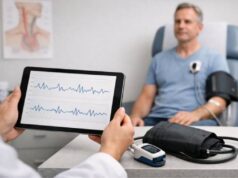
Bifascicular block is an electrocardiogram (ECG) finding that tells you the heart’s electrical “wiring” is conducting more slowly in two of the three main pathways that deliver impulses to the ventricles. For many people, it is discovered incidentally during an ECG done for unrelated reasons. For others, it appears in the middle of a bigger story—chest pain, heart failure, fainting, or recovery after a heart procedure—where the stakes feel higher.
This article explains what bifascicular block means in plain language, what commonly causes it, who is at greater risk, and what symptoms should prompt urgent evaluation. You’ll also learn how clinicians decide whether observation is enough or whether monitoring, electrophysiology testing, or a pacemaker is the safer next step.
Table of Contents
- What bifascicular block means
- Common causes and risk factors
- Symptoms, red flags, and complications
- How it is diagnosed
- Treatment and what to expect
- Living with it and when to seek care
What bifascicular block means
Your heartbeat starts with an electrical impulse in the atria (upper chambers), passes through the atrioventricular (AV) node, and then travels down a specialized highway called the His-Purkinje system to activate the ventricles (lower chambers). After the His bundle, the signal splits into a right bundle branch and a left bundle branch. The left bundle further divides into two “fascicles” (anterior and posterior). The term bifascicular literally means “two fascicles,” but in everyday cardiology it usually refers to impaired conduction in two of the three main ventricular pathways: the right bundle branch, the left anterior fascicle, and the left posterior fascicle.
The two most common ECG patterns are:
- Right bundle branch block plus left anterior fascicular block (often shows a wide QRS and left axis deviation)
- Right bundle branch block plus left posterior fascicular block (wider QRS with right axis deviation, less common)
Many clinicians also consider left bundle branch block (LBBB) a form of bifascicular disease because it reflects delay in both left fascicles together, even though the ECG label is different. This matters because the “name” on the ECG is less important than the underlying question: how stable is conduction through the remaining pathways, and is there a risk of progressing to high-grade AV block?
Bifascicular block does not automatically mean your heart is about to stop. In many people—especially those without symptoms—it behaves like a marker of underlying heart disease rather than an immediate emergency. Still, it deserves respect because it can be a sign of scarring, fibrosis, or ischemic damage in the conduction system. If conduction slows further, the impulse may intermittently fail to reach the ventricles, causing pauses, dizziness, or fainting.
A useful way to think about bifascicular block is as a “reduced redundancy” problem. The ventricles can still be activated, but the system is operating with fewer reliable routes. Whether that is simply an ECG curiosity or a warning sign depends on the context: symptoms (especially syncope), age, associated first-degree AV block (long PR interval), alternating bundle branch block, structural heart disease, or recent cardiac procedures.
Common causes and risk factors
Bifascicular block is rarely a standalone diagnosis. Most often, it reflects an underlying process that affects heart muscle, blood supply, or the conduction tissue itself. The causes cluster into a few practical categories.
Structural and ischemic heart disease
The most common driver is degenerative change in the conduction system—age-related fibrosis and calcification that gradually slows conduction. In addition, coronary artery disease can damage conduction pathways through prior myocardial infarction or chronic ischemia. Cardiomyopathies (dilated, hypertrophic, or infiltrative forms) can also involve the conduction system as part of broader myocardial disease.
Valve disease and procedures
Heavy calcification around the aortic valve and cardiac skeleton can extend into nearby conduction tissue. Bifascicular block is also relevant after certain procedures, especially those near the conduction system, such as aortic valve replacement (including transcatheter approaches). In that setting, new conduction disease can evolve over hours to days, and clinicians often monitor closely for progression.
Inflammatory, infiltrative, and systemic conditions
Some conditions inflame or infiltrate conduction tissue, including sarcoidosis, amyloidosis, myocarditis, and certain autoimmune diseases. These may cause conduction disease that fluctuates or progresses. Infections and systemic illnesses can also contribute in select settings.
Medications and reversible contributors
Bifascicular block itself is usually not “caused” by medication, but symptoms can be unmasked or worsened by drugs that slow conduction or heart rate, such as beta blockers, non-dihydropyridine calcium channel blockers (verapamil, diltiazem), digoxin, and some antiarrhythmics. Electrolyte disturbances (notably potassium abnormalities) can also affect conduction and should be corrected.
Risk factors that raise concern
Clinicians worry less about the ECG label and more about the probability of intermittent high-grade block. Factors that generally increase concern include:
- Syncope or near-syncope, especially sudden episodes without warning
- Alternating bundle branch block (ECG patterns switching between right and left bundle block), which suggests widespread conduction disease
- PR prolongation or evidence of additional AV nodal disease
- Known structural heart disease, heart failure, or prior myocardial infarction
- Older age and comorbidities that increase conduction system fibrosis
The key point: bifascicular block is often a signpost. The work is to identify what it is pointing to, how active that process is, and whether the person’s symptoms match a conduction problem.
Symptoms, red flags, and complications
Many people with bifascicular block have no symptoms. When symptoms do occur, they usually come from one of two pathways: the heart rate becomes too slow or pauses occur (bradycardia or intermittent AV block), or the bifascicular block is simply a marker of broader heart disease that causes symptoms for other reasons.
Common symptoms to take seriously
Symptoms that may reflect intermittent conduction failure include:
- Lightheadedness, especially with standing or exertion
- Unexplained fatigue or exercise intolerance
- Palpitations followed by a “drop” sensation
- Near-fainting (presyncope)
- Fainting (syncope), especially sudden episodes with injury risk
A helpful detail is how the episode starts. Syncope from intermittent complete heart block can be abrupt, with little warning. Vasovagal syncope often has a buildup (nausea, warmth, sweating), though the stories can overlap.
Red flags that warrant urgent evaluation
Seek urgent care or emergency evaluation if bifascicular block is present and you have:
- Syncope during exertion or while lying down
- Chest pain, shortness of breath at rest, or new heart failure symptoms
- Recurrent episodes over days to weeks
- A very slow pulse (for many adults, persistently below about 40 beats per minute with symptoms is concerning)
- Confusion, severe weakness, or signs of poor perfusion after an episode
Possible complications
The main complication clinicians watch for is progression to high-grade AV block, where the atrial signal intermittently or persistently fails to reach the ventricles. This can lead to:
- Recurrent syncope and falls
- Dangerous pauses and bradycardia
- Rarely, sudden cardiac arrest in specific high-risk contexts (usually when high-grade block or other malignant arrhythmias occur)
It is also important to separate complications of bifascicular block itself from complications of the underlying disease. For example, if bifascicular block occurs in the setting of cardiomyopathy or prior infarction, the long-term risks may be driven more by ventricular dysfunction or ischemia than by conduction disease alone.
Finally, anxiety is a real consequence. A surprising ECG finding can make every skipped beat feel ominous. Clear risk-stratification—especially deciding whether monitoring or pacing is indicated—often helps people regain a sense of control.
How it is diagnosed
Diagnosis starts with the ECG, but good care does not end there. The goal is to answer two questions: Is the bifascicular block new or chronic? and Is it causing symptoms or signaling unstable conduction?
ECG and baseline assessment
A standard 12-lead ECG identifies the pattern (for example, right bundle branch block plus left anterior fascicular block). Clinicians also examine:
- QRS duration (how wide the ventricular activation is)
- PR interval (for coexisting AV nodal delay)
- Evidence of prior infarction or ischemia
- Comparison with older ECGs, if available, to determine chronicity
A careful history is as valuable as the tracing. Details about fainting episodes, triggers, warning symptoms, and recovery time help distinguish conduction-related syncope from reflex (vasovagal) syncope or orthostatic hypotension.
Blood tests and imaging
Testing is individualized, but common elements include electrolytes, thyroid studies when indicated, and evaluation for ischemia or myocardial injury if symptoms suggest it. An echocardiogram is often used to assess structural heart disease, valve disease, and ejection fraction, because those findings change risk and treatment strategy.
Ambulatory monitoring
If symptoms are intermittent, rhythm monitoring is often the fastest route to an answer:
- Holter monitors (24 to 48 hours) if symptoms are frequent
- Patch monitors (1 to 2 weeks) for less frequent episodes
- Implantable loop recorders when episodes are rare but concerning
The diagnostic “win” is capturing a symptom episode with a corresponding rhythm abnormality, such as high-grade AV block or a long pause.
Electrophysiology study and conduction measurements
In selected patients—especially those with unexplained syncope—an electrophysiology study (EPS) can measure conduction through the His-Purkinje system. A commonly discussed metric is the HV interval, a measure of infra-Hisian conduction time. Markedly prolonged HV intervals or induced intra- or infra-Hisian block during pacing or pharmacologic challenge support the idea that syncope is conduction-related and that pacing may prevent dangerous pauses.
The most practical takeaway: diagnosis is not just labeling the ECG. It is matching symptoms and risk factors to evidence of unstable conduction, then choosing the least invasive approach that still protects the patient.
Treatment and what to expect
Treatment depends on whether bifascicular block is asymptomatic, symptomatic, or part of an acute or procedural setting where progression risk is higher. Many people do not need an intervention, but when pacing is indicated it can be life-changing.
When observation is enough
If you have bifascicular block without symptoms and without concerning associated findings, clinicians often focus on:
- Treating underlying conditions (blood pressure, ischemia risk, heart failure management)
- Reviewing medications that may worsen bradycardia or conduction
- Periodic follow-up with repeat ECGs and symptom checks
Observation is not “doing nothing.” It is a structured plan to watch for change.
Monitoring and targeted evaluation for syncope
For unexplained syncope or near-syncope, a common stepwise approach is rhythm monitoring (external or implantable) and, in selected cases, EPS. This is where decision-making becomes nuanced. Some patients benefit from early pacemaker implantation; others do better with monitoring that can prove the mechanism and avoid unnecessary device therapy.
Even when pacing is used, not all syncope disappears. Some people have mixed mechanisms—conduction disease plus reflex syncope—so a pacemaker can reduce bradycardic events while vasovagal episodes may still occur.
Pacemaker therapy
A permanent pacemaker is typically considered when there is evidence of high-grade AV block, symptomatic bradycardia attributable to conduction disease, alternating bundle branch block, or strong evidence that syncope is due to infra-Hisian conduction failure (for example, markedly abnormal EPS findings).
What to expect:
- Implant is usually a same-day or overnight procedure
- Restrictions on arm movement and heavy lifting for several weeks to protect leads
- Follow-up checks to optimize settings and monitor battery and leads
- Most modern devices last many years before battery replacement is needed
In certain patients who need frequent ventricular pacing, clinicians may consider pacing strategies designed to reduce pacing-induced cardiomyopathy risk, tailored to anatomy and left ventricular function.
Addressing reversible and contributing factors
Treatment also includes correcting contributors that can tip someone into symptomatic block:
- Normalize electrolytes (especially potassium and magnesium)
- Adjust rate-slowing medications when safe
- Evaluate for ischemia when symptoms or ECG changes suggest it
- Treat infiltrative or inflammatory disease when identified
A good treatment plan feels personalized: it explains why you do or do not need a device, what changes would trigger escalation, and how you will be followed over time.
Living with it and when to seek care
Living well with bifascicular block is mostly about risk awareness without hypervigilance. The right plan gives you clear guardrails: what to monitor, what to avoid, and what requires urgent attention.
Practical day-to-day management
Consider these habits and checkpoints:
- Keep a written list of current medications and doses, including over-the-counter products
- Ask specifically whether any of your medications can slow heart rate or conduction
- Track symptoms with brief notes: time, activity, posture, warning signs, duration, recovery
- If you have a home blood pressure cuff, record pulse and symptoms together (a number without context is less useful)
For exercise, many people can stay active. If you develop dizziness, chest discomfort, or unusual breathlessness during exertion, stop and seek medical guidance. Hydration, gradual position changes, and avoiding prolonged standing can reduce reflex fainting in susceptible individuals.
Follow-up planning
Follow-up is usually more structured if you have:
- A history of syncope or near-syncope
- Additional conduction delay (long PR interval) or changing ECG patterns
- Structural heart disease or reduced ejection fraction
- Recent valve procedures or new conduction findings afterward
If a pacemaker is implanted, long-term living generally includes periodic device checks and awareness of infection signs at the pocket site (redness, drainage, fever) especially in the first weeks.
When to call urgently
Seek urgent evaluation if you experience:
- Fainting, especially sudden episodes without warning
- New or worsening shortness of breath, chest pain, or confusion
- Repeated near-fainting spells over a short period
- A slow pulse with symptoms (dizziness, weakness, near-syncope)
If you have a diagnosed conduction disease and you faint, it is reasonable to treat it as a medical urgency until proven otherwise, because the cost of missing intermittent complete heart block can be high.
The most empowering step is to ask your clinician to summarize your personal risk in plain terms: What is my most likely cause? What is the plan if it happens again? At what point do we move from monitoring to pacing? Clear answers turn an alarming ECG phrase into a manageable roadmap.
References
- 2021 ESC Guidelines on cardiac pacing and cardiac resynchronization therapy 2021 (Guideline)
- Randomized Pragmatic Trial of Pacemaker Versus Implantable Cardiac Monitor in Syncope and Bifascicular Block 2022 (RCT)
- Management of Patients With Unexplained Syncope and Bundle Branch Block: Predictive Factors of Recurrent Syncope 2023
- Predictors of pacemaker requirement in patients with implantable loop recorder and unexplained syncope: A systematic review and meta-analysis 2024 (Systematic Review)
Disclaimer
This article is for educational purposes only and does not provide medical advice, diagnosis, or treatment. Bifascicular block can be harmless in some people and high-risk in others, especially when fainting, chest pain, heart failure symptoms, or recent heart procedures are involved. If you have new symptoms—particularly syncope, near-syncope, chest pain, shortness of breath, or a very slow pulse—seek urgent medical evaluation. Always discuss ECG findings, medication changes, monitoring plans, and device decisions with a qualified clinician who can consider your full history and test results.
If you found this helpful, please share it on Facebook, X (formerly Twitter), or any platform you prefer, and follow us on social media. Your support through sharing helps our team keep producing clear, reliable health content.