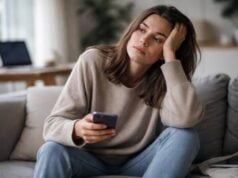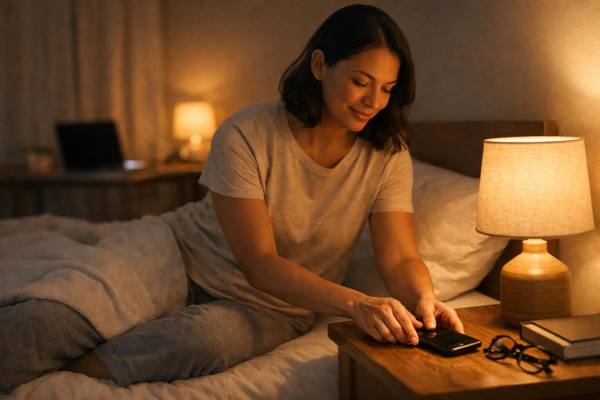
If you have ever felt oddly “wired” after late-night scrolling, you have already met the blue light and sleep debate in real life. Light is not just something you see; it is also information your brain uses to set time. Short-wavelength, blue-rich light is especially effective at signaling “daytime,” which can push your internal clock later and make it harder to feel sleepy at your usual bedtime. At the same time, not every sleep problem is a blue-light problem. What you watch, how long you stay engaged, how bright your room is, and whether you get strong daylight in the morning can matter as much as the screen itself.
This guide separates what is well-supported from what is overstated, and then turns the science into practical steps you can use tonight—without turning your evenings into a complicated project.
Essential Insights
- Reducing bright, blue-rich light in the last 2–3 hours before bed can make sleep onset easier, especially for people who already trend toward late nights.
- Morning daylight exposure anchors your body clock and can make evenings less sensitive to light and screens.
- Night modes and warm filters help, but they rarely “cancel out” late-night screen time or high room lighting on their own.
- Blue-blocking glasses may offer small benefits for some people, but results are mixed and depend heavily on timing, lens strength, and the rest of your routine.
- Start with the simplest, highest-impact changes: dim the room, lower screen brightness, and protect the final hour before bed.
Table of Contents
- How blue light affects sleep timing
- Screens versus room lighting at night
- What research shows and what it does not
- Filters and blue-blocking glasses: worth it?
- A practical evening light playbook
- Kids, shift work, and when to seek help
How blue light affects sleep timing
Your sleep is guided by two overlapping systems:
- Sleep pressure builds the longer you are awake. It is why you eventually feel tired even after a stressful day.
- Circadian rhythm is a 24-hour timing system that decides when your body is primed for sleep, alertness, digestion, and hormone release.
Light is the strongest “reset signal” for circadian timing. In the evening, bright light tells your brain that daytime is continuing. That signal can delay the natural rise of melatonin (a hormone that helps mark biological night), shift your internal clock later, and reduce the feeling of sleepiness you would normally get at that hour.
Blue light is discussed so often because the eye has specialized light-sensitive cells (in addition to rods and cones) that are tuned toward short wavelengths. Their peak sensitivity sits around the blue-cyan range, and they communicate directly with the brain’s master clock. In practical terms:
- Blue-rich light tends to be more “biologically loud” per unit of brightness, especially at night.
- Brightness still matters. A very bright warm lamp can be more disruptive than a dim screen.
- Timing matters most. Light in the morning helps you wake up and stabilizes the clock. Light at night tends to delay it.
There is also a second layer that people often miss: light does not just shift melatonin. It can increase alertness through direct pathways that keep the brain engaged even when you “should” be winding down. That is why you can feel tired in your body but mentally switched on.
If you want a simple mental model: morning light sets your “start time,” and evening darkness protects your “end time.” The more consistent those bookends are, the less fragile your sleep becomes when life gets busy.
Screens versus room lighting at night
A helpful truth: screens are not always the biggest light source in your evening. Many bedrooms and living rooms are brighter than people realize—especially with overhead LEDs, open-plan kitchens, and cool-white bulbs.
Here is how screens and room lighting differ in real life:
- Distance and angle: A phone held 20–30 cm from your face delivers light straight into the eyes. A ceiling fixture may be brighter overall, but it is farther away and often not aimed directly at you.
- Brightness habits: People frequently use screens at high brightness in dark rooms, which increases contrast and intensity at the eye. Automatic brightness can also boost output in well-lit spaces.
- Spectrum: Many LEDs (screens and bulbs) have a strong short-wavelength component. “Cool white” lighting often has more blue content than “warm white.”
- Duration: The last 60–120 minutes before bed are sensitive. A short check-in might not matter much, but a two-hour session can.
Another important point: the brain reacts to the whole evening environment, not a single device. If you are under bright kitchen lighting until 10:30 p.m., switching your phone to night mode at 10:45 p.m. may not make a dramatic difference. The strongest strategy is usually to dim and warm the room first, then refine your screen settings.
Also consider the non-light effects of devices:
- Time displacement: A “quick scroll” steals sleep time.
- Cognitive and emotional activation: News, arguments, exciting games, or work messages elevate arousal.
- Conditioning: If your bed becomes a place where you watch videos or answer emails, your brain learns that bed equals alertness, not sleep.
In other words, you can do everything “right” with blue light and still struggle if the content is stimulating or if bedtime is drifting later each night. A good plan treats light as one lever in a larger, calmer system.
What research shows and what it does not
The evidence base has three strong themes, plus a few areas where marketing runs ahead of data.
What is well-supported
- Evening bright light can delay circadian timing and suppress melatonin. This is consistent across lab studies, and it fits what we know about the eye-to-brain clock pathway.
- Reading or using light-emitting devices before bed can worsen sleep onset and next-morning alertness in controlled experiments. Effects are not identical for everyone, but the direction is predictable: later sleepiness and slower “wind-down.”
- More overall screen time and more bedtime screen use correlate with shorter sleep and worse sleep quality in large population studies. Correlation is not causation, but the pattern is robust, especially in adolescents and young adults.
What is mixed or smaller than people expect
- Night mode and blue filters: These often reduce short-wavelength output, but real-world impact on sleep is variable. If the screen stays bright, the room stays bright, or you stay mentally engaged, the benefit can be modest.
- Blue-blocking glasses: Some trials show improvements in sleep timing or subjective sleep, while others show minimal changes. The “dose” (how much blue is blocked), the timing (how long before bed), and the baseline sleep problem all influence results.
What is commonly overstated
- “Blue light is the only reason screens hurt sleep.” It is usually one contributor among several: time displacement, arousal, and habits can be equally powerful.
- “Any blue light at night is harmful.” Sensitivity exists on a spectrum. Small amounts may not meaningfully affect someone with strong sleep pressure and a stable schedule. The goal is not perfection; it is reducing unnecessary stimulation during your most sensitive window.
- “Blocking blue light guarantees deeper sleep.” Sleep architecture is influenced by stress, alcohol, caffeine timing, exercise, temperature, pain, breathing disorders, and mental health. Light changes help most when they target a real mismatch between your schedule and your internal clock.
A practical takeaway from the research is that timing and intensity beat gadgets. People who get strong morning light, keep evenings dim, and protect a consistent bedtime tend to benefit more than people who rely on a single setting or accessory.
Filters and blue-blocking glasses: worth it?
Filters and blue-blocking glasses can be useful tools, but they work best when you treat them as helpers, not cures.
Screen filters and night modes
Most phones, tablets, and computers offer some combination of:
- A warmer color temperature at night (reduces short-wavelength output)
- A brightness reduction
- Sometimes a schedule tied to sunset or a set time
These features can be worthwhile because they lower the biological “daytime” signal. However, they have two limitations:
- If the display remains bright, the eye still receives a strong light cue.
- If you keep scrolling, the bigger problem may be engagement and lost time, not spectrum.
A reasonable expectation is: night mode can make late use less disruptive, but it rarely makes it neutral.
Blue-blocking glasses
Blue-blocking glasses range from subtle “clear” lenses to deep amber lenses that dramatically cut short wavelengths. The more aggressive the lens, the more likely it is to reduce circadian stimulation, but the less natural colors will look.
What to know before you buy:
- Stronger filtering is usually required for a meaningful circadian effect. Many lightly tinted lenses are marketed for comfort but may not change biology much.
- Timing matters. Wearing them all day can be counterproductive because daytime blue-rich light supports alertness and circadian alignment.
- Expect small-to-moderate changes, not a transformation. Some people notice easier sleep onset or slightly earlier sleep timing; others notice little.
- They are not ideal for every task. If you need accurate color work, detailed reading, or safe night driving, strong amber lenses can be annoying or unsafe.
A practical “test-drive” approach is to use glasses only in a defined window—such as the last 2–3 hours before bed—and evaluate over 10–14 nights while keeping bedtime consistent. If your sleep onset becomes reliably easier and you feel better in the morning, keep them. If nothing changes, your effort is better spent on room lighting, timing, and behavior.
A practical evening light playbook
If you want the best return on effort, start with changes that reshape the whole evening environment. The goal is to make it easy for your brain to recognize “night.”
Step 1: Set your light targets
A science-informed framework is:
- Daytime: get bright light exposure, ideally outdoors.
- Three hours before bed: keep indoor light low and warm.
- Sleep environment: make the bedroom as dark as practical.
You do not need special meters to benefit from this. You can use simple cues:
- If you could comfortably read small print in your living room at night without a lamp, it is probably too bright for pre-sleep.
- If your bedroom has visible light sources, glowing LEDs, or streetlight leaking in, your “sleep darkness” is not fully protected.
Step 2: Fix the room before fixing the screen
Do this in order:
- Turn off overhead lights and switch to lamps.
- Use warm-white bulbs in evening spaces when possible.
- Dim aggressively after dinner, especially in the final 2–3 hours.
- Keep light below eye level (table lamps instead of ceiling fixtures).
This often delivers a bigger circadian benefit than any phone setting because it reduces the total light entering the eyes.
Step 3: Make screens less stimulating
If you must use a screen:
- Lower brightness to the minimum that is still comfortable.
- Use the warmest night setting you can tolerate.
- Increase distance (a tablet on a stand is often better than a phone close to the face).
- Prefer calmer content: light reading or low-stakes video over work, news, competitive games, or emotionally charged conversations.
Step 4: Protect the final hour
If you can do only one thing, make it this:
- In the last 60 minutes before bed, avoid interactive screens.
If that feels unrealistic, compromise:
- Keep screens in “passive mode” (one episode, one chapter), and set a hard stop.
- Move charging outside the bedroom to reduce temptation.
- Use a wind-down sequence you can repeat: wash up, prep tomorrow, low light, then bed.
Step 5: Anchor mornings to reduce evening sensitivity
Morning light is the underused lever. Even 10–20 minutes outdoors soon after waking can strengthen circadian timing. Over time, a stronger morning signal can make you less vulnerable to occasional late light exposure.
Kids, shift work, and when to seek help
Blue light and sleep advice should change based on the person in front of you.
Children and teens
Adolescents naturally shift later in circadian timing, and they are often more sensitive to late-night light and social stimulation. For families, the most effective moves are usually environmental and behavioral:
- Keep bedrooms device-free at night when possible, or use a consistent charging station outside the room.
- Make the home lighting dim and warm after a set time, so the environment supports winding down.
- Protect wake time consistency on school days, then use weekend mornings to catch up modestly rather than shifting the whole schedule.
For younger children who fear darkness, aim for the dimmest warm nightlight you can manage and keep it out of direct line of sight.
Shift work and jet lag
For shift work, the “right” light depends on your shift:
- If you need to be alert at night, bright light during the shift can help performance.
- When you need to sleep during the day, you want the opposite: darkness and light control, including blackout curtains and limiting light exposure on the way home.
Because shift work changes timing so dramatically, light planning can become complex. Many people benefit from individualized guidance from a sleep clinician, especially if insomnia becomes chronic.
Mental health considerations
Light is a powerful regulator of mood and timing. For some people, especially those with bipolar disorder or a history of mania, changing sleep schedules and experimenting with strong light interventions should be done thoughtfully. A simple dim-evening routine is generally low risk, but aggressive changes (such as intense light therapy) are better supervised.
When to get professional help
Consider medical evaluation if:
- You have insomnia symptoms at least 3 nights per week for 3 months or longer.
- You snore loudly, stop breathing during sleep, or wake up gasping (possible sleep apnea).
- You feel unrefreshed despite adequate time in bed, or you struggle with dangerous sleepiness while driving.
- Anxiety, depression, trauma symptoms, or medication effects appear tightly linked to sleep disruption.
Blue light adjustments are worthwhile, but persistent sleep problems deserve a broader assessment. The most effective long-term treatment for chronic insomnia is often structured therapy (such as cognitive behavioral therapy for insomnia), sometimes combined with medical evaluation for contributing conditions.
References
- Recommendations for daytime, evening, and nighttime indoor light exposure to best support physiology, sleep, and wakefulness in healthy adults 2022 (Consensus Recommendations)
- The association of screen time and the risk of sleep outcomes: a systematic review and meta-analysis 2025 (Systematic Review and Meta-analysis)
- Efficacy of blue-light blocking glasses on actigraphic sleep outcomes: a systematic review and meta-analysis of randomized controlled crossover trials 2025 (Systematic Review and Meta-analysis)
- Partial blue light blocking glasses at night advanced sleep phase and reduced daytime irritability, disruptive behavior and improved morning mood, but did not alter salivary melatonin secretion in Japanese male schoolchildren 2025 (Crossover Trial)
- Evening use of light-emitting eReaders negatively affects sleep, circadian timing, and next-morning alertness 2015 (Controlled Laboratory Study)
Disclaimer
This article is for educational purposes and does not replace personalized medical advice, diagnosis, or treatment. Sleep problems can have many causes, including insomnia, circadian rhythm disorders, sleep apnea, medication effects, chronic pain, and mental health conditions. If sleep disruption is persistent, severe, or affecting safety (for example, drowsy driving), seek evaluation from a qualified health professional. If you are pregnant, managing a neurological or psychiatric condition, or using sedating or stimulating medications, discuss sleep and light strategies with your clinician before making major changes.
If you found this guide helpful, consider sharing it on Facebook, X (formerly Twitter), or any platform you prefer so others can make more informed choices about light, screens, and sleep.