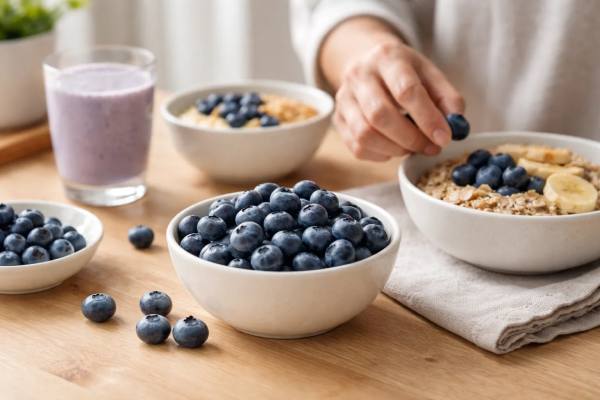
Blueberries are small, familiar, and surprisingly “brain-relevant.” Their deep color comes from anthocyanins—plant compounds that help neutralize oxidative stress and support healthy blood vessels. That combination matters for memory because the brain is both metabolically demanding and highly sensitive to changes in circulation and inflammation. Research in adults suggests blueberries can support specific thinking skills, especially in groups where cognition is under extra strain, such as older age, cardiometabolic risk, or subjective cognitive concerns. The effects are not instant and not identical for everyone, but they are realistic enough to justify a daily habit—especially because blueberries are easy to use, widely available, and fit into many eating patterns.
This article breaks down what blueberries can and cannot do for memory, why blood flow is part of the story, and how to build a simple routine that feels effortless rather than medicinal.
Key Insights
- Regular blueberry intake may modestly support memory-related skills and processing speed, particularly in older adults or those with higher cardiometabolic risk.
- Anthocyanins can support brain-relevant pathways tied to blood vessel function, oxidative stress, and inflammation.
- Benefits are typically subtle and build over weeks, not hours, and they work best alongside good sleep and steady meal timing.
- If you take blood thinners, have frequent migraines, or react to salicylates, introduce blueberries gradually and monitor symptoms.
- Aim for a repeatable dose: about 1/2 to 1 cup most days, using fresh or frozen berries in one “default” recipe.
Table of Contents
- What makes blueberries brain-friendly
- Do blueberries really improve memory
- Brain blood flow and vascular effects
- How much to eat and when
- Easy daily ideas that stick
- Safety, interactions, and smart limits
What makes blueberries brain-friendly
Blueberries earn their “memory food” reputation for reasons that go beyond vitamins. Their standout feature is a dense package of polyphenols—especially anthocyanins, the pigments that make blueberries dark blue and purple. These compounds act less like a stimulant and more like a gentle systems upgrade: they influence oxidative balance, inflammation signaling, blood vessel responsiveness, and—through those pathways—brain performance.
Why the brain cares about antioxidants and inflammation
The brain uses a lot of oxygen and energy every minute. That workload produces oxidative byproducts, which are normal in small amounts but become problematic when the body is stressed, sleep-deprived, insulin-resistant, or aging. Chronic low-grade inflammation and oxidative stress can interfere with synaptic function (how brain cells communicate), and over time may chip away at attention and memory efficiency. Blueberry polyphenols can help buffer these stressors by supporting antioxidant defenses and calming inflammatory pathways.
Why “plant compounds” can matter even in small doses
You do not need to absorb large amounts of anthocyanins intact for them to be meaningful. In the body, polyphenols are transformed into metabolites—some created by your liver and many shaped by your gut microbiome. These metabolites can circulate for hours and interact with blood vessels and signaling molecules. This is one reason blueberries may produce benefits that feel “whole-body,” such as steadier energy after meals or less mental fatigue, rather than a sharp, immediate boost.
Blueberries also support the foundations of memory
Memory is not only about neurons. It depends on stable inputs:
- Reliable blood flow to deliver oxygen and glucose
- Healthy endothelial function (how well blood vessels dilate when the brain needs more fuel)
- Metabolic stability, including less dramatic post-meal glucose swings
- Sleep and circadian regularity, which consolidate learning and regulate emotional tone
Blueberries touch several of these foundations at once. They provide fiber and water content that can slow digestion, and they pair easily with protein and healthy fats that support steadier energy.
A useful way to frame blueberries is this: they are not a “memory switch.” They are a low-effort, high-repeatability food that nudges key brain-support systems—especially those tied to circulation and cellular stress—toward a healthier baseline.
Do blueberries really improve memory
The most honest answer is: blueberries can help, but the gains are usually modest and specific. In human studies, improvements often show up in domains like processing speed, executive function (planning, switching, inhibition), and certain memory tasks—rather than a dramatic “I never forget anything now” effect. That pattern makes sense, because memory performance depends on many factors, including sleep, mood, cardiovascular health, and how demanding your daily life is.
Who is most likely to notice an effect
Blueberries tend to look most promising when the brain is operating with a bit of headwind. Examples include:
- Older adults, especially those who report mild cognitive concerns
- People with cardiometabolic risk (higher blood pressure, insulin resistance, metabolic syndrome)
- Individuals under chronic stress, poor sleep, or inconsistent meal patterns (which can amplify oxidative and inflammatory load)
In these contexts, small physiological shifts—slightly better vascular responsiveness or less oxidative stress after meals—can translate into measurable changes on cognitive tests, and sometimes into a clearer “mental feel” in everyday life.
What benefits can look like day to day
If blueberries help you, the changes are often subtle and practical:
- Faster “getting started” on mentally demanding tasks
- Fewer moments of losing your train of thought
- Better word retrieval when you are tired
- Less mental drag after a heavy meal
- Slightly steadier mood and patience when stressed
These are the kinds of shifts that do not feel dramatic in one day, but they add up across a month of consistent habits.
Why results vary
Variation does not mean blueberries are ineffective. It often means the outcome depends on context:
- If your sleep is short or fragmented, the brain may not consolidate learning well, regardless of diet.
- If your meals are irregular or high in refined carbohydrates, glucose swings can dominate attention and mood.
- If you rarely get fruits and vegetables, adding blueberries may have a stronger effect than if your diet is already rich in polyphenols.
- Individual differences in gut microbes can change how polyphenols are metabolized, which may influence response.
A realistic expectation is that blueberries can be one meaningful lever among several. If you pair them with stable sleep timing, daily movement, and a breakfast that avoids sugar spikes, you are more likely to notice cognitive benefits than if blueberries are added to an otherwise chaotic routine.
Brain blood flow and vascular effects
A compelling part of the blueberry story is vascular: memory depends on blood flow. The brain needs a constant supply of oxygen and glucose, and it needs the ability to rapidly increase delivery when you concentrate, learn, or recall information. That increase happens through finely tuned dilation of blood vessels—especially in small arteries and capillaries that feed active brain regions.
Endothelial function: the gateway to better perfusion
The endothelium is the thin inner lining of blood vessels. It helps regulate vessel dilation, inflammation, and clotting. When endothelial function is healthy, vessels respond smoothly to demand. When it is impaired—common in aging, high blood pressure, insulin resistance, smoking, and chronic stress—blood flow becomes less responsive. That can contribute to “sluggish cognition,” especially during multitasking or sustained attention.
Anthocyanin-rich foods are studied partly because they may support endothelial function through:
- Improving nitric oxide availability (a key molecule for dilation)
- Reducing oxidative stress that degrades vessel responsiveness
- Influencing inflammatory signaling that stiffens vessels over time
Even small improvements in vascular responsiveness can matter because the brain operates near a tight energy budget.
Why blood flow links to memory, not just heart health
When you try to form a memory—learning a new name, recalling details, or navigating a complex conversation—specific brain networks ramp up activity. Those networks require quick fuel delivery. If blood flow is less responsive, the brain can still function, but it may feel effortful. People often describe this as:
- Needing more time to “warm up” mentally
- Feeling mentally tired earlier in the day
- Struggling with divided attention and rapid switching
This is also where blueberries may connect with mood. Poor vascular function and metabolic strain can worsen fatigue and irritability, which then feed back into attention and memory.
Blueberries and post-meal brain clarity
Many people notice that cognition feels worse after a refined-carb-heavy meal: sleepiness, slower thinking, and reduced motivation. Part of this is normal digestion, but exaggerated responses can reflect glucose spikes, inflammation, and vascular stiffness after eating. Blueberries, especially when paired with protein, fiber, and healthy fats, may help make post-meal physiology steadier. The practical outcome is not a “buzz,” but less of a cognitive dip.
A careful, realistic interpretation
Blood-flow pathways are plausible and supported by several human trials and reviews, but they are not guaranteed. The most consistent benefits appear when blueberries are used regularly and when the baseline situation includes vascular or metabolic strain. If you are young, fit, well-slept, and already eating a polyphenol-rich diet, you may feel less noticeable change. The good news is that the habit is still supportive, low risk for most people, and aligned with broader cardiovascular and metabolic health—both of which are deeply tied to long-term brain function.
How much to eat and when
The best dose of blueberries is the one you can repeat without effort. In research, benefits are often tested using daily blueberry intake over weeks or months, commonly in the range of about 1/2 to 1 cup of blueberries per day, sometimes delivered as freeze-dried powder that matches a fresh-berry equivalent. For everyday use, you do not need a laboratory protocol—just consistency.
A practical dose range
For most adults, these are sensible targets:
- Baseline habit: 1/2 cup most days
- Stronger daily anchor: 1 cup most days
- If you are sensitive to sugars or have diabetes: start at 1/3 to 1/2 cup and pair with protein or fat
Blueberries are relatively low in calories compared with many snacks, and their fiber helps slow digestion. Still, portion size matters if you are managing blood glucose closely.
Timing: when blueberries make the most sense
Blueberries are flexible, but timing can change your experience:
- Breakfast: ideal if you tend toward late-morning brain fog or sugar cravings. Pairing blueberries with Greek yogurt, eggs, or nuts often improves satiety and reduces the urge to graze.
- Lunch: helpful if you experience a post-lunch slump, especially when combined with a balanced meal.
- Pre-exercise or post-exercise: easy carbohydrate plus polyphenols can fit well, though the priority is overall meal balance.
- Late night: generally fine, but avoid large portions if fruit triggers reflux or if you are trying to reduce evening snacking.
If you want the memory angle, a consistent time is useful because it helps you notice patterns: “When I eat blueberries with breakfast, my afternoon focus feels steadier.”
Fresh, frozen, dried, powder, or extract
- Frozen blueberries are often the best daily option: affordable, available year-round, and convenient. Freezing preserves many polyphenols well, and the berries blend easily into smoothies or thaw quickly in oatmeal.
- Fresh blueberries are perfect when in season, especially for snacking and salads.
- Freeze-dried powder can be useful if you dislike the texture of berries or want a measured dose. Choose products with minimal added sugar and clear labeling.
- Extract supplements are the least “food-like” option. They can be convenient, but quality varies, and extracts may not replicate the full benefits of whole berries (fiber, food matrix, and broader nutrient profile).
How long before you might notice changes
Some effects are reported after a single serving in certain studies, but most real-life benefits—especially those tied to vascular and metabolic health—are more plausible over several weeks of steady intake. A reasonable trial is 4 to 8 weeks with near-daily use, while keeping other major habits stable enough to observe changes.
If you treat blueberries as a small daily investment rather than a quick fix, you give their most plausible mechanisms—vascular support, oxidative balance, and metabolic steadiness—time to show up in how you think and feel.
Easy daily ideas that stick
The biggest barrier to “brain foods” is not science—it is friction. The goal is to make blueberries automatic, not another task. A good approach is to choose one default option for weekdays and a few flexible options for variety.
The simplest weekday defaults
- Yogurt bowl: Greek yogurt + 1/2 to 1 cup blueberries + chopped nuts or seeds + cinnamon
- Oatmeal upgrade: stir blueberries into oats during the last minute of cooking, then add a spoon of nut butter
- Smoothie minimalism: blueberries + milk or kefir + protein (Greek yogurt or protein powder) + spinach (optional)
These work because they require almost no planning, and they pair blueberries with protein and fat—often a better recipe for stable energy and focus than fruit alone.
Five-minute snacks that support memory habits
- A small bowl of blueberries with a handful of walnuts
- Cottage cheese with blueberries and a drizzle of honey if needed
- A “desk cup” of thawed frozen blueberries mixed into plain yogurt
- Blueberries with dark chocolate squares for a controlled sweet option
If you struggle with afternoon cravings, a planned snack like this can reduce the odds of reaching for refined sweets that produce sharper glucose swings.
Savory ideas that people overlook
Blueberries can work outside breakfast:
- Salads: blueberries + leafy greens + goat cheese or feta + pumpkin seeds
- Salsa style: blueberries with diced cucumber, mint, and a squeeze of citrus over fish or chicken
- Roasted vegetables: add blueberries near the end as a sweet-tart contrast to roasted squash or sweet potatoes
Savory use matters because it keeps blueberries from feeling like “dessert,” which can make the habit more consistent for people who do not love sweet breakfasts.
Batch strategies that reduce effort
- Keep frozen blueberries as your default and thaw portions as needed.
- Pre-portion berries into small containers or bags for grab-and-go use.
- Build a “brain snack shelf” with blueberries, nuts, and a protein option so your choices are easy under stress.
Making it work for families
For kids and teens, the best strategy is to make blueberries visible and paired:
- Add to yogurt or overnight oats rather than offering fruit alone
- Mix into pancakes or muffins occasionally, but keep added sugar low
- Use blueberries as part of an after-school snack with protein
The aim is consistency, not perfection. If your daily habit is “blueberries appear in one meal most days,” you have already done the hardest part. Over time, that repeatable pattern is more powerful than any occasional superfood push.
Safety, interactions, and smart limits
Blueberries are safe for most people, but “healthy” does not mean “no considerations.” Paying attention to a few common issues helps you use blueberries confidently and avoid surprises.
Blood sugar and portion awareness
Blueberries are generally a smart fruit choice for metabolic health because they contain fiber and have a relatively modest sugar load per serving. Still, if you have diabetes, reactive hypoglycemia, or strong cravings triggered by sweet tastes, use two tactics:
- Start with 1/3 to 1/2 cup and increase slowly.
- Pair blueberries with protein or fat (yogurt, nuts, eggs) to blunt glucose spikes.
If you notice afternoon sleepiness after fruit-heavy meals, the fix is usually pairing and portioning—not avoiding blueberries entirely.
Digestive sensitivity
Frozen blueberries and fiber-rich foods can occasionally cause bloating or loose stools, especially if your diet is low in fiber and you increase fruit intake suddenly. A simple solution is gradual change:
- Begin with a smaller portion for one week.
- Increase toward your target dose as your gut adapts.
- Consider consuming blueberries with meals rather than on an empty stomach if you are sensitive.
Allergies and salicylate sensitivity
True blueberry allergy is uncommon but possible. Also, some people sensitive to salicylates report headaches, hives, or gastrointestinal symptoms with certain fruits. If you suspect sensitivity, introduce blueberries in small portions and monitor patterns.
Medication interactions and cautious situations
Blueberries are not a common interaction risk, but caution is sensible if you:
- Take blood thinners or have a bleeding disorder (any major dietary changes should be discussed with your clinician)
- Use medications that strongly affect blood sugar (monitoring matters more than blueberries themselves)
- Have chronic kidney disease and are on a restricted diet (fruit portions may be individualized)
If you choose powders or extracts, be extra careful with labels. Concentrated products can vary widely in anthocyanin content and may include added sugars or other ingredients that change tolerability.
When memory concerns need more than food
If you are seeking blueberries for memory because you are noticing real cognitive changes—frequent forgetfulness, losing words, struggling at work, or changes others notice—diet is supportive, but it should not be your only step. Consider evaluation if symptoms are persistent, worsening, or accompanied by sleep disruption, mood changes, or functional decline.
Blueberries can be a meaningful part of a brain-supportive routine, especially as a daily habit that also supports vascular and metabolic health. The safest and most effective approach is steady use, realistic portions, and attention to your own signals—because “best for memory” is ultimately what works reliably for your body and your life.
References
- The state of the science on the health benefits of blueberries: a perspective – PMC 2024 (Review)
- Six-month intervention with wild blueberries improved speed of processing in mild cognitive decline: a double-blind, placebo-controlled, randomized clinical trial – PubMed 2023 (RCT)
- Chronic and postprandial effect of blueberries on cognitive function, alertness, and mood in participants with metabolic syndrome – results from a six-month, double-blind, randomized controlled trial – PMC 2024 (RCT)
- Effects of Anthocyanins on Cognition and Vascular Function: A Systematic Review – PubMed 2024 (Systematic Review)
- The Effect of Anthocyanins on Cognition: A Systematic Review and Meta-analysis of Randomized Clinical Trial Studies in Cognitively Impaired and Healthy Adults – PMC 2025 (Systematic Review and Meta-analysis)
Disclaimer
This article is for educational purposes only and does not provide medical advice, diagnosis, or treatment. Nutrition can support brain health, but memory and attention symptoms can also be caused by sleep disorders, depression or anxiety, thyroid disease, vitamin deficiencies, medication effects, neurological conditions, and cardiometabolic illness. If you have persistent or worsening memory problems, confusion, personality changes, or symptoms that interfere with daily functioning, seek evaluation from a qualified health professional. If you take prescription medications (including blood thinners) or manage diabetes or kidney disease, discuss major dietary changes and supplement use with your clinician.
If you found this article useful, please share it on Facebook, X (formerly Twitter), or any platform you prefer.