A brachiocephalic artery aneurysm is an abnormal widening of the first major branch that comes off the aortic arch—the vessel that quickly divides into the right carotid artery (to the brain) and the right subclavian artery (to the arm). Because this artery sits at a crossroads for blood flow to the brain and upper body, even a small problem can carry outsized risk. Many aneurysms grow quietly for years and are found incidentally on a CT scan done for another reason. Others announce themselves through pressure symptoms, blood clots that travel, or—rarely—rupture. The condition is uncommon, so care is often individualized and guided by anatomy, growth rate, symptoms, and overall cardiovascular health. This article walks through what it is, why it happens, how it feels, how it is diagnosed, and what treatment and day-to-day management usually involve.
Table of Contents
- What is a brachiocephalic artery aneurysm?
- Causes and risk factors
- Symptoms and complications to watch for
- How it is diagnosed
- Treatment options and what to expect
- Management, prevention, and when to seek care
What is a brachiocephalic artery aneurysm?
An aneurysm is a focal enlargement of an artery that is greater than normal for that vessel. In the brachiocephalic artery (also called the innominate artery), an aneurysm means the vessel wall has weakened and stretched, creating a segment that is wider than it should be. That widening matters for two main reasons: the stretched wall can tear or rupture, and the altered blood flow inside the bulge can form clots that may travel to the brain or arm.
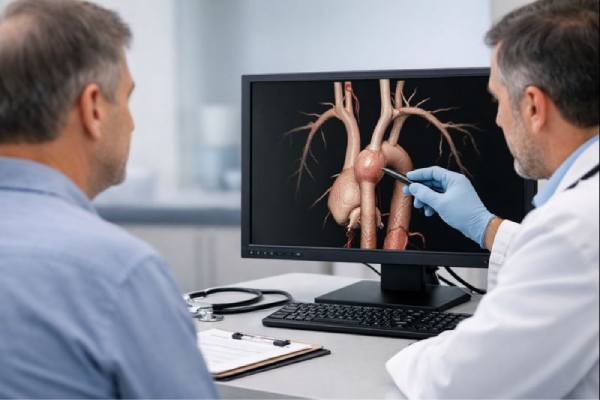
It helps to picture the anatomy. The aorta leaves the heart and curves as the aortic arch. The first branch off that arch is the brachiocephalic artery, which then splits into:
- The right common carotid artery (supplying the right side of the brain)
- The right subclavian artery (supplying the right arm and, through the vertebral artery, part of the brain)
Because of that branching, a brachiocephalic aneurysm is not simply a “big blood vessel.” It is a potential source of neurologic events (like transient ischemic attack or stroke) and upper-extremity ischemia, in addition to the more familiar aneurysm risks of rupture or dissection.
Not all enlargements are the same. Clinicians often distinguish:
- True aneurysm: all layers of the artery wall are involved in the expansion (commonly linked to atherosclerosis, connective tissue disorders, or long-term vessel degeneration).
- Pseudoaneurysm: a contained leak where blood collects outside the normal wall layers, often after trauma, surgery, catheter procedures, or infection.
This distinction matters because pseudoaneurysms may behave more unpredictably, may expand quickly, and often need earlier intervention.
Another key idea is that “size alone” is not the whole story. Two aneurysms of the same diameter can carry different risk depending on shape (saccular versus fusiform), presence of clot lining the aneurysm, symptoms, growth rate over time, and whether the aneurysm involves the branch point into the carotid and subclavian arteries. Treatment planning is therefore tailored, usually by a vascular surgeon and sometimes alongside cardiothoracic and neurovascular specialists.
Causes and risk factors
A brachiocephalic artery aneurysm is uncommon, so there is no single “typical” cause. Most cases arise from a mix of vessel wall wear-and-tear, inflammation, and mechanical stress at the aortic arch branching point. Understanding likely causes helps guide both treatment and the search for related vascular disease elsewhere.
Common causes and contributors include:
- Atherosclerosis (plaque-related degeneration): Over time, plaque, inflammation, and remodeling can weaken the artery wall. People with known coronary artery disease, carotid disease, or peripheral artery disease are more likely to have this contributor.
- Connective tissue disorders: Conditions that alter collagen and elastin in vessel walls (for example, Marfan syndrome, Loeys-Dietz syndrome, and some forms of Ehlers-Danlos syndrome) can predispose to aneurysms at younger ages and at smaller sizes.
- Chronic hypertension: High blood pressure increases stress on artery walls, especially at branch points where flow is turbulent. Hypertension also accelerates atherosclerosis.
- Prior surgery or procedures: Operations involving the aorta, arch, or nearby arteries can create weak points or anastomotic sites that later dilate. Catheter-based procedures and central line placements are less common culprits but can contribute.
- Trauma: Blunt chest or neck trauma can injure the vessel wall and lead to pseudoaneurysm formation.
- Infection (mycotic aneurysm): Bloodstream infection or local infection can damage the vessel wall. These are rarer but often urgent because infected aneurysms can expand rapidly and are more prone to rupture.
- Vasculitis and inflammatory disease: Diseases such as Takayasu arteritis can inflame and scar large vessels, causing abnormal dilation, stenosis, or both.
Risk factors that often travel with this condition:
- Age over 60 (more cumulative vessel degeneration)
- Smoking history (current or past)
- High cholesterol and diabetes
- Family history of aneurysm disease
- Known aneurysms in other locations (aorta, iliac, popliteal), which raises the chance of multi-site disease
A practical clinical insight: when a brachiocephalic aneurysm is found, clinicians often expand the lens beyond that one vessel. Many patients benefit from imaging that checks the thoracic aorta and other arch branches, because the same biology that weakens one segment may affect others. The goal is not to “find problems for the sake of it,” but to avoid surprises—such as an unrecognized aortic aneurysm that would change the safest repair strategy.
Symptoms and complications to watch for
Many brachiocephalic artery aneurysms cause no symptoms at first. They are often discovered incidentally during CT imaging for lung issues, chest pain evaluation, or preoperative planning for unrelated surgery. When symptoms do occur, they typically fall into three buckets: pressure effects, embolic events (clots traveling), and acute vascular emergencies.
Possible symptoms include:
- A pulsating mass near the lower neck or upper chest (uncommon but sometimes noticed)
- Chest discomfort or a sense of fullness at the base of the neck
- Hoarseness, cough, or swallowing difficulty from pressure on nearby nerves or the esophagus/trachea (more likely in larger aneurysms)
- Right arm symptoms: pain with use, coolness, numbness, weakness, or color change if blood flow is impaired
- Neurologic symptoms: transient vision changes, weakness, speech difficulty, facial droop, or brief episodes of confusion that resolve (transient ischemic attack)
Complications clinicians worry about:
- Thromboembolism to the brain: Irregular flow inside an aneurysm can promote clot formation. If clot travels into the right carotid artery, it can cause transient ischemic attack or stroke.
- Thromboembolism to the arm: Clot can travel into the subclavian or downstream arm arteries, causing acute limb ischemia (pain, pallor, coolness, weakness).
- Compression of nearby structures: The brachiocephalic artery lies close to the trachea and recurrent laryngeal nerve pathways; large aneurysms can create airway symptoms or voice changes.
- Rupture: Rare, but potentially catastrophic, with rapid blood loss into the mediastinum.
- Dissection or contained leak: A tear in the vessel wall can create a dangerous situation even without full rupture.
Red-flag symptoms that should be treated as urgent (call emergency services rather than “waiting to see if it passes”):
- Sudden one-sided weakness, trouble speaking, facial droop, or sudden vision loss
- Sudden severe chest pain or upper chest and neck pain, especially if tearing or accompanied by fainting
- Right arm that becomes suddenly cold, pale, painful, or weak
- New severe shortness of breath, noisy breathing, or rapidly worsening hoarseness
A nuance worth emphasizing: people sometimes assume that an aneurysm must cause “pain” to be dangerous. With brachiocephalic aneurysms, the first major event can be neurologic (from emboli) or vascular (arm ischemia) rather than local discomfort. That is why clinicians take symptom history seriously even when the aneurysm is not huge—and why prompt evaluation matters if neurologic or limb symptoms appear.
How it is diagnosed
Diagnosis usually begins with imaging, but good diagnosis is more than confirming a bulge on a scan. Clinicians also define the aneurysm’s exact anatomy, search for related vascular disease, and assess short-term risk.
Common diagnostic steps include:
- Clinical evaluation
A clinician will review symptoms (neurologic events, arm ischemia, pressure symptoms), medical history (hypertension, smoking, prior aortic surgery, inflammatory disease), and family history. They will also check pulses in both arms, measure blood pressure in both arms (a significant difference can suggest subclavian involvement), and listen for bruits (turbulent flow sounds). - CT angiography
CT angiography (CTA) is often the main workhorse. It shows:
- Maximum aneurysm diameter and length
- Whether the aneurysm is fusiform (uniform widening) or saccular (outpouching)
- Relationship to the aortic arch and to the carotid and subclavian origins
- Presence of mural thrombus (clot lining the aneurysm)
- Signs of inflammation, leak, or surrounding compression
CTA also helps surgeons plan the best approach by showing landing zones for stents (if considering endovascular options) and the feasibility of open reconstruction.
- MR angiography
MR angiography can provide similar anatomic detail without ionizing radiation and may be preferred in some patients. It can be particularly helpful for follow-up in younger patients, though availability and image quality can vary by center. - Ultrasound
Duplex ultrasound is excellent for carotid and subclavian evaluation and can sometimes assess the brachiocephalic artery depending on body habitus and anatomy. It is more often used as a complementary tool rather than the sole diagnostic test. - Additional testing when needed
- Echocardiography: If there is concern for associated aortic root disease, valve disease, or a cardiac source of emboli.
- Blood tests: If infection or vasculitis is suspected (for example, inflammatory markers, blood cultures).
- Brain imaging: If neurologic symptoms occurred, to document stroke and guide antithrombotic decisions.
A practical point patients can use: when you read your imaging report, look for more than the diameter. Notes about thrombus, saccular shape, pseudoaneurysm features, and involvement of the branch point often matter as much as size. Ask your clinician to explain these features in plain language, because they frequently drive the urgency and type of repair.
Surveillance is also part of diagnosis. If immediate repair is not chosen, clinicians typically recommend repeat imaging at a defined interval (often months, not years at first) to establish growth rate. A stable aneurysm over serial imaging is not “harmless,” but stability provides useful reassurance that a carefully planned approach is safe.
Treatment options and what to expect
Treatment ranges from careful monitoring to surgical or endovascular repair. Because brachiocephalic artery aneurysms are rare and anatomically complex, the “best” choice depends on symptoms, aneurysm morphology, size and growth, and the patient’s overall surgical risk.
When monitoring may be reasonable
Observation is usually considered when the aneurysm is small, asymptomatic, and stable on repeat imaging. Monitoring is not passive; it typically includes:
- Regular imaging (CTA or MRA) to track diameter and shape
- Aggressive risk factor control (blood pressure, lipids, smoking cessation)
- A plan for rapid reassessment if new neurologic or arm symptoms occur
When repair is typically recommended
Clinicians more strongly consider repair when there are:
- Symptoms (neurologic events, arm ischemia, pressure effects)
- Rapid growth on serial imaging
- Pseudoaneurysm features, infection concerns, or saccular shape
- Larger size where rupture or embolic risk is felt to outweigh procedural risk
Because evidence is limited, size thresholds are not as uniform as they are for abdominal aortic aneurysms. Many specialists use size, symptoms, and morphology together rather than one “magic number.”
Open surgical repair
Open surgery is the traditional approach and can be durable. Techniques vary but often involve removing or excluding the aneurysm and reconstructing blood flow with a graft. Depending on location, surgeons may use:
- Direct graft replacement
- Bypass grafting to the carotid and subclavian branches if the bifurcation is involved
- Adjuncts to protect brain blood flow during clamping, such as shunts or cerebral perfusion strategies
What to expect:
- General anesthesia and a hospital stay that may range from several days to longer if there are comorbidities
- Careful neurologic monitoring
- Recovery focused on pain control, mobility, and blood pressure stability
Endovascular and hybrid approaches
In selected anatomies, clinicians may place a stent graft to exclude the aneurysm from inside the vessel. Because the brachiocephalic artery is close to the carotid and subclavian origins, purely endovascular solutions can be challenging. Hybrid procedures combine open bypass or “debranching” (rerouting blood flow to maintain brain and arm perfusion) with endovascular stent placement.
Benefits can include less invasive access and potentially faster recovery, but trade-offs may include:
- Need for precise landing zones to prevent endoleak
- Stroke risk related to manipulating wires near arch vessels
- Lifelong imaging surveillance to monitor the repair
Medications around treatment
Medication does not “shrink” an aneurysm, but it supports safety:
- Blood pressure control reduces wall stress
- Statins and antiplatelet therapy may be used based on overall vascular risk
- Anticoagulation may be considered in select embolic scenarios, but decisions are individualized because bleeding risk and aneurysm features matter
A useful patient-centered question to ask your specialist: “What is my main risk if we wait—rupture, embolic stroke, growth, or compression—and how does that compare to the risks of the repair you recommend?” The answer clarifies why a particular strategy fits your anatomy and health profile.
Management, prevention, and when to seek care
Living with a brachiocephalic artery aneurysm—whether monitored or repaired—usually means committing to risk reduction and clear follow-up habits. Because the aneurysm sits at a high-stakes branching point, the goal is to reduce stress on the vessel wall, lower the chance of clot formation, and catch meaningful changes early.
Core management steps:
- Blood pressure control: This is often the single most important modifiable factor. Many clinicians aim for a consistent home blood pressure pattern rather than occasional “good” readings in clinic. If you measure at home, take two readings morning and evening for a week when adjusting therapy, and bring the log to appointments.
- Lipid management: Statins are commonly recommended for people with atherosclerosis or high cardiovascular risk. Even when the aneurysm cause is not purely plaque-related, lowering overall vascular risk can reduce complications.
- Smoking cessation: Ongoing smoking accelerates vessel wall damage and increases the risk of vascular events. Quitting is one of the highest-impact changes you can make.
- Activity choices: Most people are encouraged to stay active, but to avoid sudden extreme straining that spikes blood pressure. Practical examples include avoiding maximal heavy lifting or breath-holding during lifting. A clinician may give individualized limits based on aneurysm size and symptoms.
- Medication adherence: If you are prescribed antiplatelet therapy (such as aspirin) or other vascular medications, take them consistently and discuss any bleeding issues promptly.
After repair: long-term follow-up
Even after a successful repair, follow-up imaging is often recommended to confirm graft and stent integrity, rule out narrowing at reconstruction sites, and detect changes in adjacent vessels. Patients sometimes feel “fixed” after surgery and drift away from surveillance; with arch-branch pathology, surveillance is part of long-term safety.
Signs you should seek urgent care for:
- Any stroke-like symptoms (face droop, speech trouble, one-sided weakness, sudden vision changes)
- Sudden severe chest pain, upper chest pressure, or neck pain unlike your usual symptoms
- Right arm that becomes suddenly cold, pale, painful, numb, or weak
- Rapidly worsening shortness of breath, noisy breathing, or new severe hoarseness
Prevention in family members
Because this condition is rare, routine screening of relatives is not always appropriate. However, if you have a strong family history of aneurysms or a known connective tissue disorder, it is reasonable to discuss whether family members should be evaluated for heritable aortic and vascular disease.
Finally, do not underestimate the value of a “one-page summary” you keep for yourself: diagnosis, most recent aneurysm size, imaging date, treating specialist contact, and current medications. In emergencies, that information helps clinicians act quickly and safely.
References
- 2022 ACC/AHA Guideline for the Diagnosis and Management of Aortic Disease – PubMed 2022 (Guideline)
- Thoracic Endovascular Aortic Repair with Supra-Aortic Trunk Revascularization is Associated with Increased Risk of Periprocedural Ischemic Stroke – PubMed 2022
- Surgical Management of an Isolated Huge Innominate Artery Aneurysm Causing Tracheal Compression: A Case Report – PubMed 2022
- Autologous Vein Graft Repair of Mycotic Innominate Artery Aneurysm: A Case Report – PubMed 2023
Disclaimer
This article is for educational purposes only and does not provide medical advice, diagnosis, or treatment. A brachiocephalic artery aneurysm can involve serious risks, including stroke and bleeding emergencies, and management should be individualized by a qualified clinician who can interpret your imaging, symptoms, and medical history. If you have sudden neurologic symptoms, severe chest or neck pain, or signs of reduced blood flow to an arm, seek emergency care immediately.
If you found this guide helpful, please consider sharing it on Facebook, X (formerly Twitter), or any platform you prefer, and follow us on social media. Your support through sharing helps our team continue producing clear, high-quality health content.