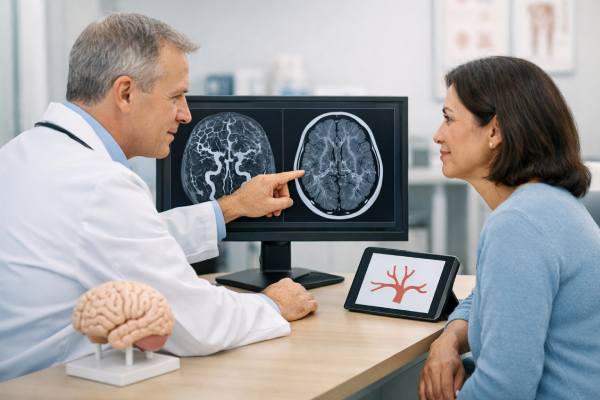
A brain aneurysm is a weak, bulging spot in a blood vessel in or around the brain. Many aneurysms never cause symptoms and are found incidentally during imaging for headaches, dizziness, or unrelated concerns. Others become clinically important because they grow, press on nearby nerves, or—most urgently—rupture and cause bleeding around the brain (subarachnoid hemorrhage), a medical emergency. What makes aneurysms challenging is the mix of “often silent” and “sometimes sudden.” The most helpful approach is to understand what an aneurysm is, which factors increase risk, what warning signs matter, and how clinicians decide between careful monitoring and treatment. This guide walks through those decisions in plain language, with practical steps you can use to reduce risk and know when to seek urgent care.
Table of Contents
- What is a brain aneurysm?
- What causes brain aneurysms?
- Symptoms and possible complications
- How brain aneurysms are diagnosed
- Treatment options and what to expect
- Management, prevention, and when to seek care
What is a brain aneurysm?
A brain aneurysm (also called an intracranial aneurysm) is a localized outpouching of an artery caused by weakening of the vessel wall. Most aneurysms form at branch points where blood flow creates higher shear stress. Over time, the wall can thin and stretch, producing a small sac (saccular aneurysm) or, less commonly, a more diffuse dilation (fusiform aneurysm). Saccular aneurysms are the classic “berry” shape and account for most cases.
Why it matters: the main concern is rupture. When an aneurysm ruptures, it can spill blood into the space around the brain, causing aneurysmal subarachnoid hemorrhage (aSAH). This can lead to sudden severe headache, stroke-like symptoms, decreased consciousness, and complications such as vasospasm (tightening of blood vessels), hydrocephalus (fluid buildup), and long-term neurological impairment.
Unruptured aneurysms are far more common than ruptured ones. They are often discovered during MRI or CT scans for other reasons. An unruptured aneurysm can still cause problems if it presses on nearby structures—especially cranial nerves. For example, an aneurysm near the posterior communicating artery may irritate the nerve controlling eyelid and pupil function, producing drooping eyelid or a new, unequal pupil.
Size is important, but not everything. Larger aneurysms tend to have a higher risk of rupture, yet small aneurysms can rupture too—particularly in higher-risk locations or in people with strong risk factors. Clinicians weigh multiple factors, including:
- Aneurysm size and shape (irregular borders, “daughter sacs,” or rapid growth raise concern).
- Location (some arteries carry higher rupture risk).
- Your age, blood pressure control, smoking history, and family history.
- Symptoms attributable to the aneurysm.
A key insight many patients find reassuring: “found” does not automatically mean “dangerous today.” Many aneurysms are managed safely with structured surveillance and risk reduction. The goal is to prevent rupture while avoiding unnecessary procedure risk when observation is the safer choice.
What causes brain aneurysms?
Brain aneurysms usually develop from a combination of vessel-wall vulnerability and long-term stress on the artery. Most are not caused by a single event; instead, they form gradually as the artery remodels in response to pressure and flow.
Core mechanisms
- Wall weakness at branch points: Arteries at forks and curves experience complex flow patterns. Repeated stress can damage the inner lining (endothelium) and contribute to structural changes in the vessel wall.
- Inflammation and degeneration: In many aneurysms, the artery wall shows loss of smooth muscle cells and breakdown of supportive proteins (like elastin and collagen), which reduces the vessel’s ability to hold its shape.
- Growth and instability: Some aneurysms remain stable for years, while others enlarge. Growth—especially over months to a few years—can signal higher future rupture risk.
Common risk factors you can influence
- High blood pressure: Chronic hypertension increases mechanical stress on artery walls. Even modest reductions in average blood pressure can meaningfully lower risk over time.
- Smoking: Tobacco exposure is one of the strongest modifiable risks for aneurysm formation, growth, and rupture. Risk decreases after quitting, but the benefit grows the longer you remain smoke-free.
- Stimulant drugs: Cocaine and methamphetamine can acutely raise blood pressure and trigger vessel injury, increasing the risk of rupture and hemorrhagic stroke.
Risk factors you cannot change but should know
- Age and sex: Aneurysms are more commonly detected in adults, and unruptured aneurysms are diagnosed more often in women.
- Family history: Having two or more first-degree relatives (parent, sibling, child) with intracranial aneurysm or aneurysmal hemorrhage raises the likelihood of having an aneurysm and may change screening decisions.
- Inherited and connective tissue conditions: Certain disorders are linked with higher aneurysm prevalence, including autosomal dominant polycystic kidney disease (ADPKD) and some connective tissue diseases that affect collagen or vessel integrity.
Medical and anatomical contributors
- Atherosclerosis and vascular risk clustering: High cholesterol, diabetes, and inflammation may not directly “cause” aneurysms the way they cause plaque, but they often travel with hypertension and smoking—two major drivers.
- Prior aneurysm or prior hemorrhage: A history of one aneurysm increases the chance of additional aneurysms.
A practical way to think about cause: your arteries have a “baseline resilience,” and daily exposures apply “baseline stress.” Aneurysms are more likely when resilience is low (genetic predisposition, connective tissue disease) and stress is high (smoking, uncontrolled blood pressure). The most powerful prevention strategy is to reduce the stress side of that equation—especially blood pressure and smoking.
Symptoms and possible complications
Many brain aneurysms cause no symptoms until they grow large enough to irritate nearby nerves or—more dangerously—rupture. Because the first sign can be sudden and severe, it helps to separate symptoms into unruptured (pressure-related) and ruptured (bleeding-related) patterns.
Symptoms of an unruptured aneurysm
Unruptured aneurysms are often silent, but symptoms can occur when an aneurysm presses on nerves or brain tissue. Possible signs include:
- New or unusual headaches that persist or change pattern (not every headache is meaningful, but new “different” headaches deserve attention).
- Vision changes, such as blurred vision or double vision.
- Drooping eyelid, a larger pupil on one side, or eye pain (suggesting pressure on the nerve that controls eye muscles and pupil response).
- Facial numbness or pain, depending on location.
Symptoms tend to be localized and may evolve over days to weeks. A “new neurologic symptom” is more concerning than headache alone.
Symptoms of a ruptured aneurysm (medical emergency)
Rupture typically causes sudden, severe symptoms, often described as:
- A “thunderclap” headache: abrupt onset, peak intensity within seconds to a minute, often called the “worst headache of my life.”
- Neck stiffness, nausea, vomiting, light sensitivity.
- Fainting, confusion, drowsiness, or loss of consciousness.
- Seizure.
- Weakness, numbness, speech difficulty, or vision loss (from associated stroke or increased pressure).
If these occur, call emergency services immediately. Minutes matter.
Complications
The most serious complications occur after rupture:
- Rebleeding: highest risk early; preventing it is a major reason ruptured aneurysms are treated urgently.
- Vasospasm and delayed brain ischemia: narrowing of arteries days after hemorrhage can reduce blood flow, causing stroke-like injury.
- Hydrocephalus: blood can block normal cerebrospinal fluid flow, raising pressure in the brain.
- Electrolyte disturbances and cardiac strain: hemorrhage can disrupt body-wide stress responses.
Unruptured aneurysms can also complicate life through anxiety and uncertainty. A practical step is to ask your clinician for your aneurysm’s size, location, and whether it has irregular features, because those details shape the true risk far more than the word “aneurysm” alone.
How brain aneurysms are diagnosed
Diagnosis usually begins with imaging—either because an aneurysm is found incidentally or because symptoms raise concern for bleeding. The best test depends on urgency, clinical context, and how much detail is needed for treatment planning.
When clinicians suspect rupture
If someone presents with a thunderclap headache or signs of subarachnoid hemorrhage, the initial priority is to confirm bleeding and stabilize the patient.
- Non-contrast CT head is commonly the first test because it is fast and highly sensitive for acute bleeding early after symptom onset.
- If CT confirms bleeding, clinicians typically add vascular imaging to identify the aneurysm.
- If CT is negative but clinical suspicion remains high, further testing may be needed based on timing and expert judgment.
Imaging tests for aneurysm detection and planning
- CTA (CT angiography): Uses contrast dye with CT scanning to visualize blood vessels. It is quick, widely available, and good for detecting many aneurysms, especially those large enough to change management.
- MRA (MR angiography): Uses MRI-based techniques to visualize vessels, sometimes without contrast. MRA is often used for follow-up surveillance because it avoids radiation and can be repeated over time.
- DSA (digital subtraction angiography): A catheter-based angiogram considered the most detailed vascular test. It provides high-resolution images and is often used when planning treatment or when noninvasive imaging is unclear. Because it is invasive, clinicians use it selectively.
Key details that get recorded
Once an aneurysm is identified, your team will typically document:
- Size (often in millimeters) and whether it is changing over time.
- Location (which artery and which segment).
- Shape (smooth vs irregular; presence of lobules or small secondary bulges).
- Neck anatomy (important for deciding between coiling, stents, flow diversion, or clipping).
- Number of aneurysms (single vs multiple).
Monitoring and follow-up
If the plan is observation, imaging is repeated on a schedule to detect growth. Follow-up timing varies, but many clinicians re-image within months to a year after diagnosis, then adjust based on stability, risk factors, and aneurysm features.
A helpful patient question is: “What change on imaging would make you recommend treatment?” That single question clarifies the plan and turns monitoring into a defined strategy rather than open-ended waiting.
Treatment options and what to expect
Treatment decisions balance two risks: the chance the aneurysm will rupture in the future versus the immediate risks of an intervention. Because those risks vary widely by aneurysm size, location, and patient factors, there is no one-size-fits-all answer.
Observation and risk reduction
Many unruptured aneurysms are managed without a procedure, especially when they are small, stable, and in lower-risk locations. Observation typically includes:
- Structured imaging surveillance (CTA or MRA at planned intervals).
- Aggressive management of modifiable risks, especially blood pressure and smoking.
- Review of medications that may affect procedure planning later (for example, antiplatelet therapy if a stent might be considered).
Observation is not “doing nothing.” It is an active plan to keep rupture risk low while avoiding unnecessary procedural harm.
Endovascular treatment
Endovascular therapy treats the aneurysm from inside the blood vessel, usually through a catheter inserted in an artery (often in the wrist or groin). Options include:
- Coiling: Small coils are placed inside the aneurysm to promote clotting and reduce blood flow into the sac.
- Stent-assisted coiling or balloon remodeling: Tools help keep coils in place for wider-neck aneurysms.
- Flow diversion: A special stent is placed in the parent artery to redirect blood flow away from the aneurysm, encouraging the aneurysm to seal over time.
Endovascular approaches often have shorter initial recovery than open surgery, but some require dual antiplatelet medications for a period of time, which can influence bleeding risk and follow-up planning.
Surgical clipping
Clipping is an open neurosurgical procedure where a small clip is placed across the aneurysm neck to exclude it from circulation. Clipping can be durable and is preferred in certain aneurysm anatomies, in some younger patients, or when endovascular access is challenging.
What to expect after treatment
After either endovascular or surgical therapy, follow-up includes:
- Short-term monitoring for neurological changes, blood pressure control, and complications.
- Repeat imaging to confirm the aneurysm is sealed and remains stable.
- A long-term plan, since some aneurysms can recur or new aneurysms can develop in higher-risk individuals.
A clear, practical way to evaluate any recommendation is to ask your team to compare: “What is my estimated rupture risk if we watch this for five years, and what is the procedure risk in your center for this specific aneurysm type?” The best decisions are anchored in those two numbers, even when they are given as ranges rather than exact predictions.
Management, prevention, and when to seek care
Living with a diagnosed brain aneurysm is often more about risk management and clarity than daily symptoms. The goal is to reduce the chance of growth or rupture, stay consistent with follow-up, and know which symptoms deserve urgent evaluation.
Daily management that meaningfully lowers risk
- Blood pressure control: Aim for steady control, not occasional “good readings.” Home monitoring helps. If you see frequent readings above your target, treat it as actionable information rather than noise.
- Stop smoking completely: Quitting is one of the most powerful steps you can take. If relapse is part of your history, plan for it—nicotine replacement, prescription options, and structured support improve long-term success.
- Limit stimulant exposure: Avoid cocaine and methamphetamine. Discuss high-caffeine supplements or pre-workout products with your clinician if they raise your blood pressure or trigger palpitations.
- Heart and vessel health: Regular aerobic activity (as approved by your clinician), weight management, lipid control, and diabetes management support vascular stability.
Exercise, sex, and everyday exertion
Many people fear that normal activity will “burst” an aneurysm. In most cases, clinicians encourage moderate exercise and avoidance of extreme, unaccustomed strain—especially heavy lifting that spikes blood pressure. A practical approach:
- Build aerobic fitness gradually (walking, cycling, swimming).
- Use lighter weights with good breathing technique (avoid breath-holding).
- Stop and reassess if activity triggers sudden severe headache, new neurological symptoms, or unusual dizziness.
Follow-up and surveillance
Keep a written record of:
- Aneurysm size (in mm), location, and any irregular features.
- The planned imaging schedule and which test will be used.
- Which changes would trigger intervention (growth, shape change, new symptoms).
This reduces uncertainty and helps you advocate for consistent care even if providers change.
When to seek urgent care
Seek emergency evaluation immediately for:
- Sudden, severe “thunderclap” headache.
- New weakness, numbness, trouble speaking, confusion, fainting, or seizure.
- New vision loss, marked double vision, or a suddenly drooping eyelid with headache.
For non-emergency concerns—like persistent new headaches, gradually changing vision, or worsening anxiety about symptoms—contact your clinician promptly and ask whether earlier imaging is warranted.
A brain aneurysm diagnosis can feel like a countdown, but for many people it becomes a manageable condition with a clear plan: reduce risk, monitor intelligently, and act decisively if warning signs appear.
References
- 2023 Guideline for the Management of Patients With Aneurysmal Subarachnoid Hemorrhage 2023 (Guideline)
- Neuroimaging modalities for intracranial aneurysm: more than meets the eye 2024 (Review)
- Natural History of Unruptured Intracranial Aneurysms: A Retrospective Single Center Analysis and Systematic Review 2022 (Systematic Review)
- Safety, effectiveness, or durability of intracranial aneurysm treatment literature 2023 (Systematic Review)
Disclaimer
This article is for educational purposes only and does not replace individualized medical advice, diagnosis, or treatment. A brain aneurysm can be life-threatening, especially if symptoms suggest rupture. If you or someone else develops a sudden severe headache, new neurological symptoms, fainting, or seizure, seek emergency care immediately. Treatment decisions for unruptured aneurysms depend on aneurysm size, location, imaging features, personal risk factors, and the expertise of the treating team; discuss your options with a qualified clinician who can evaluate your specific situation.
If you found this article helpful, please consider sharing it on Facebook, X (formerly Twitter), or any platform you prefer, and follow us on social media. Your support through sharing helps our team continue producing clear, trustworthy health content.