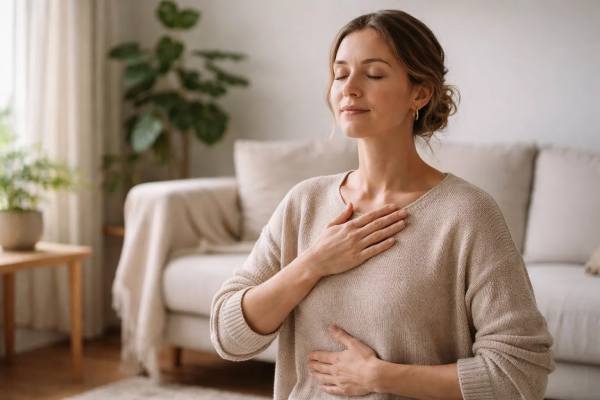
Anxiety can feel like your body is revving without permission: faster heart rate, shallow breathing, tight chest, racing thoughts, and a constant urge to “fix” the feeling. Breathwork is one of the few tools you can use in real time to change that physiology from the inside. By adjusting pace, depth, and especially the exhale, you can influence the stress response within minutes—often before your mind has caught up. Used consistently, breathing practice can also improve emotional steadiness, reduce physical tension, and make anxious spirals easier to interrupt.
Breathwork is not a personality change, and it is not a substitute for treatment when anxiety is severe. But it is practical, portable, and surprisingly teachable. This guide explains why certain breathing patterns work, which techniques are best for different anxiety moments, and how to practice safely so your breathing becomes a reliable anchor rather than another performance test.
Quick Overview
- Slow breathing with a longer exhale can reduce physical anxiety signals within minutes and make anxious thoughts less “sticky.”
- Regular practice can lower baseline tension, improve stress recovery, and strengthen attention control during anxious moments.
- Overbreathing and overly intense breathwork can worsen dizziness or panic in some people, so technique and pacing matter.
- Start with 5 minutes daily at a comfortable pace, then build toward 10–20 minutes, 3–5 days per week, based on symptoms.
Table of Contents
- What breathwork does for anxiety
- How breathing changes the stress response
- Fast techniques for acute anxiety
- Daily breathwork to lower baseline anxiety
- Safety, side effects, and common pitfalls
- A simple plan and when to get help
What breathwork does for anxiety
Breathwork is the intentional use of breathing patterns to influence body state. That might sound abstract, but it is actually concrete: anxiety has a physical signature, and breath is one of the fastest ways to change it. When you are anxious, breathing often becomes quicker, shallower, and higher in the chest. This pattern can amplify symptoms such as dizziness, tingling, chest tightness, and the sense that something is wrong. Breathwork works by gently shifting you away from that loop.
A helpful way to frame it is: breathwork does not erase anxiety; it changes the conditions that let anxiety spread. When your body is calmer, your brain is less likely to interpret sensations as threats, and you gain more room to choose your next step.
Common benefits people notice include:
- Fewer spikes of physical panic symptoms (tight chest, racing heart, shakiness)
- Faster “come down” after a stressful trigger
- Improved ability to stay present during uncertainty
- Better sleep onset when breathwork is used as a wind-down tool
- More confidence in handling anxiety because you have a repeatable method
Breathwork is a skill, not a vibe
Many people try a breathing exercise once, feel only mild change, and decide it is not for them. That’s like doing one gym session and expecting a stronger back. Breathwork has two layers:
- State change: what happens in the next 1–5 minutes
- Trait change: what happens when you practice regularly over weeks
State change is often subtle at first: your shoulders drop, your thoughts slow a half step, your chest loosens. Trait change is where it becomes more durable: you recover faster, startle less, and feel less “wired” by default.
When breathwork is especially useful
Breathwork tends to work best when anxiety is fueled by physical arousal. That includes performance anxiety, anxious insomnia, stress overload, and the body surge that comes with panic. It can also help with worry-based anxiety, but the goal there is usually to calm the body enough that you can think more clearly—not to “out-breathe” every thought.
If you treat breathwork as a quick reset plus a daily practice—rather than a last-resort emergency move—it becomes more effective and less frustrating.
How breathing changes the stress response
Breathing sits at a powerful intersection: it is automatic (your body does it without you) and controllable (you can change it on purpose). That makes it a direct line into the stress response. The most practical takeaway is simple: a slower breath with a longer exhale tends to signal safety to the nervous system.
Autonomic balance and the “exhale advantage”
Your autonomic nervous system has two broad modes:
- Mobilize: the stress response that prepares you to act
- Settle: the recovery response that supports digestion, repair, and calm attention
You cannot force yourself into calm by willpower alone, but you can influence the signals your body sends upward to the brain. A longer, gentler exhale increases activity in pathways associated with recovery. This is one reason “inhale for 4, exhale for 6” often feels more calming than equal in-and-out breathing.
Carbon dioxide, overbreathing, and why anxiety can feel dizzy
Many people unknowingly overbreathe during anxiety—taking in more air than the body needs for the moment. Overbreathing can lower carbon dioxide levels too far, which may contribute to:
- Lightheadedness or wooziness
- Tingling in fingers or around the mouth
- Tightness in the chest
- A sense of unreality or “floating”
These sensations can be misread as danger, which fuels panic. Breathwork helps by slowing the breath and reducing unnecessary volume, allowing chemistry to stabilize.
Heart rate variability and stress recovery
A calm nervous system is not one that never reacts. It is one that can shift gears quickly—up when needed, down when the moment passes. One marker of this flexibility is heart rhythm variation across the breath cycle. Slow, comfortable breathing around a steady pace can strengthen recovery patterns, which is why many breathwork programs focus on gentle, paced breathing rather than extreme techniques.
Attention and interoception
Anxiety often narrows attention toward threat signals: body sensations, imagined futures, social judgments. Breathwork gives attention a structured target. Over time, that can improve your ability to notice anxiety without being pulled into it. It also improves interoception—the skill of sensing internal signals accurately. When you can tell the difference between “tight chest from stress” and “danger,” you regain choice.
In short, breathwork works because it changes physiology, and physiology changes perception. You are not breathing to prove you are calm. You are breathing to create the conditions where calm becomes possible.
Fast techniques for acute anxiety
When anxiety hits hard, you need techniques that are simple, quick, and difficult to do “wrong.” The best acute practices share three features: they slow breathing, emphasize the exhale, and keep effort moderate.
Physiological sigh for rapid downshift
This is one of the fastest ways to reduce the “air hunger” feeling that can accompany panic.
How to do it (1–3 minutes):
- Inhale through the nose about 70–80% full.
- Take a second short inhale on top (a small “sip” of air).
- Exhale slowly through the mouth like you are fogging a mirror, longer than the inhale.
- Repeat 3–8 cycles, then switch to normal nasal breathing.
Best for: sudden spikes, tight chest, post-argument adrenaline.
Avoid if: it makes you dizzy—use fewer cycles and slow down.
Extended exhale breathing
This is the “workhorse” technique because it is subtle and usable anywhere.
How to do it (3–5 minutes):
- Inhale through the nose for 3–4 seconds.
- Exhale through the nose for 5–7 seconds.
- Keep the breath quiet and low in the torso.
- If counting increases anxiety, use a simple cue: “shorter in, longer out.”
Best for: generalized anxiety, social anxiety, waiting rooms, meetings.
Box breathing for control and steadiness
Box breathing is structured, which helps when your mind feels scattered. It is often taught for performance stress.
How to do it (2–4 minutes):
- Inhale 4 seconds
- Hold 4 seconds
- Exhale 4 seconds
- Hold 4 seconds
Repeat 4 rounds.
Best for: performance anxiety, pre-event jitters, concentration under pressure.
If you feel worse: shorten holds to 2 seconds or remove holds entirely.
4-7-8 as a sleep-leaning option
This pattern emphasizes a long exhale and can help at night, but it is not ideal for everyone during daytime panic because longer holds may feel intense.
How to do it (2–4 rounds):
- Inhale 4 seconds
- Hold 7 seconds (or less if uncomfortable)
- Exhale 8 seconds
Stop at 2–4 rounds and rest.
Best for: anxious insomnia, racing mind at bedtime.
If it triggers discomfort: switch to extended exhale breathing without holds.
A practical rule: in acute anxiety, choose the method that feels easiest to repeat. The “best” technique is the one your nervous system accepts without a fight.
Daily breathwork to lower baseline anxiety
Daily practice is where breathwork shifts from a coping trick to a real nervous-system skill. The goal is not to stay calm all the time; it is to become easier to settle after activation. A steady training routine also makes acute techniques work better because your body recognizes the pattern.
Resonant paced breathing
Many people do well with slow, even breathing near 5–6 breaths per minute, but the key is comfort. You should not strain, gasp, or force a big inhale.
How to practice (10 minutes):
- Sit upright or lie down with knees supported.
- Inhale 4–5 seconds through the nose.
- Exhale 5–6 seconds through the nose or softly through pursed lips.
- Keep the breath smooth, quiet, and lower in the ribs.
- If you feel air hunger, slightly shorten the inhale and reduce volume.
Best for: chronic worry, stress sensitivity, emotional reactivity, and building recovery capacity.
Diaphragmatic breathing with low effort
“Belly breathing” is often taught too forcefully. The aim is not a dramatic stomach push; it is a gentle expansion of the lower ribs.
Practice (5–8 minutes):
- Place one hand on the upper chest and one on the lower ribs.
- Breathe so the lower hand moves more than the upper.
- Keep shoulders relaxed and jaw unclenched.
- Use a longer exhale than inhale.
This is especially useful if you habitually breathe high in the chest or hold your breath when anxious.
Alternate nostril breathing as a focus tool
This technique can support attention and reduce mental chatter for some people. Keep it gentle and avoid forcing slow breathing.
Practice (3–6 minutes):
- Close one nostril, inhale slowly through the other.
- Switch sides, exhale slowly.
- Inhale on the same side, switch, exhale.
- Continue smoothly without breath holds.
If coordinating the steps feels stressful, skip it. Breathwork should reduce friction, not add it.
How often to practice
A realistic training schedule:
- Week 1: 5 minutes daily, pick one technique
- Weeks 2–4: 10 minutes, 4–5 days per week
- Weeks 5–8: 10–20 minutes, 3–5 days per week, plus brief “micro-practices” during the day
Micro-practice example: 3 slow exhales before opening email, entering a store, or starting a hard conversation. These small reps teach your body that calm is accessible in real contexts.
Safety, side effects, and common pitfalls
Breathwork is generally safe, but anxiety can make breathing unusually sensitive. People sometimes feel worse not because breathwork is ineffective, but because they are unintentionally overbreathing, pushing too hard, or using an overly intense style for their nervous system.
Common mistakes that backfire
- Taking bigger breaths instead of slower breaths: Bigger breaths can increase dizziness. Aim for quieter, smaller breathing.
- Trying to “win” the exercise: Effort and strain often increase arousal. The right intensity feels almost boring.
- Breath holds during panic: Holds can be helpful for some, but for others they trigger alarm. Remove holds if they feel sharp or urgent.
- Practicing only during emergencies: If your only experience is breathing while panicked, your brain may associate breathwork with danger. Build a neutral daily practice.
- Switching techniques too often: Consistency builds learning. Pick one daily practice for two weeks before changing.
Normal sensations versus warning signs
Mild sensations can happen during the first few sessions:
- warmth, tingling, or lightheadedness that resolves quickly
- emotional release such as tears or irritability
- temporary increased awareness of heartbeat
These are usually signals to slow down, reduce breath volume, and shorten sessions.
Stop and reset if you experience:
- persistent dizziness or faint feeling
- numbness that spreads or lasts
- chest pain, severe palpitations, or shortness of breath that feels medical rather than anxious
- a sense of escalating panic that does not settle when you return to normal breathing
Who should be extra cautious
If you have any of the following, consider talking with a clinician before intensive breathwork and start with gentle extended-exhale breathing:
- Asthma or chronic lung disease
- Heart rhythm conditions or unexplained fainting
- Pregnancy, especially if breath holds cause discomfort
- History of panic disorder with strong sensitivity to bodily sensations
- Trauma history where internal focus triggers distress
Also be careful with fast or intense breathwork styles that aim to provoke strong sensations. Those methods may be appropriate in specific supervised settings, but they are not the best starting point for anxiety relief. For most people with anxiety, gentle, slow practices are the safest and most sustainable.
A simple plan and when to get help
A good breathwork plan is specific enough to follow, flexible enough to adjust, and measured by real-life outcomes—not perfect calm. Think of it as training your recovery system.
A two-part plan you can start today
Part 1: Daily baseline practice (10 minutes)
- Choose one: resonant paced breathing or diaphragmatic extended-exhale breathing.
- Practice at the same time each day for two weeks.
- Keep it comfortable: quiet breath, low effort, longer exhale.
- End with 30 seconds of normal breathing and notice the difference.
Part 2: Acute “reset” protocol (2 minutes)
- Use physiological sigh for 3–6 cycles, then switch to extended exhale breathing for 6–10 breaths.
- Repeat once if needed, then move your body gently (walk, stretch, step outside).
This pairing matters: one technique builds long-term capacity, the other handles spikes.
How to track whether it is working
Use two simple markers for 14 days:
- A body marker: number of anxiety spikes per day or average intensity from 0–10
- A function marker: sleep onset time, focus blocks completed, or avoided situations you were able to face
If you only track how calm you feel immediately after breathing, you may miss the more meaningful win: better recovery and better functioning.
Breathwork works best with other supports
Breathwork pairs well with:
- Cognitive and behavioral strategies (challenging avoidance, building exposure gradually)
- Strength and aerobic exercise (improves stress tolerance)
- Sleep regularity (reduces baseline arousal)
- Therapy and, when appropriate, medication
If anxiety is driven by chronic stress, unresolved trauma, or severe insomnia, breathwork can help—but it is rarely the whole solution.
When to talk to a doctor or mental health professional
Consider a clinical conversation if:
- Anxiety is persistent, worsening, or interfering with work, school, or relationships
- You have panic symptoms that feel unmanageable or lead to avoidance
- Breathwork triggers intense dizziness, faintness, or chest symptoms
- You have thoughts of self-harm, feel unsafe, or cannot reliably care for yourself
- You suspect medication side effects, thyroid issues, anemia, or other medical contributors
Asking for help is not a failure of self-regulation. It is often the step that makes self-regulation possible.
References
- Effect of breathwork on stress and mental health: A meta-analysis of randomised-controlled trials – PMC 2023 (Meta-Analysis)
- Breathing Practices for Stress and Anxiety Reduction: Conceptual Framework of Implementation Guidelines Based on a Systematic Review of the Published Literature – PMC 2023 (Systematic Review)
- A Systematic Review of Breathing Exercise Interventions: An Integrative Complementary Approach for Anxiety and Stress in Adult Populations – PubMed 2024 (Systematic Review)
- The effect of slow breathing in regulating anxiety – PubMed 2025 (Clinical Study)
- Efficacy of Slow-Paced Breathing as a Just-in-Time Adaptive Intervention for Anxiety-A Randomized Controlled Study – PubMed 2026 (RCT)
Disclaimer
This article is for educational purposes only and does not provide medical advice, diagnosis, or treatment. Breathwork can be a helpful self-management tool for anxiety, but it is not a substitute for professional care when symptoms are severe, persistent, or worsening. Do not delay seeking help for concerning symptoms such as chest pain, fainting, severe shortness of breath, new neurological symptoms, or thoughts of self-harm. If you have a medical condition affecting breathing or heart rhythm, are pregnant, or have a history of panic or trauma-related symptoms that intensify with body-focused practices, consider speaking with a qualified clinician before starting new breathwork routines.
If you found this helpful, please consider sharing it on Facebook, X (formerly Twitter), or any platform you prefer.