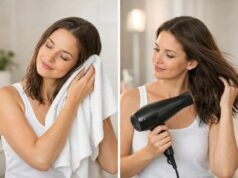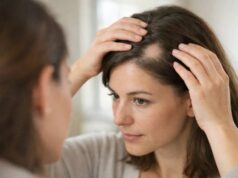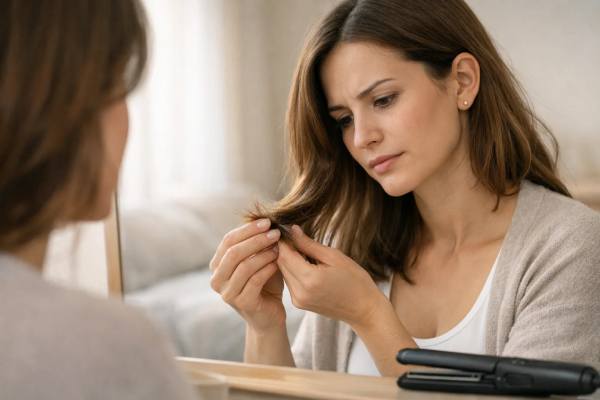
Heat styling is often framed as a tradeoff between speed and softness, but there is a less-discussed risk when high heat meets moisture: bubble hair. This acquired hair-shaft defect forms when water inside the fiber rapidly turns to steam and creates tiny air-filled cavities within the strand. The result is not “just dryness.” Bubble hair can make hair feel rough and stiff, snap at unusual points, and develop sudden patches of breakage that look like thinning.
The reassuring part is that bubble hair is also one of the more preventable forms of hair-shaft damage. Prevention is mostly about technique: fully drying hair before hot tools, controlling temperature and contact time, and choosing routines that do not repeatedly overheat the same sections. This guide explains what bubble hair is, how to recognize it, and how to build a realistic heat routine that protects both the cuticle and the inner cortex—without giving up the styles you enjoy.
Key Insights
- Bubble hair is a structural hair-shaft injury, often triggered by high heat on damp or recently washed hair, and it can cause sudden breakage.
- Early changes are often reversible at the scalp level once heat exposure stops, but damaged lengths usually require trimming and gentler care.
- Aggressive heat, chemical straightening, and bleaching together raise the risk of severe shaft fragility and uneven breakage.
- For prevention, keep hot tools for fully dry hair only and limit direct heat contact to one slow pass per section at the lowest effective temperature.
Table of Contents
- What bubble hair looks like
- Why heat creates bubbles in hair
- Common triggers and risk factors
- How bubble hair is diagnosed
- Prevention plan for heat styling
- Repair and recovery after bubble hair
What bubble hair looks like
Bubble hair (sometimes called bubble hair deformity) is an acquired defect where air-filled cavities form inside the hair shaft. Those cavities weaken the strand from within, so hair becomes more likely to kink, feel stiff, and break—often in a way that surprises people who have styled with heat for years without obvious problems.
Many people first notice it as a “texture shift” rather than a clear diagnosis. Common early clues include:
- Hair that suddenly feels crunchy, rough, or unusually wiry, especially near the crown or front where heat is often concentrated
- Breakage that creates short, uneven pieces that stick up after brushing or blow drying
- A patchy look that resembles thinning, even though the follicles are not the issue
- Strands that seem to tangle faster and snap during detangling
- Color changes in the lengths (dullness or lighter-looking ends), sometimes paired with frizz that does not respond to conditioning
A defining feature is that the problem is usually shaft-level fragility, not increased shedding from the root. That matters because it changes the solution: you are not trying to “stop hair loss,” you are trying to stop ongoing overheating and reduce mechanical stress on weakened fibers. If you are unsure whether you are dealing with breakage or shedding, a guide to breakage versus hair loss can help you interpret what you see in the sink and on your brush.
Bubble hair can affect any hair type. However, it tends to show up most clearly in areas that receive repeated heat contact: the hairline, top layers, crown, and the same “face-framing” sections that get restyled daily. It can also present as localized damage if a specific heat source is involved (for example, a blow dryer held too close to one spot, or a bathroom heat lamp used during showers).
One more nuance: bubble hair is not always obvious to the naked eye. You can have significant weakening before it becomes visually dramatic. That is why prevention is more effective than trying to “repair” bubble hair once the internal cavities are present.
Why heat creates bubbles in hair
To understand bubble hair, it helps to think of hair as a layered fiber. The outer cuticle is like overlapping shingles, while the cortex beneath provides most of the strand’s strength and elasticity. Hair also holds water—on the surface and within microscopic spaces—especially right after washing or when humidity is high.
Bubble hair forms when heat drives a rapid phase change: water inside the hair turns to steam faster than it can escape. Steam expands, pressure rises, and the fiber develops internal voids. Those voids behave like weak points in a rope: the strand may kink at that spot or fracture with much less force than usual.
Several details make this more likely:
- Wet or damp hair plus direct heat: A flat iron, curling iron, or very hot blow dryer can heat the strand above the boiling point of water, creating steam inside the fiber.
- Repeated passes: Each pass dehydrates and destabilizes the fiber further, increasing brittleness and the chance of internal defects.
- Already compromised cuticle: Bleaching, strong detergents, UV exposure, and previous heat damage can lift and crack the cuticle, making moisture movement more chaotic and the cortex more vulnerable.
- High-contact heat: Tools that clamp hair (irons) deliver intense, localized heat compared with diffuse warmth.
Temperature thresholds are not identical for everyone, because tool calibration varies and hair responds differently based on diameter, porosity, and chemical history. Still, the pattern is consistent: higher heat plus water exposure plus repeated contact is the recipe. This is also why some people develop bubble hair after a single styling mistake—like ironing hair that “felt mostly dry”—while others only see it after months of daily heat.
If you have ever wondered whether air drying is always safer, the answer is “it depends.” Air drying is gentler in many cases, but leaving hair wet for a long time can increase swelling and friction, which also contributes to damage. The most protective routine is usually a balanced one; air drying versus blow drying tradeoffs can help you choose a method that fits your hair type and climate.
The key takeaway is that bubble hair is not mysterious. It is a predictable physical injury: moisture inside the fiber plus intense heat equals internal pressure—then fragility.
Common triggers and risk factors
Bubble hair is often triggered by a specific moment—high heat on hair that is not fully dry—but risk builds when multiple stressors stack together. Knowing the usual triggers helps you identify what to change first.
High-risk styling scenarios
These are the most common “setups” for bubble hair:
- Flat ironing or curling damp hair: Even slightly damp sections can hold enough internal water to create steam pockets under high heat.
- Blow drying too close or too hot: Concentrated heat held near the same spot (especially at the crown) can overheat the fiber quickly.
- Heat plus tension: Pulling hair taut with a brush while applying heat increases stress on already-weakened strands.
- Heat on product-coated hair: Some styling products create films that change heat distribution or increase residue, encouraging repeated passes because hair does not “set” as expected.
Chemical history that raises the odds
Hair that has been chemically altered is more vulnerable because the cuticle and internal bonds are already under strain. Higher-risk backgrounds include:
- Bleaching and frequent highlighting
- Relaxers and permanent straightening
- Repeated permanent dye on the same lengths
- Acid straightening and other high-heat smoothing services that require a flat iron step
If your hair history includes salon straightening services and you are unsure what process was used, a comparison of popular keratin and straightening treatments can help you understand why some services demand stricter heat precautions afterward.
Hair type and routine factors
Bubble hair can occur in any texture, but certain factors increase vulnerability:
- Fine hair: Less cortical “mass” means less margin for error at high heat.
- High-porosity hair: Water enters and leaves quickly, and the cuticle is often more lifted, increasing irregular heating.
- Long hair with old ends: The last 10–15 cm may be years old and have accumulated more micro-damage, so it breaks first.
- Frequent retouching of the same sections: Face-framing pieces and top layers often receive daily heat while underlayers do not.
Unexpected heat sources
Not all triggers look like styling. Some people develop localized bubble hair from environmental heat exposure—such as heat lamps used during bathing, space heaters, or intense radiant heat in close proximity when hair is wet.
A practical way to identify your trigger is to look at the pattern: if breakage clusters where your dryer or iron spends the most time, your technique is usually the driver. If it clusters in one unusual spot (like a crown patch), consider whether a repeated environmental heat source might be involved.
How bubble hair is diagnosed
Bubble hair is diagnosed based on a combination of history, appearance, and hair-shaft visualization. The most helpful clinical clue is the story: recent high heat on wet hair, followed by sudden brittleness and breakage.
What clinicians look for
A focused evaluation typically includes:
- A timeline of styling and chemical services in the last 1–3 months
- Where breakage is concentrated (top layers, crown, hairline, or scattered)
- Whether hair is snapping (shaft problem) or coming out from the root (shedding)
- Scalp findings (usually normal, unless there is overlap with dermatitis, scratching, or irritation)
Trichoscopy and light microscopy
When a clinician examines hair under magnification, bubble hair shows characteristic cavities within the shaft. Trichoscopy (scalp dermoscopy) can sometimes reveal shaft irregularities and broken ends, while light microscopy can confirm the internal “bubble-like” spaces.
This matters for two reasons. First, it prevents you from chasing the wrong solution (like treating for shedding when the issue is breakage). Second, it helps rule out other shaft disorders and infections that can look similar.
Conditions that can mimic bubble hair
Several issues produce brittle hair and breakage but have different triggers:
- Trichorrhexis nodosa: a common fragility pattern linked to physical and chemical trauma, often showing brush-like fractures
- Trichoptilosis (split ends): more distal splitting that worsens with friction
- Hair casts or buildup: residue that flakes off and resembles damage
- Fungal infection or inflammatory scalp disease: usually includes scalp symptoms or patchy changes beyond the shaft
If your hair shows nodules, frayed “broom” ends, or breaks that look like two brushes pushed together, it may fit a different shaft defect; trichorrhexis nodosa signs and causes can help you compare patterns.
Do you need medical testing?
Most cases do not require labs. Bubble hair is primarily a mechanical and thermal injury. A clinician may consider broader evaluation if breakage is severe without a clear trigger, if multiple hair-bearing sites are affected, or if there are signs of nutritional deficiency, endocrine changes, or systemic illness. But in straightforward cases, the diagnosis is made by history plus hair-shaft examination.
The most important diagnostic outcome is actionable: identifying the heat and moisture pattern that created the damage so it does not continue while you try to recover.
Prevention plan for heat styling
Preventing bubble hair is less about never using heat and more about using heat with control. The goal is to avoid steam formation inside the fiber and reduce repeated overheating of the same sections.
Rule one: hot tools only on fully dry hair
“Fully dry” means dry at the scalp and through the mid-lengths, not just dry on the surface. If you are in a humid environment, give hair extra time after blow drying before using an iron. A practical check is to part a section and feel close to the roots and inner layers. If anything feels cool or slightly damp, wait.
Choose the lowest effective temperature
Temperature needs vary, but these ranges are a safer starting point:
- Fine, porous, bleached, or fragile hair: 120–150°C
- Average density and untreated hair: 150–175°C
- Coarse hair that resists styling: 175–185°C, used sparingly and with careful technique
If you consistently need maximum heat to get results, that often signals a technique issue (section size too large, tool pass too fast) or product buildup—both fixable without raising temperature.
Limit contact time and repeat passes
Bubble hair risk rises with repeated passes. Aim for:
- Smaller sections (so one pass is enough)
- One slow pass rather than three fast passes
- A short “cool down” before touching the same section again
If you must restyle, restyle fewer sections rather than reheating the entire head.
Use heat protectant correctly
Heat protectants do not make hair heat-proof, but they can reduce moisture loss, improve slip, and help distribute heat more evenly. The most common mistake is applying too little or applying it unevenly. Apply to damp hair before blow drying or to dry hair before hot tools (depending on product instructions), and focus on the lengths and ends. For a deeper explanation of what heat protectants can and cannot do, how heat protectant spray works is a helpful reference.
Reduce “hidden heat” behaviors
Many routines accidentally concentrate heat in one area:
- Holding the dryer close to the crown “to finish faster”
- Repeatedly smoothing the same top layer to fix flyaways
- Ironing face-framing pieces daily while the rest of hair gets a break
A simple fix is to rotate: choose 2–3 days per week for hot tools and use non-heat styles on other days, or alternate between blowout and air-dry styles rather than flat ironing after every wash.
A practical prevention checklist
- Dry hair completely before irons
- Keep tools moving and avoid clamping in one spot
- Use the lowest effective temperature
- Limit to one pass per section whenever possible
- Prioritize gentle detangling and low-friction styling on non-heat days
Consistency matters more than perfection. If you reduce heat intensity and repetition by even 20–30%, hair often feels stronger within weeks.
Repair and recovery after bubble hair
Once bubbles form inside the hair shaft, you cannot “seal them shut” permanently with a product. Recovery is about two parallel goals: stop ongoing injury at the scalp and manage fragile lengths so breakage does not spread.
First steps if you suspect bubble hair
For the next 2–4 weeks, treat your routine like a healing phase:
- Stop flat ironing and curling irons, and keep blow drying on a lower heat setting with more distance
- Wash with lukewarm water and avoid aggressive scrubbing
- Detangle gently, ideally on hair that is conditioned and slippery
- Avoid tight styles that put tension on weakened strands (slick ponytails, tight buns)
- Skip chemical services until breakage stabilizes
If the damage is localized, consider whether a specific heat exposure pattern is responsible. Many people see the greatest improvement once they stop overheating a single “problem zone.”
Strategic trimming and reshaping
Trimming is not a failure—it is often the fastest way to stop breakage from traveling. Bubble hair weakens internal structure, so ends may keep snapping upward. A “dusting” trim can help, but if breakage is mid-shaft, a more intentional shape may be needed to remove the most compromised lengths and reduce tangling.
Bonding and conditioning support
Conditioners improve slip and reduce friction, which is critical during recovery. Bond-building products can improve the feel and handling of damaged hair, even if they cannot reverse internal cavities completely. If you are comparing repair approaches, bond repair options for damaged hair can help you choose realistic, routine-friendly steps.
A useful structure is:
- Every wash: conditioner on lengths and ends
- Weekly: a mask that targets moisture and flexibility
- Occasional: a bonding treatment if hair has been bleached or chemically straightened
- Daily: light leave-in or serum on ends to reduce friction (especially before detangling)
When to see a dermatologist
Seek an evaluation if:
- Breakage is severe and spreading despite stopping heat
- You have scalp symptoms (pain, inflammation, pustules, significant scaling)
- There are patchy areas that look like true hair loss rather than broken hairs
- You suspect a fungal infection or inflammatory scalp disease
- There is no improvement in new growth quality after several weeks of avoiding heat
A clinician can confirm bubble hair under magnification, rule out mimics, and help you identify whether a second issue is contributing—such as dermatitis-driven scratching, chemical injury, or a separate hair-shaft disorder.
How long does recovery take?
Hair grows about 1 cm per month on average, so “full replacement” of damaged lengths depends on hair length. The good news is that the hair closest to the scalp can return to normal quickly once heat injury stops. Many people feel a meaningful difference in softness, tangling, and breakage within 4–8 weeks, even though the damaged lengths still need time and, often, trimming.
Bubble hair is a strong signal from your hair: the routine is too hot, too wet, or too repetitive. When you respond by changing technique—not just buying more products—hair usually becomes more resilient than before.
References
- A review of bubble hair deformity 2023 (Review)
- Bubble Hair Deformity Induced by Bathroom Heating Lamp: A Report of Two Cases 2025 (Case Report)
- Hair Shaft Disorders in Children – An Update 2023 (Review)
- Thermal Induced Changes in Cuticle and Cortex to Chemically Treated Hair 2026 (Research Article)
Disclaimer
This article is for general educational purposes and does not substitute for individualized medical advice, diagnosis, or treatment. Hair breakage can result from multiple causes, including thermal injury, chemical damage, scalp inflammation, infections, and inherited hair-shaft disorders. If you have rapid worsening breakage, patchy hair loss, scalp pain, significant redness, pus, fever, or symptoms that do not improve after stopping heat and simplifying your routine, consult a qualified clinician—ideally a dermatologist—for evaluation and appropriate care.
If you found this guide useful, consider sharing it on Facebook, X (formerly Twitter), or any platform where it could help someone prevent avoidable heat-related breakage and protect their hair long-term.