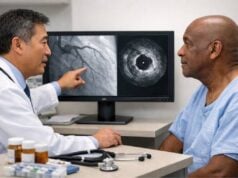
Calcific aortic valve disease (CAVD) is a slow, progressive condition where the aortic valve leaflets become thicker, stiffer, and increasingly coated with calcium. Early on, the valve may look “scarred” or mildly calcified yet still open well enough to move blood forward. Later, the opening can narrow (aortic stenosis), forcing the heart to pump at higher pressure to deliver the same amount of blood to the body. Many people live for years without obvious symptoms, then notice a sharper change in stamina as the valve becomes tight. Because the tipping point can be subtle, understanding how CAVD progresses—what to watch for, how it is measured, and when treatment changes from monitoring to valve replacement—helps you make safer, more timely decisions with your clinician.
Table of Contents
- What CAVD is and how it progresses
- Why calcium builds up on the valve
- Risk factors and who gets it earlier
- Symptoms and complications to take seriously
- How it is diagnosed and followed over time
- Treatment and management from medicines to valve replacement
What CAVD is and how it progresses
The aortic valve is the heart’s “front door” to the body. With each beat, it opens to let oxygen-rich blood leave the left ventricle and enter the aorta, then closes tightly to prevent backflow. Calcific aortic valve disease is a spectrum of changes that affect the valve leaflets over years. It often starts as aortic sclerosis—thickening and early calcification that does not significantly block flow. Some people remain in this stage indefinitely. Others progress to calcific aortic stenosis, where the valve opening becomes narrowed enough to create a meaningful obstruction.
A helpful way to think about CAVD is that it is both a valve disease and a heart muscle stress test. As the valve stiffens, the left ventricle must generate higher pressure to push blood through a smaller opening. The heart adapts by thickening its wall (hypertrophy). This can keep cardiac output normal for a time, but the thicker muscle often becomes less flexible, raising filling pressures and contributing to breathlessness.
Typical stages people hear about
- Aortic sclerosis: Calcification present, but the valve still opens reasonably well. Often found incidentally on an echocardiogram.
- Mild-to-moderate aortic stenosis: Measurable narrowing. Many people feel normal, but subtle limits may appear with exertion.
- Severe aortic stenosis: Marked narrowing that increases the risk of symptoms, heart failure, arrhythmias, and adverse outcomes if untreated.
Why progression can feel “sudden”
Valve narrowing is not linear. As the opening becomes smaller, small additional calcium deposits can produce larger increases in pressure gradient. That is why someone may feel stable for years and then notice a meaningful drop in stamina over several months.
What CAVD is not
CAVD is often labeled “degenerative,” but it is not simply passive aging. The valve undergoes active remodeling: inflammation, fibrosis (scar-like tissue), and calcification that follows bone-like signaling pathways. This matters because it explains why researchers are pursuing targeted drug therapies—although, for now, valve replacement remains the only definitive treatment once stenosis becomes severe.
Why calcium builds up on the valve
CAVD develops where biology meets physics. The aortic valve experiences intense mechanical stress—opening and closing about 100,000 times per day. Over decades, microscopic injury can occur in the thin surface layer of the leaflets (the endothelium). In susceptible valves, that injury allows lipids and inflammatory cells to enter the valve tissue and trigger a cascade that ends in fibrosis and calcium deposition.
The “active calcification” concept
Calcium does not simply “settle” onto the valve. Valve interstitial cells, which normally maintain leaflet structure, can shift into an osteogenic (bone-forming) program under chronic stress and inflammatory signals. This shift promotes:
- Fibrosis: thickened, less flexible leaflets
- Nodular calcification: hard deposits that limit leaflet motion
- Stiffening of the whole valve apparatus: sometimes extending into the annulus (the valve’s ring)
Common biological drivers
Several pathways tend to repeat across studies and explain why certain risk factors matter:
- Inflammation and oxidative stress promote tissue remodeling and calcification signaling.
- Lipid deposition (including lipoprotein(a) in many patients) can amplify inflammation locally in the valve.
- Disordered mineral metabolism (especially in advanced chronic kidney disease) can accelerate calcification through phosphate and calcium regulation changes.
- Abnormal flow patterns across the valve, such as in bicuspid aortic valves, increase shear stress and leaflet injury.
Why cholesterol control still matters, even if it does not “fix” the valve
People often ask whether statins or other lipid-lowering drugs can stop valve calcification. For established calcific stenosis, medications have not reliably prevented progression in clinical practice. However, many people with CAVD also have coronary artery disease risk. Treating blood pressure and lipids can reduce the likelihood of heart attacks and strokes and can make any future valve procedure safer.
A practical takeaway for patients
If you have CAVD, it is reasonable to treat it as two parallel priorities:
- Track the valve with appropriate imaging and symptom monitoring.
- Protect the rest of the cardiovascular system with evidence-based control of blood pressure, diabetes, smoking status, and cholesterol when indicated.
That dual focus helps you stay stable longer and improves outcomes if you eventually need valve intervention.
Risk factors and who gets it earlier
CAVD becomes more common with age, but age alone is not the whole story. Risk reflects a mix of valve anatomy, inherited biology, and long-term exposure to cardiovascular stressors. Knowing the risk factors helps clinicians decide how closely to follow a patient and helps patients understand why their course may differ from a friend’s or family member’s.
Major risk factors
- Older age: Risk rises steadily after midlife, and clinically significant stenosis is most common in older adults.
- Bicuspid aortic valve: A congenital (born-with) two-leaflet valve found in roughly 1% to 2% of people. It often leads to earlier calcification and stenosis because the flow pattern is more turbulent.
- Family history: Valve disease and elevated lipoprotein(a) can cluster in families.
- High blood pressure: Increases afterload and may accelerate ventricular thickening and symptom onset.
- Elevated lipoprotein(a) (Lp(a)): A genetically influenced lipid particle associated with aortic valve calcification and faster progression in many cohorts.
- Diabetes and metabolic syndrome: Promote inflammation and vascular and valvular remodeling.
- Smoking history: Adds oxidative stress and vascular injury signals.
- Chronic kidney disease: Especially advanced stages, where mineral metabolism changes can speed valve calcification.
- Prior chest radiation: Can cause delayed fibrosis and calcification of valves and surrounding structures years later.
Who should consider earlier or more careful screening
While routine population screening is not typical, clinicians often have a lower threshold to order an echocardiogram if you have:
- A known bicuspid valve
- A new murmur plus strong risk factors (older age, kidney disease, long-standing hypertension)
- Symptoms that do not fit your fitness level (new breathlessness, reduced exercise tolerance)
- A history of chest radiation with new cardiac symptoms
What patients can influence
You cannot change your valve anatomy or age, but you can meaningfully lower the “background noise” that worsens outcomes:
- Keep blood pressure in a clinician-recommended range.
- Aim for steady aerobic activity if your clinician says it is safe.
- Stop smoking and avoid secondhand smoke exposure.
- Treat diabetes and sleep apnea if present.
- Maintain dental and general infection care, because infections can stress the heart and complicate valve disease.
A useful mindset
CAVD is not a moral failing and not caused by dietary calcium in typical amounts. Think of risk factor control as strengthening the rest of your cardiovascular system so it can better tolerate valve disease—and so you enter any future procedure in the best possible condition.
Symptoms and complications to take seriously
Many people with early CAVD have no symptoms. The challenge is that people also “downshift” quietly—walking slower, avoiding hills, choosing lighter loads—so symptoms can hide in plain sight. A clear description of what you can and cannot do is often more helpful than a simple “I feel fine.”
Early symptoms people often overlook
- Reduced exercise capacity: Needing more breaks, taking longer to recover after activity.
- Shortness of breath with exertion: Especially on stairs or inclines.
- Chest pressure during activity: Sometimes due to the heart muscle demanding more oxygen while pumping against resistance.
- Lightheadedness with exertion: A sign the heart may not be increasing output adequately.
Red-flag symptoms that change urgency
When the valve becomes severely narrowed, certain symptoms carry higher risk and usually trigger prompt re-evaluation:
- Fainting or near-fainting
- Chest pain at rest or persistent chest pressure
- Severe breathlessness, especially at rest or waking from sleep
- Rapid swelling of legs or sudden weight gain over days
- New confusion, weakness, or stroke-like symptoms
Complications that can develop over time
CAVD can affect more than the valve:
- Left ventricular hypertrophy and stiffness: Can cause heart failure symptoms even if pumping strength looks “normal” on a basic measure.
- Reduced pumping function: After prolonged pressure overload, the ventricle can weaken.
- Pulmonary hypertension: Increased pressures can transmit backward into the lungs.
- Arrhythmias: Atrial fibrillation can occur, and severe calcification can be associated with conduction problems in some patients.
- Coronary artery disease coexistence: Many patients have overlapping vascular disease, which may influence symptoms and treatment planning.
How to describe symptoms in a way that helps decision-making
Try framing symptoms around specific activities and timelines:
- What could you do six months ago that feels harder now?
- How many flights of stairs can you climb before stopping?
- Can you carry groceries without pausing?
- Do symptoms appear only with exertion, or also at rest?
If you track one or two repeatable activities weekly—such as a walking route or stair count—you create a reliable “trend line.” That trend often guides clinicians when deciding whether monitoring is still safe or whether it is time to plan valve intervention.
How it is diagnosed and followed over time
CAVD is diagnosed through a combination of history, physical exam, and imaging. The key goal is not only to confirm calcification, but to determine whether the valve is obstructing blood flow and whether the heart is showing signs of strain.
Physical exam: helpful, not definitive
A systolic murmur is often the first clue. Clinicians may also notice changes in pulse quality or heart sounds in more advanced stenosis. However, exam findings cannot reliably grade severity, so imaging is essential.
Echocardiography as the central test
A transthoracic echocardiogram (TTE) is typically the first-line study. It can:
- Visualize valve thickening and calcification
- Measure blood flow velocity across the valve
- Estimate pressure gradients
- Calculate effective valve area
- Assess left ventricular thickness, filling patterns, and pumping function
- Evaluate other valve problems (such as regurgitation) that can change management
Clinicians often describe disease as mild, moderate, or severe using multiple measurements together rather than one number in isolation.
When results seem confusing
Sometimes measurements do not “line up.” For example, a person may have a small valve area but a lower-than-expected gradient. This can occur when forward flow is low, such as:
- A weakened ventricle that cannot generate normal stroke volume
- A small, stiff ventricle that has preserved ejection fraction but still produces low flow
In these cases, clinicians may use additional testing to clarify true severity and risk.
Other tests that inform planning
Depending on your situation, you may be offered:
- Exercise testing: Useful when symptoms are unclear; it can reveal exertional limits or abnormal blood pressure response.
- CT imaging: Helps quantify calcium burden and, importantly, maps anatomy for transcatheter valve procedures.
- Cardiac catheterization: Sometimes used to evaluate coronary arteries before valve replacement or to resolve uncertainty in hemodynamics.
- Laboratory tests: Not diagnostic for valve severity, but important for safety planning (kidney function, anemia, thyroid status, fluid balance markers).
What “good follow-up” looks like
Most safe monitoring plans include:
- A scheduled interval for repeat echocardiograms based on severity and symptoms
- Clear instructions for what symptom changes should prompt earlier review
- A plan for managing blood pressure, rhythm issues, and fluid status
The objective is to detect progression early enough that treatment can be planned thoughtfully rather than in a crisis.
Treatment and management from medicines to valve replacement
Treatment decisions in CAVD depend on where you are on the spectrum—sclerosis versus stenosis—and on how your heart is responding. Today, no medication has consistently proven able to reverse established calcific valve narrowing. For that reason, definitive therapy for severe, clinically significant stenosis is usually valve replacement. Still, “no valve-stopping pill” does not mean “no treatment.” Good management can reduce symptoms, lower cardiovascular risk, and improve outcomes after procedures.
Medical therapy: what it can do
Medicines are used to stabilize the overall cardiovascular system and treat coexisting problems:
- Blood pressure control: Reduces cardiac workload, though dosing must be individualized in more advanced stenosis to avoid excessive drops in pressure.
- Diuretics for congestion: Can relieve fluid overload in selected patients, used carefully to avoid dehydration or low output.
- Lipid-lowering therapy when indicated: Important for vascular risk reduction even if it does not stop valve calcification.
- Arrhythmia management: Rate or rhythm control strategies, and anticoagulation when appropriate, especially if atrial fibrillation develops.
A useful principle is that medications are supportive and risk-reducing, but they do not replace careful surveillance or the need for mechanical correction when obstruction becomes severe.
Valve replacement: the definitive therapy for severe stenosis
When stenosis becomes severe and symptoms are present—or when tests show the heart is being harmed—clinicians typically recommend valve replacement. Two main approaches exist:
- Surgical aortic valve replacement (SAVR): The diseased valve is removed and replaced with a mechanical or bioprosthetic valve. Mechanical valves are durable but usually require lifelong anticoagulation. Bioprosthetic valves often avoid lifelong anticoagulation but can wear over time.
- Transcatheter aortic valve replacement (TAVR): A catheter-based procedure, commonly through an artery in the groin, that deploys a new valve within the old valve. Recovery is often faster, and it can be an excellent option for many patients depending on anatomy and risk profile.
How clinicians choose the best option
Most centers weigh:
- Age and expected durability needs
- Frailty and functional status
- Kidney function and bleeding risk
- Coronary artery disease and whether bypass surgery is needed
- Valve anatomy and access route suitability for TAVR
- Personal priorities, such as recovery time, anticoagulation tolerance, and lifestyle goals
Living well before and after intervention
Before intervention, focus on symptom tracking, safe activity, and risk factor control. After intervention, success depends on follow-up and rebuilding conditioning. Many patients benefit from cardiac rehabilitation, which provides supervised exercise progression and practical education. The overarching goal is not only a better valve, but a stronger, steadier cardiovascular system for the years ahead.
References
- 2025 ESC/EACTS Guidelines for the management of valvular heart disease 2025 (Guideline)
- 2020 ACC/AHA Guideline for the Management of Patients With Valvular Heart Disease: A Report of the American College of Cardiology/American Heart Association Joint Committee on Clinical Practice Guidelines 2021 (Guideline)
- Calcific aortic valve disease: mechanisms, prevention and treatment 2023 (Systematic Review)
- Reactivation of Oxidized Soluble Guanylate Cyclase as a Novel Treatment Strategy to Slow Progression of Calcific Aortic Valve Stenosis: Preclinical and Randomized Clinical Trials to Assess Safety and Efficacy 2025 (RCT)
Disclaimer
This article is for educational purposes only and does not provide medical advice, diagnosis, or treatment. Calcific aortic valve disease can progress and may require time-sensitive evaluation, especially if symptoms develop. Seek emergency care for chest pain at rest, fainting, severe shortness of breath, or stroke-like symptoms. For personal guidance—such as how severe your valve disease is, how often you need imaging, and whether you should plan valve replacement—consult a qualified clinician who can interpret your symptoms and test results in context.
If you found this article useful, please share it on Facebook, X (formerly Twitter), or any platform you prefer, and follow us on social media. Your support through sharing helps our team continue producing high-quality health content.