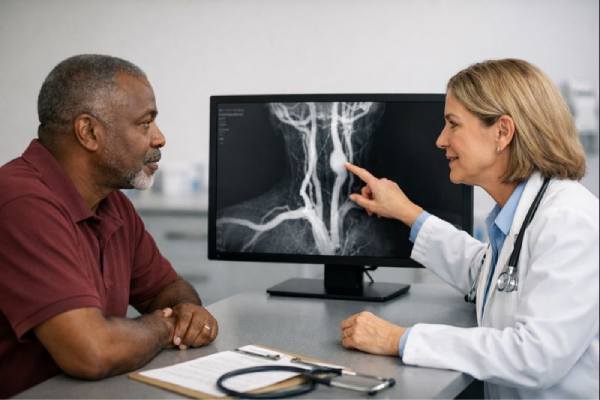
A carotid artery aneurysm is an abnormal widening of the carotid artery—one of the major blood vessels that carries oxygen-rich blood to the brain. Most people first hear the term after a scan finds a “bulge” in the neck or near the base of the skull, and the immediate worry is understandable: will it rupture, cause a stroke, or keep growing? The reassuring truth is that many carotid aneurysms are treatable, and some can be watched safely. The harder part is that “carotid aneurysm” can mean different problems—true aneurysm, pseudoaneurysm after injury, dissection-related swelling, or infection—each with its own risks and best treatment. This guide explains what the condition is, what symptoms matter most, how doctors confirm the diagnosis, and what treatment and follow-up usually involve, so you can make decisions with clear expectations rather than fear.
Table of Contents
- What it is and why it matters
- Causes and risk factors
- Symptoms, warning signs, complications
- How it’s diagnosed
- Treatment options and what to expect
- Management, prevention, and when to seek care
What it is and why it matters
A carotid artery aneurysm is a localized enlargement of the carotid artery wall. The carotid system has two main segments people refer to:
- Extracranial carotid arteries (in the neck): these are the common carotid artery and the internal carotid artery before it enters the skull.
- Intracranial carotid artery (inside the skull): aneurysms here behave more like “brain aneurysms” and are usually managed with neurovascular teams.
Most discussions of “carotid artery aneurysm” in a vascular clinic focus on the extracranial form because it can present as a neck mass, cause cranial nerve compression, or lead to embolic stroke. Extracranial carotid artery aneurysms are uncommon, so care is often individualized and guided by anatomy, symptoms, and how quickly the aneurysm is changing.
It also helps to know the type, because “aneurysm” is sometimes used loosely:
- True aneurysm: the artery wall balloons outward but remains made of the vessel’s normal layers (even if thinned). This is often related to atherosclerosis (plaque disease), fibromuscular dysplasia, connective tissue disorders, or degenerative changes.
- Pseudoaneurysm: the wall is disrupted and blood collects outside the normal layers, contained by surrounding tissue. This is commonly linked to trauma, prior surgery or catheter procedures, radiation, or infection.
- Dissection-related aneurysm (dissecting aneurysm): a tear within the artery wall creates a false channel, which can widen and mimic an aneurysm.
Why it matters comes down to three main risks:
- Stroke or transient ischemic attack (TIA): clots can form on rough aneurysm surfaces and travel to the brain.
- Local compression: a growing aneurysm can press on nearby nerves and structures, leading to pain, hoarseness, swallowing problems, or tongue weakness.
- Rupture or bleeding: this is less common in many extracranial aneurysms than people fear, but it becomes more concerning with rapidly expanding pseudoaneurysms, infection, or trauma-related lesions.
A key practical point is that treatment decisions are rarely made from size alone. Clinicians weigh the aneurysm’s cause (true vs pseudo vs infected), shape, presence of thrombus, location (how close to the skull base), and the patient’s neurologic symptoms. This is why two people with “similar” scan measurements can get very different, equally appropriate recommendations.
Causes and risk factors
Carotid artery aneurysms form when the artery wall becomes weakened or injured. For extracranial carotid aneurysms, clinicians generally sort causes into a few major buckets because each bucket points toward different risks and treatments.
Common causes
- Atherosclerosis and degenerative change: Over time, plaque and chronic inflammation can weaken the wall, especially in older adults or people with long-standing cardiovascular risk factors.
- Trauma and iatrogenic injury: Blunt neck trauma, penetrating injury, or vessel puncture during procedures can create a pseudoaneurysm. Even “minor” trauma may matter if symptoms appear later.
- Post-surgical or post-intervention changes: Prior carotid surgery, stents, or catheter-based procedures can rarely lead to pseudoaneurysm at the repair site or access site.
- Dissection: A tear within the wall can expand into a dissecting aneurysm. Some dissections follow trauma; others occur spontaneously.
- Infection (infected or “mycotic” aneurysm): Bacteria (and less commonly tuberculosis or fungi) can seed the artery wall from nearby infection or bloodstream spread, leading to a fragile, rapidly progressive aneurysm that can bleed or embolize.
- Connective tissue and inherited disorders: Conditions that affect collagen or elastic tissue can raise vulnerability (for example, certain familial aneurysm syndromes), especially in younger patients.
- Fibromuscular dysplasia (FMD): A non-atherosclerotic arteriopathy that can affect the carotids and other arteries, sometimes linked to aneurysm or dissection.
- Radiation-associated vessel injury: Prior head/neck radiation can cause long-term vessel wall damage and scarring that complicate later repairs.
Risk factors that influence suspicion and urgency
Some factors increase the likelihood of having an aneurysm; others increase the chance it will cause harm.
Factors that raise likelihood
- Age over 60 (for degenerative/atherosclerotic forms)
- Smoking history
- High blood pressure
- High cholesterol and diabetes
- Known peripheral artery disease or coronary artery disease
- Prior carotid procedures or neck surgery
- Neck radiation exposure
Factors that raise danger
- Neurologic symptoms (TIA, stroke-like symptoms, amaurosis fugax—temporary vision loss)
- Signs of infection (fever, elevated inflammatory markers, local redness, rapid expansion, pain)
- Recent trauma with a new pulsatile mass or neurologic symptoms
- Rapid growth on serial imaging
- Complex anatomy (very high internal carotid lesions near the skull base) that makes certain repairs more challenging
- Thrombus within the aneurysm (often described in imaging reports), which can increase embolic risk
One original way to think about risk is to separate “risk of forming” from “risk of consequences.” Atherosclerosis may be a slow burn: it increases the chance of developing a true aneurysm, but symptoms may creep in gradually. Infection and trauma can be the opposite: the aneurysm may be newer but more unstable, with a shorter runway to complications. That difference is why clinicians often move faster with pseudoaneurysms, dissecting lesions with symptoms, or any aneurysm suspected to be infected—even if the measured diameter does not look dramatic.
Symptoms, warning signs, complications
Many carotid artery aneurysms are found incidentally on ultrasound or CT angiography done for another reason. When symptoms do occur, they usually fall into three categories: neurologic events, local neck symptoms, or systemic illness (especially infection).
Typical symptoms
Neurologic symptoms (often embolic)
- Sudden weakness or numbness on one side of the face or body
- Trouble speaking or understanding speech
- Sudden vision loss in one eye or a “curtain” descending over vision
- Severe dizziness, loss of coordination, or imbalance
- A brief episode that fully resolves within minutes to hours (TIA)
Local neck or throat symptoms
- A pulsating lump in the neck
- Neck pain or tenderness, sometimes radiating toward the jaw or ear
- Hoarseness or voice changes
- Difficulty swallowing or a “pressure” sensation in the throat
- Tongue weakness or deviation (from nerve compression) in rare cases
Symptoms that suggest infection or an unstable pseudoaneurysm
- Fever, chills, night sweats
- Rapidly worsening neck pain or swelling
- Redness or warmth over the area
- Feeling unwell out of proportion to local symptoms
Complications clinicians try to prevent
- Stroke or TIA from emboli: Blood flow inside an aneurysm can become turbulent and sluggish, allowing clot to form. Small fragments can break off and travel to the brain. This risk tends to rise if the aneurysm contains thrombus, has an irregular surface, or is symptomatic.
- Thrombosis or flow limitation: In some cases the aneurysm or associated dissection reduces blood flow through the internal carotid artery. Reduced flow can cause neurologic symptoms, especially if collateral circulation is limited.
- Cranial nerve injury from compression: Enlargement can press on nerves controlling voice, swallowing, tongue movement, and facial sensation. These symptoms are often subtle at first—voice fatigue, mild swallowing difficulty—then become more noticeable.
- Rupture or hemorrhage: True extracranial aneurysm rupture is not the most common outcome, but pseudoaneurysms—especially traumatic or infected ones—can be fragile and bleed. If bleeding occurs near the airway, it can become life-threatening quickly.
- Procedure-related complications: When treatment is required, the biggest feared complication is stroke during repair. Open surgery can also involve temporary nerve irritation or injury because nerves run close to the carotid sheath. Endovascular procedures introduce their own issues, such as stent clotting, restenosis, or the need for long-term antiplatelet therapy.
Red flags that should trigger urgent evaluation
Seek emergency care immediately if you have:
- Any sudden stroke-like symptom, even if it resolves
- Sudden, severe neck swelling or bleeding
- New neurologic symptoms plus a known carotid aneurysm or recent neck trauma
- Fever with a painful, enlarging pulsatile neck mass
- Trouble breathing or swallowing that is worsening
When symptoms are subtle, people sometimes delay care because they feel “too normal” between episodes. With carotid aneurysms, those quiet gaps can be misleading. A single transient episode can still signal a high-risk situation that deserves prompt evaluation and a clear plan.
How it’s diagnosed
Diagnosing a carotid artery aneurysm is usually straightforward once the right imaging is performed. The more nuanced part is defining the type, the cause, and the risk profile, because these shape treatment decisions.
Step 1: History and exam
Clinicians start by looking for clues that separate true aneurysm from pseudoaneurysm or infection:
- Recent neck trauma, surgery, catheter procedure, or radiation
- TIA/stroke symptoms, even brief ones
- Fever or signs of local infection
- Headache or neck pain that began suddenly (possible dissection)
- Family history of aneurysms, connective tissue disease, or unusual vascular events at a young age
On exam, they may find a pulsatile neck mass or a bruit (a whooshing sound). They also check a focused neurologic exam, looking for subtle speech, vision, strength, and coordination changes.
Step 2: First-line imaging
- Duplex ultrasound: Often the starting point. It can confirm a vascular mass, estimate size, detect turbulent flow, and identify thrombus. It is noninvasive and useful for follow-up.
- CT angiography (CTA): Commonly used to map anatomy precisely—location relative to the skull base, relationship to branches, wall calcification, and surrounding structures. CTA is especially helpful for surgical planning.
- MR angiography (MRA): Useful when radiation avoidance matters or when better soft-tissue detail is needed. It can also help evaluate dissection and vessel wall characteristics in some settings.
Step 3: Tests used for planning or special scenarios
- Digital subtraction angiography (DSA): An invasive catheter angiogram. It provides high-resolution detail and is often used when an endovascular procedure is planned or when noninvasive imaging is inconclusive.
- Brain imaging (CT or MRI): If neurologic symptoms occurred, brain imaging helps confirm stroke, estimate timing, and guide urgency.
- Laboratory tests: If infection is possible, clinicians often order blood cultures and inflammatory markers, and they look for a source (skin, dental, throat, respiratory, or deeper infections).
What the radiology report usually tries to answer
A well-structured report helps the treating team decide between observation, open repair, endovascular repair, or hybrid approaches. It often includes:
- Exact location (common carotid vs internal carotid; distance from skull base)
- Estimated diameter and length
- Whether it appears true, pseudoaneurysm, or dissecting
- Presence of intraluminal thrombus
- Vessel tortuosity (how twisty it is) and landing zones for stents
- Evidence of dissection, stenosis, or associated carotid plaque
- Any signs of surrounding inflammation or infection
One important practical detail: different imaging methods can produce slightly different measurements. What matters most is not a single number but the trend over time and the clinical context—symptoms, growth rate, and aneurysm type. If you’re monitoring an aneurysm, it’s often safest to use the same imaging method and lab standard each time, so changes reflect biology rather than measurement noise.
Treatment options and what to expect
Treatment ranges from careful observation to urgent repair. The decision depends on symptoms, aneurysm type, and anatomy—especially how high the aneurysm sits and whether it is amenable to open surgery, endovascular repair, or a hybrid approach.
When observation may be reasonable
Observation is most often considered when the aneurysm is:
- Asymptomatic
- Stable in size on repeat imaging
- A true aneurysm without features suggesting instability
- In a patient where procedural risk is high and expected benefit is low
Observation is not “do nothing.” It usually includes antiplatelet therapy when appropriate, cardiovascular risk reduction, and scheduled imaging to detect growth or thrombus changes early.
Open surgical repair
Open repair has a long track record, especially for accessible aneurysms in the neck. Common approaches include:
- Resection of the aneurysm with end-to-end anastomosis (sewing artery ends together)
- Resection with interposition graft (using vein or synthetic graft) if a segment is removed
- Patch angioplasty or reconstruction tailored to the defect
Potential advantages:
- Direct removal or exclusion of diseased tissue
- Durable reconstruction in many anatomies
Potential downsides:
- Higher risk of temporary or permanent cranial nerve injury due to the crowded anatomy
- More challenging exposure for aneurysms close to the skull base
Endovascular repair
Endovascular treatment works from inside the vessel, usually through a catheter. Techniques may include:
- Covered stent grafts to exclude the aneurysm while maintaining flow
- Stent-assisted techniques in selected anatomies
- Adjunctive embolization in certain pseudoaneurysms (case-dependent)
Potential advantages:
- Avoids large neck dissection
- Often useful for higher lesions that are hard to expose surgically
- May lower cranial nerve injury risk
Potential downsides:
- Requires appropriate landing zones and vessel geometry
- Often requires antiplatelet therapy afterward
- Risks include in-stent thrombosis, restenosis, and embolic events during the procedure
Hybrid approaches
Some aneurysms are best handled by combining limited surgical exposure with endovascular exclusion. Hybrid strategies can help when anatomy makes a purely open or purely endovascular approach unsafe.
Special situation: suspected infection
Infected carotid aneurysms require urgent specialist care. Management commonly includes:
- Prompt antibiotics guided by cultures when possible
- Careful planning of repair (often leaning toward strategies that remove infected tissue or control the infection source)
- Close monitoring for embolic and bleeding complications
What recovery often involves
Recovery depends on the approach, but most plans include:
- Neurologic checks and blood pressure control in the early period
- Antiplatelet therapy decisions based on repair type and patient risk
- Follow-up imaging (often ultrasound, sometimes CTA/MRA) to confirm patency and exclusion
- Clear instructions on when to return to exercise and work
A useful mindset is to treat repair as the start of a longer safety plan, not the finish line. The first goal is to prevent stroke and bleeding; the second is to protect the repair for years through follow-up and risk-factor control.
Management, prevention, and when to seek care
Long-term management focuses on reducing embolic risk, preventing progression, and ensuring any repair stays open and stable. Because carotid artery aneurysms are uncommon, follow-up is often individualized—but strong patterns exist.
After diagnosis: building a practical plan
Whether you are observing an aneurysm or recovering from repair, it helps to leave each visit with four clear answers:
- What type is it? (true vs pseudo vs dissecting vs infected)
- What is the short-term risk? (symptoms, thrombus, growth, infection signs)
- What is the follow-up schedule? (which imaging test, and when)
- What symptoms should trigger urgent re-evaluation?
Many clinicians also recommend managing blood pressure tightly because pressure spikes can worsen dissection-related disease and strain vessel walls.
Medication and vascular risk reduction
Plans often include some combination of:
- Antiplatelet therapy (often considered when embolic risk is a concern or after stenting)
- Cholesterol lowering therapy when atherosclerosis is present or overall vascular risk is high
- Blood pressure control with home monitoring targets set by your clinician
- Diabetes management and weight optimization when relevant
- Smoking cessation support, which is one of the most meaningful steps for long-term vascular health
If you have a stent, do not stop antiplatelet medication abruptly without discussing it first; interruption can raise clot risk.
Imaging follow-up: what it’s trying to catch
Follow-up imaging looks for:
- Growth or shape change in an observed aneurysm
- New thrombus formation
- Narrowing at a repair site (restenosis)
- Stent patency and endoleak-like flow patterns in excluded aneurysms
Ultrasound is commonly used for surveillance because it is safe and repeatable. CTA or MRA may be used when ultrasound windows are limited, anatomy is complex, or detail is needed.
Activity and daily life
Most people can live normally with appropriate monitoring, but two practical cautions are common:
- Avoid sudden, extreme neck strain or heavy isometric lifting until your clinician confirms safety, especially after recent repair or dissection-related disease.
- Treat new neurologic symptoms as urgent, even if they resolve, because brief events can be warning shots.
When to seek care
Seek emergency care immediately for:
- Any stroke-like symptom (face droop, arm weakness, speech difficulty, sudden vision loss)
- Sudden severe neck swelling, bleeding, or breathing difficulty
- Rapidly worsening neck pain with fever
Contact your clinician promptly for:
- New or worsening pulsatile neck mass
- New hoarseness, swallowing difficulty, or tongue weakness
- Persistent headache/neck pain after a suspected dissection
- Any change in symptoms after tapering or changing medications
Prevention is not only about avoiding aneurysm growth; it is about reducing the chance that a rare condition becomes a life-changing event. A steady routine—medications as prescribed, follow-up imaging, and cardiovascular risk control—often delivers the biggest safety gains over time.
References
- Extracranial Carotid Artery Aneurysms: A Comprehensive Analysis of its Epidemiology, Pathogenesis, Diagnosis, and Management: A Scoping Review – PubMed 2024 (Scoping Review)
- Systematic Review of the Influence of Anatomy and Aneurysm Type on Treatment Choice and Outcomes in Extracranial Carotid Artery Aneurysms – PubMed 2022 (Systematic Review)
- Infective Native Extracranial Carotid Artery Aneurysms: A Systematic Review – PubMed 2023 (Systematic Review)
- Invasive treatment for extracranial carotid artery aneurysm: a single-center case series and literature review – PMC 2024 (Case Series, Review)
Disclaimer
This article is for general education and does not replace medical advice, diagnosis, or treatment from a qualified clinician. Carotid artery aneurysms can raise the risk of stroke or dangerous bleeding and may require urgent imaging and specialist care. If you develop stroke-like symptoms, sudden vision loss, severe or rapidly worsening neck swelling, bleeding, fever with a painful neck mass, or trouble breathing, seek emergency care immediately.
If this article helped you, please consider sharing it on Facebook, X (formerly Twitter), or any platform you prefer, and follow us on social media. Your support through sharing helps our team keep producing clear, reliable health content.