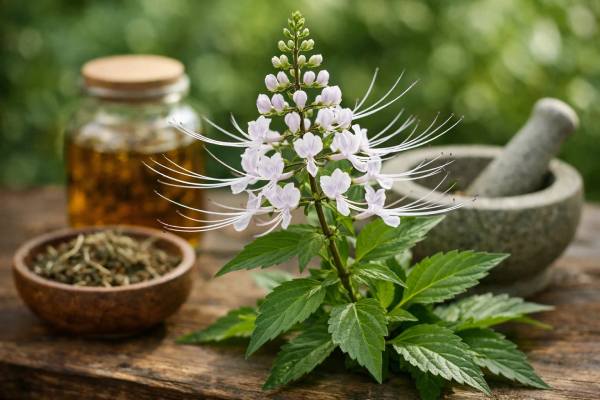
Cat’s whiskers (Orthosiphon aristatus), often called Java tea, is a traditional herbal leaf used most famously for “urinary tract flushing” and gentle fluid support. It’s a botanical that sits at the intersection of kitchen-cabinet practicality and pharmacy-level nuance: it can be brewed like a daily tea, yet its active plant compounds behave like true bioactives—shaping inflammation signals, oxidative stress, and the way the kidneys handle water and minerals.
People usually reach for cat’s whiskers when they want support for minor urinary discomfort, a tendency toward urinary “gravel,” or a feeling of water retention. Some also explore it for cardiometabolic goals—such as modest blood pressure support or help with blood sugar balance—although the strength of evidence varies by outcome and product type.
Because it influences urination, the smartest way to use cat’s whiskers is with clear goals, conservative dosing, and attention to hydration, blood pressure, and medications that already affect fluid or electrolytes.
Essential Insights for Cat’s Whiskers
- May support urinary flow and comfort when paired with adequate water intake.
- Provides antioxidant polyphenols that may help calm inflammatory stress in tissues.
- Typical tea range is 6–12 g dried leaf per day, split into 2–3 servings.
- Avoid combining with prescription diuretics unless your clinician approves.
- People who are pregnant, breastfeeding, or fluid-restricted should avoid it unless advised by a clinician.
Table of Contents
- What is cat’s whiskers?
- Key ingredients in Orthosiphon aristatus
- Cat’s whiskers for urinary health
- Does it support blood pressure and metabolism
- How to use cat’s whiskers
- How much to take per day
- Safety, interactions, and evidence
What is cat’s whiskers?
Cat’s whiskers (Orthosiphon aristatus) is a leafy herb in the mint family (Lamiaceae). The nickname comes from its distinctive flowers: long, fine stamens that resemble whiskers. In many regions, the dried leaves are brewed as “Java tea,” a daily infusion used to encourage urine flow and support urinary comfort. You may also see it listed under closely related or overlapping botanical names in commerce and research, including Orthosiphon stamineus and Clerodendranthus spicatus. In practice, the most important detail is the plant part: reputable products specify leaf (folium) and provide a standardization marker (often rosmarinic acid) or a dried-leaf equivalent.
Traditionally, cat’s whiskers is used as an adjuvant—meaning it supports the body’s own flushing mechanisms rather than acting as a direct antimicrobial or painkiller. The classic use pattern is simple: drink the tea and drink enough water to make the “flush” meaningful. This is why many traditional instructions pair it with a clear hydration goal rather than treating it as a standalone fix.
Modern interest goes beyond the urinary tract. The leaf contains phenolic acids and flavonoids that have antioxidant behavior in lab models, and researchers have explored potential roles in metabolic balance (glucose and lipids), inflammatory signaling, and uric-acid related pathways. The catch is that “cat’s whiskers” is not one standardized drug; effects depend on the extract type, dose, and how it’s prepared (tea vs concentrated extract).
If you’re choosing cat’s whiskers for a practical reason, it helps to be specific about the target:
- Urinary flow support and minor urinary discomfort (most traditional fit)
- Tendency toward urinary gravel (supportive, not a substitute for evaluation)
- Water retention feelings (sometimes helpful, sometimes not the true cause)
- Cardiometabolic support (evidence is more mixed and often involves combinations)
Key ingredients in Orthosiphon aristatus
Cat’s whiskers is best understood as a “polyphenol-forward” herb with a few signature compound families. These compounds don’t behave like single, high-impact pharmaceuticals; instead, they work more like a network—supporting antioxidant capacity, influencing inflammatory enzymes, and potentially shaping how the kidneys respond to oxidative and mineral stress.
1) Phenolic acids (caffeic-acid derivatives)
- Rosmarinic acid is the best-known marker compound in many standards. It acts as an antioxidant in experimental models and is often used to confirm identity and quality.
- Related caffeic-acid derivatives may also contribute to tissue-protective effects, especially where oxidative stress is part of the story (such as metabolic strain or renal irritation).
2) Flavonoids (especially polymethoxylated flavones)
Cat’s whiskers is known for flavones such as sinensetin and eupatorin (plus related compounds). In lab research, these compounds are studied for effects on inflammatory signaling, vascular tone pathways, and metabolic enzymes. Practical takeaway: flavonoids are a major reason extracts may feel “stronger” than tea—because concentrated extracts deliver higher amounts of these lipophilic compounds.
3) Diterpenes and triterpenes
Some standards and monographs describe characteristic diterpenes (often grouped as orthosiphol-type compounds) alongside triterpenes. These are part of why different extraction methods yield different “personalities” of the herb: water preparations emphasize hydrophilic polyphenols, while hydroalcoholic extracts often pull more lipophilic fractions.
4) Minerals and potassium salts
Traditional use as a diuretic-style tea also relates to mineral content and the overall matrix of the leaf. This does not mean it is a “potassium supplement,” but it does reinforce why cat’s whiskers belongs in the “fluid and electrolyte-aware” category—especially if you combine it with other diuretics.
Why preparation changes the chemistry
A practical point many people miss: boiling and steeping can change the chemical profile. Heat can increase extractable compounds and create a different mix than raw powdered leaf or cold infusions. That’s one reason research results can look inconsistent—two studies may both say “Orthosiphon,” but the actual chemistry in the cup (or capsule) is not identical.
Quality cues worth looking for on labels: leaf part specified, a standardization marker (often rosmarinic acid), and a stated dried-leaf equivalent for extracts.
Cat’s whiskers for urinary health
The most grounded, intent-aligned use of cat’s whiskers is urinary tract flushing—supporting urine output as an adjuvant for minor urinary tract discomfort and a sensation of “not feeling clear.” In this role, cat’s whiskers is less like an antibiotic and more like a structured hydration tool: it encourages flow while supplying plant antioxidants that may soothe irritation.
What it may help with (realistic expectations)
- Urinary flow support: People often report more frequent urination or a higher urine volume when using cat’s whiskers tea consistently. This can be useful when the goal is to “flush” the tract.
- Minor urinary discomfort: If discomfort is mild and related to transient irritation, supporting flow may help. This is not a guarantee, and it should not delay medical care when symptoms are significant.
- Urinary gravel tendency: Traditional systems often pair Java tea with advice aimed at reducing crystallization risk (hydration, dietary modifications). Some evidence suggests effects on urine parameters (like pH) in certain contexts, but clinical conclusions are limited.
- A “puffy” or water-retention feeling: If the driver is diet (high sodium), inactivity, or hormonal fluctuations, gentle diuretic-style herbs may help symptomatically. If the driver is heart, kidney, or liver disease, self-treating can be risky.
How it compares to other “urinary herbs”
Cat’s whiskers is often grouped with other flushing herbs such as corn silk for urinary tract support. The shared theme is not “killing germs” but supporting urine flow and comfort, especially when combined with adequate water intake.
When urinary symptoms are not a “tea problem”
Seek medical care promptly if you have any of the following:
- Fever, chills, flank pain, nausea, or vomiting
- Blood in urine, severe burning, or inability to urinate
- Symptoms lasting longer than a few days
- Recurrent urinary symptoms (pattern matters)
- Known kidney disease, kidney stones, or gout with new urinary symptoms
A practical urinary-support routine
- Choose tea or an extract with a clear dried-leaf equivalent.
- Pair each serving with a full glass of water.
- Use a short trial window (often 7–14 days) for minor complaints.
- Stop if you develop dizziness, weakness, rapid heartbeat, or signs of dehydration.
Cat’s whiskers is best viewed as a supportive strategy—useful when hydration and gentle flow are the right tools, and inappropriate when symptoms signal infection, obstruction, or systemic illness.
Does it support blood pressure and metabolism
Beyond urinary support, cat’s whiskers is frequently discussed for cardiometabolic goals—especially blood pressure, blood sugar balance, lipids, and inflammatory markers. Here, the evidence is more nuanced: promising mechanisms and some human research exist, but outcomes often depend on product formulation and whether cat’s whiskers is used alone or in combination.
Blood pressure and vascular support (what’s plausible)
There are two main ways cat’s whiskers could influence blood pressure:
- Fluid balance: If someone is salt-sensitive or retaining fluid, increased urine output may modestly reduce volume-related pressure. This effect is not guaranteed and may be subtle.
- Vascular and oxidative pathways: Flavonoids and phenolic acids are studied for antioxidant activity that can support endothelial function in experimental models. In real-world terms, this might translate to small improvements in vascular tone or inflammatory status for some individuals.
A key detail: some clinical studies involve multi-ingredient nutraceuticals where cat’s whiskers is one component alongside minerals or other botanicals. In those cases, it’s difficult to attribute benefits to cat’s whiskers alone, but the combination pattern is still relevant for consumers because it reflects how products are commonly formulated. For example, blends that include hibiscus for cardiovascular support may target both vascular tone and fluid balance, which can make outcomes more noticeable than a single herb.
Blood sugar and lipids (where the interest comes from)
Research has explored cat’s whiskers for:
- Support of glucose handling and insulin signaling pathways in preclinical work
- Antioxidant effects that may protect tissues stressed by high blood sugar
- Potential influence on lipid metabolism markers in experimental settings
The practical interpretation is conservative: cat’s whiskers is not a replacement for diet, exercise, or prescribed therapies. If it helps, it’s most likely as a modest adjunct—supporting inflammatory balance and oxidative stress rather than acting like a stand-alone glucose-lowering drug.
Who might notice benefit
- People with mild, early cardiometabolic strain who are also improving lifestyle factors
- Individuals with high-normal blood pressure who respond to changes in sodium and hydration
- Those who tolerate diuretic-style herbs well (no dizziness or low blood pressure)
Who should be cautious
- Anyone already on antihypertensive drugs (risk of additive lowering)
- People prone to low blood pressure, lightheadedness, or dehydration
- Those on fluid restrictions or with unstable kidney/heart conditions
Bottom line: cardiometabolic use is plausible, but it’s the area where product choice and medical context matter most.
How to use cat’s whiskers
Cat’s whiskers is versatile, but the “best” form depends on your goal and your tolerance for diuretic-style effects. In general, tea is gentler and easier to titrate, while extracts can be more concentrated and less forgiving if you are sensitive to blood pressure or dehydration.
1) Tea (infusion or decoction)
This is the traditional and often most practical route for urinary support.
- How it’s made: Place dried leaf in hot water, steep covered, then strain. Some people simmer briefly (a light decoction) for a stronger brew.
- Why it works for intent: You’re pairing the herb with hydration, which is the point for urinary flushing.
- Taste and compliance: The flavor is typically herbal and slightly bitter. A consistent routine matters more than making it extremely strong.
2) Standardized dry extract (capsules/tablets)
Extracts are useful when:
- You need portability or dislike tea
- You want a product with a defined standardization marker
- You’re trying to match a studied dried-leaf equivalent
Because extracts vary widely, look for labels that state either:
- Standardization (for example, a marker like rosmarinic acid), and/or
- A drug extract ratio (DER) with extraction solvent, and/or
- A dried-leaf equivalent amount
3) Liquid extracts and tinctures
These can be easier to titrate than capsules for some people. The solvent matters: hydroalcoholic preparations can pull different compounds than water-based extracts, which may shift the feel and potency.
4) Combining with lifestyle supports
Cat’s whiskers tends to perform best when paired with the basics that determine urinary and cardiometabolic outcomes:
- Adequate water intake (unless medically restricted)
- Lower sodium intake if fluid retention is an issue
- Regular movement (helps edema and vascular tone)
- Regular bathroom access (important if you increase urine output)
Common use mistakes
- Taking it while not drinking enough water, then wondering why urinary discomfort persists
- Stacking it with other diuretics (herbal or prescription) and developing dizziness
- Using it to self-treat severe urinary symptoms that warrant evaluation
- Taking concentrated extracts late in the day and disrupting sleep with nighttime urination
Used thoughtfully, cat’s whiskers can be a steady, low-drama support tool—especially in tea form—when your goal is urinary flow and comfort.
How much to take per day
Dosing cat’s whiskers is easiest when you think in dried-leaf equivalents. Tea dosing is usually expressed in grams of dried leaf per day, while extracts should ideally tell you what amount of dried leaf they correspond to.
Tea dosing (most traditional approach)
A common range is:
- 2–3 g dried leaf per serving, taken 2–3 times daily
- This typically equals 6–12 g dried leaf per day
Practical timing tips:
- Morning and early afternoon are often best if you want to avoid nighttime urination.
- If urinary support is the goal, pair each serving with a glass of water.
- If you are using tea for a short urinary “flush” routine, many people trial 7–14 days, then reassess.
Extract dosing (capsules, tablets, liquids)
Because products vary, follow the label—then sanity-check it with these principles:
- Prefer products that list a DER and/or dried-leaf equivalent.
- If the label provides a dried-leaf equivalent, many protocols aim around 3–4 g dried leaf equivalent per day for extracts used in short clinical contexts, while tea routines often sit higher (because they include hydration and a less concentrated preparation).
Titration: start low, then adjust
A cautious approach is especially important if you are sensitive to diuretics:
- Start with one serving daily for 2–3 days.
- Increase gradually to the target range if tolerated.
- Stop or reduce if you notice dizziness, unusual fatigue, cramps, or a “dry” feeling.
When to take breaks
Cat’s whiskers is often used in cycles rather than continuously, especially for urinary goals. Consider breaks if:
- Your initial goal is achieved
- You develop signs of dehydration
- You are not seeing meaningful benefit after 1–2 weeks
Avoiding diuretic stacking
If you already use diuretic-style supports—like dandelion as a traditional diuretic herb—use extra caution. Stacking multiple diuretics increases the chance of lightheadedness and electrolyte imbalance, especially in warm weather or with high activity.
If you have kidney disease, heart failure, or are on blood-pressure medications, dosing should be clinician-guided.
Safety, interactions, and evidence
Cat’s whiskers is widely used as a tea, and traditional monographs generally frame it as appropriate for short-term urinary flushing in otherwise healthy adults. Still, “natural” does not mean “risk-free,” especially because the herb can influence urination, blood pressure, and hydration status.
Common side effects (usually dose-related)
- Increased urination and possible sleep disruption if taken late
- Thirst, dry mouth, or mild dehydration if fluid intake is inadequate
- Lightheadedness, especially when standing quickly
- Stomach upset in sensitive individuals (more common with concentrated extracts)
Who should avoid cat’s whiskers unless advised by a clinician
- Pregnant or breastfeeding people: safety data is limited for these populations.
- Children: avoid unless specifically recommended by a qualified clinician.
- People on fluid restriction (heart failure, advanced kidney disease, certain liver conditions).
- Those with very low blood pressure or frequent dizziness/fainting.
Medication and supplement interactions to consider
- Diuretics: additive fluid and electrolyte effects.
- Antihypertensive drugs: may increase the chance of low blood pressure symptoms.
- Lithium: any diuretic-like effect can potentially influence lithium levels; this requires medical supervision.
- Diabetes medications: if you are using it for metabolic support, monitor for changes rather than assuming it is neutral.
Safety red flags that should stop use
- Rapid heartbeat, confusion, severe weakness
- Persistent vomiting or inability to keep fluids down
- Severe flank pain, fever, or blood in urine
- Swelling with shortness of breath (possible systemic issue)
What the evidence actually says (plain-language summary)
- Urinary flushing: the most consistent rationale is traditional use plus limited human data; it’s best framed as supportive care, not definitive treatment.
- Kidney stones and urinary gravel: mechanistic and preclinical research is promising, but human evidence is not strong enough to treat stones without medical evaluation.
- Blood pressure and metabolic outcomes: some human studies exist, often involving combined formulations; results can be meaningful but are not proof that cat’s whiskers alone will replicate the effect.
- Overall: cat’s whiskers is a reasonable short-term adjunct when the goal is urine flow support and the person is not medically fluid-restricted or on interacting medications.
For recurring urinary symptoms, consider evidence-based options such as hydration strategies, evaluation for causes, and—when appropriate—adjunct dietary measures. Some people also explore cranberry for urinary tract support, which is aimed at different mechanisms than diuretic-style flushing.
References
- Assessment report on Orthosiphon aristatus (Blume) Miq. var. aristatus, folium 2021 (Assessment Report)
- A Systematic Review of Orthosiphon stamineus Benth. in the Treatment of Diabetes and Its Complications 2022 (Systematic Review)
- Effect of dietary supplementation with Diuripres® on blood pressure, vascular health, and metabolic parameters in individuals with high-normal blood pressure or stage I hypertension: The CONDOR randomized clinical study 2023 (RCT)
- Analysis of the chemical constituents and their metabolites in Orthosiphon stamineus Benth. via UHPLC-Q exactive orbitrap-HRMS and AFADESI-MSI techniques 2024 (Phytochemistry Study)
Disclaimer
This article is for educational purposes only and does not replace medical advice, diagnosis, or treatment. Herbal products can affect hydration, blood pressure, electrolytes, and how some medications work. If you are pregnant, breastfeeding, have kidney or heart disease, take diuretics or blood pressure medications, or have persistent urinary symptoms (pain, fever, blood in urine, or flank pain), consult a qualified clinician before using cat’s whiskers. Stop use and seek care if symptoms worsen or new concerning symptoms appear.
If you found this guide helpful, consider sharing it on Facebook, X (formerly Twitter), or your favorite platform so others can make more informed, safer choices.