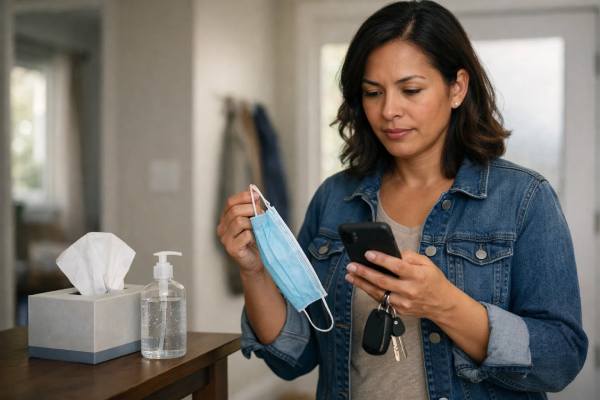
When you wake up with a sore throat or a tight, tired cough, the hardest decision is rarely the tissues or tea—it is whether you should stay home, and what “safe to return” really means. Updated respiratory virus guidance from Centers for Disease Control and Prevention aims to make that decision clearer across common illnesses such as COVID-19, flu, and RSV, while recognizing a practical reality: people need rules they can follow on ordinary days, not only during headlines.
The core idea is straightforward. Stay home during the most contagious phase, return when you have been improving and fever-free for a full day, and then add extra layers—especially masking and better airflow—for several days because contagiousness can linger even after you feel “mostly fine.” This article explains what the updated approach means in real life, how to apply it at work and school, and how to choose mask strategies that actually reduce spread.
Essential Insights
- Stay home and away from others until your symptoms are improving overall and you have been fever-free (without fever-reducing medicine) for at least 24 hours.
- Plan for a “caution window” after you return: extra prevention steps for 5 days can meaningfully reduce spread to higher-risk people.
- If symptoms worsen again or fever returns, restart the stay-home period and reapply precautions after you improve.
- Use masks as a targeted tool: a well-fitted respirator-type mask offers the most protection when you must be indoors around others.
Table of Contents
- How the guidance changed
- When to stay home
- When it is safe to return
- The five-day added precautions
- Mask choices and fit basics
- Work, school, and high-risk settings
How the guidance changed
The updated respiratory virus guidance is less about “counting days” and more about matching your behavior to contagiousness and risk. In earlier COVID-era rules, many people learned a simple script: isolate for a set number of days, then mask for a set number of days. The new approach keeps the spirit—reduce spread when you are most infectious—but uses symptom improvement and fever status as the practical signals for when you can safely re-enter daily life.
A key shift is that the same overall framework can be used for multiple respiratory viruses, not just one. That matters because, in real life, most people do not know on day one whether they have influenza, COVID-19, RSV, or a different cold virus. Symptoms overlap. Testing may not be available, may be delayed, or may not be used consistently. A unified approach helps households, workplaces, and schools make faster decisions without waiting for a label.
Another important change is how the guidance treats “back to normal.” Returning does not mean “not contagious.” It means your risk of spreading virus is typically lower than during the peak-symptom phase, but not zero. That is why the guidance emphasizes layered prevention steps after you return, especially around people who face higher risk of severe illness.
Finally, the guidance highlights practical prevention beyond masks: cleaner air, hand hygiene, and staying up to date on vaccines and treatments where appropriate. The intent is not to remove caution, but to focus it where it has the best payoff—during the days you are sick, and the days immediately after you start feeling better.
When to stay home
“Stay home” sounds simple until you are dealing with borderline symptoms: mild headache, a scratchy throat, or fatigue you could explain away. The updated guidance is built for that messy reality. If your symptoms suggest a respiratory virus and are not clearly explained by something else (for example, known allergies that behave exactly the same way every season), the safest default is to act as though you could be contagious—especially in the first 24 to 48 hours.
Respiratory virus symptoms often include combinations of:
- Fever or feeling feverish, chills, or sweats
- Cough (dry or productive), sore throat, congestion, or runny nose
- Body aches, headache, unusual fatigue, or reduced appetite
- New gastrointestinal symptoms alongside other respiratory signs (sometimes seen with viral infections)
Staying home is not only about work or school. It also means limiting close contact inside your household when possible—particularly with older adults, infants, pregnant people, and anyone with immune suppression or chronic lung or heart conditions. If you share space, think in terms of “shared air.” A separate room is ideal, but if that is not possible, you can still reduce spread by opening windows, using a fan to move air out, and wearing a mask during close interactions.
Use the stay-home period to do three practical things:
- Monitor the pattern: Are symptoms clearly progressing, plateauing, or improving?
- Plan for essentials: Food, medicines, and childcare coverage are easier to arrange early than after you crash.
- Watch for warning signs: Seek urgent evaluation for severe shortness of breath, chest pain or pressure, confusion, bluish lips or face, dehydration, or a rapidly worsening condition. For children, signs like difficulty breathing, dehydration, or unusual lethargy are reasons to get medical care promptly.
If you are at higher risk for complications, consider contacting a clinician early—even if symptoms still feel “moderate.” Some antiviral treatments work best when started quickly, and early guidance can prevent a rough course from turning into an emergency.
When it is safe to return
Under the updated guidance, you return to normal activities when both of these have been true for at least 24 hours:
- Your symptoms are getting better overall, and
- You have not had a fever (and you are not using fever-reducing medicine)
That wording is intentional. It is not “symptoms are gone,” and it is not “I feel better this afternoon.” It is improvement that lasts and a full day without fever while off fever reducers.
Here is how to apply that in real life.
What “getting better overall” looks like
You are trending in the right direction: less body ache, improving energy, less intense cough, decreasing congestion, or fewer bouts of chills. Many respiratory infections leave a “tail” of symptoms—especially cough and fatigue—that can last 1 to 3 weeks. Lingering does not automatically mean you must stay home, but you should be honest about whether you are improving or simply pushing through.
How to think about fever
A fever is a strong clue that your body is still in the active phase of infection. If you need acetaminophen or ibuprofen to keep your temperature normal, you have not met the “fever-free without medicine” standard. Track temperatures at consistent times, and avoid “resetting the clock” by taking fever reducers right before you decide to return.
What if you feel better, then worse again?
This is common. If you develop a new fever or your symptoms meaningfully worsen after you return to normal activities, treat that as a signal to go back to staying home. Then you can return again once you have met the same 24-hour improvement and fever-free criteria.
Do you need a test to end the stay-home period?
The updated framework does not require testing to decide when to return. Still, testing can be useful for choices around higher-risk contacts. If you test positive (especially with a rapid antigen test) during the first days back, consider that a sign to strengthen precautions—mask more consistently, avoid indoor meals with others, and postpone visits with vulnerable people.
If you have no symptoms but test positive, the guidance focuses less on staying home and more on extra precautions for several days, because you may still be contagious even without feeling sick.
The five-day added precautions
Once you return to normal activities, the updated guidance emphasizes a 5-day period of added prevention strategies. Think of it as a “protect others while you finish clearing the virus” phase. Many people are less contagious once symptoms are improving and fever has resolved, but some can still spread virus—especially in indoor, poorly ventilated settings or during close contact.
The five-day period is not meant to be a punishment or a rigid checklist. It is a practical window to apply layers that reduce spread without forcing everyone to fully isolate for a fixed number of days. The most effective approach is to stack strategies based on your setting and who you might expose.
Ways to apply added precautions:
- Improve air: Open windows when feasible, run exhaust fans, and aim for gatherings outdoors or in larger rooms. If you have a portable HEPA air cleaner at home or work, use it in shared spaces.
- Be deliberate about close contact: Limit prolonged, close indoor conversations, especially with higher-risk people. Choose quick interactions instead of long ones.
- Mask in shared indoor air: When you are around others indoors during this period—especially in public transit, rideshares, open-plan offices, classrooms, or crowded shops—masking lowers the chance of passing virus to someone else.
- Use testing strategically: If you will be around others indoors and want extra certainty, a rapid test can guide decisions (for example, postponing a dinner, or masking more strictly).
- Tighten hygiene habits: Wash hands after coughing, sneezing, blowing your nose, or touching shared surfaces. Keep tissues handy and avoid touching your face.
A useful rule of thumb: during the five-day period, choose at least two layers, and add more when you cannot control the environment. For example:
- Office day: well-fitted mask + lunch outdoors or alone + open window at your desk if possible
- School pickup: mask + stay outside while waiting + keep the interaction short
- Visiting an older relative: postpone if possible; if not, mask + improve airflow + shorten visit + consider testing beforehand
If you tested positive without symptoms, treat the next five days as a high-priority time to use these precautions. Quiet infections can still spread.
Mask choices and fit basics
Masks are most helpful when you use them like a precision tool: during the days you are most likely to expose others, and in places where shared indoor air makes transmission easy. Under the updated guidance, masking is highlighted as an additional prevention strategy—especially during illness and the five days after you return.
Which masks protect best
Protection depends on filtration and fit. In general:
- Respirator-style masks (such as N95-type and similar high-filtration options) provide the strongest protection when they seal well.
- KN95-type and similar filtering facepiece masks can offer strong protection, but fit varies widely by brand and face shape.
- Surgical or disposable masks can reduce spread, particularly for source control, but often leak around the edges.
- Cloth masks vary greatly and generally provide the least consistent protection, especially in crowded indoor settings.
Fit matters more than most people think
Air follows the path of least resistance. If your mask gaps at the nose, cheeks, or chin, much of your breath can bypass the filter. Quick fit checks that actually help:
- Press the nose piece firmly and check that the mask sits flat against your cheeks.
- Talk, turn your head, and take a few deep breaths—if you feel strong airflow at the edges, adjust or switch masks.
- Choose head straps when possible for a more stable seal, especially if you will wear it for hours.
Practical masking tips for the five-day precaution window
- Wear a higher-filtration mask in crowded indoor spaces and on public transportation.
- If you must eat or drink indoors around others, keep it brief and avoid long, mask-off conversations.
- Replace disposable masks if they become wet, visibly soiled, or lose shape. A damp mask is less comfortable and may fit worse.
- If you have facial hair, you will usually get less seal. Consider trimming close for the five-day period if masking is your main protection layer.
When masking is hard
Some people cannot tolerate masks due to sensory issues, certain medical conditions, or workplace demands that require clear communication. In those cases, lean harder on other layers: improve ventilation, keep distance, shorten indoor time, and choose outdoors. If you are actively coughing and cannot mask, it is an especially strong reason to stay home longer when possible.
Work, school, and high-risk settings
The updated guidance provides a practical baseline, but real life includes policies, vulnerable populations, and settings where the stakes are higher. The goal is to apply the same framework—stay home while you are most infectious, return when improving and fever-free, then add layers—while adapting to context.
Workplaces
A major barrier to following any stay-home guidance is economic pressure. If you manage a team, you can make the guidance usable by building supportive norms:
- Encourage staying home at the first clear signs of respiratory illness, not only after a positive test.
- Normalize remote options for a few days when symptoms are improving but not resolved.
- Provide masks during periods of high community illness so returning workers have an easy way to reduce spread.
- Avoid rewarding presenteeism. When sick employees “push through,” outbreaks do not stay contained to one person.
If you are an employee deciding what to do, a simple script can reduce awkwardness: “I’m improving and fever-free, but I’m in the precaution window, so I’m masking and keeping distance this week.”
Schools and childcare
Children often have lingering coughs long after they feel well enough to participate. The key is the trend: are they clearly improving and fever-free for a full day without fever reducers? During the five-day precaution period, consider extra emphasis on ventilation (open windows when feasible) and masking for older children who can wear a well-fitted mask consistently. For younger children, focus on airflow, hand hygiene, and reducing close contact with high-risk family members at home.
High-risk people and high-risk contacts
If you are immunocompromised, older, pregnant, or living with chronic lung or heart disease, you may choose to be more conservative than the baseline guidance—especially during high community spread. Practical upgrades include extending masking beyond five days, avoiding indoor gatherings while recovering, and using testing to guide when you are likely to be contagious. Likewise, if you live with or will visit someone at higher risk, prioritize postponing the visit, or use multiple layers together (mask + ventilation + shorter duration).
Healthcare and congregate settings
Hospitals, long-term care facilities, shelters, and similar settings often have stricter rules because the consequences of transmission are greater. Follow facility policies even if they go beyond baseline guidance, and do not assume the same timing applies across settings.
Travel and public transportation
If travel is unavoidable during recovery, treat it as a setting where masking and ventilation matter most. Choose a high-filtration, well-fitted mask, minimize eating on crowded transport when possible, and keep interactions brief. When you arrive, consider continuing extra precautions beyond five days if you will be around high-risk people.
References
- Preventing Spread of Respiratory Viruses When You’re Sick | Respiratory Illnesses | CDC 2025 (Guideline)
- Masks and Respiratory Viruses Prevention | Respiratory Illnesses | CDC 2025 (Guideline)
- CDC updates and simplifies respiratory virus recommendations | CDC Online Newsroom | CDC 2024 (Guideline)
- Physical interventions to interrupt or reduce the spread of respiratory viruses – PubMed 2023 (Systematic Review)
Disclaimer
This article is for general educational purposes and does not replace individualized medical advice, diagnosis, or treatment. Guidance can change, and personal risk varies based on age, pregnancy status, immune function, and underlying health conditions. If you are at higher risk for complications, your symptoms are severe, or your condition is worsening (such as trouble breathing, chest pain, confusion, or signs of dehydration), seek urgent medical care. For questions about returning to work, school, or high-risk environments, follow any local or organizational requirements and consult a licensed clinician when needed.
If you found this article useful, consider sharing it on Facebook, X (formerly Twitter), or any platform you prefer so others can make safer, more confident choices when illness hits.