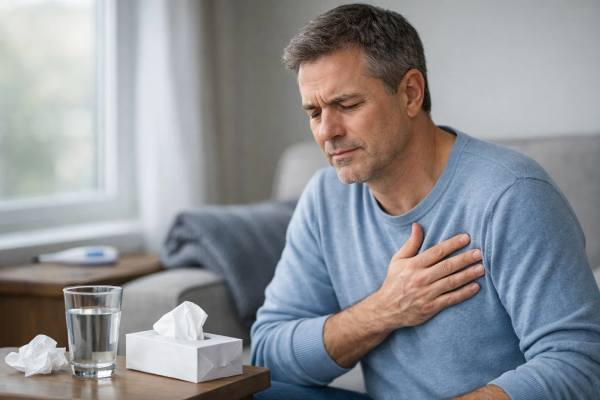
Chest pain that sharpens when you take a deep breath can feel alarming because breathing is constant and unavoidable. In many cases, the pain comes from the lining around the lungs (the pleura) or the muscles and joints of the chest wall, which can become irritated during a respiratory infection or after heavy coughing. Sometimes, though, the same “stabbing on inhalation” pattern can signal conditions that need urgent evaluation, such as a blood clot in the lung or a collapsed lung. The goal is not to diagnose yourself from a symptom, but to recognize patterns, check for red flags, and choose a safe next step. This guide explains what breathing-related chest pain often means, how pleurisy and pneumonia typically differ, and what to do today to protect your breathing and your heart.
Core Points for Fast Decisions
- Most breathing-related chest pain is pleuritic or chest-wall pain and often improves as inflammation settles and cough becomes less forceful.
- Fever, worsening shortness of breath, and a deep productive cough make pneumonia more likely than “simple” pleurisy alone.
- Sudden severe pain, fainting, blue lips, or new one-sided leg swelling are emergency warning signs, even if symptoms seem mild at rest.
- If you are not in danger, prioritize checking temperature and breathing effort, limiting exertion for 24 hours, and using safe pain control to breathe more comfortably.
Table of Contents
- Understanding pleuritic chest pain
- Pleurisy and pneumonia clues
- Dangerous causes to rule out
- When to seek urgent care
- What evaluation and tests look like
- Relief and recovery steps
Understanding pleuritic chest pain
Pain that worsens with a deep breath, cough, or sneeze is often described as pleuritic. That word points to the pleura, two thin layers that allow your lungs to glide smoothly as you breathe. When these layers become inflamed or roughened, the normal sliding motion can create a sharp, localized pain—often along one side of the chest, sometimes felt in the shoulder or upper back.
Why breathing makes it worse
Breathing stretches and moves tissues in the chest. Anything inflamed in that area can protest when it is tugged. Common “movement-sensitive” sources include:
- Pleura (lung lining): irritation from a viral infection, pneumonia, or a small fluid buildup can trigger pain with inhalation.
- Chest wall muscles: repeated coughing is like doing thousands of mini sit-ups for your rib muscles.
- Rib joints and cartilage: the sternum and ribs connect through joints that can become tender after strain (often called costochondral irritation).
- Diaphragm-related referral pain: irritation near the lower lung can refer pain to the shoulder because of shared nerve pathways.
What the pain usually feels like
People often report one or more of these features:
- Sharp, stabbing, or “catching” pain on deep breaths
- Pain that is worse with coughing or laughing
- A small, specific spot that feels sore when you inhale
- Relief when you take shallow breaths or brace the area with a hand or pillow
These patterns point toward inflammation or strain, not always danger. However, symptom shape is not a perfect safety filter. Some serious conditions can be subtle at first.
The big picture: symptom clusters matter
Breathing-related chest pain becomes more interpretable when you pair it with:
- Breathing effort: Are you short of breath just walking across a room?
- Fever and chills: Are you having repeated, measured fevers?
- Cough character: Dry, barking, mildly productive, or thick and colored?
- Onset: Gradual over days versus sudden in minutes
- Risk factors: recent immobility, surgery, pregnancy, lung disease, smoking, or vaping
Think of pleuritic pain as a signal that something in the chest is irritated—then use the rest of your symptoms to narrow what that “something” might be.
Pleurisy and pneumonia clues
Pleurisy and pneumonia can overlap, because pneumonia can inflame the pleura. Still, their most typical profiles differ in ways that help you choose a safer plan.
Pleurisy: often pain-forward
Pleurisy often stands out because the pain is the headline symptom. It may start during or after a viral cold, flu, or COVID-like illness. Common clues include:
- Sharp pain that changes with breath depth, coughing, or position
- Cough that may be present but is not always severe
- Mild shortness of breath mainly because deep breaths hurt
- Low-grade fever or no fever at all, especially with viral causes
- Soreness that improves when you splint the chest (hand or pillow)
If the pain is pleural, people sometimes instinctively take shallow breaths. That can make you feel “air hungry,” even when oxygen levels are normal.
Pneumonia: often infection-forward
Pneumonia is an infection in the lung tissue itself. Chest pain can happen—especially if it involves the pleura—but it is usually paired with systemic illness or meaningful breathing symptoms:
- Fever that is measured and persistent, often with chills or sweats
- Cough that becomes more productive, sometimes with thick sputum
- Shortness of breath that is noticeable with light activity, not only because it hurts
- Fatigue that feels disproportionate to a typical cold
- Chest tightness or heaviness in addition to sharp pain
Another clue is trajectory. A cold that seems to improve and then worsens again (new fever, deeper cough, more breathlessness) can be a classic pneumonia pattern.
Where people commonly get misled
- “My mucus is green, so I need antibiotics.” Color alone is not a reliable infection test. Many viral infections produce colored mucus.
- “I can still breathe, so it cannot be pneumonia.” Early pneumonia can be subtle, especially in older adults or people who suppress fever with medications.
- “It is just a pulled muscle.” Cough strain is common, but worsening shortness of breath, faintness, or persistent high fever should override that assumption.
A practical way to compare at home
Ask four questions:
- Is pain the main problem, or is overall sickness the main problem?
- Is your breathing limited by pain, or by lack of air?
- Are fevers persistent (not just one spike)?
- Is the trend improving after 24 to 48 hours, or clearly getting worse?
If infection signs and breathlessness dominate, pneumonia rises on the list and medical evaluation becomes more important.
Dangerous causes to rule out
Breathing-related chest pain is often benign, but a few conditions can look similar at the start. The safest approach is to know what “too risky to watch at home” looks like.
Pulmonary embolism
A pulmonary embolism (PE) is a blood clot that travels to the lungs. It often causes sudden pleuritic chest pain and shortness of breath, but symptoms can vary.
More concerning clues:
- Sudden onset chest pain or sudden shortness of breath
- Breathing fast at rest, or feeling unable to catch your breath
- New fainting, near-fainting, or unusual dizziness
- Coughing up blood (even small streaks)
- One-sided leg swelling or calf pain
- Recent high-risk context: long travel without movement, recent surgery, hospitalization, active cancer, pregnancy or postpartum period, estrogen therapy, or a prior clot history
PE is not something to “sleep off.” If it is on the table, urgent evaluation is the right move.
Pneumothorax
A pneumothorax is a collapsed lung caused by air leaking into the pleural space. It can happen after trauma, but also spontaneously—especially in tall, thin young adults, smokers, and people with underlying lung disease.
Common clues:
- Sudden sharp one-sided chest pain
- Sudden shortness of breath that is not explained by congestion alone
- Pain that does not track with cough soreness and feels abrupt and intense
- Symptoms after strenuous exertion, heavy lifting, or a sudden coughing fit
Some small pneumothoraces are stable; others are emergencies. New, sudden one-sided chest pain with breathlessness should be assessed promptly.
Heart and vessel emergencies can mimic pleuritic pain
Not all cardiac pain is “classic pressure.” While heart attack pain is often crushing or squeezing, some people experience atypical symptoms.
Seek emergency care if chest pain is paired with:
- Pressure, heaviness, or pain radiating to jaw, arm, or back
- Profuse sweating, nausea, or a sense of doom
- New irregular heartbeat, severe weakness, or collapse
- Severe tearing pain to the back (a vascular emergency)
If you have cardiac risk factors (older age, diabetes, hypertension, high cholesterol, smoking), a lower threshold for evaluation is wise.
Other serious infections and inflammation
- Severe pneumonia: can cause pleuritic pain, high fever, and low oxygen.
- Pleural infection: can follow pneumonia and may cause persistent fever and worsening pain.
- Pericarditis: inflammation around the heart can cause chest pain that may change with position and breathing.
This is why the combination of symptoms matters more than one isolated sensation.
When to seek urgent care
Use this section as a safety filter. If any red flag applies, it is safer to seek urgent evaluation rather than trying another home remedy.
Go to emergency care now
- You are struggling to breathe, cannot speak full sentences, or your lips look bluish or gray.
- Chest pain is severe, sudden, or worsening rapidly.
- You fainted, nearly fainted, or feel profoundly lightheaded.
- You have chest pain plus new confusion, severe weakness, or collapse.
- You are coughing up blood.
- You have one-sided leg swelling or calf pain along with chest symptoms.
- You recently had major surgery, were hospitalized, are postpartum, or have a history of blood clots and now have sudden chest pain or shortness of breath.
If you have access to a pulse oximeter, persistently low oxygen is also a reason to get urgent care (especially if readings stay low at rest and match how you feel).
Seek same-day urgent evaluation
- Fever that is persistent and measured, especially if paired with worsening cough or breathlessness
- Shortness of breath that limits normal walking or climbing a few steps
- Chest pain that is not improving over 24 hours or that prevents deep breathing
- High-risk medical background: chronic lung disease, immune suppression, sickle cell disease, significant heart disease, or advanced age
- Signs of dehydration or inability to keep fluids down
Same-day does not necessarily mean “ambulance,” but it does mean you should not wait several days to see what happens.
Reasonable to monitor at home with a plan
Home monitoring can be reasonable when:
- Pain is mild to moderate and clearly linked to coughing or deep breaths
- Breathing feels normal at rest and only limited by discomfort
- Fever is absent or mild and improving
- You can hydrate, rest, and sleep
- Symptoms are stable or trending better over 24 to 48 hours
Even in “watchful waiting,” set a checkpoint: if pain, fever, or breathlessness is worse tomorrow than today, you escalate care rather than extending the wait.
If you are unsure
Uncertainty is a valid reason to ask for medical guidance—especially with chest pain. Many clinics and nurse lines can help you decide whether you need imaging, testing, or simply safer symptom control.
What evaluation and tests look like
Knowing what clinicians are looking for can reduce anxiety and help you give a clearer story. The purpose is not to “collect tests,” but to sort dangerous causes from treatable and self-limited ones.
The first minute: vital signs and quick risk scan
Clinicians typically focus on:
- Temperature
- Heart rate
- Breathing rate
- Blood pressure
- Oxygen saturation
- General appearance (work of breathing, ability to speak comfortably)
They will also ask targeted questions about clot risk (recent immobility, surgery, estrogen therapy), lung disease, smoking or vaping, and recent infections.
What the physical exam can reveal
A careful exam can suggest likely directions:
- Localized crackles or reduced breath sounds: may suggest pneumonia or fluid
- Wheezing: may point toward bronchospasm or airway irritation
- Chest wall tenderness: supports muscle or joint strain
- A pleural rub: a scratchy sound that can occur with pleural inflammation
- Leg swelling or tenderness: raises concern for a clot source
No single sign is perfect, which is why tests are often used when risk is not clearly low.
Common tests and what they mean
- Electrocardiogram (ECG): checks for heart strain, rhythm problems, and patterns that may suggest ischemia or pericarditis.
- Chest X-ray: helps identify pneumonia, pneumothorax, fluid around the lungs, or other structural issues.
- Blood tests: may include markers of inflammation, anemia, or cardiac injury when appropriate.
- D-dimer: used in selected patients to help rule out clots when pre-test probability is low to moderate.
- CT pulmonary angiography: imaging used when PE is a serious possibility.
- Ultrasound: may be used for leg veins (clot search), pleural fluid assessment, or bedside lung evaluation in some settings.
Why clinicians ask so many “timeline” questions
The timeline changes the probability:
- Sudden symptoms push PE or pneumothorax higher.
- Slow buildup with fever and worsening cough pushes pneumonia higher.
- Pain after days of coughing pushes muscle and cartilage strain higher.
A clear, concise story helps the clinician choose fewer, more appropriate tests.
Relief and recovery steps
If you have been screened for red flags—or your symptoms are mild and stable—your short-term goal is to reduce inflammation and pain enough to breathe normally, while monitoring for signs that you need medical care.
Pain control that supports better breathing
Breathing shallowly because it hurts can worsen fatigue and make you feel more short of breath. Safer options for many adults include:
- Acetaminophen: helpful for pain and fever, gentler on the stomach for many people.
- Nonsteroidal anti-inflammatory drugs (NSAIDs): can be effective for pleural or chest wall inflammation, but are not appropriate for everyone (ulcer history, kidney disease, certain heart conditions, blood thinners, or late pregnancy).
Avoid doubling up on combination cold medicines that already contain pain relievers. Accidental overdose is a common mistake, especially with multi-symptom products.
Positioning and breathing tactics
- Splint the painful area with a pillow when coughing. This reduces strain.
- Try side-lying on the painful side if it helps; some people find that stabilizes movement.
- Use slow, controlled breaths several times per hour. The goal is gentle expansion, not force.
- Warmth to the chest wall can help muscle-based pain, while cool air sometimes calms an irritated cough.
If pain is severe enough that you cannot take occasional deeper breaths, that is a reason to contact a clinician.
Hydration and mucus management
Thicker mucus makes coughing more forceful, which can aggravate chest wall pain. Helpful steps include:
- Warm fluids and adequate water intake
- Humidified air or a warm shower to loosen secretions
- Honey (for adults and children over age 1) to reduce cough frequency at night
- Avoiding smoke and vaping, which inflame airways and prolong cough
Activity: when rest is the smarter medicine
For 24 to 48 hours, reduce exertion if breathing or pain increases with activity. Resume light movement as symptoms improve, but stop if you develop:
- New breathlessness out of proportion to the effort
- Dizziness or chest pressure
- A clear worsening trend over a single day
When recovery should be re-checked
Consider follow-up if:
- Pain persists beyond a week without a clear improving trend
- Cough lasts more than 3 weeks, especially with fatigue or shortness of breath
- Fever returns after improving
- You develop new wheezing, persistent fast heart rate, or reduced exercise tolerance
Most benign causes improve steadily. A plateau or reversal is your cue to reassess.
References
- Overview | Pneumonia: diagnosis and management | Guidance | NICE 2025 (Guideline)
- Pleurisy – StatPearls – NCBI Bookshelf 2024 (Clinical Review)
- Acute Pulmonary Embolism – StatPearls – NCBI Bookshelf 2024 (Clinical Review)
- Pleural Disease | British Thoracic Society | Better lung health for all 2023 (Guideline)
Disclaimer
This article is for general education and cannot diagnose chest pain or replace care from a licensed clinician. Chest pain and shortness of breath can be signs of serious illness. If symptoms are severe, sudden, worsening, or accompanied by fainting, blue lips, confusion, or coughing up blood, seek emergency care immediately. If you are pregnant, postpartum, immunocompromised, older, or have significant heart or lung disease, use a lower threshold to get same-day medical advice.
If you found this helpful, please consider sharing it on Facebook, X (formerly Twitter), or any platform you prefer.