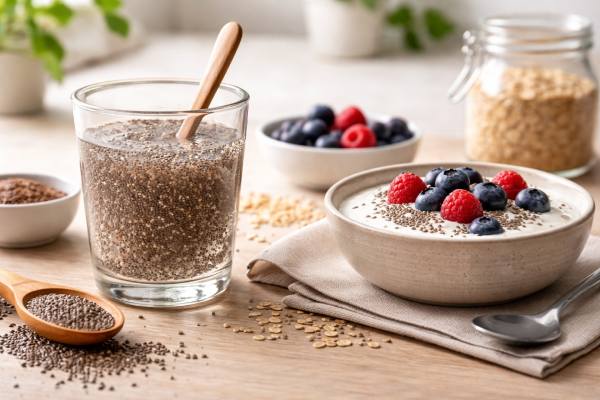
Chia seeds are small, but they behave like a powerful “hydration sponge” in the digestive tract. When soaked, they form a gel that can soften stool, add bulk, and support more regular bowel movements—especially for constipation linked to low fiber intake or inconsistent hydration. They are also easy to fit into everyday routines: stirred into yogurt, blended into smoothies, or used as a simple chia pudding.
However, chia is not a magic fix. Used the wrong way, it can backfire—worsening bloating, causing cramping, or making constipation feel tighter rather than easier. The difference often comes down to dose, water, and timing. This article explains how much chia tends to help, how to introduce it without discomfort, and the most common mistakes that keep people stuck.
Quick Overview
- Starting with a small dose and increasing gradually can improve stool softness and regularity within 3–7 days for many people.
- Soaked chia is usually better tolerated than dry chia for constipation relief.
- Without enough fluid, chia can worsen constipation or cause uncomfortable fullness.
- A practical starting point is 1 teaspoon daily, building toward 1–2 tablespoons per day if tolerated.
- Stop and seek advice if constipation is new and severe, accompanied by bleeding, weight loss, or persistent abdominal pain.
Table of Contents
- Why chia seeds can help constipation
- How much chia to take and how fast to increase
- The best ways to take chia for stool softening
- Common mistakes that make chia backfire
- Who should use caution with chia seeds
- When chia is not enough and what works better
Why chia seeds can help constipation
Chia seeds help constipation primarily through fiber plus water-holding capacity. Constipation is often a mechanical problem: stool becomes dry, small, and slow-moving, especially when fiber intake is low, fluid intake is inconsistent, or daily movement drops. Chia can improve stool texture and transit by acting in three supportive ways.
1) They add soluble fiber that forms a gel
Chia contains both soluble and insoluble fiber, but its most noticeable feature is how the soluble portion behaves in water. When soaked, chia seeds develop a gel-like coating. In the gut, that gel can help:
- Soften stool by retaining water
- Reduce friction and make passage easier
- Support more consistent stool form rather than hard pellets
For people with hard stools, straining, or a “stuck” feeling, this stool-softening effect is often the most helpful piece.
2) They add bulk in a gentler way than some fibers
Insoluble fiber adds bulk and can stimulate movement in the colon. Some people tolerate insoluble fiber poorly when constipated, especially if they add it too fast. Chia’s gel-forming behavior can make it feel gentler than rougher fibers, but only when introduced slowly and paired with water.
3) They can support the gut microbiome indirectly
Fiber is a food source for gut microbes. As microbes ferment certain fibers, they produce compounds that can support intestinal lining health and motility. You do not need to memorize the chemistry to use this insight—what matters is that consistent fiber intake often supports more predictable bowel habits over time.
Why chia works for some constipation patterns and not others
Chia is most likely to help when constipation is related to:
- Low overall fiber intake
- Dehydration or inconsistent fluid intake
- Travel, schedule changes, or low daily movement
- Mild constipation without major pain or alarm signs
It is less likely to solve constipation driven by:
- Pelvic floor dysfunction (difficulty relaxing to pass stool)
- Medication side effects that slow motility
- Severe slow-transit constipation
- Underlying medical conditions causing obstruction or inflammation
Think of chia as a tool for stool texture and consistency. If your main issue is coordination or motility, you may need different strategies even if chia adds some benefit.
How much chia to take and how fast to increase
The best chia dose for constipation is the smallest dose that improves stool softness without causing bloating or cramping. More is not always better. A gradual approach is both safer and more effective because fiber needs time to integrate into your routine and your gut needs time to adapt.
A practical dosing ladder
A simple schedule many people tolerate well:
- Days 1–3: 1 teaspoon per day (soaked)
- Days 4–7: 2 teaspoons per day (soaked), if comfortable
- Week 2: 1 tablespoon per day (soaked)
- Week 3 and beyond (optional): up to 2 tablespoons per day, if needed and tolerated
For many people, 1 tablespoon daily is enough. Some do well with 2 tablespoons split into two smaller servings (morning and evening). Splitting the dose often reduces gas and “heavy” fullness.
How long before it helps
If chia is going to help constipation, you may notice changes in:
- Stool softness: sometimes within 24–72 hours
- Regularity: often within 3–7 days
- Reduced straining: typically within 1–2 weeks if hydration and routine improve too
If nothing changes after two weeks of consistent use—especially with adequate fluids—chia may not be the right lever for your constipation type.
The hydration rule that makes chia work
Because chia holds water, it works best when your body has enough water to spare. A practical rule is:
- Pair each serving of chia with a full glass of water or another non-caffeinated beverage.
If you are adding chia on top of an already low-fluid day, you are asking fiber to do a job without enough raw material.
When to avoid “jumping” to higher doses
Increase slowly if you have:
- A history of bloating or IBS symptoms
- Constipation with significant gas trapping
- A tendency toward cramping when you increase fiber
- Low appetite or early fullness (chia can make you feel full quickly)
In these cases, staying at 1 teaspoon to 1 tablespoon and focusing on fluids and routine may be more effective than pushing higher.
A reality check on serving sizes
Chia is calorie-dense for its size. People sometimes add several tablespoons without realizing it, especially in smoothies or overnight oats. If constipation is your only goal, treat chia like a measured supplement, not an unlimited topping.
The best ways to take chia for stool softening
How you take chia matters as much as the dose. For constipation, the priority is consistent gel formation and consistent hydration, which is why soaking is usually the most reliable method.
Option 1: Soaked chia “gel”
This is the most predictable approach:
- Mix chia into water and let it sit until it thickens.
- Stir again to break up clumps.
The goal is not a perfect pudding texture—it is simply to pre-hydrate the seeds so they do not pull as much water from your gut.
Option 2: Chia pudding
Chia pudding is often easier for daily consistency. It works well when:
- The chia is fully hydrated
- The total portion is not oversized
- You tolerate the base (some people react to large amounts of dairy or high-fat additions)
For constipation relief, many people do best with a modest serving rather than a huge bowl that adds too much fiber too fast.
Option 3: Stirred into yogurt or oatmeal
This can work if the mixture sits long enough to hydrate. If you stir chia into food and immediately eat it, the seeds may still absorb fluid later, which can increase fullness and discomfort for some people.
Option 4: Smoothies
Smoothies can be effective, but they also make it easy to overdo fiber in one sitting—especially if you also add berries, greens, flax, and protein powders. If you are prone to bloating, keep the rest of the smoothie simple while you test chia.
Dry chia: why it is a common problem
Dry chia sprinkled onto food can be safe for many people, but it is a frequent reason chia “does not work” for constipation. Dry seeds may:
- Increase fullness and discomfort
- Contribute to a tight, heavy feeling
- Worsen constipation if your fluid intake is low
If you want the laxation-supporting effect, start with soaked chia. Once you know you tolerate it and it helps, you can experiment with small amounts dry—paired with adequate fluids.
Pairing chia with supportive habits
Chia works best when it is part of a constipation-friendly routine:
- A consistent breakfast time
- A brief walk after meals
- Regular toileting time without rushing
- Adequate daily fluids
Fiber is a facilitator, not a substitute for these foundations.
Common mistakes that make chia backfire
Most chia-related problems come from enthusiasm rather than the seeds themselves. If you avoid the most common mistakes, chia is more likely to feel like a gentle assist rather than an uncomfortable experiment.
Mistake 1: Starting with too much
Jumping straight to 2–3 tablespoons can cause:
- Bloating and gas
- Abdominal cramping
- A sense of stool “bulk” without movement
The solution is boring but effective: start with 1 teaspoon, then increase gradually.
Mistake 2: Not increasing fluids
Chia binds water. If you do not increase fluids, you can end up with thicker stool or discomfort. Signs you need more fluid include:
- Hard stool despite added fiber
- Worsening straining
- Dry mouth or dark urine
- Feeling “heavy” after chia
A reliable fix is pairing chia with a full glass of water and checking that you are drinking consistently across the day, not only at night.
Mistake 3: Using chia when constipation is actually pelvic floor related
Some people have daily urge and stool present, but difficulty relaxing the pelvic floor to pass it. Adding fiber can make stool larger without solving the coordination problem. Clues include:
- Long toilet time with minimal output
- A sense of blockage
- Needing to change position, press on the perineum, or use other maneuvers to pass stool
In that case, a clinician evaluation and pelvic floor therapy may do more than any seed.
Mistake 4: Combining chia with too many other fiber boosters
Chia plus flax plus bran cereal plus a high-fiber bar can become too much too soon. If you want to know whether chia helps, keep other new fiber additions stable and modest.
Mistake 5: Expecting instant results while ignoring routine factors
Constipation often worsens with:
- Skipping breakfast
- Low movement
- Irregular sleep
- High stress and rushed toileting
Chia can help stool texture, but it cannot override a routine that consistently slows motility.
Mistake 6: Continuing despite worsening symptoms
If chia causes persistent pain, worsening bloating, vomiting, or new severe constipation, stop and reassess. A supplement-like food should not make you feel progressively worse.
The best mindset is “measured trial.” Give chia a fair test, but do not keep escalating the dose in response to discomfort.
Who should use caution with chia seeds
Chia is generally safe as a food, but constipation is a symptom with many causes, and certain situations require caution. The goal is not to make chia feel risky—it is to make sure you do not use it in settings where it could delay needed care or worsen a mechanical problem.
People who should start lower and go slower
Use extra caution if you have:
- IBS with significant bloating or pain sensitivity
- A history of diverticulitis flares or complicated bowel history (seek clinician guidance)
- A tendency toward nausea or early fullness
- A very low baseline fiber diet (the gut needs time to adapt)
In these cases, a tiny starting dose and fully soaked chia is usually better tolerated.
Swallowing problems or esophageal narrowing
Chia absorbs liquid and expands. If you have trouble swallowing, a history of strictures, or known esophageal motility issues, avoid swallowing dry chia. Even soaked chia should be used thoughtfully. The safest approach is to discuss with a clinician if you have any history of food sticking, choking episodes, or significant reflux with narrowing.
Medication interactions and timing
Fiber can affect how quickly some medications are absorbed. A practical safeguard is to separate chia from oral medications by about 1–2 hours when possible, especially for medicines where timing matters.
Pregnancy and postpartum constipation
Chia can be a reasonable food-based fiber tool in pregnancy and postpartum when used gently with hydration, but constipation during these periods can also be influenced by iron supplements, reduced activity, and pelvic floor changes. If constipation is severe or accompanied by bleeding, significant pain, or dehydration, seek medical guidance.
When constipation should not be self-treated
Seek prompt evaluation if constipation is:
- New and severe
- Accompanied by blood in stool, black stools, fever, persistent vomiting, or significant abdominal swelling
- Associated with unintentional weight loss
- Occurring with severe, escalating abdominal pain
- Paired with inability to pass gas, which can signal obstruction
Chia can be supportive for uncomplicated constipation, but it should not be used to “wait out” warning signs.
When chia is not enough and what works better
If chia does not improve constipation, it is not a personal failure and it does not mean you need an even larger dose. It usually means your constipation is driven by a factor chia cannot fully address: motility, pelvic floor coordination, medication effects, or an underlying medical condition.
Signs you need a different strategy
Consider another approach if you have:
- Persistent hard stools despite good hydration
- Significant straining or incomplete evacuation
- Constipation lasting weeks with little change
- Alternating constipation and diarrhea with ongoing pain
- Severe bloating that worsens with fiber
Fiber alternatives that are often more predictable
Some people do better with:
- Soluble fiber supplements that can be titrated precisely and are less “bulky” per serving
- Kiwi fruit or prunes in measured amounts, which combine fiber with natural compounds that support bowel movement patterns
- Osmotic approaches recommended by clinicians that draw water into stool more reliably than food alone in some cases
The best choice depends on whether your main issue is stool dryness, motility, or evacuation mechanics.
Behavioral and routine upgrades that amplify any fiber
The most evidence-friendly routine shifts are not glamorous, but they work:
- A consistent morning meal to trigger the gastrocolic reflex
- A 10–20 minute walk most days, especially after meals
- A scheduled, unrushed toilet window
- Adequate fluid distribution across the day
If you are using chia, these habits often determine whether it feels like a mild assist or a genuine turning point.
When to ask about pelvic floor evaluation
If constipation feels like “I have to go but cannot,” or you spend a long time on the toilet with minimal output, a pelvic floor component is possible. In that case, the most effective intervention may be pelvic floor therapy rather than more fiber.
A balanced way to use chia long term
If chia helps, keep the dose steady and modest. Many people maintain benefits with 1 tablespoon daily or 1 tablespoon most days, as long as fluids remain adequate. The goal is regularity without ongoing bloating.
Chia is a useful tool, but the best constipation plan is personalized: the right fiber form, the right dose, enough water, and a routine that supports normal motility.
References
- ACG Clinical Guideline: Management of Irritable Bowel Syndrome 2021 (Guideline)
- American Gastroenterological Association Institute Guideline on the Medical Management of Opioid-Induced Constipation 2019 (Guideline)
- Dietary fiber and the gut microbiota: a systematic review 2020 (Systematic Review)
- Chia seed supplementation and cardiovascular risk factors in overweight and obese subjects: a randomized controlled trial 2015 (RCT)
Disclaimer
This article is for educational purposes and does not replace medical advice. Constipation can have many causes, including medication effects, pelvic floor dysfunction, thyroid disorders, neurologic conditions, and intestinal obstruction. Seek urgent medical care if constipation is new and severe, accompanied by blood in stool or black stools, persistent vomiting, fever, severe or worsening abdominal pain, marked abdominal swelling, inability to pass gas, fainting, dehydration, or unintentional weight loss. If you are pregnant, have swallowing difficulties, have a history of bowel obstruction, or take prescription medications, consult a qualified clinician before making major fiber changes.
If you found this article helpful, please consider sharing it on Facebook, X (formerly Twitter), or any platform you prefer.