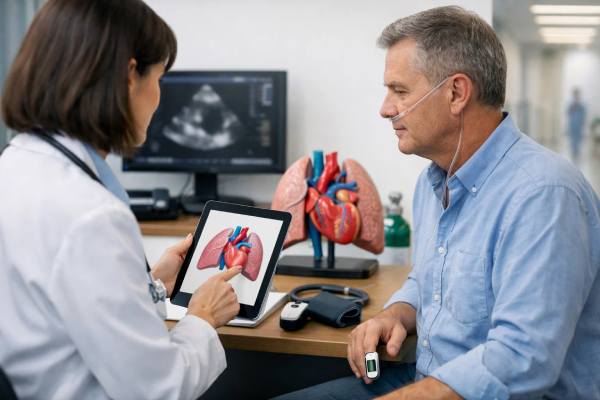
Chronic thromboembolic pulmonary hypertension (CTEPH) is a form of high blood pressure in the lung arteries that develops after blood clots fail to clear completely. Instead of dissolving, parts of the clot can organize into firm scar-like material that narrows or blocks pulmonary arteries. Over time, the right side of the heart must pump harder to push blood through the lungs, which can lead to right heart strain and, eventually, heart failure.
What makes CTEPH especially important is that it is often treatable—and sometimes curable—when identified early and evaluated at an experienced center. The challenge is that symptoms can creep in slowly and mimic asthma, deconditioning, or “just getting older.” This guide explains how CTEPH affects the body, what raises risk, how it’s diagnosed, and what treatment and day-to-day management typically look like.
Table of Contents
- What is CTEPH and why it matters?
- What causes CTEPH and who is at risk?
- Symptoms and complications to watch for
- How CTEPH is diagnosed, step by step
- Treatments that improve or cure CTEPH
- Living with CTEPH, prevention, and when to seek care
What is CTEPH and why it matters?
CTEPH is a type of pulmonary hypertension caused by chronic obstruction in the pulmonary arteries—most often from prior blood clots (pulmonary emboli) that do not fully resolve. Over weeks to months, leftover clot material can become organized and “fixed” to the vessel wall, creating webs, bands, or tight narrowings. These changes do two harmful things at once:
- They reduce the cross-sectional “pipeline” for blood flow through the lungs.
- They trigger disease in smaller vessels beyond the blockage (a remodeling process that can resemble other forms of pulmonary arterial hypertension).
The result is higher pressure and resistance in the lung circulation. Clinicians often describe pulmonary hypertension using measurements from a right-heart catheterization. In simple terms, the right ventricle faces a heavier workload every minute of the day. At first, it compensates by thickening and squeezing harder. Later, it can dilate, weaken, and struggle to keep up—especially during exertion, when the body demands a rapid increase in blood flow.
Why it matters: CTEPH is one of the few causes of pulmonary hypertension where a procedure can remove the mechanical obstruction. Pulmonary endarterectomy (a specialized surgery) can be life-changing and, in many people, offers the closest thing to a cure. For those who are not surgical candidates, balloon pulmonary angioplasty and targeted medications can still improve symptoms, exercise tolerance, and hemodynamics.
A practical way to think about CTEPH is as a condition with two timelines: the silent timeline (clot organization and gradual vessel damage) and the functional timeline (when you notice stairs, hills, or ordinary walking becoming harder). Recognizing the functional timeline early is often what leads to diagnosis and better options.
What causes CTEPH and who is at risk?
Most people diagnosed with CTEPH have a history of pulmonary embolism (PE) or deep vein thrombosis (DVT), but not all recall a clear clot event. Small or “silent” emboli can occur, and symptoms of an earlier PE can be mistaken for pneumonia, anxiety, or a viral illness. The core problem is impaired clot resolution—a mismatch between clot formation and the body’s ability to break it down and restore normal vessel structure.
Several mechanisms likely contribute:
- Abnormal clot biology: Some clots become unusually dense or resistant to breakdown.
- Inflammation and scarring: Persistent inflammation can promote fibrosis and fixed obstruction.
- Changes in the vessel lining (endothelium): Damaged endothelium can encourage further clotting and narrowing.
- Small-vessel remodeling: Even after the major obstruction is addressed, microvascular disease can sustain pulmonary hypertension in some patients.
Risk is not evenly distributed. Factors associated with higher likelihood of CTEPH include:
- Prior PE, especially if symptoms never fully returned to baseline after treatment
- Large clot burden or recurrent PE episodes
- Delays in PE diagnosis or treatment, or stopping anticoagulation early
- Certain medical histories that can affect clot behavior or inflammation, such as:
- Prior splenectomy
- Chronic inflammatory conditions
- Certain indwelling devices (for example, long-term central venous hardware)
- Prior cancer or cancer treatment (risk can vary widely by cancer type and activity)
It is also important to separate “risk of getting a clot” from “risk of developing CTEPH after a clot.” Many people with classic clot risks (long travel, surgery, hormonal therapy, immobility) never develop CTEPH. Conversely, some people with CTEPH have no obvious ongoing risk and may have had a single remote clot event.
A high-yield clinical clue is this: breathlessness that persists or worsens for months after a PE is not something to simply “push through.” If exertional symptoms plateau or deteriorate 3–6 months after PE treatment—especially with reduced exercise tolerance compared with pre-PE baseline—CTEPH should be part of the evaluation.
Symptoms and complications to watch for
CTEPH often starts subtly. Early symptoms typically appear during exertion, when the pulmonary circulation cannot increase flow adequately. Many people adjust their routines without realizing it—taking fewer stairs, walking more slowly, avoiding hills—so the disease can advance before it is named.
Common symptoms include:
- Shortness of breath on exertion (the most common complaint)
- Reduced exercise capacity or fatigue out of proportion to activity
- Chest pressure or discomfort, especially with exertion
- Lightheadedness or near-fainting during activity
- Palpitations (sometimes from rhythm changes due to right heart strain)
- Swelling in ankles/legs and abdominal bloating (later signs of right heart failure)
- Cough; occasionally coughing up blood (hemoptysis), which needs prompt evaluation
Symptoms can shift over time. A helpful pattern to notice is recovery time: if a short walk now requires several minutes to “catch your breath,” or if you feel unwell for hours after activity that used to be routine, the cardiopulmonary system may be under strain.
Complications can be serious and sometimes abrupt:
- Right ventricular failure: Fluid retention, worsening swelling, liver congestion, and profound fatigue can develop as the right heart decompensates.
- Syncope (fainting): Especially during exertion, this can signal an inability to increase cardiac output and is a red flag.
- Arrhythmias: Atrial flutter or fibrillation can worsen symptoms quickly.
- Progressive hypoxemia: Oxygen levels may drop during activity or later even at rest.
- Recurrent clots: Ongoing clot risk is why long-term anticoagulation is central in management.
When symptoms escalate quickly—new fainting, chest pain at rest, significant swelling over days, confusion, bluish lips, or coughing up more than a small streak of blood—treat it as urgent. People sometimes attribute worsening to stress or a respiratory infection, but in CTEPH the margin for compensation can be narrow.
How CTEPH is diagnosed, step by step
Diagnosis typically involves confirming three things: (1) pulmonary hypertension or abnormal pulmonary pressures, (2) chronic thromboembolic obstruction, and (3) whether the disease pattern is treatable with surgery or catheter-based therapy. Many missed diagnoses happen because the workup stops after an echocardiogram or a CT scan that is not optimized for chronic clot patterns.
A common stepwise approach looks like this:
1) Clinical suspicion and baseline testing
A clinician starts with symptom history (especially post-PE trajectory), physical exam, and baseline tests such as ECG, chest imaging, and bloodwork. These may be normal early, so normal results do not exclude CTEPH.
2) Echocardiography as a screening tool
An echocardiogram can estimate the likelihood of pulmonary hypertension and show right heart size and function. It is useful, but it does not directly prove chronic clot disease.
3) Ventilation–perfusion (V/Q) scan
A V/Q scan is often the most sensitive screening test for chronic thromboembolic disease. A pattern of mismatched perfusion defects (areas ventilated but not well perfused) raises suspicion for chronic obstruction.
4) CT pulmonary angiography and/or specialized imaging
CT imaging can show chronic clot features (webs, bands, ring-like stenoses, pouch lesions) and can help assess anatomy and alternative diagnoses. Some centers also use advanced MRI or dual-energy CT to map perfusion.
5) Right-heart catheterization (RHC) and pulmonary angiography
RHC confirms pulmonary hypertension and quantifies severity by directly measuring pressures and cardiac output. Pulmonary angiography (often performed at experienced centers) helps map the distribution of chronic obstruction and guides decisions about operability and balloon angioplasty planning.
A key nuance: some people have chronic thromboembolic obstruction with symptoms but without resting pulmonary hypertension—sometimes described as chronic thromboembolic pulmonary disease. These patients still deserve expert evaluation because they may benefit from tailored therapy and close follow-up.
Because treatment decisions depend heavily on anatomy and expertise, many patients benefit from referral to a center that regularly evaluates CTEPH for pulmonary endarterectomy and balloon pulmonary angioplasty. The “best test” is not only the most accurate scan—it is the right scan interpreted by teams who see the full spectrum of the disease.
Treatments that improve or cure CTEPH
CTEPH treatment is individualized, but most care plans combine three pillars: anticoagulation, procedural therapy when appropriate, and supportive/targeted medical management. The order matters: identifying candidates for a potentially curative procedure is often the first priority.
1) Lifelong anticoagulation
Most people with CTEPH require long-term anticoagulation to prevent new clots. The specific medication (and whether a direct oral anticoagulant or warfarin is preferred) depends on individual factors such as kidney function, drug interactions, clot history, and certain thrombophilias. The practical goal is consistency: missing doses can raise risk, and over-anticoagulation increases bleeding risk, so monitoring and medication review are essential.
2) Pulmonary endarterectomy (PEA)
PEA is a complex surgery performed at specialized centers. Surgeons remove organized clot material from the pulmonary arteries, restoring flow. In appropriately selected patients, benefits can include major symptom improvement and normalization or near-normalization of pulmonary pressures. Recovery is not “instant,” and some people have residual pulmonary hypertension due to small-vessel disease, but overall outcomes can be excellent when performed in experienced hands.
3) Balloon pulmonary angioplasty (BPA)
BPA is a catheter-based procedure where balloons are used to open narrowed segments, often over multiple staged sessions. It is especially valuable for people with inoperable disease (for example, obstruction located too distally for surgery) or those with persistent pulmonary hypertension after PEA. BPA programs vary, but patients often notice gradual improvements in breathlessness and exercise tolerance as sessions progress.
4) Targeted medications
Some medications used in pulmonary hypertension can help in inoperable CTEPH or residual disease after procedures. These drugs aim to reduce pulmonary vascular resistance and improve hemodynamics. Medication choice depends on severity, blood pressure, comorbidities, and whether a procedure is planned—because in some cases, optimizing the pulmonary circulation first can make later intervention safer.
5) Supportive therapy and rehab
- Diuretics may help control swelling and fluid overload in right heart failure.
- Oxygen may be prescribed if levels drop at rest or with exertion.
- Supervised exercise rehabilitation can be surprisingly powerful when tailored to the patient’s hemodynamic limits.
A useful expectation to set: CTEPH treatment often improves what you can do in daily life, but it may take weeks to months to see the full benefit—especially when staged procedures, rehab, and medication adjustments are involved.
Living with CTEPH, prevention, and when to seek care
Living well with CTEPH is less about perfection and more about building a stable routine: protecting the right heart, preventing new clots, and responding early to symptom changes. Many people do best when they track a few simple markers rather than trying to interpret every sensation.
Daily and weekly habits that make a difference
- Take anticoagulation exactly as prescribed. Build a system (pill organizer, phone reminders). Always discuss new supplements or medications first—interactions can be clinically significant.
- Monitor fluid status if you retain fluid. A daily weight trend can reveal worsening right heart strain before swelling is obvious. A gain over a few days can be a reason to call your clinician.
- Move consistently, within your safe zone. Short, frequent walks often outperform sporadic “big” workouts. Many patients tolerate interval-style pacing: walk 2–3 minutes, rest 1 minute, repeat.
- Avoid dehydration and prolonged immobility. Both can increase clot risk. For travel, plan standing/walking breaks, hydration, and compression strategies if recommended.
- Vaccinations and respiratory health. Respiratory infections can destabilize symptoms; prevention and early treatment plans matter.
Rehabilitation and pacing
Pulmonary or cardiac rehab programs can teach pacing strategies, breathing techniques, and safe progression. A practical goal is to reduce the “recovery tax” after activity. If you consistently feel wiped out after routine tasks, your plan may need adjustment (diuretics, oxygen evaluation, rehab intensity, or reassessment for intervention).
Prevention of recurrence
Even after PEA or BPA, follow-up remains crucial. Some people have residual pulmonary hypertension or develop changes in smaller vessels over time. Follow-up typically includes symptom review, functional testing (such as walk tests), echocardiography, and periodic hemodynamic reassessment when indicated.
When to seek urgent care
Seek urgent evaluation for:
- Fainting, near-fainting, or new severe dizziness
- Chest pain at rest, severe breathlessness, or blue/gray lips
- Rapidly worsening swelling, confusion, or inability to lie flat
- Coughing up more than a small amount of blood
- Signs of a new clot (sudden breathlessness, sharp chest pain, one-sided leg swelling)
CTEPH can be demanding, but it is also a condition where the right diagnosis opens doors to high-impact treatments. If something feels like it is steadily shrinking your world, that is often the moment to push for a thorough, CTEPH-aware evaluation.
References
- 2022 ESC/ERS Guidelines for the diagnosis and treatment of pulmonary hypertension 2023 (Guideline)
- Chronic thromboembolic pulmonary disease 2024 (Guideline/Position Statement)
- Chronic thromboembolic pulmonary hypertension: the diagnostic assessment 2024
- Balloon pulmonary angioplasty versus riociguat for the treatment of inoperable chronic thromboembolic pulmonary hypertension (RACE): a multicentre, phase 3, open-label, randomised controlled trial and ancillary follow-up study 2022 (RCT)
- Balloon Pulmonary Angioplasty Versus Riociguat in Inoperable Chronic Thromboembolic Pulmonary Hypertension: Systematic Review and Meta-Analysis of Randomized Controlled Trials 2025 (Systematic Review)
Disclaimer
This article is for educational purposes only and does not replace individualized medical advice, diagnosis, or treatment. Chronic thromboembolic pulmonary hypertension is a complex condition that requires evaluation by qualified clinicians, and treatment decisions (including anticoagulation, procedures, and pulmonary hypertension medications) must be tailored to your health history, test results, and bleeding/clotting risks. If you have worsening shortness of breath, chest pain, fainting, coughing up blood, or signs of a new blood clot, seek urgent medical care.
If you found this article helpful, please consider sharing it on Facebook, X (formerly Twitter), or any platform you prefer—and follow us on social media. Your support through sharing helps our team continue creating high-quality, trustworthy health content.