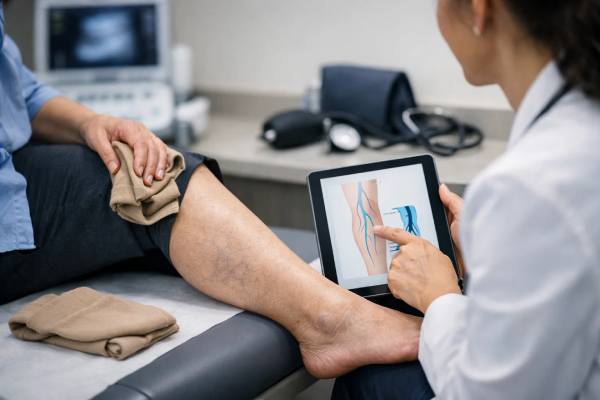
Chronic venous insufficiency (CVI) happens when the veins in your legs struggle to send blood back to the heart efficiently. Instead of moving upward, blood can pool in the lower legs, raising pressure inside the veins and gradually stressing the surrounding tissues. Over time, that pressure can lead to swelling, heaviness, skin changes, and—at its most advanced—slow-healing venous ulcers near the ankles.
CVI is common, often develops slowly, and is strongly influenced by everyday factors like long hours sitting or standing, weight, and past blood clots. The reassuring part is that many people feel significantly better with a clear plan: targeted movement, compression therapy, skin care, and—when needed—vein procedures that address reflux or obstruction. This guide explains what’s happening in the body and how to take practical, step-by-step control.
Table of Contents
- What is chronic venous insufficiency?
- What causes it and who is at risk?
- Symptoms and common complications
- How chronic venous insufficiency is diagnosed
- Treatments that improve circulation
- Living with CVI: prevention and when to seek care
What is chronic venous insufficiency?
Your leg veins work against gravity. To pull blood upward, they rely on two main helpers:
- One-way valves inside the veins that prevent backflow.
- The calf muscle pump, which squeezes deep veins when you walk and pushes blood toward the heart.
In chronic venous insufficiency, that system becomes inefficient. The most common reason is venous reflux—valves don’t close well, so blood slips backward between steps. Another cause is venous obstruction, where flow is narrowed or blocked (often after a prior deep vein thrombosis, or DVT). Either way, the result is the same: higher pressure in the leg veins, especially around the ankles.
That elevated pressure doesn’t stay confined to the vein. It affects the tiny vessels and skin by:
- Promoting fluid leakage into surrounding tissues → swelling.
- Triggering inflammation in the vein wall and skin → itching, discoloration, tenderness.
- Reducing oxygen and nutrient delivery to the skin → fragile tissue and poor healing.
You’ll also see CVI discussed under the broader umbrella chronic venous disease (CVD). CVI usually refers to the more clinically significant end of that spectrum—persistent swelling, skin changes, or ulcers—rather than mild cosmetic veins.
A useful way clinicians describe severity is the CEAP classification, which groups findings from visible veins (like varicose veins) to skin damage and ulcers. You don’t need to memorize CEAP, but it helps explain why two people can both “have vein problems” yet experience very different day-to-day impact.
The key idea: CVI is not just “bad veins.” It’s a long-term pressure problem in the legs that can be improved—sometimes dramatically—when you reduce venous pressure and fix the underlying reflux or blockage.
What causes it and who is at risk?
CVI develops when vein valves fail, venous pathways narrow, or the muscle pump can’t do its job well. Often, it’s a combination that builds over years.
Core causes
- Primary valve failure (degenerative reflux): Vein walls stretch, valves no longer meet in the middle, and reflux begins. This is a common pathway behind varicose veins and long-term venous symptoms.
- Post-thrombotic syndrome (after DVT): A clot can damage valves or leave behind scarring that narrows the vein. Even after the clot “resolves,” the vein may not function normally.
- Iliac vein compression or other outflow obstruction: Narrowing higher up in the pelvis can increase pressure downstream. This can coexist with reflux in the superficial veins.
- Calf pump dysfunction: Limited ankle motion, sedentary lifestyle, prolonged immobilization, or neuromuscular problems reduce the pumping action that normally empties leg veins.
Risk factors you can’t change (but should know)
- Age: CVI becomes more common over time.
- Family history: Genetics influence vein wall strength and valve integrity.
- Biological sex and hormones: Pregnancy and hormonal shifts can increase venous pressure and vein dilation.
- History of DVT or pulmonary embolism: One of the strongest risk signals for later CVI.
Risk factors you can influence
- Prolonged sitting or standing: Especially without walking breaks.
- Higher body weight: Increases abdominal and leg venous pressure.
- Low physical activity: Less calf pump activation.
- Smoking: Linked to vascular inflammation and poorer wound healing.
- Poorly controlled sleep, diet, or cardiometabolic health: Not direct causes of valve failure, but they can worsen swelling, inflammation, and skin resilience.
A practical way to think about risk
If you want a simple “why me?” model, picture CVI as the intersection of:
- Valve or flow pathway vulnerability (genetics, pregnancy, prior clot), plus
- Daily pressure load (weight, long standing, sitting), plus
- Pump activity (walking and ankle motion).
When all three push in the wrong direction, symptoms become more persistent, and skin complications become more likely. The good news is that two of those three are very modifiable with a realistic plan.
Symptoms and common complications
CVI symptoms often creep in slowly. Many people first notice them at the end of the day, after travel, or during hot weather—times when venous pressure rises.
Common symptoms
- Leg heaviness, aching, or “tired legs,” especially after standing
- Swelling around the ankles that improves overnight
- Tightness in shoes or socks by late afternoon
- Itching, burning, or mild pain over irritated skin
- Visible veins: spider veins, reticular veins, or varicose veins
- Night cramps or restlessness (not specific to CVI, but often reported)
A useful clue is the pattern: symptoms that worsen with standing and improve with walking, leg elevation, or compression are classic for venous disease.
Skin changes that signal progression
As venous pressure stays high, inflammation affects the skin:
- Hyperpigmentation: brownish discoloration from iron deposits after red cells leak into tissue
- Eczema-like dermatitis: itchy, scaly patches—often near the ankles
- Lipodermatosclerosis: firm, tender, tight skin and subcutaneous tissue, sometimes described as a “champagne bottle” leg shape
- Atrophie blanche: small white scar-like areas with surrounding discoloration, indicating fragile skin
These changes matter because they raise the risk of ulcers and infection.
Complications to watch for
- Venous leg ulcers: usually near the medial ankle. They can ooze, crust, and persist for weeks to months without targeted care.
- Recurrent skin infections (cellulitis): warmth, spreading redness, tenderness, fever, or chills.
- Superficial thrombophlebitis: a painful, firm, cord-like area along a superficial vein. This is usually less dangerous than DVT but can sometimes extend or coexist.
- Bleeding from varicose veins: thin skin over a varicosity can rupture after minor trauma or scratching.
Red flags that deserve urgent evaluation
Seek urgent care if you notice:
- Sudden one-leg swelling with pain or redness (possible DVT)
- New chest pain, shortness of breath, or coughing blood (possible pulmonary embolism)
- A rapidly spreading, hot, painful rash with fever (possible serious infection)
- An ulcer with increasing pain, foul odor, black tissue, or rapidly expanding redness
CVI is usually manageable, but these warning signs suggest a different problem—or a complication that should not wait.
How chronic venous insufficiency is diagnosed
Diagnosis starts with a clear story and a focused exam. The goal is to confirm that symptoms truly come from venous dysfunction, define the pattern (reflux vs obstruction), and measure severity so treatment matches the problem.
What your clinician looks for
During the physical exam, expect attention to:
- Swelling pattern (ankle swelling vs whole-leg swelling)
- Varicose veins distribution
- Skin discoloration, eczema, thickening, or scarring
- Tender “cords” suggesting superficial thrombophlebitis
- Ulcers: location, depth, drainage, surrounding skin
They may also check pulses in the feet. That matters because arterial disease changes the safety and type of compression you can use.
The main test: duplex ultrasound
Duplex ultrasound is the cornerstone test for CVI. It combines:
- B-mode imaging (structure of veins)
- Doppler flow (direction and speed of blood flow)
It can show:
- Valve reflux in superficial and deep veins
- Prior clot damage or residual obstruction
- Vein diameter, anatomy, and suitability for procedures
- Whether superficial reflux is feeding an ulcer area
If you’re being evaluated for procedures, the ultrasound is usually done standing (or in a position that reliably provokes reflux), because gravity helps reveal backflow.
When more imaging is needed
Additional imaging is considered when symptoms suggest outflow obstruction higher in the pelvis or abdomen, or when ulcers persist despite good care:
- CT venography or MR venography: maps pelvic and abdominal veins, identifies compression or post-thrombotic narrowing.
- Intravascular ultrasound (IVUS): sometimes used during procedures to assess and treat iliac vein obstruction.
- Ankle-brachial index (ABI): compares blood pressure at the ankle and arm to screen for arterial disease before stronger compression.
Classifying severity
Clinicians often use structured scales to track severity and response:
- CEAP (Clinical–Etiologic–Anatomic–Pathophysiologic): describes stage and mechanism.
- Venous Clinical Severity Score (VCSS): captures symptom burden and physical findings over time.
You don’t need perfect labels to get good care, but classification helps prevent missed drivers—like a deep obstruction that won’t improve with superficial vein treatment alone.
“Look-alikes” that should be ruled out
Leg swelling and skin changes can come from several conditions. A good workup considers:
- Heart failure or kidney/liver disease (often both legs, more generalized swelling)
- Lymphedema (firm swelling, skin thickening, often involves foot)
- Medication-related swelling (certain blood pressure drugs)
- Inflammatory skin disease unrelated to veins
A careful diagnosis prevents years of treating “swelling” while missing the true underlying issue.
Treatments that improve circulation
CVI treatment works best when it targets the specific driver—reflux, obstruction, poor calf pump function, or ongoing skin inflammation—rather than relying on a single approach. Most people benefit from layered therapy.
First-line foundation: compression and movement
Compression therapy reduces vein diameter, improves valve function, and lowers ankle venous pressure. It can:
- Decrease swelling and heaviness
- Improve skin irritation
- Support ulcer healing and help prevent recurrence
Compression options include:
- Graduated compression stockings (knee-high is common)
- Wrap systems (adjustable Velcro-style)
- Multilayer bandaging (often used for ulcers)
Fit and consistency matter more than “maximum strength.” The best compression is the one you can wear safely and regularly.
Movement is the partner therapy:
- Walk in short, frequent bouts throughout the day.
- Use ankle flexion exercises if you sit for long periods.
- Consider calf-strengthening and balance work 2–3 times per week.
Skin and ulcer care
For CVI with dermatitis or fragile skin:
- Use a bland moisturizer daily to reduce cracking.
- Treat flare-ups of eczema-like inflammation with clinician-guided topical therapy.
- Avoid harsh soaps and very hot showers that worsen dryness.
For venous leg ulcers, effective care usually includes:
- Consistent compression (often higher-intensity bandaging initially)
- Appropriate dressings to manage drainage
- Addressing infection when clinically present
- Considering procedures to correct reflux when it contributes to ulcer persistence
Medications: supportive, not “curative”
Medications don’t repair valves, but they may help symptoms in selected patients. Depending on local practice, options can include:
- Agents aimed at reducing venous inflammation and capillary leak (used as adjuncts)
- Diuretics only when swelling has a clear systemic cause; they are not a primary CVI fix
Always treat medication as add-on support, not a replacement for compression and a reflux/outflow plan.
Procedures to treat reflux
When duplex ultrasound shows significant superficial reflux that matches symptoms, procedures can provide durable relief. Common options include:
- Endovenous thermal ablation (laser or radiofrequency): closes the refluxing vein through a catheter-based technique.
- Non-thermal ablation (chemical or adhesive-based approaches): avoids heat and may reduce the need for tumescent anesthesia in some cases.
- Ultrasound-guided foam sclerotherapy: useful for some tributaries and residual varicosities.
- Phlebectomy: removes bulging surface varicosities through tiny incisions.
The goal is not “remove all veins,” but remove the reflux pathway that keeps pressure high.
Treatments for obstruction
If symptoms, history, and imaging suggest significant pelvic/iliac obstruction, treatment may involve:
- Venous stenting in selected cases to restore outflow
- A structured plan for post-thrombotic disease, sometimes with anticoagulation considerations
This is typically managed by specialists with experience in venous outflow disease.
What to expect after treatment
Many people notice improvements in heaviness and swelling within weeks, but skin recovery can take longer. If you’ve had long-standing inflammation or ulcers, think in months, not days. Even after a successful procedure, compression and movement often remain important—especially if deep venous damage or multiple risk factors persist.
Living with CVI: prevention and when to seek care
CVI management is less about perfection and more about building repeatable habits that keep venous pressure down. The most effective plan is the one that fits your real life.
A daily routine that works
Morning
- Put on compression soon after waking, before swelling builds.
- Do 1–2 minutes of ankle pumps or calf raises while brushing teeth.
During the day
- Take walking breaks: aim for 2–5 minutes every 30–60 minutes if you sit or stand for work.
- If standing, shift weight, do gentle heel raises, and avoid locking knees.
- If sitting, avoid crossing legs for long stretches.
Evening
- Elevate legs above heart level for 15–30 minutes if swelling is persistent.
- Moisturize the lower legs and ankles to protect the skin barrier.
Exercise targets that specifically help CVI
You don’t need extreme workouts. CVI responds well to consistent basics:
- Walking most days (even broken into short sessions)
- Calf strengthening 2–3 times/week (standing calf raises, step-ups)
- Ankle mobility daily if stiffness is present
- Weight management if applicable, focusing on sustainable changes
Water-based exercise can be especially helpful because hydrostatic pressure acts like gentle compression.
Travel and heat strategies
Swelling often worsens with long flights/drives and hot weather.
- Wear compression during travel.
- Stand up and walk every hour when possible.
- Stay hydrated and avoid excessive alcohol during long trips.
- In heat, prioritize shade, lighter clothing, and earlier-day activity.
Ulcer prevention (especially after a healed ulcer)
If you’ve had a venous ulcer, long-term prevention usually relies on:
- Ongoing compression (matched to comfort and safety)
- Skin care to prevent cracking and inflammation
- Prompt treatment of new dermatitis or minor wounds
- Reassessment for reflux or obstruction if ulcers recur
When to call a clinician soon (not necessarily emergency)
- New or worsening swelling that doesn’t improve overnight
- Increasing skin discoloration, tightness, or pain around the ankle
- New weeping/oozing areas, blistering, or open sores
- Frequent flares of itchy dermatitis despite good moisturizing and compression
- Recurrent superficial thrombophlebitis
When to seek urgent care
- Sudden painful one-leg swelling, redness, or warmth (possible DVT)
- Shortness of breath, chest pain, fainting, or coughing blood (possible pulmonary embolism)
- Fever with rapidly spreading leg redness (possible serious infection)
- Uncontrolled bleeding from a varicose vein
Living with CVI becomes much easier when you treat it like a long-term pressure management problem: keep blood moving, reduce pooling, protect the skin, and escalate to procedures when the anatomy calls for it.
References
- 2025 SCAI clinical practice guidelines for the management of chronic venous disease 2025 (Guideline). ([PMC][1])
- Compression for preventing recurrence of venous ulcers 2024 (Systematic Review). ([PMC][2])
- Clinical Guidelines on Compression Therapy in Venous Diseases 2025 (Guideline).
- Cyanoacrylate Embolization versus Endovenous Laser Ablation for Lower Extremity Varicose Veins: A Systematic Review and Meta-analysis 2022 (Systematic Review). ([PubMed][3])
Disclaimer
This article is for general educational purposes only and does not replace medical advice, diagnosis, or treatment from a qualified clinician. Chronic venous insufficiency can overlap with conditions that require urgent evaluation, including deep vein thrombosis, infection, and arterial disease. If you have sudden one-sided leg swelling, chest pain, shortness of breath, fever with spreading redness, or a rapidly worsening wound, seek emergency care. For individualized guidance—especially before starting compression therapy or pursuing a vein procedure—consult a licensed healthcare professional who can assess your symptoms, circulation, and test results.
If you found this article helpful, please consider sharing it on Facebook, X (formerly Twitter), or any platform you prefer—and follow us on social media. Your support through sharing helps our team continue producing reliable, high-quality health content.