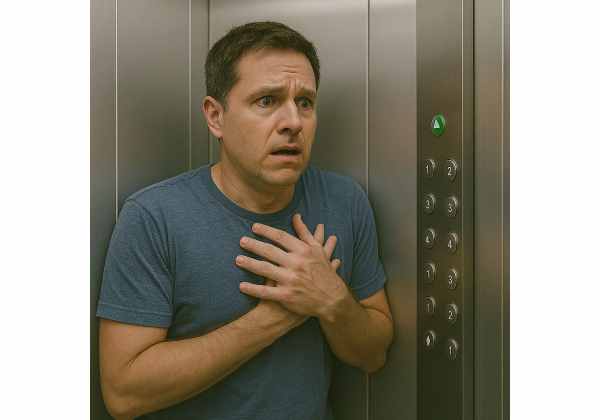
Claustrophobia is an intense fear of enclosed, crowded, or hard-to-exit spaces. It is more than ordinary discomfort in a small room or elevator; for some people, the fear becomes strong enough to cause panic-like symptoms, avoidance, missed activities, and difficulty completing medical tests such as MRI scans.
Clinically, claustrophobia is usually understood as a situational form of specific phobia. The feared situation may be a physically small space, such as a closet or elevator, but it may also be any setting that feels inescapable, crowded, airless, locked, or difficult to leave. The fear often centers less on the space itself and more on what the person believes might happen there: being trapped, fainting, suffocating, losing control, panicking, or being unable to get help.
Table of Contents
- What Claustrophobia Means
- Common Claustrophobia Triggers
- Claustrophobia Symptoms and Signs
- Why Claustrophobia Happens
- Risk Factors for Claustrophobia
- Diagnostic Context and Related Conditions
- Effects and Complications
- When Symptoms Need Urgent Attention
What Claustrophobia Means
Claustrophobia is a fear response to enclosed or restrictive situations that feels out of proportion to the actual danger and can interfere with daily life. In mental health classification, it is commonly considered a situational specific phobia when the fear is persistent, predictable, distressing, and linked to avoidance or major discomfort.
The word is often used casually, but clinically important claustrophobia has a recognizable pattern. A person may know that an elevator, airplane cabin, tunnel, or MRI scanner is not likely to harm them, yet their body reacts as if they are in serious danger. That mismatch between actual risk and felt threat is one reason phobias can feel confusing or embarrassing to the person experiencing them.
The central fear is often a sense of being trapped. Some people fear that they will not be able to leave quickly. Others fear that there will not be enough air, that the walls will close in, that the door will jam, that they will faint, or that they will panic in front of others. A person may also fear losing control of their behavior, such as shouting, crying, pushing past people, or needing to escape suddenly.
Claustrophobia can range from mild to severe. Someone with mild claustrophobic fear may feel tense in elevators but still use them. Someone with more severe symptoms may climb many flights of stairs, avoid underground trains, decline air travel, refuse small meeting rooms, or postpone medical imaging. The issue is not simply whether fear is present, but how intense it becomes, how often it occurs, and how much it limits normal choices.
A key feature is anticipatory anxiety. The distress can begin long before the person enters the space. They may worry for days before a flight, feel dread before a scheduled scan, or mentally rehearse escape routes before entering a crowded venue. This anticipation can become almost as disruptive as the situation itself.
Claustrophobia also differs from a reasonable preference for open spaces. Many people dislike crowded elevators or windowless rooms. A phobia is more likely when fear is intense, persistent, hard to control, and connected with avoidance, panic-like reactions, or significant distress. For a broader look at how anxiety symptoms are evaluated clinically, anxiety screening can help explain the difference between everyday anxiety and symptoms that may need formal assessment.
Common Claustrophobia Triggers
Claustrophobia triggers are usually situations that feel enclosed, crowded, restrictive, or difficult to exit. The trigger does not have to be objectively dangerous; it only has to create a convincing sense of confinement or loss of escape.
Common triggers include:
- Elevators, especially crowded or slow-moving ones
- Airplanes, trains, buses, subways, and other enclosed transport
- Tunnels, bridges, parking garages, and underground walkways
- Small rooms, locked rooms, basements, closets, or windowless offices
- MRI scanners, CT scanners, dental chairs, or other medical settings where movement is limited
- Crowded stores, concerts, theaters, classrooms, or meeting rooms
- Tight clothing, helmets, masks, seatbelts, or anything that feels physically restrictive
- Bathrooms, changing rooms, or stalls where the door locks
- Situations where leaving would feel socially difficult, such as a packed row in a theater
Some people are triggered mainly by small spaces. Others are triggered more by crowded spaces, even when the room is large. A crowded airport gate, lecture hall, or train platform may feel claustrophobic because movement is restricted and exits are not immediately reachable.
Medical settings are especially important. MRI machines are a common example because the person must lie still inside a narrow scanner, often with loud noises, limited visibility, and a sense that they cannot easily move. Dental work, eye exams, casts, sleep studies, and some hospital procedures can also trigger claustrophobic fear when the person feels pinned down, covered, or unable to pause the situation.
The same person may react differently depending on context. An elevator may feel manageable when empty but intolerable when crowded. A small room may be fine if the door is open but frightening if the door is closed. A car may feel safe with the windows down but alarming in heavy traffic, a tunnel, or a locked parking structure.
Triggers can also expand over time. Someone who first avoids elevators may later avoid high-rise buildings because elevators might be needed. Someone who fears MRI scanners may begin to worry about other medical tests. This spread does not happen to everyone, but it can make the fear feel broader than the original situation.
Claustrophobia Symptoms and Signs
Claustrophobia symptoms can affect the body, thoughts, emotions, and behavior at the same time. The reaction may resemble a panic attack, especially when exposure is sudden or escape feels impossible.
Physical symptoms may include:
- Rapid heartbeat or pounding pulse
- Shortness of breath or a feeling of not getting enough air
- Chest tightness or pressure
- Sweating, trembling, shaking, or chills
- Dizziness, lightheadedness, or feeling faint
- Nausea or stomach discomfort
- Dry mouth, throat tightness, or a choking sensation
- Hot flashes, tingling, or numbness
- Muscle tension, restlessness, or an urgent need to move
The breathing symptoms can be especially distressing. Many people with claustrophobia fear suffocation, even when the space has normal airflow. The feeling of breathlessness can then intensify the belief that something is wrong, creating a feedback loop between body sensations and fear.
Emotional and cognitive symptoms often include a sudden sense of danger, dread, or urgency. A person may think, “I have to get out,” “I can’t breathe,” “I’m trapped,” “I’m going to pass out,” or “I’m going to lose control.” These thoughts may arrive quickly and feel convincing in the moment, even if the person later recognizes that the situation was not dangerous.
Behavioral signs are just as important as internal symptoms. A person may scan for exits, stand near doors, refuse to sit in the middle of a row, avoid elevators, leave events early, cancel appointments, or ask for repeated reassurance that they can leave. Some people carry safety items, travel only with a trusted person, or plan routes around tunnels, bridges, or underground transport.
Children may show claustrophobia differently from adults. They may cry, freeze, cling to a caregiver, refuse to enter a room or vehicle, have tantrums, complain of stomachaches, or become unusually quiet. They may not be able to explain that the problem is a fear of being trapped.
Not every episode is visible to others. Some people endure the situation silently while feeling intense internal panic. They may appear calm but mentally count the seconds until they can leave. This can make claustrophobia easy to miss unless the person describes what is happening.
Because symptoms such as chest tightness, breathlessness, dizziness, and palpitations can also occur with medical conditions, context matters. Symptoms that appear only in predictable enclosed-space situations suggest claustrophobic fear, but new, severe, unusual, or medically concerning symptoms should not be assumed to be anxiety without proper evaluation.
Why Claustrophobia Happens
Claustrophobia usually develops from a mix of learning, temperament, biology, and life experience rather than a single cause. Many people can identify a frightening event, but others develop the fear gradually or without a clear memory of where it began.
One common pathway is direct experience. A person may have been stuck in an elevator, trapped in a crowded room, locked in a small space, restrained during a medical procedure, or unable to leave a frightening situation. Even one intense event can teach the brain to treat similar spaces as dangerous later.
Another pathway is observational learning. A child may see a parent panic in an elevator or hear repeated warnings about suffocation, entrapment, or unsafe spaces. Over time, the child may learn that enclosed spaces are threatening, even without having a direct bad experience.
Claustrophobia may also involve heightened sensitivity to body sensations. People who are very aware of breathing changes, heart rate, dizziness, or heat may interpret normal stress reactions as signs of danger. In an enclosed space, a small change in breathing or temperature can feel like evidence that the space is unsafe.
Fear conditioning is another useful concept. The brain can connect a neutral situation with danger after a frightening experience. Once that connection forms, the body may react automatically before the person has time to reason through the facts. This is why someone may intellectually know that an elevator is safe while still feeling intense physical fear.
Certain brain systems involved in threat detection, especially networks that include the amygdala, are thought to play a role in phobic fear. These systems help humans respond quickly to danger, but in phobias they may become overly reactive to cues that resemble threat. Claustrophobia can therefore feel fast, physical, and automatic.
The fear often centers on two themes: restriction and suffocation. Restriction means the person feels unable to move, leave, or control the situation. Suffocation means the person fears not having enough air or being unable to breathe freely. These themes can appear separately or together. For example, someone may tolerate a small room if the door is open, but panic in a large crowded room if they cannot easily reach an exit.
Stress can make claustrophobia more noticeable. During periods of poor sleep, grief, burnout, illness, trauma reminders, or general anxiety, the nervous system may be more reactive. A situation that was once uncomfortable may start to feel intolerable when the person’s overall stress load is high.
Risk Factors for Claustrophobia
Risk factors increase the chance of claustrophobia but do not guarantee that it will develop. A person may have several risk factors and never develop a phobia, while another person may develop claustrophobia after a single memorable event.
Important risk factors include:
- A past frightening experience involving confinement, restriction, crowding, or inability to escape
- A family history of anxiety disorders or specific phobias
- An anxious, behaviorally inhibited, or highly threat-sensitive temperament
- Childhood experiences involving being trapped, locked in, restrained, or unable to leave
- Frequent exposure to frightening stories or warnings about enclosed spaces
- Panic attacks or strong fear of panic-like body sensations
- Traumatic experiences in which escape was blocked or felt impossible
- High stress, poor sleep, or ongoing emotional strain
- Medical experiences involving restraint, scanning machines, masks, casts, or limited movement
Age and sex patterns are also relevant, though not absolute. Specific phobias often begin in childhood or adolescence, but claustrophobia can also appear in adulthood, especially after a frightening medical, travel, or entrapment-related event. Research on specific phobias often finds higher rates in women than men, though men may underreport symptoms because of stigma or expectations around fear.
A person’s interpretation of the situation matters as much as the situation itself. Two people can enter the same elevator; one sees a routine ride, while the other notices the closed door, limited air, crowded bodies, and lack of control. That threat interpretation can determine whether anxiety stays mild or escalates.
People with panic-like symptoms may be especially vulnerable. If someone has previously felt sudden breathlessness, racing heart, dizziness, or chest tightness, they may begin to fear places where escape would be difficult if those sensations returned. This can overlap with panic-related avoidance, which is why careful diagnostic assessment can matter. For comparison, panic attacks and anxiety disorders can look similar on the surface but have different patterns.
Trauma can also shape claustrophobic fear. If a person’s trauma involved being trapped, restrained, confined, or unable to leave, enclosed spaces may later act as reminders. In that situation, the fear may not be only about the current room or vehicle; it may also reflect the body’s memory of a past threat.
Diagnostic Context and Related Conditions
Claustrophobia is usually assessed through clinical history rather than a blood test or brain scan. A clinician looks at the trigger pattern, symptom intensity, duration, avoidance, impairment, and whether another condition better explains the fear.
For a diagnosis of specific phobia, the fear is typically persistent, occurs almost every time the person encounters or anticipates the feared situation, is out of proportion to the actual danger, and leads to avoidance or endured distress. The symptoms must also cause meaningful distress or interfere with daily functioning. In many diagnostic systems, duration matters, especially when distinguishing a temporary fear from a persistent phobia.
A careful evaluation may ask questions such as:
- Which spaces or situations trigger the fear?
- What does the person fear will happen in those situations?
- How long has the fear been present?
- Does the person avoid activities, travel, work settings, or medical tests because of it?
- What physical symptoms occur during exposure?
- Does anxiety happen only in enclosed spaces or also in many unrelated situations?
- Are there trauma reminders, panic attacks, obsessive fears, or medical symptoms involved?
- Has the fear changed over time?
Claustrophobia can overlap with several other conditions. Agoraphobia involves fear of situations where escape might be difficult or help might not be available, often across multiple settings such as public transportation, open spaces, enclosed places, crowds, or being outside alone. Claustrophobia is narrower when the fear is mainly about enclosed or restrictive spaces, but the two can resemble each other.
Panic disorder is different because panic attacks are recurrent and often unexpected, rather than consistently tied to one specific situation. A person with claustrophobia may have panic attacks, but those attacks usually occur in response to enclosed-space triggers.
Social anxiety disorder can involve avoidance of crowded rooms, meetings, classrooms, or public transportation, but the central fear is negative judgment, embarrassment, or scrutiny. In claustrophobia, the central fear is usually entrapment, suffocation, restriction, or inability to escape. social anxiety screening focuses on that judgment-related fear pattern.
Post-traumatic stress symptoms may also include avoidance of enclosed spaces, especially if confinement was part of a traumatic event. In that case, symptoms such as intrusive memories, nightmares, emotional numbing, hypervigilance, or trauma-specific triggers may point beyond a simple phobia. A related comparison is PTSD versus anxiety disorder, because both can involve avoidance and intense physical arousal.
Medical conditions can complicate the picture. Asthma, heart rhythm problems, vestibular disorders, thyroid disease, medication effects, and other health issues can cause symptoms that resemble anxiety. A mental health diagnosis should not be used to dismiss symptoms that are new, unexplained, severe, or medically concerning.
Effects and Complications
Claustrophobia can become limiting when avoidance starts shaping work, travel, healthcare, relationships, and everyday decisions. The complication is not only fear during an episode, but the way life can narrow around preventing the next one.
Daily routines may become more complicated. A person may avoid elevators, underground parking, trains, planes, tunnels, crowded shops, public bathrooms, or rooms without visible exits. They may arrive early to choose aisle seats, leave events before crowds form, decline invitations, or avoid buildings where the layout feels uncertain.
Work and education can also be affected. High-rise offices, crowded classrooms, windowless meeting rooms, security checkpoints, elevators, and public transportation can all become barriers. A person may turn down opportunities that involve travel, conferences, field work, or enclosed workspaces.
Healthcare avoidance is one of the most important complications. Claustrophobia can make MRI scans, dental procedures, certain eye exams, sleep studies, and some hospital tests difficult to complete. In some cases, fear of confinement may delay diagnosis of unrelated medical problems. This does not mean every person with claustrophobia avoids care, but it is a common enough issue that medical teams often ask about it before certain procedures.
Claustrophobia can also strain relationships. Friends or family may not understand why the person refuses a flight, leaves a crowded event, or insists on taking stairs. The person may feel ashamed, frustrated, or dependent on others for reassurance. Over time, secrecy and avoidance can create tension.
Emotional complications may include embarrassment, reduced confidence, irritability, or a sense of being controlled by fear. Some people become anxious not only about enclosed spaces but also about having symptoms in public. This can increase isolation and make the fear feel more pervasive.
Specific phobias can occur alongside other mental health conditions, including other anxiety disorders, depressive symptoms, substance use problems, and trauma-related symptoms. This does not mean claustrophobia causes these conditions directly in every case. Rather, persistent fear, avoidance, impaired functioning, and repeated distress can increase overall psychological burden.
In severe cases, avoidance can become self-reinforcing. Each avoided elevator, flight, scan, or crowded room may bring short-term relief, which teaches the brain that avoidance prevented danger. Over time, this can make the feared situations feel even more threatening, even if no actual danger occurred.
When Symptoms Need Urgent Attention
Claustrophobia itself is not usually a medical emergency, but some symptoms and situations need prompt professional evaluation. The safest approach is to take new, severe, or unusual physical symptoms seriously rather than assuming they are only anxiety.
Urgent medical attention may be needed if a person has chest pain, fainting, severe shortness of breath, blue lips, weakness on one side, confusion, seizure-like symptoms, or symptoms that feel different from their usual anxiety pattern. These signs can have medical causes and should be assessed promptly.
Immediate mental health support is important if claustrophobic fear is accompanied by thoughts of self-harm, feeling unable to stay safe, severe dissociation, psychosis-like symptoms, or escalating panic that cannot be contained in the moment. A person who feels at risk of harming themselves or someone else should seek emergency help right away. Guidance on ER-level mental health or neurological symptoms can help clarify when urgent evaluation is appropriate.
Professional evaluation is also important when claustrophobia prevents necessary medical care. For example, fear that repeatedly stops someone from completing scans, dental work, procedures, or hospital visits can create health risks unrelated to the phobia itself. The issue deserves careful clinical attention, even if the person feels embarrassed discussing it.
Assessment may also be warranted when the fear is spreading, causing major avoidance, interfering with work or school, or occurring alongside depression, trauma symptoms, substance use, or frequent panic attacks. These patterns can suggest that claustrophobia is part of a broader anxiety or stress-related picture.
The goal of urgent wording is not to alarm people with claustrophobia. Most episodes are frightening but not dangerous. The key distinction is whether symptoms are typical for the person and clearly tied to a known trigger, or whether they are new, severe, medically concerning, or connected with safety risk.
References
- Claustrophobia 2023 (Clinical Review)
- Specific Phobia 2024 (Clinical Review)
- Specific Phobias 2026 (Clinical Reference)
- Key factors behind various specific phobia subtypes 2023 (Research Article)
- Frequency of and sex distribution in specific phobia subtypes in a treatment-seeking sample 2025 (Research Article)
- The cross-national epidemiology of specific phobia in the World Mental Health Surveys 2017 (Epidemiological Study)
Disclaimer
This content is for general educational purposes only and is not a substitute for professional medical advice, diagnosis, or treatment. Claustrophobia-like symptoms, especially when severe, new, medically unusual, or linked with safety concerns, should be discussed with a qualified healthcare or mental health professional.
Thank you for taking the time to read this resource; sharing it may help someone better understand claustrophobia with less confusion or shame.