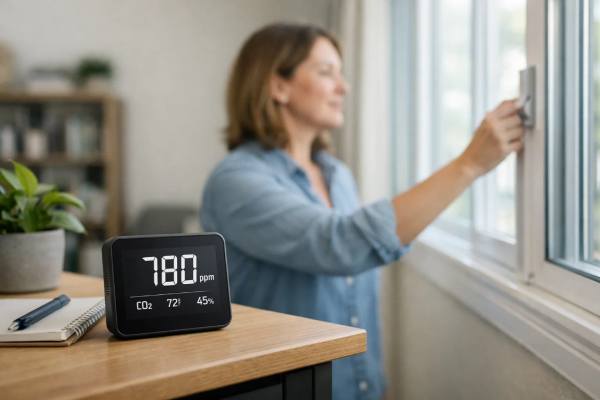
A carbon dioxide (CO2) monitor can turn an invisible indoor problem into a clear, actionable signal. Because people exhale CO2 with every breath, indoor CO2 tends to rise when a room is crowded or under-ventilated—and fall when fresh outdoor air replaces stale air. That simple relationship makes CO2 one of the most practical “comfort and risk” indicators for everyday spaces like bedrooms, classrooms, offices, and living rooms.
Still, CO2 is easy to misunderstand. A high reading does not automatically mean the air is toxic, and a low reading does not guarantee the air is clean. The real value is in using CO2 as a proxy for how much exhaled air is accumulating, which often tracks how well a space is ventilated. With the right placement and a few clear thresholds, a CO2 monitor can help you ventilate earlier, reduce that “stuffy room” feeling, and support healthier indoor breathing during cold and flu season.
Quick Overview
- CO2 is a practical proxy for ventilation and “rebreathed air,” not a direct measure of germs, smoke, or chemicals.
- For many everyday spaces, sustained readings under about 800 ppm suggest strong ventilation for the number of people present.
- If CO2 stays above 1,000 ppm during normal use, the room likely needs more fresh air or fewer occupants.
- Do not use CO2 monitors as a substitute for carbon monoxide alarms; they measure different gases and different dangers.
- A simple rule works well: ventilate when readings are rising quickly or staying high for 10–15 minutes, and confirm the number drops afterward.
Table of Contents
- What CO2 really tells you
- Understanding ppm readings at home
- When to ventilate and how long
- Choosing a reliable CO2 monitor
- Best placement and measurement habits
- Limits, safety, and special situations
What CO2 really tells you
CO2 monitors are useful because they track something people generate constantly: exhaled air. In most homes, classrooms, and offices, the primary indoor source of CO2 is breathing. When ventilation is limited—windows closed, fans off, outdoor air intake low—CO2 accumulates. When you bring in outdoor air, CO2 drops. That relationship makes CO2 a practical “ventilation thermometer.”
CO2 is a ventilation proxy, not a toxin meter
At the levels usually seen indoors (often hundreds to a couple thousand parts per million), CO2 is rarely the main health hazard by itself. The point is what CO2 represents: how much exhaled air is lingering. If exhaled air is building up, other things that travel with it can also build up—odors, humidity from breathing, and, during respiratory virus season, the potential for airborne particles from coughs, talking, and singing.
Why the number is in ppm
Most monitors show CO2 in ppm (parts per million). That scale is convenient because:
- Outdoor air typically sits in the low hundreds of ppm.
- Normal indoor spaces can move noticeably with occupancy (for example, 600 to 1,500+ ppm).
- The range helps you see changes over minutes, not just hours.
What CO2 can and cannot predict
CO2 correlates best with “how well a space is ventilated for the number of people in it.” It is less informative when:
- A room has strong ventilation but also a pollution source (smoke, strong chemicals, cooking emissions).
- People are present briefly (not enough time for CO2 to rise) but exposure risk is still possible.
- Air is cleaned by filtration (which can reduce particles) without changing CO2 (which filters do not remove).
A more useful mindset: trend plus context
A single reading matters less than the pattern:
- Does CO2 climb steadily when people enter the room?
- Does it stay elevated during normal use?
- Does it drop promptly after you ventilate?
When you treat CO2 as a feedback tool—measure, ventilate, re-check—you turn indoor air quality from guesswork into a repeatable habit.
Understanding ppm readings at home
Most people want a simple chart: “What number is good, and what number means I should open a window?” The most practical answer uses ranges, because the right target depends on how many people are in the room, how big the room is, and how quickly fresh air is replaced.
Practical ranges for everyday spaces
These ranges are commonly used as ventilation decision thresholds for typical homes and public rooms:
- Under ~800 ppm: Strong ventilation for the current occupancy in many settings. Often feels less “stuffy,” and it usually indicates exhaled air is not accumulating quickly.
- ~800–1,000 ppm: Ventilation may be adequate, but the room is trending toward “shared air buildup,” especially if the number is rising and staying elevated.
- ~1,000–1,500 ppm: Likely under-ventilated for the number of people present. Consider ventilating soon, reducing occupancy, or increasing mechanical outdoor air.
- Over ~1,500 ppm: Poor ventilation for most occupied spaces. Ventilate promptly and look for causes (closed vents, clogged filters, disabled fans, or too many people for the room).
If you see 2,000+ ppm during normal use, treat it as a strong signal that the space needs major changes—more outdoor air, fewer people, or both—especially in rooms where people spend long periods.
Why bedrooms often look “worse” overnight
Bedrooms are a classic CO2 trap: closed door, closed windows, and hours of steady breathing. It is normal to see CO2 climb overnight, especially with two people or a pet in the room. If you wake up with a headache, dry throat, or “stale air” feeling, CO2 may be telling you the room needs a small, consistent fresh-air pathway.
Why kitchens can be confusing
Cooking adds humidity and particles, and some appliances can add combustion byproducts. CO2 can rise with people and poor ventilation, but a low CO2 reading does not mean the kitchen air is clean during cooking. In kitchens, use CO2 as one signal, but rely heavily on:
- A vent hood that exhausts outdoors
- A cracked window or cross-ventilation during heavy cooking
- Avoiding lingering smoke or strong odors
A key safety clarification: CO2 is not carbon monoxide
CO2 monitors do not replace carbon monoxide (CO) alarms. CO is a dangerous gas from incomplete combustion that can cause severe poisoning even at low concentrations. Keep CO alarms in place wherever recommended, especially near sleeping areas and fuel-burning appliances.
When to ventilate and how long
The best CO2 strategy is not perfection; it is timely response. You do not need to chase the lowest possible number. You need to catch rising CO2 early enough that a short ventilation action keeps the room comfortable and lowers shared-air buildup during long conversations, family gatherings, work sessions, or sleep.
A simple ventilation trigger system
Use one of these clear triggers:
- Trend trigger: CO2 rises steadily for 5–10 minutes after people enter, and the slope does not flatten.
- Threshold trigger: CO2 stays above ~1,000 ppm for 10–15 minutes during normal use.
- High-alert trigger: CO2 hits ~1,500 ppm or higher, especially with prolonged occupancy.
If you prefer an easy household rule: ventilate any time the number is rising quickly or staying high, and keep ventilating until it clearly drops.
How long to ventilate
Ventilation time depends on weather, wind, and layout, but these patterns are common:
- Cross-ventilation (two openings on opposite sides): often works in 5–10 minutes for noticeable improvement.
- Single window crack plus a fan: may need 10–30 minutes, but can be less disruptive in cold weather.
- Mechanical ventilation or HVAC outdoor air: improvement can be steady but slower; confirm by watching CO2 fall over 15–30 minutes.
The practical goal is a measurable drop, not a specific minute count. If the number does not move, the action may not be providing real outdoor air exchange.
Ventilation methods that work well
- Open windows briefly and widely for a fast exchange, then close to maintain temperature.
- Create a “push-pull” pathway: open a window and crack a door to the hallway, or use two windows in different rooms.
- Use exhaust fans: bathroom fans and kitchen hoods that vent outdoors can help remove air, but fresh air must still enter somewhere.
- Adjust HVAC settings: if your system has an outdoor air intake, ensure it is enabled and not blocked by seasonal settings.
What about air purifiers?
Air purifiers that use HEPA filtration can reduce particles and can be very helpful during respiratory virus season, wildfire smoke, or high indoor dust. But air purifiers do not reduce CO2. If CO2 is high, you need outdoor air exchange or reduced occupancy.
Confirm success with a “ventilation check”
After you ventilate, look for:
- A downward trend within 5–15 minutes (faster with cross-ventilation)
- A new, lower “plateau” during ongoing occupancy
- Faster recovery after people leave the room
This feedback loop is the real power of CO2 monitors: they let you see what actually works in your specific space.
Choosing a reliable CO2 monitor
Not all “CO2” monitors measure CO2 directly. Choosing a device with the right sensor type and reasonable accuracy is the difference between helpful feedback and confusing noise.
Look for true CO2 sensing
For indoor air decisions, prioritize NDIR (non-dispersive infrared) CO2 sensors. NDIR sensors measure CO2 by how the gas absorbs infrared light at specific wavelengths. In plain terms: it is a direct measurement method and is widely used for indoor monitoring.
Be cautious with monitors labeled “CO2” that actually estimate “equivalent CO2” (sometimes called eCO2) from other gases such as VOCs. Those can be misleading because:
- Cooking, cleaning products, and fragrances can change VOCs dramatically.
- The device may “guess” CO2 changes that are not real.
- You may ventilate for the wrong reason or miss true ventilation problems.
Accuracy and useful specifications
You do not need laboratory precision, but you want stability and believable trends. Helpful features include:
- A stated accuracy range (often something like ±(a number of ppm plus a percentage))
- A response time that updates within a few minutes
- A measurement range that covers at least up to a few thousand ppm
- Data logging or at least a clear real-time display
A monitor that is slightly off but consistent can still be useful for decision-making, especially if you focus on changes and trends rather than obsessing over single numbers.
Calibration and automatic baseline features
Many consumer monitors use an “automatic baseline calibration” approach that assumes the sensor will occasionally be exposed to fresh outdoor air. This can be fine in homes where windows open regularly, but it may drift if:
- The device is kept indoors continuously in a space that never drops near outdoor levels
- The room is occupied most of the time
- The monitor is used in a crowded facility with limited fresh-air breaks
If your device allows it, periodic manual checks can help. A simple habit is to place the monitor outdoors for several minutes (away from car exhaust) and see if it settles near typical outdoor readings. Do this only when conditions are safe and stable, and treat it as a “sanity check,” not a perfect calibration.
Convenience features that matter
Consider how you will actually use the monitor:
- Portable vs fixed: portable helps you diagnose different rooms; fixed helps you track a problem space like a bedroom or classroom.
- Battery life and warm-up time: some sensors need a few minutes to stabilize.
- Alarms: a gentle alert at a chosen threshold can make the monitor useful even when you are busy.
A good monitor is one you will keep on, glance at, and act on—not one that lives in a drawer because it is fussy.
Best placement and measurement habits
Placement is the most overlooked part of CO2 monitoring. A well-chosen monitor in the wrong location can make good ventilation look bad—or hide a real problem.
Place the monitor in the breathing zone
A practical rule is to place the monitor:
- At about head height when seated (or in the general breathing zone)
- In the main occupied area of the room
- Where air mixes naturally, not in a “dead corner”
Avoid placing it:
- Right next to a window you open often (it may read artificially low)
- Directly under an HVAC supply vent (fresh air blasts can distort readings)
- Near an exhaust fan or return vent (which can pull air differently than the room average)
- On a couch, bed, or soft surface that can block airflow around the sensor
Do not measure your own breath
CO2 in exhaled air is extremely high compared with room air. If the monitor is too close to where people are speaking or sleeping, a single breath can spike the reading. Keep it a little distance away from faces and pillows so it reflects the room, not a single person.
Use one room as your “reference space”
If you are new to CO2 monitoring, start with one predictable space:
- Your bedroom
- A home office
- A classroom corner where people sit consistently
Learn how it behaves:
- What does it read when the room is empty?
- How quickly does it rise with one person, then two?
- What ventilation action reliably drops it?
Once you have a baseline, moving the monitor to other rooms becomes more informative.
Measure during the moments that matter
CO2 monitoring is most valuable during:
- Overnight sleep
- Meetings, tutoring sessions, and gatherings
- Children’s playdates in a closed room
- Winter days when windows stay closed
- Times when someone at home is sick and you want better ventilation discipline
A quick “diagnostic walk-through” you can repeat
Try this once per season:
- Place the monitor in the room during typical use for 30–60 minutes.
- Note the peak and whether it is still rising at the end.
- Ventilate using your best method (cross-ventilation if possible).
- Watch how fast and how far the number drops.
- Adjust: add a fan, change which window opens, or reduce crowding.
This turns CO2 from a passive display into a practical indoor air routine.
Limits, safety, and special situations
CO2 monitors are powerful tools, but they are not full indoor air quality labs. Understanding what they miss—and when to escalate beyond “open a window”—keeps the tool honest and protects health.
CO2 does not equal clean air
A low CO2 number can occur while air quality is still poor. Examples include:
- Wildfire smoke or heavy outdoor pollution: opening windows may lower CO2 but increase fine particles.
- Cooking emissions: particles and irritants can rise even with moderate CO2.
- Strong chemicals: cleaning sprays, solvents, and fragrances can be irritating without changing CO2 much.
In these cases, the right move may be a combination: ventilate strategically when outdoor air is cleaner, use a vent hood that exhausts outdoors, and consider particle filtration for smoke or dust. Remember: filtration helps particles; ventilation helps CO2 and stale air.
Safety: do not confuse CO2 with carbon monoxide
CO monitors and CO alarms are essential for combustion safety. Keep them active and tested, especially if you have:
- Gas or wood appliances
- A garage attached to the home
- A fireplace or space heater
If you ever suspect a combustion problem (soot, unusual odors, headaches that improve outside, dizziness, nausea), do not rely on a CO2 monitor. Treat it as a separate issue that needs urgent evaluation.
Classrooms, childcare, and busy waiting rooms
In shared public spaces, CO2 is most useful as an operational signal:
- Is the room consistently under-ventilated for the class size?
- Do readings spike during certain periods (after lunch, during group work, during assemblies)?
- Does opening a door to a corridor help, or does it just move air without bringing in outdoor air?
For decision-making, it often helps to set a clear target (for example, staying under ~1,000 ppm during normal occupancy) and plan a repeatable ventilation action when the number rises.
Bedrooms and infants
Families often ask about baby rooms. The key is not fear of CO2 toxicity at typical levels, but recognizing that:
- Closed doors and closed windows can lead to sustained high CO2 overnight.
- Better ventilation can improve comfort, reduce stuffiness, and support healthier breathing during virus season.
If you choose to improve ventilation in a baby’s room, focus on safe, stable approaches: a small, consistent fresh-air pathway and comfortable room temperature. Avoid unsafe heating devices and ensure smoke and CO alarms are installed as recommended.
When to get professional help
Consider an HVAC or building evaluation if:
- CO2 stays high despite obvious ventilation attempts
- The number barely changes when you open windows or run fans
- Multiple rooms show the same pattern
- People frequently feel unwell in a specific space (persistent headaches, irritation, unusual fatigue)
A CO2 monitor is excellent at showing you there is a ventilation problem. It cannot always tell you why. That is where a professional assessment can be worth it.
References
- ASHRAE Position Document on INDOOR CARBON DIOXIDE 2025 (Position Document)
- Indoor Carbon Dioxide Metric Analysis Tool 2022 (Technical Note)
- About Ventilation and Respiratory Viruses | Ventilation | CDC 2024 (Guidance)
- Guidance on improving indoor air quality in office buildings 2025 (Guidance)
- Roadmap to improve and ensure good indoor ventilation in the context of COVID-19 2021 (Guidance)
Disclaimer
This article is for educational purposes and does not provide medical, engineering, or legal advice. CO2 monitors can help you understand ventilation patterns, but they do not directly measure viruses, allergens, smoke, or toxic gases, and they do not replace carbon monoxide alarms or professional indoor air assessments. If you or your child has severe or worsening breathing symptoms, chest pain, confusion, fainting, blue or gray discoloration around the lips, or any emergency warning signs, seek urgent medical care. For persistent indoor air concerns—especially where combustion appliances or repeated symptoms are involved—consult a qualified professional.
If you found this article helpful, please share it on Facebook, X (formerly Twitter), or any platform you prefer.