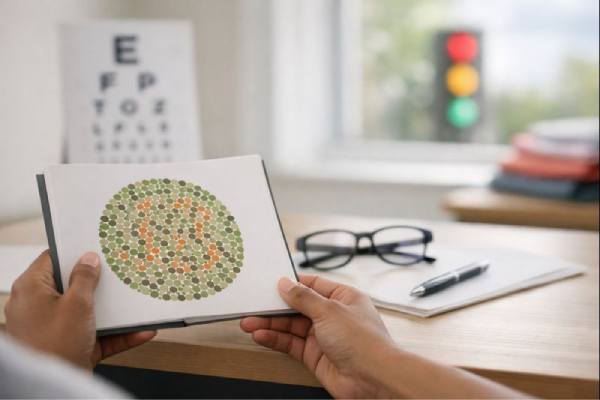
Color blindness (more accurately, color vision deficiency) is not the inability to see color. For most people, it is a predictable shift in how certain hues separate—often reds and greens—because one type of cone cell in the retina responds differently than expected. Many people live for years without realizing it, until a school screening, a job requirement, or a frustrating moment like “Why do these two socks look identical to me?” The reassuring part is that color vision deficiency is usually stable and compatible with a full, independent life. The challenging part is that color is embedded in safety labels, maps, digital interfaces, and career pathways in ways people do not always anticipate.
This guide breaks down the major types, how testing really works, and how to adapt at home, at school, and at work. It also covers a critical exception: when color vision changes suddenly, it can signal an eye or nerve problem that deserves prompt care.
Quick Facts
- Knowing your specific type (red-green, blue-yellow, or more rare patterns) makes practical fixes far easier.
- Formal testing can document severity for school, workplace accommodations, and safety-critical roles.
- Many daily challenges can be solved with design tweaks: labels, high-contrast settings, and not relying on color alone.
- Sudden new color vision change in one eye is not typical and should be evaluated urgently.
- A simple habit—checking each eye separately when something looks “off”—helps catch acquired problems early.
Table of Contents
- What color blindness is and what causes it
- Types and severity: red-green, blue-yellow, and rare forms
- How color vision testing works and what it can miss
- What color blindness changes in real life
- When color vision changes are a medical red flag
- Tools, accommodations, and smart workarounds
What color blindness is and what causes it
Color vision starts in the retina, where cone cells respond to light at different wavelength ranges. Most people have three main cone classes that are most sensitive to long (often called “red”), medium (“green”), and short (“blue”) wavelengths. Your brain compares signals across these cones to interpret color. Color vision deficiency happens when one cone type is missing, shifted, or working differently—so the comparison step produces less separation between certain hues.
Why “color blindness” is usually the wrong mental picture
Most people with color vision deficiency still see a rich, colorful world. The difference is more like this:
- Some colors that look clearly different to others may look similar to you.
- Color boundaries may feel “compressed,” especially in dim light or low-contrast situations.
- You may rely more on brightness, texture, position, and context instead of hue alone.
That is why someone can be excellent at art, cooking, or design and still have a measurable deficiency. The brain is highly adaptable, and many people develop strong compensatory strategies without conscious effort.
Congenital vs acquired color vision deficiency
There are two broad categories, and the distinction matters.
- Congenital (inherited) color vision deficiency: Present from early life, typically stable, and usually affects both eyes similarly. The most common forms are red-green deficiencies. These are often X-linked, which is why they are far more common in males than females, though females can be affected too.
- Acquired color vision deficiency: Develops later because of eye disease, optic nerve disease, neurologic conditions, or medication toxicity. Acquired changes can be one-sided, can worsen over time, and often come with other symptoms like blur, dimming, pain with eye movement, or a new blind spot.
If you have “always been this way,” that points toward congenital causes. If you notice a new change—especially in one eye—think acquired until proven otherwise.
Why lighting and fatigue can make it feel worse
Color discrimination is harder when:
- Light is dim, yellow, or uneven.
- Colors are low saturation (pastels, grays, “dusty” tones).
- A display is set to night mode or has a warm color temperature.
- You are tired or have dry eyes, which reduce clarity and contrast.
This is why many people describe their symptoms as situational: “In daylight I can tell, but indoors I cannot.” That pattern is common and does not automatically mean your condition is worsening.
Types and severity: red-green, blue-yellow, and rare forms
Color vision deficiency is not one condition. It is a family of patterns, and the pattern predicts what will be hard (and what will not). Understanding your type also prevents overgeneralizing—many people assume they “mix up every color,” when in reality the confusion is clustered in specific pairs.
Red-green deficiencies
These are the most common inherited forms.
- Deutan-type: The “green” (medium-wavelength) cone response is altered. Confusions often include greens, yellows, browns, and reds that share similar brightness.
- Protan-type: The “red” (long-wavelength) cone response is altered. Red shades can look darker, and distinguishing red from black or dark brown can be harder in low light.
Red-green deficiencies can range from mild to severe:
- Anomalous trichromacy: You still have three cone types, but one is shifted. This is common and often mild to moderate.
- Dichromacy: One cone type function is essentially absent. This is more severe and creates more consistent confusion lines.
A practical clue: if you mostly struggle with red-green pairs, certain browns vs greens, or traffic-light color identification at a distance, you are likely in this group.
Blue-yellow deficiencies
Blue-yellow issues (often called tritan defects) are less common as inherited conditions and more often appear as acquired changes. Confusions can include:
- Blue vs green
- Yellow vs pink or light gray
- Purple appearing similar to blue
Because blue-yellow changes can be acquired, noticing this pattern later in life should raise the bar for evaluation, especially if it is new or worse in one eye.
Complete or near-complete color vision loss
- Achromatopsia: A rare condition where cone function is severely impaired. People often have very limited color perception plus light sensitivity and reduced sharpness.
- Cone dystrophies and other retinal disorders: Can also reduce color discrimination, often with progressive changes.
These conditions tend to affect more than color alone. If your color vision issues are paired with strong light sensitivity, unusual glare, or reduced sharpness from early life, it is worth confirming the diagnosis.
Severity is about function, not labels
Severity describes how easily you can separate colors under real-world conditions. Two people with the “same type” may function very differently depending on:
- The exact cone shift
- Lighting and screen settings
- Visual acuity and contrast sensitivity
- Learned strategies and environment
That is why testing matters. A clear diagnosis helps you predict challenges, set expectations, and request accommodations when needed.
How color vision testing works and what it can miss
Color vision tests are tools with strengths and blind spots. Some are designed for quick screening, others for detailed classification, and others for occupational standards. The best test depends on what you need to know: “Do I have a deficiency?” “What type?” “How severe?” or “Can I safely meet a job requirement?”
Common screening tests
- Ishihara plates: These are the familiar dotted number or path plates. They are excellent for screening many red-green deficiencies, fast to administer, and widely used in schools and clinics. They are less informative for blue-yellow issues and can miss subtle acquired patterns.
- HRR-style pseudoisochromatic plates: Often used when clinicians want broader coverage, including some blue-yellow detection, and a better sense of severity.
Screening tests answer “likely yes or no.” They do not always define the exact type or severity in a way that is useful for occupational decisions.
Classification and severity tests
- Arrangement tests (such as D15 or similar hue ordering): You place colored caps in order. These can help classify patterns and show functional confusion lines. They can also pick up some acquired defects better than simple screening plates.
- Farnsworth-Munsell 100 hue test: More detailed and time-consuming, often used when fine discrimination matters (for example, quality control work or research contexts). It is also useful to document change over time in some acquired conditions.
- Anomaloscope testing: Often considered a reference standard for quantifying certain congenital red-green defects because it measures color matching behavior precisely. It is not available in many clinics, but it can be used in specialized settings.
Why online tests are not a substitute for clinical testing
Online color vision tests can be interesting, but they are not reliable for diagnosis because results depend heavily on:
- Monitor calibration and color gamut
- Brightness and color temperature settings
- Ambient lighting and reflections
- Phone “night shift” or blue-light filters
- Compression and color management in the test images
If your goal is documentation for school, driving, licensing, or employment, you want formal testing in a controlled setting.
Testing tips that make results more accurate
- Test with your usual vision correction (glasses or contacts) unless instructed otherwise.
- Avoid testing when your eyes are very dry or irritated; surface blur reduces contrast and can worsen performance.
- If you suspect an acquired issue, ask for each eye to be tested separately and compared.
- If color vision has changed, ask whether repeat testing over time is recommended to track progression.
A well-chosen testing plan does more than label you. It tells you what color pairs are risky, what environments amplify the problem, and how to adjust your daily systems so you spend less time guessing.
What color blindness changes in real life
The daily impact of color vision deficiency is usually less about “seeing the wrong color” and more about uncertainty. When a system relies on color alone—without text, shape, position, or contrast—people with color vision deficiency lose information and must compensate. The goal is to redesign your environment so you do not have to compensate constantly.
Everyday situations where people get tripped up
- Clothing and grooming: Coordinating outfits, matching socks, choosing makeup shades, or noticing stains can be harder under warm indoor light.
- Food and cooking: Judging doneness by color alone (especially meats), spotting mold, or identifying ripe fruit by subtle hue shifts may be unreliable.
- Maps and charts: Heat maps, transit lines, and color-coded dashboards can blur together without strong contrast or labels.
- Home and work organization: Colored folders, sticky notes, and wiring systems often assume “red means stop” is universally obvious.
- Safety and compliance: Warning lights, chemical labels, and medication packaging sometimes rely on color distinctions that are not robust.
A useful rule: if you have to “memorize” a color system, it is not a good system. Add redundancy.
Driving, signals, and safety
Many people with red-green deficiency drive safely. Traffic systems are designed with position cues (top-middle-bottom) and brightness differences, and most drivers learn the pattern quickly. Still, problems can arise with:
- Distant or glare-heavy signals
- Nonstandard signal layouts
- Small indicator lights on dashboards
- Color-only warnings in navigation apps
If you have any uncertainty, rely on position, symbols, and text rather than hue. Also remember that fog, rain, and bright sun reduce everyone’s color and contrast sensitivity, not just yours.
School and learning
Children may be mislabeled as inattentive or “not trying” if tasks are color-based:
- Color-coded math, grammar, and geography materials
- Science labs with color change reactions
- Art projects graded on color matching
- Classroom behavior systems using color zones
A simple adjustment often fixes the problem: pair colors with labels, shapes, or patterns. For example, instead of “use the green marker,” say “use the green marker labeled G” or “the marker with the triangle sticker.”
Emotional and social impact
Many adults describe a low-grade stress of being corrected: “No, that is purple,” or “How do you not see that?” Over time, some people stop asking for confirmation and simply avoid tasks. Normalizing the condition and building no-shame workarounds usually improves confidence quickly.
Color vision deficiency does not remove your ability to make good choices. It changes which cues are reliable. Once your systems are set up with redundancy, the daily burden often drops dramatically.
When color vision changes are a medical red flag
Inherited color vision deficiency is typically stable and similar in both eyes. A key exception is acquired color vision loss, which can signal retinal disease, optic nerve disease, or medication toxicity. In this context, color change is not just a “quirk.” It can be an early symptom—sometimes appearing before major vision loss.
Warning patterns that deserve prompt evaluation
Seek medical eye care promptly if you notice:
- A new color vision change in one eye (one eye sees colors as duller, grayer, or “yellowed”)
- Rapid worsening over days or weeks
- New central blur, a blind spot, or distortion along with color change
- Color change plus pain with eye movement or eye discomfort
- Color change after starting a new medication known to affect the retina or optic nerve, especially if doses are high or prolonged
A practical home check: cover one eye at a time and compare a bright red object or a familiar image. If one eye consistently sees it as dimmer or less saturated, that asymmetry is meaningful.
Common medical causes of acquired dyschromatopsia
- Optic neuritis and optic nerve inflammation: Often causes loss of color “vividness,” sometimes with pain on eye movement and reduced contrast.
- Optic neuropathies: Reduced blood flow or toxic-nutritional causes can impair color discrimination.
- Macular and retinal disease: Swelling or damage in the central retina can change color perception and contrast.
- Medication toxicity: Certain drugs can affect retinal function or the optic nerve, leading to acquired color changes.
Not every acquired change is permanent, but time matters. Early detection can prevent further loss and improve the odds of recovery.
Why clinicians test color vision in neurologic eye complaints
Color testing is a sensitive way to detect optic nerve dysfunction. In some optic nerve conditions, standard acuity (eye chart sharpness) may be only mildly reduced while color and contrast are clearly impaired. This is why color tests are often part of a complete evaluation when vision seems “off” but the eye chart does not fully explain it.
What to do if you suspect an acquired change
- Do not assume it is “screen fatigue” if the change is one-sided or worsening.
- Make note of onset time, pain, new neurologic symptoms, and medication changes.
- Request testing for each eye separately and ask whether optic nerve and macular evaluation is indicated.
The rule of thumb is simple: lifelong, stable color vision difference is usually benign. New or changing color vision is a symptom that should be evaluated like any other vision change.
Tools, accommodations, and smart workarounds
There is no universal “fix” for congenital color vision deficiency, but there are many practical upgrades that reduce daily friction. The best solutions do not force you to “see like everyone else.” They redesign the task so color is not the only channel of information.
High-impact habits at home and on screens
- Turn on accessibility settings: Many devices include color filters, contrast adjustments, and options to reduce reliance on color alone.
- Avoid warm-only color modes when precision matters: Night mode can compress color differences. Use neutral daylight settings when choosing clothing or interpreting charts.
- Label, do not guess: Use text labels or patterned tape for cables, containers, and folders. Pattern beats color when lighting changes.
- Use brightness and position cues: When a system is color-based (like a dashboard), learn the symbol and location first, color second.
Workplace strategies that reduce errors
- Ask for charts and dashboards with patterns, shapes, direct labels, and high contrast, not only color gradients.
- For wiring, parts bins, or lab labeling, request numbered tags or distinct textures in addition to color.
- In team settings, normalize quick verification: “Can you confirm this label color for me?” A two-second check can prevent a costly mistake.
Do color-correcting glasses help?
Some glasses and filters can change how colors appear, sometimes increasing separation for certain red-green confusions in specific lighting. However, “improvement” often means the world looks different, not necessarily more accurate. For many people, the benefit is situational and does not translate well to tasks like reading color-coded charts under varied lighting. If you try them, evaluate with real tasks:
- traffic signals at a distance
- work charts
- clothing matching under indoor light
If the glasses make you feel more confident but do not improve accuracy, focus instead on system changes and labels.
Career considerations and documentation
Some occupations have strict color vision requirements (often for safety reasons), and standards can be role-specific. If a job or training program requires documentation:
- Get formal testing results recorded in your medical file.
- Ask what test is accepted for that role, because not all employers accept the same screening methods.
- If you are borderline on screening, a more detailed assessment may clarify functional capacity.
Helping a child thrive
For children, the best approach is early identification and small classroom changes:
- Ensure teachers know the child is not “missing instructions,” but missing color cues.
- Replace “red group and green group” with “circle group and triangle group” or add labels.
- Teach the child a no-shame script: “I do not see that color reliably. Can you label it for me?”
A good workaround is not a workaround at all—it is good design. When color is paired with text, shape, and contrast, everyone performs better, not only people with color vision deficiency.
References
- An Integrative Review for Clinical Evaluation of Color Vision: The Right Test for the Right Disease 2025 (Review)
- Global Prevalence of Congenital Color Vision Deficiency among Children and Adolescents, 1932-2022 2025 (Systematic Review and Meta-Analysis)
- Acquired Dyschromatopsia and Its Link to Drug Toxicity 2024 (Review)
- Color vision devices for color vision deficiency patients: A systematic review and meta-analysis 2022 (Systematic Review and Meta-Analysis)
- Gene Therapy for Achromatopsia 2024 (Review)
Disclaimer
This article is for educational purposes and does not provide medical advice, diagnosis, or treatment. Color vision deficiency is often inherited and stable, but new or worsening color vision changes—especially in one eye—can be a sign of eye or optic nerve disease and should be evaluated promptly by a qualified clinician. Seek urgent medical care for sudden vision loss, severe eye pain, new flashes or many new floaters, or vision changes accompanied by weakness, numbness, trouble speaking, or severe headache.
If you found this article helpful, please consider sharing it on Facebook, X (formerly Twitter), or any platform you prefer. Sharing helps our team continue producing high-quality, reader-focused health content.