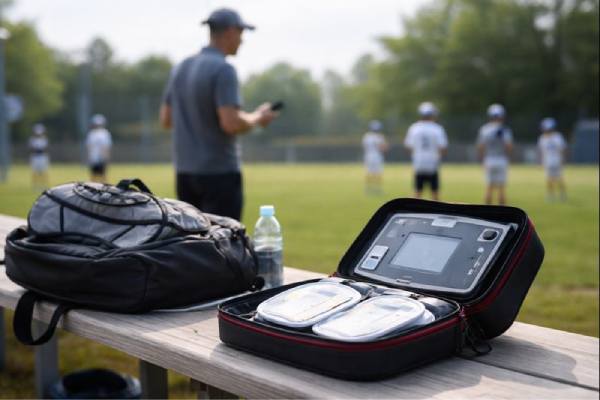
Commotio cordis is one of the most sudden and unsettling medical emergencies in sport: a healthy person takes a seemingly routine blow to the chest—often from a ball, puck, or another player—and collapses within seconds. Unlike a heart attack, this is not caused by blocked arteries, and unlike a bruise to the heart, there may be no visible injury on imaging or at autopsy. The danger comes from timing. If the impact lands during a tiny “vulnerable window” in the heartbeat, it can trigger a lethal rhythm, most often ventricular fibrillation, and the heart stops pumping effectively.
Because survival depends heavily on immediate action, understanding commotio cordis is less about memorizing rare biology and more about readiness: recognizing collapse as cardiac arrest, starting CPR, and using an AED without delay.
Table of Contents
- What commotio cordis is
- Why it happens and who’s at risk
- First signs and dangerous mimics
- How it’s diagnosed after collapse
- Treatment: CPR, AED, and hospital care
- Prevention, preparedness, and return to sports
What commotio cordis is
Commotio cordis means “agitation of the heart,” and it describes sudden cardiac arrest caused by a blunt blow to the chest in a person who usually has no structural heart disease. The impact does not need to be massive. What makes it deadly is where it lands (over the heart) and when it lands (during a precise part of the cardiac electrical cycle). The event most often produces ventricular fibrillation (VF)—a chaotic rhythm in which the heart quivers instead of pumping—so blood flow to the brain stops almost immediately.
It helps to separate commotio cordis from other chest-trauma problems:
- Not a heart attack: A heart attack is typically caused by blocked coronary arteries. Commotio cordis is an electrical catastrophe triggered by impact timing, not plaque rupture.
- Not “cardiac contusion” (a bruised heart): A contusion can cause rhythm problems too, but it involves measurable injury to the heart muscle. Commotio cordis can happen with little or no detectable damage.
- Not simply “getting the wind knocked out”: A player who is winded is usually conscious and breathing, even if uncomfortable. In commotio cordis, the person becomes unresponsive and may have no normal breathing.
The most common setting is youth or adolescent sport—baseball, lacrosse, hockey, softball, and sometimes football—because a smaller, more compliant chest wall may transmit energy to the heart more effectively. But commotio cordis is not limited to organized athletics; it can occur in recreational play, workplace incidents, falls, or interpersonal violence.
Two practical truths matter most for readers:
- Commotio cordis is treatable in the moment. Survival improves dramatically when bystanders respond as if it is cardiac arrest: call emergency services, start high-quality CPR, and use an AED as soon as possible.
- Prevention is largely about systems, not perfect gear. Safer rules, better technique, rapid access to AEDs, and rehearsed emergency action plans usually protect more lives than any single protective product.
If you remember one sentence: a sudden collapse after a chest blow should be treated as cardiac arrest until proven otherwise.
Why it happens and who’s at risk
Commotio cordis is a “perfect storm” of physics and physiology. The heart’s electrical cycle has moments when it is more vulnerable to disruption. During a narrow slice of time—often described as occurring during the early repolarization phase (near the upstroke of the T wave)—a mechanical удар (impact) can destabilize the electrical system and trigger VF. Outside that window, the same blow may cause nothing more than pain and surprise.
Several factors influence risk, and they often stack together:
Impact timing and location
- Timing: The vulnerable window is very brief—measured in milliseconds—so most chest blows do not cause commotio cordis.
- Location: Blows directly over the precordium (left-center chest where the heart sits closest to the chest wall) carry higher risk than impacts to the shoulder or abdomen.
- Angle and contact area: A focused impact to a small area (for example, the edge of a ball or a narrow contact point) may deliver energy differently than a broad, glancing blow.
Object and sport characteristics
- Hard, fast projectiles (baseballs, lacrosse balls, hockey pucks) are frequent culprits.
- Body-to-body contact can also cause it, especially when a shoulder, helmet, or elbow strikes the chest at the wrong moment.
- Level of play: Higher speeds can raise risk, but youth sports remain a key concern because chest-wall characteristics may contribute.
Individual factors
Commotio cordis often affects boys and young men, particularly in the early-teen years, but it can occur in any sex and at different ages. Potential contributors include:
- A more flexible, thinner chest wall that transmits force more efficiently.
- Lower body mass and less protective muscle bulk over the chest.
- Lack of prior exposure to coaching on avoiding chest blocks with the torso.
Importantly, many survivors have no hidden heart disease, but clinicians still treat every case seriously because some inherited rhythm disorders and cardiomyopathies can also present as sudden collapse during sport.
Protective gear: helpful, but not a guarantee
Chest protectors may reduce bruising and some types of injury, but they do not reliably eliminate commotio cordis risk. Fit, coverage, movement during play, and the physics of a small projectile striking a specific point all matter. “Wearing a protector” should never replace the essentials: AED access, rapid recognition, and rehearsed response.
A realistic way to frame risk is this: commotio cordis is rare, but when it happens, seconds matter. That is why preparedness is considered part of basic safety—much like having a lifeguard at a pool rather than hoping nobody ever struggles.
First signs and dangerous mimics
Commotio cordis typically announces itself in a stark, recognizable pattern: a witnessed blow to the chest followed by sudden collapse. Sometimes the person takes a few steps, speaks briefly, or attempts to continue play before falling—those seconds can mislead bystanders into thinking the situation is less serious. Treat it as an emergency anyway.
Common first signs
- Immediate or near-immediate collapse after a chest impact.
- Unresponsiveness (no meaningful reaction to voice or touch).
- Abnormal breathing: no breathing, or gasping that looks like “snoring” or “fish out of water” breaths.
- No pulse when checked by trained responders (bystanders should not delay CPR to search for a pulse).
Because VF is the usual rhythm, the person may look “normal” for a moment—no obvious bleeding, no broken bone, no dramatic trauma—yet the heart is not pumping.
Dangerous mimics that delay action
Several situations can resemble commotio cordis but require different management. The problem is not distinguishing them perfectly; the problem is delaying CPR and defibrillation while debating. A few key mimics include:
- Vasovagal fainting: Often preceded by lightheadedness, nausea, or tunnel vision; breathing remains normal and consciousness returns quickly. After a chest blow, assume cardiac arrest first.
- Concussion: May involve confusion, headache, or slow responses, but breathing and circulation are usually present.
- “Wind knocked out”: The person is distressed but awake, can usually signal, and improves with time. In cardiac arrest, the person is unresponsive and not breathing normally.
- Structural chest trauma: Rib fracture, pneumothorax, or cardiac contusion can cause collapse too. These still require urgent care, and if the person is unresponsive with abnormal breathing, you treat it as cardiac arrest.
What bystanders should do in the first minute
Use a simple, decisive sequence—especially for coaches, parents, and teammates:
- Call emergency services immediately (or direct a specific person to call).
- Check responsiveness and breathing quickly. If unresponsive and not breathing normally, begin CPR.
- Start chest compressions hard and fast in the center of the chest.
- Send for the AED at once and turn it on as soon as it arrives.
- Follow AED prompts and continue CPR until help takes over.
If you are in a setting with trained staff, the best outcomes usually happen when one person starts compressions, another retrieves the AED, and someone else meets emergency responders at the entrance.
A practical benchmark used in many emergency plans is to aim for defibrillation within 3–5 minutes of collapse whenever possible. That goal shapes where AEDs are placed and how practices and games are staffed.
How it’s diagnosed after collapse
Commotio cordis is primarily a clinical diagnosis, meaning it is recognized by the story and the sequence of events rather than by a single definitive test. The typical scenario is sudden collapse after a chest blow, VF on the monitor or AED rhythm analysis, successful resuscitation, and no evidence of major structural heart injury afterward.
Still, clinicians take the evaluation seriously, because the most important job after survival is to confirm two things:
- Was this truly commotio cordis?
- Is there any underlying heart condition that needs treatment or affects return to activity?
Information that matters at the scene
The details captured by witnesses can be medically valuable. Responders may ask:
- Where on the chest did the impact occur?
- How long after impact did collapse occur?
- Was an AED used, and did it advise or deliver a shock?
- How quickly were CPR and defibrillation started?
- Did the person have any symptoms before the impact (chest pain, dizziness, palpitations)?
Many AEDs store rhythm data that can help confirm VF and timing, so preserving and sharing that information with medical teams can be useful.
Emergency department and hospital workup
After return of circulation, clinicians often evaluate for:
- Ongoing arrhythmia risk and heart function.
- Evidence of bruising, bleeding, or structural injury.
- Other causes of collapse, including congenital or inherited conditions.
Common tests may include:
- Electrocardiogram (ECG): looks for abnormal rhythms or inherited electrical patterns.
- Echocardiogram: assesses pumping function and structure.
- Blood tests: can reflect stress on the heart, oxygenation, and other organ effects from the arrest.
- Cardiac imaging (selected cases): evaluates for contusion or other injuries.
- Exercise testing or rhythm monitoring later: helps rule out exertion-related arrhythmias not explained by trauma.
How clinicians distinguish commotio cordis from other trauma-related problems
A key point: commotio cordis is not the same as blunt cardiac injury that causes structural damage. If imaging or clinical signs suggest contusion, valvular injury, or internal bleeding, the diagnosis shifts toward trauma-related cardiac injury, and management may differ.
Why a “normal heart” still needs follow-up
Even if the heart looks normal afterward, a cardiac arrest is a major event. Survivors often benefit from:
- A structured cardiology follow-up plan.
- Review of the setting (sport, rules, equipment, supervision).
- A personalized return-to-activity decision that considers physical and psychological readiness.
For families and teams, the evaluation phase can feel frustrating because there may be no clear “fix” to prevent recurrence. The most useful way forward is usually a combination of medical clearance and upgraded emergency preparedness, so that if an arrest occurs again—whether commotio cordis or another cause—response is immediate.
Treatment: CPR, AED, and hospital care
Commotio cordis is one of the clearest examples in medicine where the first few minutes often outweigh everything that happens later. The primary treatment is not a pill or procedure—it is rapid defibrillation supported by high-quality CPR.
On-field priorities: what saves lives
Most commotio cordis arrests are due to VF, which is “shockable.” That leads to a straightforward priority stack:
- Immediate recognition: a sudden collapse after a chest impact is presumed cardiac arrest.
- High-quality CPR:
- Push hard and fast in the center of the chest.
- Minimize pauses. Even short stops reduce blood flow to the brain.
- If trained and willing, provide rescue breaths; if not, compression-only CPR is far better than waiting.
- AED as soon as it arrives:
- Turn it on, expose the chest, attach pads as shown.
- Follow prompts. If shock advised, ensure nobody is touching the person and deliver the shock.
- Resume CPR immediately after the shock unless the AED instructs otherwise.
A practical coaching point: the AED is not “advanced medicine.” It is a guided device designed for lay responders. The best AED is the one that is close, charged, and used without hesitation.
Emergency medical services and hospital stabilization
After return of circulation, treatment focuses on:
- Supporting breathing and blood pressure.
- Preventing recurrent arrhythmias.
- Managing the consequences of cardiac arrest (including brain protection and careful temperature management when indicated).
- Evaluating for other injuries from the impact or fall.
Some patients may require:
- Temporary ventilation support.
- Antiarrhythmic medications (case-dependent).
- Management of aspiration, chest wall injury, or muscle breakdown.
- Neurologic monitoring and rehabilitation planning if recovery is delayed.
Do survivors need an implanted defibrillator?
This decision is individualized. Many commotio cordis survivors with a normal heart and no inherited rhythm disorder do not automatically require an implantable cardioverter-defibrillator (ICD). Clinicians weigh:
- Evidence for an underlying arrhythmia syndrome.
- Recurrence risk based on circumstances.
- The person’s sport, exposure risk, and safety planning.
Emotional recovery and return to normal life
Even when physical recovery is complete, commotio cordis can leave a psychological imprint on the athlete, family, teammates, and staff. Common needs include:
- A staged return to training with medical oversight.
- Support for anxiety, sleep disruption, or fear of re-injury.
- A debrief focused on learning (what went well, what to improve) rather than blame.
The most compassionate message for many survivors is also the most factual: commotio cordis is a rare event driven by timing, and survival is often the result of a prepared community that acted quickly. Those same systems can reduce risk for everyone who participates in sport.
Prevention, preparedness, and return to sports
Preventing commotio cordis is challenging because the vulnerable timing window is unpredictable. The most effective prevention strategy is therefore risk reduction plus rapid response capacity—a layered approach that assumes rare events can still happen.
Primary prevention in sports settings
Practical measures that can lower risk include:
- Coaching safer techniques:
- Batters turning away from inside pitches when possible.
- Fielders avoiding chest-first blocks when alternatives exist.
- Lacrosse and hockey players learning positioning that reduces direct chest impacts.
- Rule enforcement and sport culture:
- Penalizing dangerous checks and avoidable chest contact.
- Promoting skill-based play over “taking the hit.”
- Appropriate equipment:
- Properly fitted protective gear for the sport and position.
- Considering softer balls where age-appropriate, especially in younger leagues.
- Regular equipment checks (broken or ill-fitting gear provides false reassurance).
It is worth stating plainly: protective gear may reduce some injuries, but no protector makes commotio cordis impossible. Preparedness remains essential.
The cardiac emergency response plan (CERP)
A strong plan is written, practiced, and specific to the venue. It answers:
- Where is the nearest AED, and is it accessible during games and practices?
- Who is trained in CPR/AED use, and who calls emergency services?
- Who meets EMS at the entrance and guides them to the field/court?
- What is the exact address and best entry point for ambulances?
- What is the backup plan if the first AED fails or is too far?
Many programs aim for a realistic standard: AED to patient within 3 minutes at organized events, with CPR started immediately.
Training: the hidden multiplier
The single best “upgrade” many teams can make is not expensive: it is routine training.
- Annual CPR/AED refreshers for coaches, staff, and officials.
- Brief “start of season” orientation for parents and older athletes.
- Short drills that practice roles: compressions, AED retrieval, EMS call, crowd control.
When a real collapse happens, people do not rise to the occasion—they fall to the level of their training. Rehearsal builds speed.
Return to sports after commotio cordis
Return-to-play decisions should be individualized and typically include:
- Confirmation that the heart is structurally normal and rhythm risk is low.
- A plan for gradual conditioning and confidence rebuilding.
- Agreement on safety measures at the athlete’s venues (AED presence, trained responders).
- Shared decision-making that includes the athlete (when age-appropriate), family, clinicians, and sport leadership.
When to seek medical guidance
Even without a collapse, seek evaluation if an athlete develops:
- Unexplained fainting, especially with exercise.
- Chest pain with exertion.
- Palpitations with dizziness.
- Unusual shortness of breath out of proportion to conditioning.
These symptoms do not mean commotio cordis, but they can signal other heart conditions that also deserve careful attention.
The practical goal is not zero risk—no sport can promise that. The goal is a community that is ready, so a rare electrical accident does not become a preventable tragedy.
References
- Commotio Cordis in 2023 – PMC 2023 (Review)
- Incidents and patterns of commotio cordis among athletes in the USA from 1982 to 2023 – PubMed 2024 (Observational Study)
- 2024 HRS expert consensus statement on arrhythmias in the athlete: Evaluation, treatment, and return to play – PubMed 2024 (Guideline/Consensus)
- Commotio Cordis in Sudden Cardiac Death in the Young: A State-of-the-Art Review – PMC 2025 (Review)
- Commotio Cordis | American Heart Association 2025 (Patient Education)
Disclaimer
This article is for educational purposes only and does not provide medical advice, diagnosis, or treatment. Commotio cordis causes sudden cardiac arrest and can be fatal without immediate CPR and rapid AED use. If someone collapses after a blow to the chest and is unresponsive or not breathing normally, call emergency services right away, start CPR, and use an AED as soon as it is available. If you have concerns about sports safety, fainting, chest pain, or exercise-related symptoms, seek evaluation from a licensed healthcare professional.
If you found this article useful, please share it on Facebook, X (formerly Twitter), or any platform you prefer, and follow us on social media. Your support by sharing helps our team continue producing clear, high-quality health content.