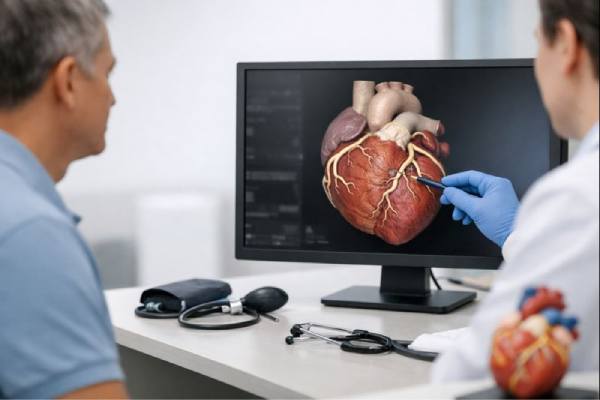
A congenital coronary artery anomaly is an “as-built” difference in the way one or more coronary arteries arise, travel, or connect. Many variants never cause trouble and are discovered by chance on an echocardiogram or CT scan done for another reason. Others matter because they can limit blood flow to the heart muscle, especially during exertion, and in rare cases can trigger dangerous heart rhythms. The key is not the label alone, but the anatomy: where the artery starts, whether it passes between major vessels, whether part of it runs within the aortic wall, and whether the opening is narrow or slit-like. This article explains what these anomalies are, which patterns carry higher risk, what symptoms to watch for, how doctors confirm the diagnosis, and what treatment and long-term follow-up usually involve.
Table of Contents
- What this anomaly means
- Causes and risk patterns
- Symptoms and danger signs
- How it is diagnosed
- Treatment options and surgery
- Living with follow-up and prevention
What this anomaly means
Your coronary arteries are the heart’s own blood supply lines. In most people, the left main coronary artery arises from the left aortic sinus and quickly divides into the left anterior descending (LAD) and circumflex arteries, while the right coronary artery (RCA) arises from the right aortic sinus. A congenital coronary artery anomaly (CCAA) means one of those details differs from the usual pattern from birth.
How clinicians classify anomalies
Doctors typically describe anomalies in three practical buckets:
- Abnormal origin: the artery comes from an unexpected place (for example, the RCA from the left sinus, or the left coronary from the right sinus, often discussed as “anomalous aortic origin of a coronary artery,” or AAOCA).
- Abnormal course: the artery takes an unusual route after it starts. The course matters because it can expose the vessel to compression or kinking.
- Abnormal termination: the artery drains into an unusual site (for example, a coronary artery fistula that empties into a heart chamber or vessel).
Some named patterns are worth knowing because they change urgency:
- AAOCA with an interarterial course: the artery passes between the aorta and pulmonary artery. Risk depends on additional features such as a narrow or slit-like opening, an acute takeoff angle, or a segment that runs within the aortic wall (an intramural segment).
- ALCAPA (anomalous left coronary artery from the pulmonary artery): usually presents in infancy unless collateral vessels develop. It can cause heart failure or ischemia because the left coronary system receives low-oxygen, low-pressure blood.
- Coronary artery fistula: an abnormal connection that can “steal” blood away from the heart muscle or create volume overload over time.
- Myocardial bridging: a portion of a coronary artery runs through heart muscle rather than on the surface. Many bridges are benign, but some can contribute to chest pain or ischemia in selected cases.
Why the same anomaly can be low-risk or high-risk
Two people may share the same broad diagnosis (for example, “anomalous right coronary artery”), yet have very different risk. The difference often comes down to anatomy and physiology:
- Is blood flow restricted at rest or only under stress?
- Does the artery get squeezed between large vessels during exercise?
- Is the opening small, slit-like, or angled sharply?
- Is there evidence of reduced blood flow (ischemia) on stress testing?
The goal of evaluation is to translate a picture of anatomy into a realistic risk profile and a sensible plan—ranging from reassurance and periodic follow-up to surgical repair in higher-risk patterns.
Causes and risk patterns
Congenital coronary artery anomalies form during early fetal development, when the coronary arteries connect to the aorta and the heart’s outflow tract is taking shape. In most cases, there is no single identifiable cause that a patient or parent “did” or could have prevented. These are structural variants that occur sporadically.
What causes these anomalies?
The precise developmental steps are complex, but the broad idea is simple: the coronary arteries must connect to the correct location on the aorta and then grow along the heart in a stable route. Small changes in timing, signaling, or tissue remodeling can lead to a different connection point or pathway.
Known contributors are usually nonspecific and apply to many congenital heart conditions:
- Chance developmental variation: the most common explanation.
- Genetic influences: sometimes suspected, especially when congenital heart defects cluster in a family, but most coronary anomalies do not follow a clear inheritance pattern.
- Associated congenital heart disease: some coronary anomalies appear alongside other structural conditions (for example, certain outflow tract or valve abnormalities).
Who is at higher risk of having one?
Because many anomalies produce no symptoms, “risk factors” for having the anatomy are less useful than risk factors for having a clinically important form. Still, clinicians more often detect CCAA in:
- Infants and children evaluated for murmurs, poor growth, or congenital heart disease.
- Teens and young adults evaluated for exertional symptoms, syncope, or sports screening findings.
- Adults who undergo coronary CT angiography or catheterization for chest pain, abnormal stress tests, or preoperative evaluation.
Which patterns tend to be higher risk?
Risk is not uniform. Features more often associated with ischemia or sudden events (particularly in AAOCA) include:
- Interarterial course (between aorta and pulmonary artery), especially when paired with:
- Intramural segment (artery runs within the aortic wall)
- Slit-like orifice (narrow opening)
- Acute-angle takeoff (sharp turn at the origin)
- Proximal narrowing or long compressed segment
- Left-sided involvement can be more concerning in certain AAOCA patterns because it supplies a larger portion of the heart muscle.
- ALCAPA is typically high impact without correction, even if symptoms are delayed.
- Large coronary fistulas can create meaningful shunting, enlargement of chambers, or ischemia from “steal.”
Why exertion changes the picture
During exercise, the heart beats faster and the great vessels expand and shift with each pulse. A vulnerable coronary segment may narrow further exactly when the heart needs extra blood flow. That is why careful history about exertional symptoms and targeted stress testing often matter as much as the initial discovery on imaging.
Symptoms and danger signs
Many people with a congenital coronary artery anomaly feel entirely well. When symptoms occur, they often show up during exertion, illness, or dehydration—situations that increase the heart’s demand for oxygen. Symptoms can also be subtle and easily mistaken for asthma, poor fitness, anxiety, or “growing pains,” especially in adolescents.
Common symptoms that deserve attention
Symptoms vary by anomaly type, but these are the patterns clinicians take seriously:
- Chest discomfort with exercise: pressure, tightness, burning, or pain that appears predictably with exertion and improves with rest.
- Unexplained shortness of breath out of proportion to conditioning, especially when it occurs suddenly or with chest symptoms.
- Palpitations: a rapid, fluttering, or pounding heartbeat that is new, severe, or associated with lightheadedness.
- Dizziness or near-fainting during exercise, particularly if abrupt and recurrent.
- True fainting (syncope) during exertion: a red flag that needs prompt evaluation.
In infants with severe anomalies such as ALCAPA, symptoms may look different:
- Poor feeding, sweating with feeds, rapid breathing
- Irritability that can resemble colic
- Failure to thrive
- Signs of heart failure, such as enlarged liver or poor perfusion
Complications clinicians watch for
Potential complications depend on anatomy, but can include:
- Myocardial ischemia (too little blood flow to heart muscle), which can cause chest pain, ECG changes, or reduced heart function.
- Arrhythmias: from benign extra beats to dangerous rhythms, especially if ischemia occurs.
- Sudden cardiac arrest: rare, but a major concern in specific AAOCA patterns and in some athletes.
- Heart failure or valve leakage: more common in conditions like ALCAPA if untreated, because the left ventricle can weaken or the mitral valve can become leaky.
- Endocarditis risk: certain fistulas or abnormal flow patterns may increase risk in selected cases, though this is individualized.
What “danger signs” mean in real life
Seek urgent medical care (emergency services) if any of the following occur:
- Chest pain or pressure with fainting, severe shortness of breath, or collapse
- Fainting during exercise, even if recovery is quick
- Seizure-like activity after collapse (which can reflect cardiac arrest)
- New neurologic symptoms after a suspected cardiac event
If symptoms are milder but recurring—especially exertional chest pain, repeated near-syncope, or exercise intolerance that is getting worse—schedule a prompt evaluation with a clinician experienced in congenital or sports cardiology. The safest approach is to treat exertional fainting and exertional chest pain as “not normal until proven otherwise.”
How it is diagnosed
Diagnosis has two jobs: confirm the coronary anatomy and determine whether the anomaly affects blood flow or risk. Many patients already have an “incidental finding” from imaging, but still need a structured workup to understand what it means.
Step one: history and exam that sharpen the question
A focused history often guides the entire plan. Clinicians will ask:
- What symptoms occur, and are they triggered by exertion?
- Any fainting, especially during sports or sprinting?
- Family history of sudden death, cardiomyopathy, or unexplained drowning/vehicle accidents?
- Athletic participation, intensity, and recent changes in training?
- In infants: feeding patterns, breathing rate, sweating, irritability, and growth.
Physical exam may be normal, but can reveal murmurs (sometimes from associated defects or fistulas), signs of heart failure, or blood pressure/oxygenation concerns.
Electrocardiogram and basic tests
- ECG can show prior ischemia, rhythm issues, or strain patterns, but it can also be completely normal.
- Blood tests are not diagnostic for the anomaly itself, but may help assess acute chest pain or heart strain in urgent settings.
Imaging that defines the anatomy
- Transthoracic echocardiography (TTE) is often the first test, especially in children. It can sometimes visualize the coronary origins and proximal course and assess heart function and valves.
- Coronary CT angiography (CCTA) is often the clearest noninvasive way to map coronary origin and course in three dimensions. It is particularly useful for identifying interarterial and intramural segments.
- Cardiac MRI (CMR) can assess anatomy, heart function, scar, and perfusion without radiation, though coronary visualization can be less detailed than CT in some patients.
- Invasive coronary angiography may be used when noninvasive imaging is unclear, when intervention is planned, or when the clinical picture suggests significant ischemia. Additional tools such as intravascular ultrasound or physiologic measurements may be used in selected cases.
Tests that assess risk and blood flow
Because anatomy alone does not always predict symptoms, clinicians often add functional testing:
- Exercise stress testing (with ECG monitoring) to look for symptoms, rhythm changes, and ischemic patterns.
- Stress imaging (stress echo, nuclear perfusion imaging, or stress MRI) to evaluate blood flow to the heart muscle under demand.
- Holter or event monitoring if palpitations, dizziness, or intermittent symptoms suggest arrhythmia.
A helpful way to think about the process is: imaging answers “what does it look like,” while stress testing answers “what does it do during demand.” Treatment decisions often depend on both.
Treatment options and surgery
Treatment is individualized because “congenital coronary artery anomaly” includes a wide range of anatomy—from benign variants needing reassurance to higher-risk patterns where repair is recommended. Your plan should make sense for your specific coronary map, symptoms, test results, age, and activity level.
When observation is appropriate
Many anomalies are managed conservatively when:
- The course is not considered high risk (for example, no interarterial/intramural segment in AAOCA).
- There is no evidence of ischemia on stress testing.
- The person is asymptomatic and heart function is normal.
Observation still has structure. It usually includes periodic follow-up, repeat imaging at reasonable intervals, and reassessment if symptoms change.
Medical management: what medications can and cannot do
Medication does not “fix” the anatomy, but may reduce symptoms or reduce triggers:
- Beta-blockers may be used in some patients to reduce heart rate peaks and lessen ischemic stress, especially when exertional symptoms exist or surgery is being considered.
- Antianginal therapy may be used in selected cases, depending on the physiology.
- Arrhythmia management (if present) may include medication and rhythm monitoring plans.
Medications are not a substitute for repair when anatomy and testing indicate high risk. They are most useful as part of a broader strategy: symptom control, risk reduction, and bridging decisions.
Interventions for AAOCA: why anatomy drives the choice
In higher-risk AAOCA (especially with concerning features or documented ischemia), surgery may be recommended. Common surgical approaches include:
- Unroofing: used when there is an intramural segment within the aortic wall. The surgeon opens the intramural portion to create a wider, more stable channel.
- Reimplantation: moving the coronary origin to the correct sinus to eliminate a risky route.
- Ostioplasty (patch enlargement): enlarging a narrowed opening in selected anatomies.
- Coronary bypass grafting: less favored in some younger patients because competitive flow from the native vessel can reduce graft durability, but it may be considered in specific adult situations.
No single operation is “the standard” for every patient; the surgical plan matches the precise origin, course, and coronary dominance, and it should be done in experienced congenital or coronary anomaly centers when possible.
ALCAPA and fistulas: different problems, different fixes
- ALCAPA generally requires surgical correction, typically by re-establishing a two-coronary system connected to the aorta. The timing and approach depend on age, collateral circulation, and heart function.
- Coronary fistulas may be managed with observation if small and asymptomatic, or closed (catheter-based or surgical) when large, symptomatic, or causing heart enlargement, ischemia, or complications.
What to expect after treatment
After surgery or closure procedures, follow-up focuses on:
- Recovery of heart function and symptom resolution
- Ensuring the repaired coronary pathway stays open
- Safe return-to-activity planning
- Ongoing rhythm surveillance if needed
Many patients return to full, active lives, but the timeline and sports clearance decisions should be guided by postoperative imaging and stress testing rather than by time alone.
Living with follow-up and prevention
Living well with a congenital coronary artery anomaly is mostly about precision: knowing your anatomy, understanding your personal risk profile, and matching activity and follow-up to that reality. For many people, the condition becomes a “known detail” rather than a daily limitation.
Follow-up: what good monitoring looks like
A sensible follow-up plan usually includes:
- A clear written description of anatomy (origin, course, high-risk features, dominance) that you can share with new clinicians.
- Periodic imaging (often echo, CT, or MRI depending on age and the question being asked).
- Repeat functional testing if symptoms change, if activity goals increase (for example, competitive sports), or after repair.
Ask your clinician what should trigger earlier reassessment. Good plans name thresholds, such as “new exertional chest tightness,” “any fainting,” or “a step-change in exercise tolerance.”
Exercise and sports: a practical approach
Exercise advice depends on the specific anomaly and test results. In broad strokes:
- If the anatomy is low risk and stress testing is reassuring, many people can exercise freely.
- If there are high-risk features or ischemia, temporary restriction from intense or competitive exertion is often recommended until evaluation is complete or treatment is performed.
- After surgical repair, return-to-sport decisions should be based on healing, imaging of the repaired artery, and stress testing that recreates real athletic demand.
If you or your child participates in organized sports, it can help to coordinate among cardiology, the school/club, and athletic trainers so that expectations are clear and emergency plans are in place.
Everyday risk reduction that actually matters
Even when an anomaly is congenital, overall heart health still influences symptoms and resilience:
- Maintain a healthy blood pressure and address high cholesterol when present.
- Prioritize hydration and avoid sudden extreme exertion when ill or dehydrated.
- Treat anemia, thyroid disease, and sleep disorders that can worsen palpitations or exercise tolerance.
- Avoid stimulant misuse and discuss energy drinks or performance supplements with a clinician if palpitations or chest symptoms occur.
Planning for emergencies
For families, schools, and sports organizations, preparation saves lives regardless of diagnosis:
- Ensure access to an AED (automated external defibrillator) during training and events.
- Encourage CPR training in coaches and staff.
- Take exertional collapse seriously and activate emergency response immediately.
When to seek care now
Contact urgent care or emergency services for:
- Fainting during exercise
- Chest pain with shortness of breath, collapse, or severe dizziness
- Sustained palpitations with near-syncope
- Any episode of unexplained collapse, even if recovery seems complete
For non-urgent but concerning changes—new exercise intolerance, recurring chest discomfort, or repeated dizziness—schedule prompt reassessment. Most importantly, do not normalize exertional symptoms, especially in young people. In this condition group, “listening to the pattern” is often the difference between reassurance and prevention.
References
- Coronary Artery Anomalies 2021 (Review)
- Therapeutic Management of Anomalous Coronary Arteries Originating From the Opposite Sinus of Valsalva: Current Evidence, Proposed Approach, and the Unknowing 2022 (Review)
- Anomalous Aortic Origin of a Coronary Artery 2024 (Review)
- Multi‐Modality Imaging in Coronary Anomalies: Focus on Anomalous Aortic Origin of Coronary Arteries 2025 (Review)
Disclaimer
This article is for general educational purposes and does not provide medical advice, diagnosis, or treatment. Congenital coronary artery anomalies range from harmless variants to conditions that can raise the risk of serious events, and safe decisions depend on your exact anatomy, symptoms, and test results. If you have chest pain with exertion, unexplained fainting, severe shortness of breath, or collapse, seek emergency care. For individualized guidance, review your findings with a qualified clinician, ideally one experienced in congenital or sports cardiology.
If you found this article useful, please consider sharing it on Facebook, X (formerly Twitter), or any platform you prefer, and follow us on social media. Your support helps our team keep producing clear, high-quality health content.