Constrictive pericarditis is a condition where the pericardium—the thin sac around the heart—becomes thickened, scarred, and sometimes calcified. Instead of stretching smoothly as the heart fills, the stiff pericardium acts like a tight shell. The heart may still squeeze well, yet it cannot fill normally, so pressures rise and fluid backs up into the body. That is why constrictive pericarditis can look like “heart failure,” liver disease, or unexplained swelling, especially when the diagnosis is delayed. Some cases develop slowly after repeated inflammation; others follow surgery, radiation therapy, or infection. The most important point is this: constrictive pericarditis is often treatable, and in selected patients it can be curable with surgery. Clear diagnosis and timing are what separate long-term limitation from meaningful recovery.
Table of Contents
- What constrictive pericarditis does to the heart
- Causes and risk factors you should know
- Symptoms and complications, why it mimics other diseases
- How constrictive pericarditis is diagnosed
- Treatment options: medications, procedures, and surgery
- Living with constriction, prevention, and when to seek care
What constrictive pericarditis does to the heart
Constrictive pericarditis is fundamentally a filling problem. The heart sits inside the pericardium, a two-layered sac designed to reduce friction and provide gentle support. When the pericardium becomes scarred and nonelastic, it cannot expand as blood returns to the heart. The result is a distinctive pattern: early filling happens quickly, then stops abruptly once the stiff “casing” reaches its limit.
Why symptoms can be severe even when the heart “pumps normally”
Many people assume heart disease always means weak squeezing. In constrictive pericarditis, the squeezing function (often measured as ejection fraction) may be preserved. Yet the body still experiences congestion because pressures rise upstream:
- Right-sided congestion tends to dominate: leg swelling, abdominal fluid (ascites), liver enlargement, and early fullness after meals.
- Left-sided congestion can also occur, causing breathlessness and reduced exercise tolerance.
The two key physiologic ideas clinicians look for
- Ventricular interdependence: the right and left ventricles compete for space inside a fixed shell. During breathing, pressure changes shift the septum and alter filling in a telltale way.
- Dissociation between chest and heart pressures: normally, breathing changes intrathoracic pressure and helps blood move. In constriction, the stiff pericardium blocks normal transmission of those pressure changes, producing characteristic respiratory variation in blood flow.
Not all constriction is the same
Some patients have a predominantly fibrotic, calcified pericardium that is unlikely to reverse. Others have “transient” or inflammatory constriction, where swelling and inflammation play a larger role and improvement may occur with careful medical therapy. The clinical challenge is sorting these apart early—because the correct treatment and timing can change the entire course of the illness.
Causes and risk factors you should know
Constrictive pericarditis usually develops after injury or inflammation of the pericardium. The pericardium heals with scarring; repeated insults increase the chance that scarring becomes thick, rigid, and restrictive.
Common causes
- Prior cardiac surgery: inflammation and bleeding around the heart can lead to adhesions and scarring months to years later.
- Radiation therapy to the chest: used for certain cancers; can injure the pericardium and nearby heart structures over time.
- Prior pericarditis (viral or idiopathic): repeated episodes raise risk, especially if inflammation is prolonged.
- Tuberculosis and other infections: more common in regions where TB is endemic; can strongly predispose to constriction.
- Systemic inflammatory or autoimmune disease: conditions such as rheumatoid arthritis, lupus, or other inflammatory syndromes can involve the pericardium.
- Malignancy: cancer involving the pericardium or treatments for cancer may contribute.
- Kidney failure and uremia: chronic inflammation and fluid shifts can affect the pericardium in some patients.
Risk factors that increase suspicion
A clinician will be more alert to constrictive pericarditis when a patient has:
- A history of chest radiation, open-heart surgery, or recurrent pericarditis
- Signs of congestion that seem “out of proportion” to pumping function
- Prominent abdominal symptoms (ascites, enlarged liver) without a clear primary liver cause
- A prior episode of pericardial effusion (fluid around the heart), especially if it was persistent or recurrent
Why the cause matters for treatment
The underlying cause often predicts how reversible the process may be and what else should be evaluated. Radiation-associated disease, for example, may involve heart valves or coronary arteries alongside constriction, which can change surgical planning. Post-surgical constriction may present with dense adhesions that affect operative complexity. Infectious causes may require targeted antimicrobial therapy plus careful timing of surgery.
A practical takeaway: if you have a history of pericarditis, chest radiation, or heart surgery and you develop progressive swelling, abdominal fullness, or unexplained breathlessness, it is reasonable to ask whether constrictive pericarditis has been specifically considered.
Symptoms and complications, why it mimics other diseases
Constrictive pericarditis is notorious for looking like other conditions, especially right-sided heart failure and chronic liver disease. Symptoms often develop gradually, which can make them easier to normalize—until daily life becomes noticeably smaller.
Typical symptoms
Many patients report a combination of:
- Swelling in feet, ankles, or legs that worsens through the day
- Abdominal bloating or increasing waist size from fluid (ascites)
- Early satiety (feeling full quickly), nausea, or reduced appetite
- Breathlessness on exertion, sometimes with reduced ability to climb stairs or walk briskly
- Fatigue and low exercise tolerance
- Weight gain over days to weeks, often fluid-related
Because the pressure backup often starts on the right side, abdominal symptoms can be prominent early. Some people first present to gastroenterology or hepatology rather than cardiology.
Signs clinicians may notice
On exam, clinicians may find:
- Elevated neck veins (a clue to high right-sided pressures)
- A firm, enlarged liver or abdominal fluid
- Leg edema
- A pericardial “knock” (an early diastolic sound) in some patients
- Low blood pressure or narrow pulse pressure in more advanced cases
Complications that can develop when diagnosis is delayed
- Progressive fluid retention requiring frequent diuretics or hospitalization
- Cardiac cirrhosis or congestive hepatopathy: chronic liver congestion can cause scarring and abnormal liver tests
- Kidney dysfunction: reduced effective forward flow and high venous pressures can impair kidney filtration
- Malnutrition and muscle loss: early fullness and chronic inflammation can reduce intake and strength
- Atrial fibrillation: may develop as the atria dilate under chronic pressure
Symptoms that should prompt urgent evaluation
Seek urgent care for:
- Severe shortness of breath at rest, fainting, confusion, or new chest pressure
- Rapidly worsening swelling with low urine output
- Marked abdominal pain or severe distention with breathing difficulty
A useful mindset is to treat persistent congestion as a “systems problem.” In constrictive pericarditis, swelling and abdominal fluid are not simply nuisance symptoms—they can be the clearest signs that the heart is being mechanically constrained and needs targeted evaluation.
How constrictive pericarditis is diagnosed
Diagnosing constrictive pericarditis is less about one “magic test” and more about assembling a consistent story from symptoms, imaging, and sometimes invasive pressure measurements. The goal is to confirm constriction and rule out look-alikes—especially restrictive cardiomyopathy, which can appear similar but requires different management.
Step 1: Clinical clues and baseline tests
Clinicians usually start with:
- A careful history (prior surgery, radiation, TB exposure, recurrent pericarditis)
- Physical exam focused on signs of venous congestion
- ECG and chest imaging to look for rhythm issues or calcification
- Blood tests to assess kidney function, liver enzymes, anemia, thyroid status, and inflammatory markers when relevant
Natriuretic peptides (BNP or NT-proBNP) can be helpful, but they are not definitive. Levels may be lower than expected for the degree of congestion in some constrictive cases, and higher in others depending on comorbidities.
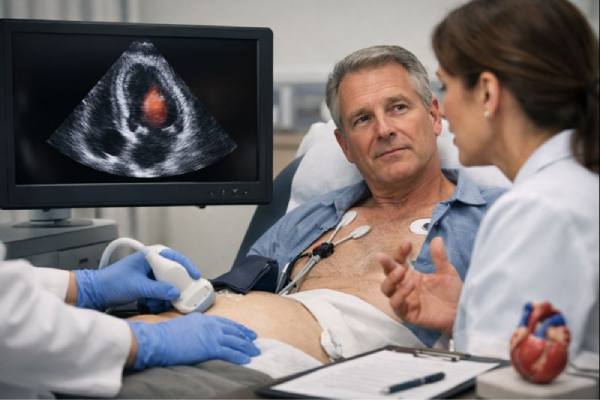
Step 2: Echocardiography as the workhorse
Echocardiography often provides the first strong evidence by showing characteristic patterns such as:
- Respiratory variation in filling across valves
- Septal “bounce” reflecting ventricular interdependence
- Tissue Doppler patterns that support constriction rather than myocardial stiffness
Because findings can be subtle, experience matters. A normal or ambiguous echo does not always exclude the diagnosis, especially early in the disease.
Step 3: CT and cardiac MRI to define anatomy and inflammation
- Cardiac CT can show pericardial thickening and calcification clearly and may help surgical planning.
- Cardiac MRI can assess pericardial thickness and, importantly, signs of active inflammation. This can support a trial of anti-inflammatory treatment in selected “transient” cases and helps distinguish stiff myocardium from pericardial restriction.
Step 4: Cardiac catheterization when uncertainty remains
When the diagnosis is still uncertain—or when surgical decisions depend on stronger proof—right and left heart catheterization can document hallmark hemodynamic patterns. This is especially useful when echo/MRI findings are mixed or when restrictive cardiomyopathy is a serious alternative.
A practical tip for patients: ask your clinician to explain whether your case looks more like a fixed, fibrotic constriction or a more inflammatory, potentially reversible form. That distinction often guides the next steps and the urgency of surgery.
Treatment options: medications, procedures, and surgery
Treatment depends on two questions: how congested you are today and whether the constriction is likely reversible. Many patients need symptom relief immediately, but definitive management may require careful timing.
Medical therapy: controlling congestion and treating inflammation
- Diuretics are the mainstay for symptom control. They reduce leg swelling and abdominal fluid and can improve breathlessness. Dosing must be individualized to avoid kidney injury, low blood pressure, and electrolyte imbalance.
- Salt strategy often matters. Rather than extreme restriction, many patients do best with consistent, moderate sodium intake that avoids major swings.
- Anti-inflammatory treatment may be considered when imaging or clinical features suggest active inflammation and the constriction may be transient. The approach depends on the suspected cause and the patient’s overall risks.
Medical therapy can stabilize symptoms, but it does not “remove” a rigid pericardium once dense scarring is established. For many patients, medications are a bridge to definitive therapy, not the destination.
Procedures for fluid and complications
Some patients require:
- Therapeutic paracentesis (draining abdominal fluid) for severe ascites while the underlying problem is being treated
- Rhythm management if atrial fibrillation develops, because rate and rhythm control can meaningfully affect symptoms
- Careful management of kidney function and nutrition, which often improves after congestion is relieved
Pericardiectomy: the definitive treatment for chronic, fixed constriction
Pericardiectomy is surgical removal of the constricting pericardium. In appropriately selected patients, it can provide dramatic, lasting improvement. Outcomes depend heavily on:
- The underlying cause (for example, radiation-associated disease may carry additional risks)
- How advanced the illness is at the time of surgery (severe frailty, liver dysfunction, and malnutrition increase risk)
- How complete the pericardial resection can be
Recovery is not always instant. Even after successful surgery, the heart and other organs may need weeks to months to recalibrate after years of high venous pressures. Still, for many patients, surgery is the point where life expands again—walking distance improves, appetite returns, and swelling recedes.
A practical patient-centered approach is to ask: “Are we treating symptoms while waiting for recovery, or are we treating symptoms while preparing for surgery?” The answer clarifies goals and timelines.
Living with constriction, prevention, and when to seek care
Living with constrictive pericarditis often requires a structured plan, especially before definitive treatment. The focus is to keep congestion controlled, preserve strength, and avoid preventable destabilizers.
Daily habits that help you stay stable
- Daily morning weights under consistent conditions (after the bathroom, before eating). A steady upward trend is often more meaningful than a single number.
- Symptom tracking: swelling, abdominal tightness, breathlessness, and fatigue. Many people benefit from a simple 0–10 scale.
- Medication reliability: diuretics work best when taken consistently. Skipping doses often leads to a “catch-up spiral” that is harder to control.
Food, fluid, and activity: practical balance
- Keep sodium intake predictable. Large sodium spikes can overwhelm diuretics and trigger rapid fluid accumulation.
- Discuss fluid goals with your clinician if you develop low sodium levels or persistent fluid retention.
- Maintain gentle activity as tolerated—short walks and light strengthening can reduce deconditioning. If you become dizzy, unusually breathless, or experience chest pressure, stop and contact your clinician.
Preventing flare-ups
Common triggers include:
- Missed diuretics or medication changes without guidance
- NSAIDs (certain pain medicines) that can worsen fluid retention and kidney function in susceptible patients
- Alcohol excess, which can worsen fluid balance and rhythm stability
- Untreated infections, which increase metabolic demand and inflammation
- New atrial fibrillation or fast heart rhythms
When to seek urgent care
Go to emergency care for:
- Severe breathlessness at rest, fainting, blue/gray color, confusion, or chest pressure with sweating or nausea
- Rapidly worsening swelling with very low urine output
- A sustained rapid heartbeat with dizziness or near-fainting
Contact your clinician promptly for:
- Clear upward weight trend over several days
- Increasing abdominal distention or leg swelling
- Needing more pillows to breathe comfortably
- Marked decline in walking distance or daily function
Finally, ask for a written action plan: what symptoms should trigger a call, what weight changes matter for you, and how quickly medication adjustments should occur. In constrictive pericarditis, earlier response to congestion often protects the liver, kidneys, and nutrition—key factors that influence both quality of life and procedural risk.
References
- Constrictive Pericarditis: A Comprehensive Overview – PMC 2025 (Review)
- Constrictive Pericarditis: An Update on Noninvasive Multimodal Diagnosis – PubMed 2024 (Review)
- Pericardiectomy for Constrictive Pericarditis with or without Cardiopulmonary Bypass – PubMed 2024 (Review)
- ESC Guidelines on Pericardial Diseases (Diagnosis and Management of) 2025 (Guideline)
Disclaimer
This article is for educational purposes only and does not provide medical advice, diagnosis, or treatment. Constrictive pericarditis can have multiple causes and may resemble other serious conditions, so evaluation and treatment should be individualized by a qualified clinician, often with cardiology input. Seek urgent medical care immediately for severe shortness of breath, fainting, confusion, blue/gray color, chest pressure with weakness or sweating, or a sustained rapid heartbeat with dizziness.
If you found this article helpful, please share it on Facebook, X (formerly Twitter), or any platform you prefer, and follow us on social media. Your support through sharing helps our team continue producing high-quality, practical health content.