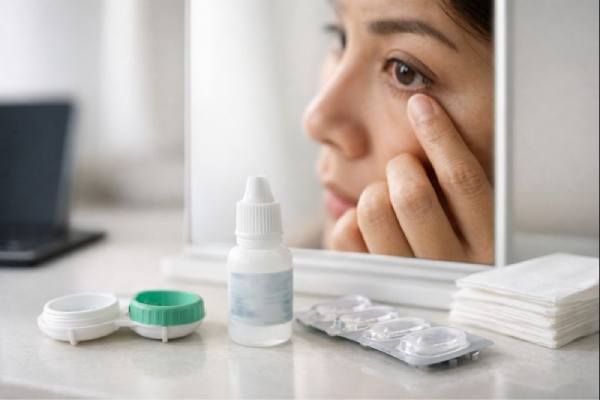
Contact lenses can be one of the most convenient tools in eye care: crisp vision without frames, full peripheral view, and a sense of freedom during sports, commuting, and everyday life. When they become uncomfortable, the change is often gradual—slightly dry by late afternoon, a lens that feels “present” with every blink, or vision that goes hazy unless you stare and refocus. The frustrating part is that discomfort rarely has a single cause. Tear film instability, screen-heavy days, seasonal allergies, lens deposits, and subtle fit problems can stack together until your eyes finally push back.
The reassuring truth is that most contact lens discomfort is fixable. The key is matching the solution to the mechanism: treating dryness differently than a tight lens, and approaching irritation differently than a care-solution reaction. This article walks you through the most common patterns, the fastest relief steps, and the best evidence-based switches so you can wear lenses comfortably and protect your eyes long-term.
Core Points
- Short breaks from lenses and targeted comfort steps can often restore tolerance within days when discomfort is mild and caught early.
- Fit problems tend to worsen over the wear day and do not reliably improve with more drops; they usually require a refit or lens change.
- Daily disposable lenses and peroxide-based care systems reduce deposits and solution exposure for many people with recurring irritation.
- Do not keep wearing lenses through pain, light sensitivity, or reduced vision—those symptoms can signal a corneal problem that needs urgent care.
- Track your “comfortable wearing time” for one week; that single number often guides the most effective next change.
Table of Contents
- Why contacts start feeling dry
- How fit issues create irritation
- What your symptoms are trying to tell you
- Best solutions for contact lens dryness
- What to switch to for better comfort
- Habits that prevent discomfort from coming back
Why contacts start feeling dry
Dryness is the most common reason people shorten their wearing time, and it can show up even when your eyes “look fine” in the mirror. The core issue is that a contact lens sits inside the tear film and can disrupt its smooth, protective layer. When that layer breaks up too quickly, friction rises with every blink, vision can fluctuate, and the eye surface becomes more reactive.
Several drivers tend to overlap:
- Tear film instability: Your tears have oil, water, and mucus components that work together. If the oil layer is thin, tears evaporate faster, especially in heated or air-conditioned spaces.
- Reduced blinking and screen use: People blink less and blink incompletely when focusing on screens. Incomplete blinks leave part of the eye surface and lens less coated with fresh tears.
- Lens dehydration and surface changes: Some lenses lose water or change surface wettability over the wear day. Even when a lens is designed to retain moisture, real-world conditions (low humidity, long hours) can overwhelm it.
- Deposits: Proteins, lipids, cosmetics, and environmental particles can coat the lens surface. Deposits make the lens less smooth, increasing friction and irritation.
- Allergy load: Seasonal pollen and indoor allergens can inflame the surface and make the tear film more unstable. You might feel “dry” and itchy at the same time.
- Medications and health factors: Many common medications and hormonal changes can reduce tear production or alter tear quality, lowering your margin of comfort.
A useful way to think about contact lens dryness is timing. If lenses feel decent early and deteriorate late, your eyes may be running out of tear-film stability over the wear day. If discomfort starts almost immediately, consider a solution sensitivity, an already-irritated ocular surface, or a lens that is not interacting well with your lids.
Dryness also has a posture component. If you wear contacts while working at a screen, your eyes are often more open and exposed than during relaxed tasks, which accelerates evaporation. That means the “same lens” can feel comfortable on weekends and miserable on weekdays—without anything being wrong with the lens itself. The solution often combines eye-surface support (lubrication and lid care) and a lens choice that minimizes friction and deposits.
How fit issues create irritation
Not all discomfort is dryness. A lens can feel irritating because it does not fit your eye properly, even if it is clean and your tear film is reasonably stable. Fit issues matter because they can reduce oxygen delivery, increase mechanical friction, trap debris, and create localized stress on the cornea and conjunctiva.
Here are the most common fit-related patterns:
A lens that is too tight
A tight lens may feel comfortable at first and then become progressively annoying: pressure, aching, redness that grows, or a lens that feels “stuck.” Vision can blur after hours because the lens is not moving enough to refresh tears under it. Some people notice a ring of redness near the colored part of the eye or feel relief immediately after removing the lens.
Tightness can be caused by lens curvature, diameter, material stiffness, or even subtle swelling of the eye surface from allergies or dryness. Tight lenses often respond poorly to “more drops” alone because the main issue is mechanical interaction.
A lens that is too loose or unstable
If a lens moves too much, you may feel edge awareness, intermittent blur, or a lens that shifts when you look sideways or blink. Loose lenses can also decenter, which matters even more with toric lenses for astigmatism because rotation can distort vision and create strain.
Edge design and lid interaction
Some discomfort is essentially “blink friction.” If the lens edge interacts strongly with the upper lid, you may feel it with each blink, especially late in the day when the tear film thins. People often describe this as scratchy or “like an eyelash,” even when no foreign body is present.
Toric and multifocal lenses
Toric lenses may feel different because they are designed to stabilize on the eye. Multifocal lenses can create visual effort if the optics do not match your pupil size, lighting conditions, and near-demand. Visual strain often masquerades as discomfort: brow furrowing, headaches, or a desire to remove lenses early “just to relax.”
Fit problems are best solved with objective changes: refitting measurements, trying a different base curve or diameter, switching to a lens with different material properties, or changing modality altogether. The goal is not merely “tolerable.” A properly fitted lens should center well, move appropriately, feel quiet on the eye, and maintain predictable comfort over your typical wearing day.
What your symptoms are trying to tell you
Your symptoms often point toward the cause—if you pay attention to the pattern. Instead of asking, “Are contacts supposed to feel this way?” try asking, “When does it happen, in which eye, and what makes it better or worse?” That information is often more diagnostic than the redness you can see.
Dryness-dominant pattern
Common clues include burning, grittiness, fluctuating blur that improves briefly with blinking, and discomfort that peaks after long screen sessions or in dry environments. You may feel better outside or on days with less screen time. Lubricating drops often help, but only temporarily.
Fit-dominant pattern
Clues include a sensation of pressure, lens awareness with every blink, redness that is more pronounced in one eye, and discomfort that does not meaningfully improve with drops. You might notice the lens feels stuck or, conversely, shifts too much. Removing the lens often provides immediate relief.
Deposit and solution reaction pattern
If discomfort starts soon after insertion, consider the lens care system. Burning on insertion, low-grade irritation that never fully settles, or recurring redness despite “doing everything right” can indicate sensitivity to preservatives or a mismatch between lens material and solution. Deposits often show up as late-day scratchiness or a “coated lens” feeling, sometimes with stringy mucus.
Allergy and inflammation pattern
Itching is the standout symptom for allergy. If you feel a strong urge to rub your eyes, especially during pollen season or around pets, allergy is likely contributing. Allergy can also worsen dryness by destabilizing the tear film. Some people notice puffy lids and watery tearing, then a gritty feeling later.
When to stop wearing lenses immediately
Contact lenses should not be worn through warning signs that suggest corneal involvement. Remove lenses and seek urgent evaluation if you have:
- moderate to severe pain
- significant light sensitivity
- reduced vision that does not clear with blinking
- a rapidly worsening one-eye problem
- a white spot or haze on the cornea
- marked redness with excessive discharge
These symptoms can signal a corneal abrasion, inflammatory event, or infection, which is time-sensitive in contact lens wearers.
A practical self-check is the “two-hour rule”: if discomfort feels worse after two hours than it did at insertion, and this repeats daily, something in the system is not sustainable. Track the time you first notice symptoms, what you were doing at that moment (screen work, driving, outdoors), and whether drops or removal helps. Bring that pattern to an eye exam—it often shortens the path to the right solution.
Best solutions for contact lens dryness
When dryness is the dominant issue, the best solutions reduce friction, stabilize the tear film, and lower evaporation. The most effective plans usually combine small changes rather than relying on a single “miracle drop.”
Start with the basics that actually change physiology
- Blink quality: During screen work, practice a few deliberate full blinks every 20–30 minutes. Incomplete blinks leave the lower part of the lens less refreshed.
- Environment control: Direct fans, car vents, and low humidity are comfort killers. If you cannot change the environment, shorten wear time on those days and use a supportive strategy earlier rather than later.
- Timing of breaks: A short lens-free break can be more effective than repeated drops. Even 15–30 minutes of glasses time can allow the surface to recover.
Choose lubrication strategically
Lubricating drops can help, but they work best when you match them to the situation:
- If you need drops more than a few times daily, consider preservative-free options, which are often gentler with frequent use.
- Use drops before discomfort peaks. Waiting until your eyes feel “sandpaper dry” often leads to a cycle of temporary relief followed by rapid relapse.
- If blur worsens right after drops, you may be using a thicker drop than your lenses tolerate well; switching texture can help.
Support the eyelids, not just the eye surface
A large portion of contact lens dryness is evaporative, linked to oil-layer instability. If you have oily lids, flaky lashes, or morning crusting, eyelid care can improve comfort over weeks by stabilizing the tear film. Consistency matters more than intensity. Many people do a burst of care during a flare and stop once they feel better, only to repeat the cycle.
Reduce deposit formation
Deposits make dryness feel worse by increasing friction. Practical ways to reduce deposits include:
- replacing lenses on schedule (or earlier if symptoms predictably spike late in the replacement cycle)
- minimizing lens exposure to cosmetics, lotions, and aerosols
- inserting lenses before makeup and removing them before heavy makeup removal routines
Know when dryness is not the whole story
If your “dryness” improves only briefly with drops and you still feel strong lens awareness, a fit issue may be layered on top. Conversely, if discomfort disappears when you stop screen work or move to a humid environment, your lens fit may be fine and your tear film is the main target.
Dryness solutions work best when they are proactive. A good outcome is measurable: longer comfortable wearing time, fewer drops needed, and less end-of-day redness. If your comfort improves but you still cannot reach your typical wearing time after two to four weeks of consistent changes, it is a strong sign you should switch lens type or care system rather than pushing harder.
What to switch to for better comfort
When discomfort persists, switching is not defeat—it is precision. The goal is to reduce friction, deposits, and chemical exposure while improving fit stability. The best switch depends on your pattern, but a few options have consistently high payoff.
Daily disposable lenses
For many people with recurring dryness, late-day irritation, or deposit problems, daily disposables are the most effective switch because they reset the lens surface every morning. They also reduce exposure to disinfecting preservatives and eliminate the lens case as a variable. If your symptoms worsen during allergy seasons, daily disposables can be especially helpful because allergens and proteins have less time to accumulate.
A peroxide-based care system for reusable lenses
If you prefer two-week or monthly lenses, switching from a multipurpose solution to a peroxide-based system can reduce preservative exposure and improve comfort for solution-sensitive eyes. This is a strong option when burning starts soon after insertion or when your eyes feel chronically “borderline irritated.”
Safety matters here: peroxide systems must fully neutralize before the lenses touch your eyes. Used incorrectly, they can cause a painful chemical injury.
Different lens material or surface design
Some discomfort is driven by lens surface wettability and coefficient of friction—how smoothly the lid glides over the lens. If you feel friction with blinking, ask about trying a lens with a different material family or surface treatment. People sometimes assume “all soft lenses feel the same,” but small material changes can produce meaningful comfort differences.
Refitting for movement and centration
If one eye is consistently worse, or if you feel pressure, stuckness, or excessive movement, a refit should be high priority. A small change in base curve, diameter, or design can transform comfort. For toric lenses, improving stability can reduce both blur and fatigue.
Rigid gas permeable, hybrid, or scleral lenses
If soft lenses repeatedly fail—especially in significant dryness or irregular corneas—other modalities can be worth discussing:
- Rigid gas permeable lenses can provide excellent optics and a different tear interaction pattern.
- Hybrid lenses combine a rigid center with a soft skirt for comfort.
- Scleral lenses vault the cornea and hold a fluid reservoir, which can be helpful in certain dry eye and ocular surface conditions, though they require careful fitting and hygiene.
A smart switching plan is staged. Start with the most likely high-payoff change (often daily disposables or a peroxide system), then reassess wearing time and symptoms after a stable trial period. Comfort should improve in a predictable way; if it does not, the lens system still does not match your eyes.
Habits that prevent discomfort from coming back
Long-term comfort is rarely about a single product. It is about reducing the repeated micro-stresses that slowly inflame the ocular surface: overdrying, overwearing, undercleaning, and ignoring early warning signs.
Protect your wearing time like a budget
Most people have a maximum “tolerable” time and a shorter “comfortable” time. Aim for the comfortable number. If you repeatedly wear lenses past your comfortable limit, you train your eyes into an inflammatory loop: each day starts slightly worse, and your tolerance shrinks.
Practical strategies include:
- wearing glasses for the first hour of the day if mornings feel dry
- taking a planned mid-day glasses break on screen-heavy days
- choosing lower-wear days for errands that involve wind, heat, or long driving
Keep replacement schedules strict and simple
Stretching replacement is one of the fastest ways to increase deposits and discomfort. Use a consistent rule: if a lens is “monthly,” it is 30 days from opening, not 30 wears. If comfort drops in the last week of a monthly cycle, that is a sign to shorten the cycle or switch categories.
Reduce high-risk habits that increase irritation and infection risk
- keep lenses away from water (showering, swimming, rinsing)
- do not sleep in lenses unless explicitly prescribed for overnight wear
- replace cases regularly and allow them to air-dry fully
- never top off old solution in the case
These habits protect comfort and safety at the same time.
Make screens less punishing
If your discomfort tracks with screen time, build a routine you can sustain:
- adjust monitor position so your gaze is slightly downward
- reduce direct airflow to your eyes
- take brief visual breaks and blink fully
- treat dryness early rather than waiting for a late-day crash
Schedule follow-up when the pattern changes
If you suddenly lose hours of comfortable wearing time, or one eye becomes consistently worse, do not assume it will “settle.” Eyes change with seasons, hormones, medications, and health conditions. An updated fit or care plan early is easier than a long recovery after you push through weeks of irritation.
A helpful benchmark is this: contact lenses should feel neutral most of the day. If you are thinking about them every hour, your eyes are giving you useful information. Use it while the problem is still reversible.
References
- Topical review: Twenty-five years of silicone hydrogel soft contact lenses 2025 (Review)
- Contact lenses in dry eye disease and associated ocular surface disorders 2023 (Review)
- A Review of Contact Lens-Related Risk Factors and Complications 2022 (Review)
- Common Ophthalmic Preservatives in Soft Contact Lens Care Products: Benefits, Complications, and a Comparison to Non-Preserved Solutions 2021 (Review)
Disclaimer
This article is for educational purposes and does not replace personalized medical advice, diagnosis, or treatment. Contact lens discomfort can be caused by dry eye, allergy, lens fit problems, or contact lens–related complications that sometimes require urgent care. Remove your lenses and seek prompt evaluation if you develop significant pain, light sensitivity, worsening redness, reduced vision, a rapidly worsening one-eye problem, or any concern for a corneal injury or infection. For ongoing discomfort, schedule an eye exam so an eye care professional can assess lens fit, ocular surface health, and the safest lens or care-system changes for you.
If you found this helpful, please consider sharing it on Facebook, X (formerly Twitter), or any platform you prefer. Your support helps our team continue producing high-quality, trustworthy health content.