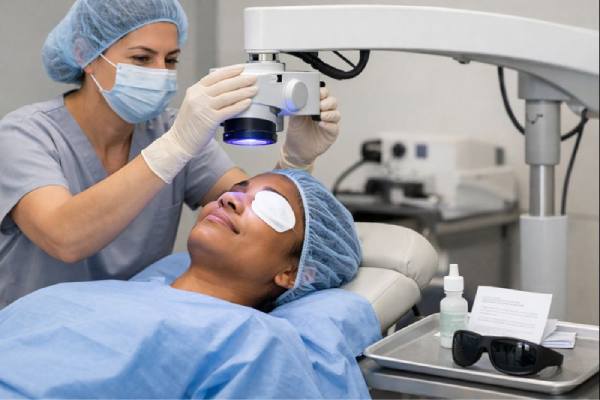
Corneal cross-linking is a vision-saving procedure designed to strengthen a weakening cornea and slow or stop diseases that cause it to bulge forward, such as keratoconus and post-refractive corneal ectasia. Instead of “reshaping” the cornea like laser vision correction, cross-linking aims to lock in stability by increasing the cornea’s biomechanical stiffness. For many people, that means preserving the vision they have now and reducing the likelihood of needing a corneal transplant later.
The experience is also more predictable than many expect: it is typically an outpatient treatment, the most uncomfortable phase is usually the first few days, and the vision “roller coaster” that follows has a typical pattern. This guide explains what cross-linking does at a tissue level, who benefits most, how recovery usually unfolds, and how to interpret success rates in a way that matches real-life goals.
Key Insights for Patients Considering Cross-Linking
- Cross-linking is primarily meant to stop progression, not to eliminate glasses or contact lenses.
- Most people return to routine daily activities within about a week, but vision can fluctuate for weeks to months.
- Epithelium-off treatment has the strongest evidence base, while epithelium-on approaches may trade comfort for variable effectiveness.
- Infection risk is low but real; worsening pain, light sensitivity, and reduced vision after day 2–4 should be assessed urgently.
- Follow your surgeon’s schedule closely, and avoid eye rubbing long term to protect the result.
Table of Contents
- What cross-linking actually does
- Who benefits and when to do it
- Types of cross-linking protocols
- Recovery timeline and what feels normal
- Success rates and what they mean
- Risks, complications, and long-term care
What cross-linking actually does
Corneal cross-linking is a biomechanical treatment. In keratoconus and related ectasias, the cornea gradually thins and protrudes, creating irregular curvature that blurs and distorts vision. Glasses can only partially compensate, and even rigid lenses may become harder to fit as the shape changes. Cross-linking is designed to slow that shape change by strengthening collagen bonds within the cornea.
The procedure uses two key ingredients: riboflavin (vitamin B2) drops and ultraviolet-A (UVA) light. Riboflavin saturates the corneal tissue and acts as a photosensitizer. When UVA light is applied, it triggers a controlled photochemical reaction that creates additional “cross-links” between collagen fibers. A useful mental model is to imagine reinforcing a fabric: the goal is not to make it thicker, but to make it more resistant to stretching.
What cross-linking does not do is equally important. It does not reliably “return the cornea to normal,” and it is not a guaranteed refractive procedure. Some people gain sharper vision over time as the cornea slightly flattens or becomes more regular, but the core intent is stabilization. If you go into cross-linking expecting to throw away glasses, you are more likely to feel disappointed—even if the procedure is medically successful.
Cross-linking also interacts with corneal biology in a predictable way. The cornea’s most superficial layers heal and remodel after treatment, and deeper layers reorganize over months. That is why the early recovery period can involve fluctuating blur: the surface is smoothing out, nerves are regenerating, and the cornea is adjusting to a new stiffness profile.
Finally, cross-linking is often discussed as a single event, but it is better understood as a decision point in a longer plan. The most successful outcomes come when cross-linking is paired with the habits and treatments that protect the cornea afterward—especially allergy control and a firm commitment to avoiding eye rubbing.
Who benefits and when to do it
The strongest indication for corneal cross-linking is documented progression of keratoconus or corneal ectasia. “Progression” typically means measurable change over time—such as increasing corneal steepness, rising astigmatism, thinning, or worsening best-corrected vision that cannot be explained by dry eye or contact lens fit alone. The reason timing matters is simple: cross-linking works best when there is still enough healthy tissue to stabilize.
Common situations where cross-linking is considered
- Progressive keratoconus, often in teenagers and young adults, where the natural course tends to be more active
- Post-refractive surgery ectasia (after procedures such as LASIK or PRK) with signs of ongoing weakening
- Rapid progression in one eye, even if the other eye is stable, when risk factors suggest the stable eye could follow
Clinicians also look at risk factors that make progression more likely. Younger age, a history of significant eye rubbing, uncontrolled allergies, and steeper or more advanced corneal shape patterns can all tilt the decision toward earlier treatment. In contrast, a patient with long-term stability and minimal documented change may not benefit from immediate cross-linking, and may do well with careful monitoring.
What “early” actually means
Early cross-linking does not mean “as soon as you are diagnosed.” It means treating at a stage where:
- progression is present or strongly suspected, and
- the cornea is still suitable for safe UVA exposure, and
- the cornea is not so scarred that stabilization will not restore usable function.
For many people, “early” is the moment progression is confirmed on sequential corneal scans, not the first time keratoconus is mentioned.
How suitability is assessed
A pre-procedure evaluation commonly includes corneal topography or tomography, refraction, and a slit-lamp exam to check for scarring and surface disease. A key safety variable is corneal thickness, because UVA energy must be controlled to protect the deeper endothelial layer. If the cornea is thin, surgeons may use modified protocols or may recommend other strategies.
A practical reminder: cross-linking is most helpful when it is paired with vision optimization—glasses, specialty contacts, and sometimes additional corneal procedures later. Cross-linking protects the structure; your optical correction restores function. Those are complementary goals, not competing ones.
Types of cross-linking protocols
If you search cross-linking online, you will quickly see multiple “versions.” The differences mainly involve whether the corneal surface layer is removed and how long UVA light is applied. These details matter because they influence comfort, healing time, and—most importantly—how reliably riboflavin reaches the deeper corneal stroma where cross-linking is needed.
Epithelium-off cross-linking
Epithelium-off (often called “epi-off”) is the most established approach. The surface epithelium is gently removed so riboflavin can penetrate the cornea effectively. UVA is then applied for a specified duration. Patients typically wear a temporary bandage contact lens afterward while the epithelium regrows.
The main advantages are strong evidence and consistent tissue penetration. The trade-offs are a more noticeable first-week recovery—pain, light sensitivity, tearing, and blurred vision during surface healing.
Transepithelial and epithelium-on approaches
Epithelium-on (“epi-on” or transepithelial) techniques keep the surface intact and aim to deliver riboflavin through the epithelium using enhanced formulations, additives, or other delivery methods. The appeal is obvious: less discomfort and faster initial recovery. The challenge is also clear: the epithelium is a barrier, and if riboflavin penetration is inconsistent, the biomechanical effect can be smaller or more variable.
For patients, the practical takeaway is to ask a direct question: “What evidence supports this exact protocol for my corneal measurements and age group?”
Standard and accelerated UVA dosing
Some protocols use lower-intensity UVA for a longer time, while “accelerated” protocols use higher intensity for a shorter time. In real-world care, the key issue is not only treatment duration, but whether the delivered energy profile produces a reliable strengthening effect in your cornea.
Modified approaches for thin corneas and combined plans
When corneas are thinner, clinicians may adapt treatment to maintain safety. In some patients, cross-linking is also discussed as part of a staged plan that may later include specialty contact lenses or other corneal procedures designed to improve vision quality after stability is achieved. The sequence matters: stabilize first, refine optics second.
Before you choose a center, consider asking for a plain-language summary of:
- Which protocol they recommend and why.
- What corneal thickness and scan findings guide that choice.
- What the follow-up schedule looks like and who you contact after hours.
Clear answers here usually correlate with a smoother recovery experience.
Recovery timeline and what feels normal
Recovery after corneal cross-linking is often described in broad strokes, but most patients want something more concrete: “What will I feel, and when should I worry?” While experiences vary, the timeline below captures the typical pattern, especially after epithelium-off treatment.
Days 0 to 3: the intense phase
The first 24–72 hours are usually the most uncomfortable. Common symptoms include:
- sharp or burning pain
- heavy tearing and watery blur
- light sensitivity that makes you want to keep the eye closed
- a gritty, foreign-body sensation
This is when prescribed pain control strategies, cold compresses, and strict drop schedules matter most. Vision is often quite blurry during this period because the corneal surface is healing and the tear film is unstable.
Days 3 to 7: surface healing and turning the corner
As the epithelium closes, discomfort typically decreases. Many people feel a noticeable improvement in pain once the surface is intact. Light sensitivity can linger, and vision may still fluctuate. If a bandage contact lens is used, it is usually removed once the surface is healed.
During this week, it is normal to have:
- intermittent blur that changes during the day
- glare or halos, especially at night
- a feeling of dryness or mild scratchiness
It is not normal to have worsening pain and worsening vision after initial improvement.
Weeks 2 to 6: functional recovery with fluctuations
Many patients can resume routine work and driving sooner, but vision may not feel “settled.” The cornea is remodeling, and the ocular surface may be drier than usual. It is common to notice that vision is better in the morning and hazier by afternoon, especially with screen use.
Helpful habits in this phase include preservative-free lubricating drops, blink breaks, and avoiding eye rubbing. If you wear contact lenses, your clinician may advise a waiting period before refitting, depending on lens type and corneal healing.
Months 2 to 6: stabilization and clearer trends
Cross-linking’s structural effect continues to mature over months. This is when clinicians look for longer-term trends in scans and refraction. Some people experience modest improvements in corneal shape or vision quality; others stay similar but stable. A common milestone is reassessing glasses or contact lens prescriptions after the cornea is less “in flux.”
When to call urgently
Seek prompt evaluation if you develop:
- increasing pain after day 2–4
- increasing redness with discharge
- a noticeable drop in vision that does not improve with blinking
- significant light sensitivity that worsens rather than slowly improves
Recovery is a partnership: your surgeon manages biologic healing, and you protect the result with careful drop use, hygiene, and long-term avoidance of rubbing.
Success rates and what they mean
Success in corneal cross-linking is best defined as stopping progression. That sounds simple, but patients often measure success by sharper vision, fewer contact lens problems, or less distortion. Those may happen, but they are secondary outcomes.
What studies often report as “success”
Clinically, success usually means the cornea remains stable on scans and vision measures over time. Many studies report stabilization in the broad range of about 85% to 95% of treated eyes over several years, with variation based on age, baseline severity, and protocol. In other words, most patients achieve the core goal: reduced risk of continued steepening and thinning.
Why success rates vary
Success is not a single number because patients are not a single group. Several factors influence outcomes:
- Age and growth phase: Younger patients can have more aggressive disease. Cross-linking still helps, but progression risk after treatment can be higher, and retreatment may be needed more often than in older adults.
- Baseline severity: Very steep or advanced corneas may be harder to stabilize completely, and even when stabilized, vision may remain limited by scarring or extreme irregularity.
- Eye rubbing and allergy control: Ongoing mechanical trauma can undermine stability. Managing itch and stopping rubbing is one of the most practical ways to protect results.
- Protocol and tissue penetration: Comfort-focused approaches can be appealing, but the biomechanical effect must be strong enough for your disease pattern.
What changes you might notice
Some people see modest improvements in vision or corneal shape over time, such as slight flattening or better best-corrected acuity. Others notice little change in clarity but feel relief that the condition is no longer worsening. It can help to define your success target ahead of time:
- Preserve current best-corrected vision.
- Reduce the pace of change in prescription and lens fit.
- Lower the likelihood of needing transplant-level surgery.
What counts as “failure”
Failure usually means continued progression despite treatment. Even then, it does not automatically mean the procedure was pointless; partial slowing can still be valuable. If progression occurs, clinicians may discuss:
- repeat cross-linking in select cases
- more specialized contact lens fitting
- staged procedures aimed at improving optical quality once stability is addressed
- corneal transplantation only when vision cannot be functionally restored with less invasive options
Success is most realistic when you view cross-linking as a stabilizing foundation—then build the best visual correction on top of it.
Risks, complications, and long-term care
Corneal cross-linking has a strong safety profile in appropriate candidates, but it is still a medical procedure with real risks. Understanding complications is not meant to alarm you—it helps you recognize early warning signs and protect your outcome.
Common short-term effects
These are expected in many patients, especially after epithelium-off treatment:
- pain and light sensitivity in the first few days
- temporary haze or “foggy” vision during healing
- dryness and fluctuating blur for weeks
- glare and halos at night, usually improving over time
Mild corneal haze can be part of normal healing. The practical question is whether the haze is improving gradually or becoming more visually significant.
Less common but important risks
- Infection (microbial keratitis): Uncommon, but potentially vision-threatening. Risk is higher when the surface is healing and when bandage contact lenses and topical steroids are used. Symptoms typically include increasing pain, redness, discharge, and worsening vision rather than steady improvement.
- Delayed epithelial healing: More likely in people with significant dry eye, eyelid inflammation, or poor ocular surface health.
- Sterile infiltrates and inflammation: Can cause localized discomfort and blur and may require treatment adjustments.
- Herpes simplex reactivation: A concern in people with a history of herpetic eye disease; preventive strategies may be used in higher-risk patients.
- Scarring or persistent haze: Rarely, the cornea heals with more lasting opacity that affects vision quality.
- Endothelial risk in thin corneas: This is why thickness thresholds and protocol modifications matter.
Long-term care that protects success
The months after cross-linking are not passive. You can significantly influence outcomes with a few consistent habits:
- Avoid eye rubbing completely. If itching is a trigger, treat allergies proactively and keep hands off the eyes.
- Keep follow-up appointments. Stability is confirmed over time, not in a single visit.
- Support the ocular surface. Treat dryness and lid inflammation early so your cornea heals in the best environment.
- Be patient with refits. If you wear rigid, scleral, or specialty lenses, your clinician may adjust timing so the fit matches a more stable corneal shape.
Cross-linking often lowers the long-term risk of transplant, but it does not eliminate the need for ongoing care. Think of it as strengthening the foundation—then maintaining that foundation with smart, consistent protection.
References
- Safety and Efficacy of Epithelium-Off Corneal Collagen Cross-Linking for the Treatment of Corneal Ectasia: A Report by the American Academy of Ophthalmology – PubMed 2024 (Guideline and Evidence Report)
- Comparison of standard versus accelerated corneal collagen cross-linking for keratoconus: 5-year outcomes from the Save Sight Keratoconus Registry – PubMed 2024 (Observational Registry Study)
- Transepithelial versus epithelium-off corneal crosslinking for progressive keratoconus – PubMed 2021 (Systematic Review)
- Infectious keratitis after corneal crosslinking: systematic review – PubMed 2021 (Systematic Review)
- Corneal Collagen Cross-Linking- Clinical Determination and Indications – U.S. Department of Veterans Affairs 2025 (Clinical Determination)
Disclaimer
This article is for educational purposes only and does not provide medical advice, diagnosis, or treatment. Corneal cross-linking is a medical procedure that requires individualized assessment, including corneal imaging and safety screening. If you have worsening eye pain, increasing redness, discharge, severe light sensitivity, or a sudden drop in vision after cross-linking, seek urgent eye care promptly. Always follow your clinician’s postoperative instructions, medication plan, and follow-up schedule, since early detection of complications is essential for protecting vision.
If you found this article useful, please consider sharing it on Facebook, X (formerly Twitter), or any platform you prefer.