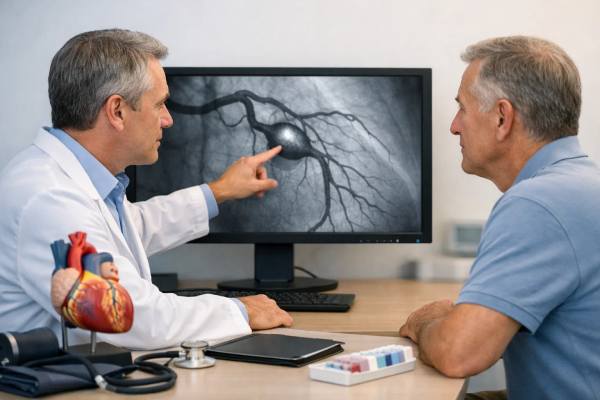
A coronary artery aneurysm is an abnormal “ballooning” of a section of a heart artery. It is not the same as a blockage, but it often travels with the same risks: reduced blood flow, clot formation, and—rarely—rupture. Many people never feel anything and learn about it only after a scan or an angiogram done for chest pain or a heart attack. Others develop symptoms because the aneurysm holds sluggish blood, collects clot, or sits next to a narrowed segment that limits oxygen delivery to the heart muscle. The most important goal is to understand why it formed, how large it is, and whether it contains clot—because those details guide treatment, follow-up, and the urgency of care.
Table of Contents
- What is a coronary artery aneurysm?
- What causes coronary artery aneurysms?
- Who is at higher risk?
- Symptoms, emergencies, and complications
- How doctors diagnose it
- Treatment, follow-up, and self-care
What is a coronary artery aneurysm?
A coronary artery aneurysm (CAA) means a segment of a coronary artery has expanded beyond its normal size. Clinicians commonly define it as a focal dilation that is at least 1.5 times wider than a nearby normal segment. When the enlargement involves a longer stretch rather than a focal bulge, some clinicians use the term coronary ectasia. In practice, the two can overlap, and what matters most is whether the widened segment changes blood flow, collects clot, or sits beside narrowing.
CAAs can be described in ways that predict behavior and guide decisions:
- Shape
- Saccular: a pouch-like bulge on one side.
- Fusiform: a more uniform widening around the vessel.
- Size
- Small to moderate dilations may remain stable.
- “Giant” aneurysms (definitions vary by study and age group) are more likely to harbor clot or compress nearby structures.
- Location
- Any coronary artery can be affected; the right coronary artery is often cited in adult series, while patterns differ in childhood vasculitis.
- Contents
- Some aneurysms partially fill with mural thrombus (clot lining the wall), which increases the risk of downstream embolization.
Why does size matter? When a vessel widens, blood can slow and swirl rather than moving smoothly forward. This disturbed flow can injure the inner lining (endothelium) and encourage clotting. Aneurysms also commonly coexist with atherosclerosis, meaning the same artery may contain both dilated segments and tight, plaque-driven narrowings. This combination can set up a “double hit”: reduced flow from narrowing plus clot risk from the widened pocket.
It also helps to distinguish CAA from related terms you may hear:
- Dissection: a tear in the artery wall creating a false channel; it can sometimes look aneurysmal but behaves differently.
- Pseudoaneurysm: a contained rupture where the wall is not intact; it has a higher rupture concern and is treated more urgently.
- Coronary fistula: an abnormal connection to a heart chamber or vessel; it can enlarge adjacent segments but is a different diagnosis.
The bottom line: a coronary artery aneurysm is not automatically dangerous, but it is never “nothing.” The safest approach is structured evaluation—cause, size, clot, and symptoms—followed by a plan for prevention and surveillance.
What causes coronary artery aneurysms?
A coronary artery aneurysm forms when the artery wall weakens and remodels outward. Think of the artery wall as a layered, living scaffold. When inflammation, mechanical stress, or degenerative changes disrupt that scaffold, the vessel can expand rather than stay cylindrical.
In adults, the most common driver is atherosclerosis. Plaque is not only a “clogging” process; it is also an inflammatory process that can damage the structural proteins (elastin and collagen) that give arteries strength. Over time, inflammatory cells and chemical signals can activate enzymes that degrade the extracellular matrix, making parts of the wall less resistant to blood pressure and pulse stress.
Other important causes include:
- Inflammatory or immune-mediated vasculitis
- Kawasaki disease (often childhood onset) can leave persistent coronary aneurysms into adulthood.
- Takayasu arteritis and other systemic vasculitides can involve coronary arteries less commonly.
- Infections
- Rare today, but severe bloodstream infections or endocarditis can weaken arterial walls and lead to aneurysms or pseudoaneurysms.
- Iatrogenic or procedure-related injury
- Balloon angioplasty, stent placement, atherectomy, or vessel trauma can rarely contribute to aneurysm formation at a treated site—especially if dissection or deep injury occurred.
- Connective tissue and genetic conditions
- Disorders that affect collagen and elastin (for example, certain hereditary connective tissue syndromes) can increase vulnerability, though coronary involvement is less common than aortic disease.
- Congenital (present from birth)
- True congenital CAAs exist but are uncommon. Sometimes they are associated with other structural heart anomalies.
- Substance-related and other triggers
- Stimulants that sharply raise blood pressure and heart rate can increase arterial stress and, in rare situations, contribute to vascular injury patterns.
Mechanistically, several processes often overlap:
- Endothelial injury starts the cycle: the vessel lining becomes less protective and more prone to clot and inflammation.
- Inflammation and enzyme activation weaken the vessel framework.
- Remodeling under pressure causes outward dilation, especially in areas exposed to high shear and pulse force.
- Thrombosis and scarring may follow, sometimes stabilizing the wall but also raising embolic risk.
A practical point: the “cause” is not always singular. Many patients have atherosclerosis plus a second factor (past Kawasaki disease, inflammatory condition, or prior intervention). Your clinician’s job is to identify the most likely contributors because that affects both treatment (for example, anti-inflammatory management in vasculitis) and the intensity of clot-prevention strategies.
Who is at higher risk?
Risk depends on two different questions: Who is more likely to develop a coronary aneurysm? and Who is more likely to have complications from one? Those groups overlap, but they are not identical.
People more likely to develop a coronary artery aneurysm often have factors that injure the coronary wall over time:
- Known coronary artery disease (history of angina, heart attack, coronary stents, or bypass)
- Traditional cardiovascular risk factors
- Smoking
- High blood pressure
- Diabetes
- High LDL cholesterol or familial lipid disorders
- Chronic kidney disease
- Male sex and older age are commonly reported in adult cohorts, largely reflecting higher rates of atherosclerosis.
- Inflammatory or autoimmune disease
- Vasculitis (including prior Kawasaki disease)
- Chronic inflammatory states that accelerate vascular damage
- History of coronary interventions
- Prior angioplasty/stenting, especially if there were complications like dissection
Complication risk is shaped more by aneurysm features than by demographics alone. Factors linked to higher risk include:
- Large or “giant” aneurysm size (more room for clot, more disturbed flow)
- Aneurysm with visible thrombus or prior embolic events
- Aneurysm located near a tight narrowing (turbulence plus reduced forward flow)
- Multiple aneurysms or diffuse ectasia
- Symptoms suggestive of ischemia (chest pressure with exertion, shortness of breath with activity)
- Prior heart attack or reduced heart pumping function
- In children or young adults with Kawasaki disease history
- Persistent aneurysms, especially large ones, can carry long-term risks for stenosis, thrombosis, or later ischemic events.
It is also important to recognize a subtle risk scenario: the person with a CAA who feels “fine.” Many aneurysms are found incidentally during CT scans or angiography. When that happens, patients may assume nothing needs attention. But aneurysms can evolve quietly—clot can form without warning, and neighboring segments can narrow over time. This is why clinicians often recommend a structured plan even if you have no symptoms.
A useful way to think about your personal risk profile is to bring three details to every appointment:
- The measured size (in millimeters) and whether it is focal or diffuse.
- Whether thrombus is present and whether blood flow looks sluggish.
- Whether there is associated stenosis (narrowing) in the same vessel.
Those elements, together with your overall cardiovascular risk, determine whether management is mostly “aggressive prevention and monitoring” or whether you should consider procedural or surgical options.
Symptoms, emergencies, and complications
Many coronary artery aneurysms cause no symptoms. When symptoms occur, they usually reflect one of three problems: reduced blood flow from associated narrowing, clot formation inside the aneurysm, or—rarely—mechanical effects on nearby structures.
Common symptom patterns include:
- Chest pressure, tightness, or heaviness with exertion (angina), sometimes improving with rest.
- Shortness of breath with activity, especially if the heart muscle is not getting enough oxygen or if heart function is reduced.
- Palpitations or awareness of an irregular heartbeat, which may occur after ischemia or in people with prior heart injury.
- Atypical discomfort (jaw, neck, shoulder, or upper abdominal discomfort), particularly in older adults, women, and people with diabetes.
Complications clinicians watch for:
- Thrombosis (clot) within the aneurysm
- Slow flow encourages clot formation.
- Clot can partially block the artery locally or break off and lodge downstream.
- Distal embolization
- Small clot fragments travel and obstruct smaller branches, causing chest pain or heart attack.
- Myocardial infarction (heart attack)
- Can occur from thrombosis, embolization, or coexisting plaque rupture in the same artery.
- Progressive stenosis
- Some aneurysms, especially after childhood vasculitis, can later scar and narrow, leading to late ischemia.
- Rupture
- True rupture of a coronary aneurysm is uncommon, but risk may increase in pseudoaneurysms or very large lesions.
- Compression of adjacent structures
- Large aneurysms can press on nearby cardiac structures, occasionally contributing to symptoms.
Emergency warning signs that should prompt urgent evaluation (call emergency services in many settings) include:
- Chest pressure or pain lasting more than a few minutes, or recurring and worsening
- Chest discomfort with sweating, nausea, faintness, or shortness of breath
- Sudden severe shortness of breath at rest
- New confusion, collapse, or fainting
- A racing or irregular heartbeat with dizziness or chest pain
One practical challenge: symptoms do not reliably tell you whether the aneurysm itself is the problem. Many patients have aneurysms plus atherosclerotic narrowing, and the narrowing may drive symptoms more than the aneurysm. That is why clinicians focus on ruling out ischemia and heart attack first, then refining risk based on imaging details.
If you have a known aneurysm and develop new symptoms, it is safer to treat it as potentially ischemic until proven otherwise. Waiting to see if it “passes” can cost critical time if clot or acute narrowing is present.
How doctors diagnose it
Diagnosis typically begins with a suspicion of coronary disease (chest pain, abnormal stress test, heart attack) or an incidental finding on imaging. The goal is not only to confirm an aneurysm, but to define its size, shape, contents, and impact on blood flow.
Common diagnostic tools include:
- Coronary angiography (cardiac catheterization)
- Often considered the reference standard for seeing the coronary lumen.
- Best for assessing associated narrowings and planning interventions.
- Limitation: it shows the inside channel of the artery but may underestimate wall thrombus or the full outer diameter.
- Coronary CT angiography (CCTA)
- Noninvasive and excellent for mapping the aneurysm’s anatomy, wall calcification, and relationship to surrounding structures.
- Helpful for identifying mural thrombus and for follow-up comparisons over time.
- Echocardiography
- In children (especially with Kawasaki disease), echo is central for coronary evaluation.
- In adults, transthoracic echo may not visualize coronary arteries well, but it evaluates heart function and consequences of ischemia.
- Cardiac MRI
- Useful for assessing heart muscle damage, scarring, inflammation, and perfusion patterns without radiation.
- Less commonly used to define coronary anatomy compared with CT.
- Stress testing (exercise or pharmacologic)
- Helps determine whether the aneurysm is associated with reduced blood flow to the heart muscle.
- May be paired with imaging (nuclear perfusion, echo, or MRI) to improve accuracy.
Your clinician will also use lab tests and history to search for underlying causes:
- Cardiovascular risk assessment: lipids, diabetes screening, kidney function
- Inflammatory evaluation if vasculitis is suspected: symptom review (fevers, weight loss, rashes, joint pain), targeted blood tests
- Review of past childhood illness: a history consistent with Kawasaki disease can be relevant even decades later
- Procedure history: prior stenting or vessel injury may change management
A structured “report card” for a CAA often includes:
- Max diameter (mm) and length
- Vessel involved and exact segment
- Presence/absence of thrombus
- Degree of coexisting stenosis (% narrowing)
- Evidence of ischemia or prior infarction
- Comparison with prior imaging (growth, stability, new clot)
Follow-up frequency depends on risk. Small, stable aneurysms without thrombus may be monitored periodically, while larger aneurysms, aneurysms with thrombus, or aneurysms tied to symptoms often warrant closer surveillance. The key is consistency: follow-up imaging should ideally use the same modality and measurement approach so changes are meaningful rather than “measurement noise.”
Treatment, follow-up, and self-care
Treatment is individualized because coronary aneurysms vary widely—from incidental small dilations to large, clot-filled lesions linked to heart attacks. Most care plans blend three pillars: prevent clot and ischemia, treat the underlying cause, and decide whether a procedure is needed.
Medical management often includes:
- Aggressive cardiovascular risk reduction
- LDL-lowering therapy (often with statins) is common when atherosclerosis is present or likely.
- Blood pressure control, diabetes management, smoking cessation, and regular physical activity as advised.
- Antithrombotic therapy
- Many patients receive antiplatelet therapy (such as aspirin), especially if they also have coronary artery disease.
- In higher-risk aneurysms (large size, sluggish flow, visible thrombus, prior embolic events), clinicians may consider anticoagulation or dual strategies. The exact regimen depends on bleeding risk, coexisting stents, and the aneurysm’s features.
- Symptom control
- Anti-anginal medications may be used if ischemia is present (for example, beta-blockers or nitrates), tailored to blood pressure, heart rate, and other conditions.
Interventional and surgical options may be considered when risk or symptoms justify it:
- Percutaneous coronary intervention (PCI)
- If there is significant narrowing near the aneurysm or if ischemia is clear, PCI may treat obstructive disease.
- Covered stents can sometimes exclude an aneurysm from circulation, but feasibility depends on location, side branches, size mismatch, and the risk of stent thrombosis.
- Surgery
- Options include bypass grafting, aneurysm ligation/exclusion, or reconstruction in select cases.
- Surgery is more often considered for giant aneurysms, complex multi-vessel disease, recurrent ischemic events despite medication, or aneurysms not suitable for PCI.
If a vasculitis or inflammatory condition is active, treating inflammation becomes central. That may involve specialist-directed immunotherapy, because lowering vascular inflammation can reduce ongoing injury.
Day-to-day self-care and monitoring steps that genuinely matter:
- Know your emergency threshold
- If chest pain is new, severe, or persistent, treat it as urgent.
- Keep a medication list you trust
- Antiplatelets/anticoagulants have high impact. Missing doses or doubling doses by mistake can be dangerous.
- Avoid unplanned NSAID use if you are on blood thinners
- Many over-the-counter pain medicines can increase bleeding risk or interfere with antiplatelet benefits.
- Discuss exercise clearly
- Many people can exercise safely, but those with large aneurysms or ischemia may need limits or supervised cardiac rehab.
- Schedule follow-up imaging
- The value of surveillance is catching growth, new thrombus, or new stenosis early.
A realistic outlook: many people live for years with a stable coronary aneurysm, especially when risk factors are controlled and follow-up is consistent. The most preventable harms usually come from undertreated atherosclerosis, poorly controlled blood pressure, and gaps in antithrombotic therapy when it is indicated.
References
- Contemporary review of the clinical features, multi-modality imaging, and management of coronary artery aneurysms 2025 (Review)
- New Insights into the Pathophysiology of Coronary Artery Aneurysms 2024 (Review)
- Long-Term Prognosis of Coronary Aneurysms: Insights of CAAR, an International Registry 2024 (Observational Study)
- Coronary artery aneurysm: A review 2021 (Review)
Disclaimer
This article is for educational purposes and does not replace medical advice, diagnosis, or treatment. Coronary artery aneurysms can be associated with serious complications, including heart attack and blood clots, and management must be individualized based on imaging findings, symptoms, and overall risk. If you have chest pain, sudden shortness of breath, fainting, or new concerning symptoms, seek urgent medical care. For personalized guidance—especially regarding blood thinners, exercise limits, and follow-up imaging—consult a qualified clinician who can review your history and test results.
If you found this guide helpful, please consider sharing it on Facebook, X (formerly Twitter), or any platform you prefer, and follow us on social media. Your support through sharing helps our team continue producing clear, reliable health content.