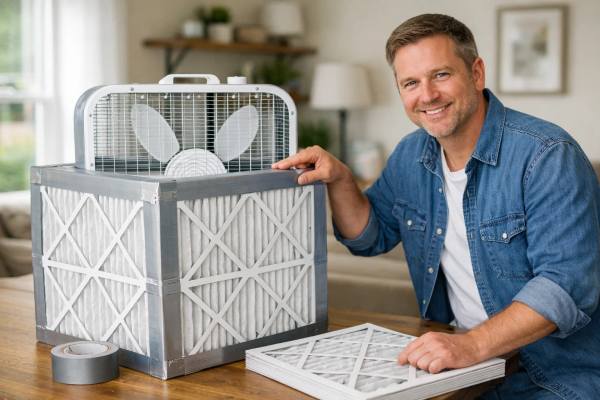
A Corsi–Rosenthal Box is a do-it-yourself air filter that pairs a standard box fan with high-efficiency HVAC filters to reduce airborne particles in a room. When it is built tightly and run consistently, it can meaningfully lower levels of fine particulate matter (including smoke and dust) and respiratory aerosols—often with a cost-to-performance profile that surprises first-time builders. The real value, though, is not the cardboard-and-tape aesthetic. It is the ability to create “cleaner air on demand” during respiratory virus season, wildfire smoke events, or in any space that feels stuffy and particle-heavy. This guide focuses on what makes the design work, which filter ratings are worth paying for, and the practical details that determine real-world performance: airflow, noise, placement, and maintenance. By the end, you should be able to build one confidently, size it to your room, and run it safely for the long haul.
Quick Overview
- A well-sealed build with quality filters can deliver strong particle reduction at a fraction of the cost of many commercial units.
- Filter rating alone does not guarantee better results; airflow and fit often matter just as much as the label.
- The biggest performance killers are air leaks, blocked intake, and placing the unit where it short-circuits its own clean air.
- Use extra caution with older box fans, cords, and crowded spaces; stability and clearance are non-negotiable.
- For most rooms, target at least 4–6 air changes per hour by matching airflow to your room volume.
Table of Contents
- What the box can and cannot do
- Filter ratings that actually matter
- Build guide for four and five filters
- How to predict and verify performance
- Placement and day-to-day use tips
- Safety and maintenance checklist
What the box can and cannot do
A Corsi–Rosenthal Box is best understood as a high-airflow particle filter. It pulls room air through multiple HVAC filters and pushes filtered air back into the space. Over time, repeated passes reduce the concentration of airborne particles, which is why these units can be helpful for wildfire smoke, dust, allergens, and respiratory aerosols that linger indoors.
The key idea is delivery, not perfection. Filters do not have to capture 100% of particles in one pass to make a room cleaner. What matters is how much clean air the device supplies per minute. A lower-efficiency filter with high airflow can sometimes outperform a higher-efficiency filter choked by resistance. That is why this design often performs well: multiple filters increase surface area, lower resistance, and let the fan move more air.
What it can do well:
- Reduce particle levels in a room when run consistently, especially fine particle pollution like smoke (PM2.5) and larger particles like dust and pollen.
- Improve comfort for many people during smoky days or in dusty rooms, because particle load drops.
- Support cleaner-air strategies in occupied spaces by lowering airborne particle concentration over time.
What it does not do (or does only indirectly):
- It does not remove carbon dioxide. If the room feels “stuffy,” you may also need ventilation (fresh outdoor air when conditions allow).
- It is not a gas and odor solution. Typical HVAC filters are designed for particles, not volatile chemicals. Some odor reduction requires activated carbon, which this design usually lacks.
- It is not a sterilizer. It does not disinfect surfaces, and it does not guarantee immediate protection near a contagious person. It reduces risk by lowering airborne concentration over time, especially when combined with good ventilation habits.
A practical way to think about it: a Corsi–Rosenthal Box is a “room air scrubber.” If you give it enough runtime and enough airflow for your room size, you can make a meaningful dent in particle concentration—often faster than people expect.
Filter ratings that actually matter
Shopping for filters can feel like alphabet soup: MERV, MPR, FPR, “HEPA-like,” and more. For a Corsi–Rosenthal Box, you can simplify the decision by focusing on three questions: Is it truly a pleated particle filter? How restrictive is it for airflow? And how well does it fit your build?
MERV in plain language
MERV (Minimum Efficiency Reporting Value) is a common rating for HVAC filters. Higher numbers generally capture smaller particles more efficiently, but they also tend to add resistance to airflow.
A useful rule of thumb for this design:
- MERV 13 is the go-to starting point for most builds because it offers strong small-particle capture while still allowing good airflow.
- MERV 14–16 can capture more particles per pass, but the added resistance may reduce airflow enough that the net “clean air delivered” does not improve—and can even worsen if the fan struggles.
Because performance is a balance of filtration efficiency and airflow, the “best” filter is often the one that maintains strong airflow without excessive leakage or strain.
Thickness matters more than most people expect
Filters commonly come in 1-inch, 2-inch, 4-inch, and 5-inch thicknesses. Thicker filters usually have more pleated surface area, which can:
- lower resistance at the same airflow,
- maintain performance longer as dust loads,
- reduce the rapid “drop-off” you can see with thin filters in dirty environments.
If you have the budget and availability, 2-inch or 4-inch filters are often a sweet spot for durability and airflow. If cost is tight, 1-inch filters can still work well—just expect more frequent replacement and a bigger impact from dust loading.
Other ratings you may see
- MPR and FPR are brand-specific or retailer-specific scales. They can be useful, but they do not always map cleanly to MERV. If you can, choose filters that clearly state a MERV rating on the packaging.
- HEPA is a different category. True HEPA filters are extremely efficient, but typical HEPA media is not what you buy as a standard HVAC panel filter. A Corsi–Rosenthal Box is usually built with MERV-rated HVAC filters, not HEPA cartridges.
Fit and consistency are performance features
Small size differences between filter frames can create gaps. Choose filters with the same dimensions and ideally the same model line so edges align cleanly. A tight seal matters: air will take the path of least resistance, and a gap turns “high-efficiency filter” into “mostly bypassed filter.”
If you are undecided, start with MERV 13 in 2-inch thickness if accessible. It is a reliable balance of capture, airflow, and practicality for most homes and classrooms.
Build guide for four and five filters
There are two common builds: a four-filter cube and a five-filter build (four sides plus a bottom filter). Both can work well. The best choice depends on your priorities: stability, cost, and how much you value the extra filter surface area.
Materials and tools
Typical list:
- One 20-inch box fan (newer is generally better for safety and reliability)
- Four or five pleated HVAC filters (commonly 20 by 20 inches in nominal size)
- Duct tape (or high-quality foil HVAC tape) for seams
- Cardboard (for a base and optional shroud)
- Scissors or a utility knife
- Optional: measuring tape, marker, zip ties, and a non-slip mat
Step-by-step: four-filter cube
- Orient the filters. Find the airflow arrows on each filter frame. Arrange the four filters so the arrows point into the cube (air should be drawn through the filters toward the fan).
- Form the square. Stand the filters on edge to form a box with four sides.
- Seal the vertical seams. Tape each corner seam from top to bottom. Press firmly so there are no channels for air to bypass.
- Create a base. Cut a cardboard square slightly larger than the bottom opening. Tape the cube onto the base so the bottom is sealed and the structure is stable.
- Attach the fan. Place the box fan on top so it exhausts upward (the fan should pull air through the filters and push clean air out the top). Tape around the perimeter where the fan meets the filter frames.
Step-by-step: five-filter build
The five-filter version adds a bottom filter instead of a cardboard base.
- Build the four-filter walls as above.
- Add the bottom filter with airflow arrows pointing up into the cube (toward the fan).
- Tape the bottom edges carefully. This version increases filter surface area and can improve airflow and stability, but it costs more.
The shroud: a small add-on with outsized impact
A shroud is a circular cutout of cardboard placed on the fan’s exhaust side to reduce recirculation and improve airflow efficiency. To make one:
- Cut a square of cardboard that matches the fan face.
- Cut a centered circle (commonly around 14–16 inches in diameter).
- Tape it to the fan’s exhaust side, keeping the opening centered.
Build quality checklist before you turn it on
- No visible gaps at corners or along the fan edge
- Filters are oriented correctly (arrows toward the fan)
- Unit is stable and cannot tip easily
- Intake sides have clearance (not pressed against furniture or curtains)
A careful build is not about craftsmanship points—it is about ensuring air goes through the filters, not around them.
How to predict and verify performance
“Does it work?” becomes easier to answer when you translate performance into two practical measures: clean air delivered and how quickly your room’s air is being turned over.
Start with room size and air changes per hour
Air changes per hour (ACH) describes how many times the air in a room is effectively cleaned or replaced in one hour. For filtration, an easy planning approach is:
Target airflow (cfm) ≈ Room volume (ft³) × Desired ACH ÷ 60
Example: A bedroom that is 12 feet by 12 feet with an 8-foot ceiling has a volume of:
- 12 × 12 × 8 = 1,152 ft³
If you want 6 ACH:
- 1,152 × 6 ÷ 60 ≈ 115 cfm
That target is often achievable even on lower fan speeds with a good build. Larger rooms may need higher speed or more than one unit.
Why your fan speed choice matters
Most Corsi–Rosenthal Boxes deliver a wide range of results depending on:
- fan model and blade design
- fan speed setting
- filter thickness and MERV rating
- how tightly the edges are sealed
- how dirty the filters are
In real life, a lower speed that you can tolerate continuously often beats a higher speed you only run for an hour. If noise forces you to shut it off, the room rebounds to its normal particle level.
Simple ways to sanity-check performance
You do not need lab instruments to learn something useful.
- Tissue test (very rough): Hold a tissue near the intake side. It should pull steadily toward the filter surface. If it barely moves, airflow may be restricted or the fan orientation may be wrong.
- Leak hunt: With the unit running, pass your hand slowly along seams and the fan edge. If you feel strong jets of air being pulled through a crack, that is bypass air. Add tape.
- Visual loading: After a week or two in a dusty environment, the filter face should look slightly darker. If it looks pristine despite heavy use, you may have major bypass leaks.
If you have access to a consumer particle monitor, you can do a more informative test:
- Close windows and doors, and run the unit on a stable fan speed.
- Track particle readings every few minutes for 30–60 minutes.
- Look for a steady decline and then a plateau. A quick drop suggests the unit is meaningfully cleaning the air.
What “better filters” do to net performance
Upgrading from MERV 13 to MERV 16 can increase capture per pass, but if airflow drops substantially, your net clean-air delivery may not improve. This is why many experienced builders prioritize:
- thicker filters,
- strong sealing,
- and good placement
before paying extra for the highest MERV rating available.
Your goal is not theoretical maximum filtration. Your goal is reliable, repeatable clean air in the room you actually use.
Placement and day-to-day use tips
Once the box is built, placement and runtime determine whether it becomes a high-impact tool or a noisy corner project. The same unit can perform very differently depending on where it sits and how it is used.
Where to place it for best results
- Give it breathing room. Keep at least 12–24 inches of clearance around the intake sides. Do not push it into a corner or under a desk where airflow is blocked.
- Avoid short-circuiting. If the exhaust blows straight into a wall and immediately loops back into the intake, you waste airflow. Center-of-room placement often performs better than edge placement.
- Think “mixing,” not “aiming.” The goal is to circulate and clean the whole room’s air over time, not to blast air directly at someone’s face. Direct drafts can be uncomfortable and may stir dust.
- Use the room’s natural flow. In bedrooms, placing it near the door side can help move air across the space. In living rooms, place it where people spend time, with clear intake.
How many units do you need?
If your room is large, has high ceilings, or is connected to an open floor plan, one unit may not provide enough effective ACH. Two smaller units placed in different locations can be better than one unit running at maximum speed because:
- noise is often easier to tolerate,
- airflow coverage improves,
- and performance is less sensitive to one “bad” placement spot.
A simple approach is to calculate the target airflow for 4–6 ACH and then decide whether one unit at a comfortable speed likely meets it. If not, add a second unit instead of pushing one unit into an intolerable noise level.
Wildfire smoke vs respiratory season use
- During wildfire smoke events: prioritize a “cleaner air room.” Keep doors closed, minimize indoor particle sources (frying, candles), and run filtration continuously.
- During respiratory virus season: filtration helps most when it is consistent and paired with smart ventilation habits. Run the unit during gatherings and for a while after, especially in smaller rooms.
Noise strategies that preserve consistency
- Run higher speeds when the room is unoccupied, then drop to a sleep-friendly setting.
- Place the unit on a firm surface with a non-slip pad to reduce vibration.
- If the unit rattles, check tape joints and fan stability; rattling often signals loose contact points.
The “best” setup is the one you will actually keep running. Treat comfort as part of the design, not an afterthought.
Safety and maintenance checklist
DIY does not mean “unsafe,” but it does mean you are responsible for basic engineering decisions: electrical safety, stability, and routine upkeep. Most issues are preventable with a simple checklist and a habit of inspecting the unit.
Electrical and fire safety fundamentals
- Use a newer, reputable box fan in good condition. Avoid fans with damaged cords, loose plugs, or inconsistent operation.
- Do not block the fan intake or exhaust. Reduced airflow can increase motor strain and heat.
- Keep clear of curtains, bedding, paper piles, and soft furniture that can be pulled toward the intake.
- Place it where it cannot be tipped easily. Homes with pets, toddlers, or narrow walkways need extra stability measures.
- Use a proper outlet setup. Avoid daisy-chained power strips. If you must use an extension cord, choose a heavy-duty cord rated for the fan’s load and keep it fully uncoiled.
Physical safety in real homes
- If children are present, consider adding an external guard or placing the unit where fingers cannot reach the fan blades through the grille.
- Avoid placing the unit on high surfaces where it could fall.
- If someone has mobility challenges, ensure the cord does not create a trip hazard.
Maintenance schedule that matches reality
Filter life depends on what you are filtering:
- Normal indoor dust: often weeks to months, depending on home conditions and runtime.
- Heavy smoke or renovation dust: filters can load quickly and may need replacement in a much shorter interval.
Watch for these replacement cues:
- visible darkening and dust matting on the filter surface
- noticeably reduced airflow at the same fan setting
- increased fan noise or a “strained” sound
- a rise in indoor particle readings if you track them
A useful habit is a quick weekly check:
- look at filter faces for uneven loading (which can signal leaks)
- confirm tape seams are still sealed
- ensure the fan sits flush and stable
Cleaning the fan and extending filter life
- Wipe exterior surfaces and fan grilles as dust accumulates.
- If you disassemble for cleaning, unplug first and follow the fan’s manufacturer guidance.
- Some people add a very low-resistance prefilter layer to catch larger dust, but be cautious: anything you add can reduce airflow. If you experiment, prioritize airflow preservation and monitor performance.
A well-maintained unit can stay effective for a long time. Think of it like a small appliance: safe placement, routine inspection, and timely filter changes keep performance high and risks low.
References
- Guide to Air Cleaners in the Home | US EPA 2025 (Guidance)
- Improving Air Cleanliness | Ventilation | CDC 2024 (Guidance)
- Impact of do‐it‐yourself air cleaner design on the reduction of simulated wildfire smoke in a controlled chamber environment – PMC 2022 (Study)
- Efficacy of Do-It-Yourself air filtration units in reducing exposure to simulated respiratory aerosols 2023 (Study)
- Research on DIY Air Cleaners to Reduce Wildfire Smoke Indoors | US EPA 2021 (Research Summary)
Disclaimer
This article is for educational purposes only and does not provide medical advice or replace guidance from qualified professionals. Air filtration can reduce airborne particle concentrations, but it does not eliminate all risk from respiratory infections, wildfire smoke, or indoor pollutants. DIY air cleaners involve electrical devices and should be used thoughtfully: inspect cords and fans, maintain safe clearances, and prioritize stable placement—especially around children, pets, and high-traffic areas. If you have health conditions that make smoke or respiratory irritants dangerous, follow individualized medical guidance and seek prompt care for concerning symptoms.
If you found this guide useful, please consider sharing it on Facebook, X (formerly Twitter), or any platform you prefer.