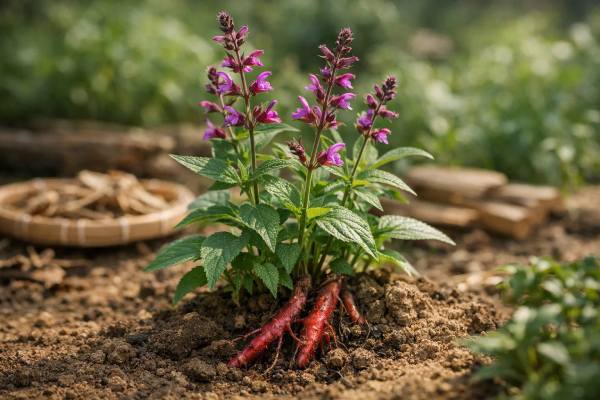
Danshen—also known as red sage or Chinese sage—is the dried root of Salvia miltiorrhiza, a plant with a long history in traditional East Asian medicine. Today, it’s most often discussed for cardiovascular support, especially for circulation-related concerns, occasional chest tightness associated with stable angina under medical care, and broader “microcirculation” effects that may influence tissue oxygenation and recovery. What makes Danshen unique is its split personality: water-soluble antioxidants (such as salvianolic acids) and fat-soluble diterpenes (such as tanshinones) can behave differently depending on how the herb is extracted and formulated. That matters in real life, because a tea, a capsule, and a concentrated extract can deliver very different profiles—even when the label says “Danshen.”
This guide walks through what Danshen is, what’s in it, what the evidence realistically suggests, and how to use it safely—especially if you take blood thinners or have a higher bleeding risk.
Essential Insights
- May support circulation and endothelial function, with the strongest clinical use history in cardiovascular settings.
- Quality and extraction method matter; water-based and alcohol-based extracts can behave differently.
- Avoid combining with anticoagulants or antiplatelet drugs unless a clinician is monitoring you.
- Typical traditional decoction range is 9–15 g dried root per day.
- Avoid during pregnancy, before surgery, or with bleeding disorders unless specifically advised.
Table of Contents
- What is danshen?
- Key compounds and actions
- Does danshen support heart health?
- Inflammation and brain support
- How to use it
- How much danshen per day?
- Side effects and interactions
What is danshen?
Danshen is the root and rhizome of Salvia miltiorrhiza, a species in the Salvia genus (the same broad family as culinary sages, but not the same plant as common kitchen sage). You may also see it called “Dan Shen,” “red sage,” or “Chinese sage.” Traditionally, it’s categorized as an herb that “moves blood” and addresses patterns often described as stagnation—language that maps, in modern terms, to circulation, vessel tone, and blood-flow dynamics.
In contemporary use, Danshen shows up in three common contexts:
- Single-herb products: dried root for tea or decoction, capsules, powders, and standardized extracts.
- Compound formulas: especially Chinese patent medicines where Danshen is paired with other ingredients. A well-known example is “Compound Danshen Dripping Pills,” which combine Danshen with other components (notably Panax notoginseng and borneol).
- Clinical-style preparations: in some regions, Danshen-derived constituents also appear in injectables or hospital formulations. Those are not appropriate for self-use and shouldn’t be treated as equivalent to supplements.
That distinction matters because many positive clinical signals relate to specific formulas rather than “any Danshen product.” If you’re buying an over-the-counter supplement, you’re essentially choosing (1) an extraction style, (2) a dose form, and (3) a quality standard—all of which influence how “Danshen-like” the result really is.
Historically, Danshen is also discussed in women’s health traditions (often in the context of menstrual discomfort or cycle irregularity). It’s sometimes paired with other botanicals used for similar goals, such as dong quai uses and safety, but these combinations are exactly where interaction risks can increase—especially if you also use pain relievers, blood thinners, or hormonal therapies.
Finally, Danshen is a great example of why “natural” does not mean “simple.” It has multiple bioactive families, and the same properties that may support circulation can also raise safety concerns for people with clotting risks, upcoming procedures, or certain medications.
Key compounds and actions
Danshen’s activity is usually explained through two major chemical “teams,” and which team dominates depends heavily on preparation.
1) Water-soluble phenolic acids (often emphasized in teas and water extracts)
These include salvianolic acids and related polyphenols. They’re discussed for antioxidant capacity, endothelial support, and signaling effects tied to inflammation and vascular tone. Salvianolic acid B is frequently highlighted as a major water-soluble component in Danshen research and reviews, and it’s used as a marker compound in some standardization approaches.
2) Fat-soluble diterpene quinones (often emphasized in alcohol extracts)
These include tanshinones (such as tanshinone IIA and others). They tend to be less water-friendly, which means a simple tea may not deliver much of them. Tanshinones are often discussed in relation to vascular smooth muscle, inflammatory signaling, fibrosis-related pathways, and cellular stress responses.
In practical terms, this means two products can both be “Danshen,” yet perform differently:
- A water decoction may concentrate phenolic acids more than tanshinones.
- An alcohol-based extract may capture more tanshinones.
- A blended extract may aim for a broader spectrum, but quality control matters.
Mechanistically, Danshen is often described (in modern biomedical language) as supporting cardiovascular function through overlapping pathways:
- Endothelial function and nitric oxide signaling, which influences vessel relaxation and blood flow.
- Antioxidant effects, especially relevant when tissues are under oxidative stress (exercise stress, metabolic strain, ischemia-reperfusion contexts).
- Inflammation modulation, which may influence vascular stiffness, plaque biology, and microvascular function over time.
- Platelet and coagulation effects, which are a double-edged sword: potentially relevant for circulation, but risky if you already use anticoagulants or have bleeding vulnerability.
A helpful way to think about Danshen is as a “systems herb” for circulation: it doesn’t act like a single-target drug. The trade-off is that broad activity can also mean broader interactions. The more you stack it with other “circulation” supplements, the more you should shift from casual use to careful monitoring.
Does danshen support heart health?
Danshen is best known for heart and circulation applications, but the evidence base is uneven across outcomes and product types. Clinical research commonly focuses on stable angina, coronary heart disease contexts, and recovery or functional markers after major cardiac events—often using standardized, region-specific products or compound formulas.
One of the most discussed modern preparations is Compound Danshen Dripping Pills (CDDP), a formula that includes Danshen plus additional ingredients. Clinical reviews of trials in stable angina settings suggest potential benefits such as symptom relief, improved exercise tolerance measures, and supportive effects when used alongside conventional care—while also emphasizing that more rigorous, large, multi-center trials are still needed for confident conclusions and long-term outcomes.
Separately, placebo-controlled randomized research in post–heart attack settings has explored whether CDDP can support cardiac function measures (for example, left ventricular ejection fraction over months of follow-up). Results like these are encouraging, but they should be interpreted as adjunctive rather than replacement therapy—especially because standard post-event medications (antiplatelets, statins, beta-blockers, ACE inhibitors, and others) are foundational and time-tested for survival benefits.
A realistic “what might it do?” framework looks like this:
- Most plausible: support for circulation-related symptoms and certain functional markers, particularly when the product is standardized and used consistently.
- Possible but less certain: improvements in biomarkers tied to endothelial health or inflammation, depending on formulation and population.
- Not established: hard endpoints like preventing heart attack or stroke when used as a supplement outside medical systems.
Because many studies are conducted in specific clinical contexts, the strongest takeaway for everyday users is conservative: Danshen may be worth discussing with a clinician if you have circulation-related goals, but it’s not a do-it-yourself solution for chest pain, shortness of breath, irregular heartbeat, or suspected cardiovascular disease.
If you’re building a broader “heart support” plan, it’s also worth comparing mechanisms and risk profiles with other options that have their own evidence traditions—such as hawthorn for cardiovascular antioxidant support—while remembering that combining multiple circulation-acting agents can increase blood pressure and bleeding-related complexity.
Inflammation and brain support
Beyond the heart, Danshen is often discussed for its influence on inflammation, oxidative stress, and microcirculation—a trio that matters in many body systems, including the brain. The “microcirculation” concept shows up frequently in Danshen discussions because small-vessel blood flow helps determine oxygen delivery and waste clearance in tissues that are sensitive to perfusion changes.
From a biology standpoint, the same compound families that are relevant to vascular tone and endothelial signaling can also overlap with:
- Neurovascular function (blood flow dynamics that influence brain energy supply)
- Ischemia-reperfusion stress (cellular stress patterns after temporary oxygen restriction)
- Inflammatory signaling that may influence tissue recovery
That said, brain-related claims can easily drift into hype. A responsible view is that Danshen’s antioxidant and circulation-related mechanisms make it a plausible candidate for supportive research in neurovascular contexts, but translating that into “memory booster” promises is premature. Many studies in this area are preclinical, region-specific, or focused on injectable or hospital-style preparations rather than over-the-counter supplements.
Where Danshen may fit more realistically for everyday users is as part of a broader anti-inflammatory lifestyle pattern. If your goal is “lower systemic inflammation,” the biggest levers are still sleep quality, metabolic health (especially blood sugar stability), movement, and dietary patterns. Botanicals may add modest support, but rarely override fundamentals.
If you’re exploring inflammation-focused supplements, it can help to compare Danshen’s circulation-forward profile with more inflammation-centered options—such as curcumin benefits, dosage, and safety—while staying mindful that “anti-inflammatory” does not automatically mean “safe with medications.” Many anti-inflammatory or circulation-acting ingredients share the same interaction neighborhoods (blood thinners, blood pressure medicines, diabetes drugs).
The most practical takeaway: treat Danshen as a circulation-support herb with potential downstream benefits in systems influenced by microcirculation, rather than as a direct brain nootropic. If your primary concern is cognition, make your baseline plan evidence-forward (sleep apnea screening when relevant, hearing correction, resistance training, cardiovascular fitness, and medication review), then consider botanicals as optional add-ons.
How to use it
Danshen can be used in several forms, and choosing the right form is less about preference and more about matching your goal, tolerance, and risk profile.
Common forms you’ll see:
- Dried root for tea or decoction: traditional, but not always convenient. The extraction is mostly water-based, which can emphasize phenolic acids over tanshinones.
- Powder and capsules: simple, but quality varies widely. “Root powder” is not the same as “standardized extract.”
- Standardized extracts: often the most consistent option if you want repeatable dosing. Look for clear standardization (for example, to a named compound family) and third-party testing.
- Compound formulas: products like “dripping pills” are common in clinical research, but they are not pure Danshen. If you use these, you’re evaluating a formula, not the single herb.
- Tinctures: may capture a broader spectrum depending on alcohol percentage, but dosing precision can be trickier.
Practical steps for safer, more effective use:
- Define your goal in one sentence. “I want general circulation support” is different from “I want to self-treat chest pain” (which is not appropriate).
- Pick one primary format. Don’t start with tea plus capsules plus a formula at the same time.
- Choose quality signals. Prefer products that provide: batch testing, heavy metal screening, and clear labeling of extract ratio and standardization.
- Track one or two outcomes. Examples: resting blood pressure, exercise tolerance, frequency of cold hands and feet, or clinician-guided markers.
- Reassess at 4–8 weeks. If nothing measurable changes, increasing complexity is usually less valuable than changing the approach.
Danshen is often stacked with other cardiovascular-support supplements. If you do that, keep the stack simple and avoid overlapping “blood-thinning” effects. Many people pair circulation support with mitochondrial or energy-metabolism support, such as coenzyme Q10 benefits and dosage. The key is to introduce changes one at a time so you can tell what actually helped.
Most importantly: if you use prescription cardiovascular medications, view Danshen as something to coordinate, not to experiment with casually. The same mechanisms that are attractive on paper can meaningfully shift bleeding risk or blood pressure in real life.
How much danshen per day?
Danshen dosing is highly dependent on the form used, and it’s one of the places where labels can mislead. “500 mg Danshen” could mean 500 mg of raw powder, or 500 mg of an extract that concentrates multiple grams of root. Those are not interchangeable.
Traditional decoction range
A commonly cited traditional daily range is 9–15 g of dried Danshen root (prepared as a tea or decoction). This is a root-equivalent range, not a standardized extract dose, and it assumes the herb is being used in a traditional manner with appropriate screening for contraindications.
Extracts and capsules: how to think about them
For extracts, focus on three label elements:
- Extract ratio (for example, 5:1)
- Standardization marker (if provided)
- Root-equivalent math (some labels state this clearly; others do not)
If a product is a 5:1 extract, then 1,000 mg of extract may represent roughly 5,000 mg (5 g) of raw herb equivalent. But this is still an approximation because extraction methods differ (water vs hydroalcoholic extraction, temperature, and purification steps).
A cautious dosing approach for new users
- Start at the lower end of the product’s labeled range for 3–7 days.
- Increase gradually only if you tolerate it well (no unusual bruising, bleeding gums, dizziness, or significant blood pressure changes).
- Avoid “high-dose experiments,” especially if you also use aspirin, NSAIDs, fish oil, or any prescription anticoagulant or antiplatelet medication.
Timing and duration
- Many people take Danshen with food to reduce stomach upset.
- If your goal is circulation support, consistency matters more than “perfect timing.”
- Consider a trial period of 4–8 weeks, then reassess. Longer use should be more conservative and ideally clinician-informed, especially if you have cardiovascular disease.
When the best dose is “none”
If you have unexplained chest pain, fainting, unusual shortness of breath, black stools, blood in urine, or severe headaches, do not treat yourself with herbs. Get evaluated first. Danshen is best used as a supportive tool after the basics—diagnosis, risk management, and medication review—are already in place.
Side effects and interactions
Danshen is often well tolerated, but its safety profile depends on your baseline risk—especially your bleeding risk—and what else you take.
Common side effects (when they occur)
- Stomach upset, nausea, or loose stools
- Dizziness or lightheadedness (sometimes related to blood pressure changes)
- Headache
- Skin reactions (rare, but possible with many botanicals)
The most important safety issue: bleeding risk
Danshen can influence platelet function and coagulation pathways. That’s why many safety cautions focus on anticoagulants and antiplatelet drugs, including warfarin and similar medications. If you take any of these, do not add Danshen without clinician oversight and appropriate monitoring.
Use extra caution or avoid Danshen if you:
- Take anticoagulants (warfarin, direct oral anticoagulants) or antiplatelets (clopidogrel and related drugs)
- Use daily aspirin, frequent NSAIDs, or other supplements that may affect clotting
- Have a bleeding disorder or history of unexplained bleeding
- Are pregnant, trying to conceive, or breastfeeding (safety data are limited, and blood-flow–modulating effects may be undesirable)
- Have upcoming surgery or dental procedures (a common precaution is to stop circulation-acting herbs in advance, per clinician guidance)
- Have very low blood pressure or frequent fainting
Interaction “hot zones” to discuss with a clinician
- Blood thinners and clotting-related supplements: stacking increases risk. If you’re already using enzymes or supplements marketed for circulation, treat that combination as high-risk without supervision. For example, nattokinase and bleeding precautions belongs in the same caution category.
- Blood pressure medications: additive lowering can occur in sensitive individuals.
- Diabetes medications: improved circulation and metabolic signaling changes can sometimes shift glucose dynamics; monitor if you’re prone to lows.
- Liver-metabolized drugs: some data suggest Danshen can affect drug metabolism pathways; the practical relevance varies by product and person, so this is a “mention it to your clinician” category rather than a universal rule.
Red flags that should stop use and prompt medical advice
- Unusual bruising, nosebleeds, bleeding gums, black or tarry stools
- New chest pain, severe headache, fainting, or neurologic symptoms
- Allergic reactions (hives, facial swelling, wheezing)
Danshen can be valuable, but it’s not a casual add-on for everyone. If you’re in a higher-risk group, the safest path is coordination: a clinician can help you decide whether Danshen fits—and how to monitor it if it does.
References
- Advances of clinical trials on compound Danshen dripping pills for stable angina pectoris: A perspective 2025 (Review)
- Effect of Compound Danshen Dripping Pills on cardiac function after acute anterior ST-segment elevation myocardial infarction: A randomized trial 2025 (RCT)
- Salvianolic Acid B: A Review of Pharmacological Effects, Safety, Combination Therapy, New Dosage Forms, and Novel Drug Delivery Routes 2023 (Review)
- Salvia Miltiorrhiza Root Water-Extract (Danshen) Has No Beneficial Effect on Cardiovascular Risk Factors. A Randomized Double-Blind Cross-Over Trial 2015 (RCT)
- Interaction between warfarin and danshen (Salvia miltiorrhiza) 2001 (Review)
Disclaimer
This article is for educational purposes only and does not provide medical advice, diagnosis, or treatment. Herbal products can act like drugs in the body and may cause side effects or interact with prescription and over-the-counter medications—especially blood thinners and cardiovascular drugs. If you are pregnant or breastfeeding, have a medical condition, take medications, or are preparing for surgery, consult a qualified healthcare professional before using Danshen or any supplement. Seek urgent medical care for chest pain, severe shortness of breath, fainting, signs of stroke, or any unusual bleeding.
If you found this guide useful, consider sharing it with friends or family on Facebook, X (formerly Twitter), or any platform where people might benefit from clearer, safer supplement information.