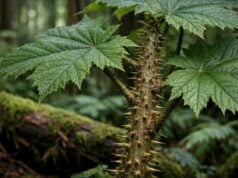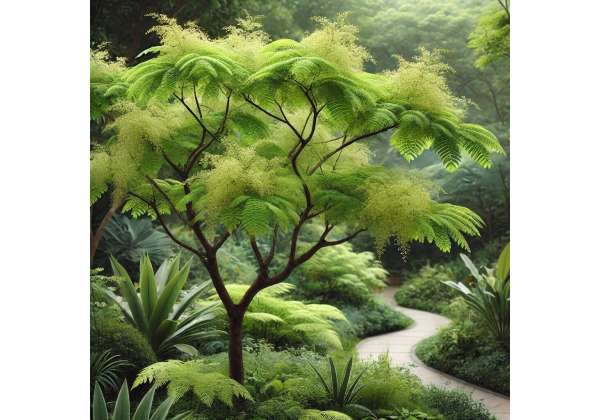
Devil’s walkingstick (Aralia spinosa), also known as Hercules’ club or angelica tree, is a spiny, aromatic shrub or small tree native to the eastern United States. In gardens it’s admired for its dramatic, tropical-looking leaves and late-summer flower clusters, but in traditional North American herbalism it has a different identity: a strong, stimulating plant used in small amounts and for short periods. Historical preparations most often used the root bark and bark, while the berries and young shoots appear in some folk accounts.
Modern interest in devil’s walkingstick centers on its chemistry. As a member of the ginseng family (Araliaceae), it contains triterpenoid saponins and related compounds that may influence inflammation signaling, circulation, and tissue response in laboratory models. Still, human evidence is limited, dosing is not standardized, and safety depends heavily on plant part and preparation. This guide focuses on realistic benefits, practical use, conservative dosing, and the safety issues that matter most.
Quick Safety and Use Highlights
- Traditionally used for short-term joint and muscle discomfort, and for “stuck” congestion during colds
- Root bark contains triterpenoid saponins that may affect inflammation pathways, but human evidence is limited
- Conservative traditional range is 2–6 g/day dried root bark (decoction) for short periods, or label-directed tincture doses
- Avoid during pregnancy or breastfeeding, and keep berries and bark away from children and pets due to poisoning risk
Table of Contents
- What is devil’s walkingstick?
- Key ingredients and active compounds
- Health benefits and traditional uses
- How to use devil’s walkingstick
- How much devil’s walkingstick per day?
- Side effects, interactions, and who should avoid it
- What the evidence actually says
What is devil’s walkingstick?
Devil’s walkingstick (Aralia spinosa) is a thorny, fast-growing plant that often forms thickets through suckering. It can grow as a large shrub or a small tree, typically with upright stems armed with sharp prickles. The leaves are unusually large and twice-compound, giving the plant a bold, architectural look. In late summer it produces broad clusters of small white flowers, followed by dark purple-black berry-like fruits.
From an herbal perspective, the most important detail is that Aralia spinosa is a strong plant with variable “edible” folklore, not a gentle everyday tonic. The common name “Hercules’ club” is a reminder: the plant’s physical character is forceful, and traditional preparations were often used when people wanted something stimulating, warming, and mobilizing—especially for aches, sluggish circulation, or lingering congestion.
You’ll see devil’s walkingstick compared to other Araliaceae plants, particularly ginseng and spikenard-type roots. The family resemblance matters because Araliaceae plants often share a chemistry pattern dominated by saponins. But family resemblance does not mean identical effects. Aralia spinosa has a more irritant, “pungent” reputation than classic ginseng preparations, and it is used differently in traditional practice.
It also helps to clarify what people mean when they say “devil’s walkingstick.” In online searches, it is sometimes confused with unrelated “devil” herbs. It is not devil’s claw, and it is not the same as devil’s-bit scabious. If you are buying a product, confirm the Latin name on the label: Aralia spinosa.
Finally, consider the real-world context: many people encounter this plant in a yard or hedgerow. In that situation, the most relevant questions are practical and safety-driven: which parts are irritating, what happens if berries are eaten, and whether handling can cause dermatitis. Those points matter as much as any potential health benefit, especially for households with children and pets.
Key ingredients and active compounds
Devil’s walkingstick does not have one single “signature” compound that explains everything. Its activity is best understood as the combined effect of several compound families—some potentially helpful in controlled doses, and some irritating when used carelessly.
Triterpenoid saponins
The best-known constituents in Araliaceae plants are triterpenoid saponins. These are soap-like glycosides that can interact with cell membranes and influence signaling pathways related to inflammation and immunity. In practical terms, saponins can help explain why Araliaceae plants are sometimes used for joint discomfort, slow recovery, and “stagnant” conditions in traditional systems.
Saponins can also irritate the stomach for some people, especially at higher doses or with concentrated preparations. That’s why devil’s walkingstick is generally approached as a short-term herb with conservative dosing.
If you want a reference point for how saponin-rich Araliaceae herbs are discussed in modern supplement culture, compare it with ginseng active compounds and effects. The chemistry theme overlaps, but the safety and “feel” of the herbs can differ.
Phenolic acids and flavonoids
Analytical studies of Aralia spinosa identify phenolic acids (often quinic-acid conjugates) and flavonoids. These compounds are commonly associated with antioxidant activity and may contribute to tissue-protective effects in laboratory testing. In a whole-plant preparation, they may support a gentler “background” effect—less like a stimulant and more like a resilience support—though this remains an inference rather than proven clinical benefit.
Volatile constituents and aromatic compounds
Many people notice that the plant is aromatic when cut or bruised. Volatile compounds can influence sensory experience (smell and taste) and can contribute to the traditional “warming” character of certain roots and barks. In practice, aromatic intensity can vary by harvest time, drying method, and storage conditions.
Cyanogenic potential and plant defense chemistry
One reason to avoid casual experimentation is that Aralia spinosa has been studied for intermittent cyanogenesis (the ability to release small amounts of hydrogen cyanide under certain conditions). That does not automatically mean the plant is “cyanide dangerous” in normal handling, but it reinforces a key theme: this is a defended plant with chemistry that changes by organ and season.
What this means for real-world use
- Whole herb preparations are chemically complex and can be unpredictable.
- “More” is not a safe strategy; irritation is often dose-limiting.
- The part used matters: root bark and bark are the most discussed medicinal parts, while berries raise safety concerns and are not a routine internal remedy.
The chemistry is interesting, but it mainly supports a conservative approach: small doses, short trials, and clear stop rules.
Health benefits and traditional uses
Most claims about devil’s walkingstick come from traditional practice rather than modern clinical trials. That does not make the plant irrelevant, but it does change how to interpret “benefits.” A responsible way to use traditional information is to treat it as a map of likely use-cases—then apply modern caution around dosing, safety, and diagnosis.
1) Joint and muscle discomfort
In folk and eclectic-style herbal traditions, Aralia spinosa root bark was used as a stimulating remedy for rheumatic discomfort—aching joints, stiffness, and soreness that feels worse with cold or damp conditions. The intended effect was often described as “warming” and mobilizing, which aligns with how many stimulating roots are used: not to numb pain, but to support circulation and a sense of looseness.
For readers who want a more common, better-characterized botanical for minor pain support, willow bark for pain relief is a frequent comparison point. It is not risk-free, but it has clearer modern context than Aralia spinosa.
2) Respiratory congestion and “stuck” colds
Traditional accounts sometimes place devil’s walkingstick in the category of stimulating expectorants or diaphoretic-style herbs—taken as hot preparations to support the body during chest tightness, thick mucus, or lingering cough after a cold. The realistic expectation here is comfort and supportive momentum, not a rapid cure.
This use is most plausible when the issue is mild and self-limited. If symptoms include shortness of breath, wheezing, high fever, chest pain, or coughing up blood, medical evaluation is the right tool.
3) External uses for skin and localized discomfort
Some traditional sources describe poultices or washes for boils, eruptions, or localized swelling. From a modern perspective, caution is essential: bark and root handling can irritate skin, and applying strong plant material to compromised skin can backfire. If someone explores external use, it should be gentle, diluted, and discontinued at the first sign of worsening irritation.
4) Historical “strong medicine” claims
Older texts sometimes list uses that are not appropriate to replicate today, such as severe purging approaches or treating serious infectious diseases. These are best viewed as historical context, not guidance. The safest interpretation is: devil’s walkingstick was used in an era with fewer options, and it was used because it had noticeable physiological impact—often at a cost.
What benefits are most realistic today?
For most people, the best-case benefit is modest: slightly less stiffness, a warmer sense of circulation, or a small improvement in congestion comfort during a cold. If you need large, reliable changes, Aralia spinosa is unlikely to be the most efficient or safest first choice.
How to use devil’s walkingstick
Because devil’s walkingstick is not a mainstream supplement with standardized products, “how to use it” is mostly about choosing conservative forms and avoiding common missteps. The goal is not intensity; the goal is controlled, short-term support.
1) Decoction (traditional root bark tea)
A decoction is made by simmering tougher plant material such as root bark. This is the most traditional internal form, but also the easiest to overdo.
A conservative method many herbalists use for strong roots:
- Start with 1–2 g dried root bark in 250–350 mL water.
- Simmer gently for 10–20 minutes with the lid on.
- Strain and drink warm, ideally with food.
- Use once daily at first, increasing only if clearly tolerated.
If the preparation causes nausea, burning, or loose stools, that is a sign to stop or reduce.
2) Tincture (more controllable dosing)
A tincture can be easier to dose consistently than a homemade decoction. Because strength varies by manufacturer, follow the label and begin with the lowest suggested amount. Tinctures are often used for “warming” support during a flare of aches or a short cold, not as an everyday habit.
3) External use: diluted wash rather than strong poultice
If someone is drawn to traditional external uses, a diluted wash is generally safer than applying concentrated plant material directly to skin. Even then, patch testing matters because some individuals develop contact irritation.
For most skin goals, it makes sense to use gentler botanicals as the foundation. For example, calendula for topical skin support is often chosen for comfort and barrier support, while stronger plants are used only with experience and caution.
4) What not to do
Avoid these high-risk approaches:
- Eating berries or experimenting with bark chewing
- Using fresh bark preparations internally without clear guidance
- Using the plant as a replacement for evaluation of chronic pain, infection, or inflammatory disease
- Foraging without confident identification and clean sourcing
How to tell if it is helping
Devil’s walkingstick is not a “take it and forget it” herb. The best practice is to define a small goal and measure it:
- Morning stiffness feels slightly reduced within 7–14 days
- Congestion feels easier to clear over 3–7 days
- No digestive upset or skin irritation occurs
If there is no meaningful benefit in a short, conservative trial, the safest choice is to stop rather than escalating.
How much devil’s walkingstick per day?
There is no universally accepted clinical dosage for Aralia spinosa. Most dosing guidance is traditional, experience-based, and shaped by tolerance—because the plant can become irritating before it becomes “stronger.” The safest approach is to treat dosing as a structured experiment with boundaries.
Conservative traditional ranges (adults)
These ranges assume dried root bark unless otherwise specified:
- Decoction: 1–2 g per serving, 1–2 times daily (about 2–4 g/day)
- Short-term upper end sometimes used traditionally: up to 6 g/day total, divided, if well tolerated
- Commercial tincture: follow label directions; start with the lowest suggested dose
Because product strengths vary, tincture dosing should be label-led. If a label gives a range, treat the low end as your starting point.
Timing and duration
- For aches and stiffness: try 7–14 days, then reassess.
- For colds and congestion: 3–7 days is a reasonable window.
- Avoid long continuous use unless a qualified professional is guiding you.
If you feel you “need it every day,” that is often a sign to revisit the underlying issue and choose better-supported strategies.
How to start low without guessing
A practical step-up plan:
- Days 1–2: 1 g/day (decoction once daily) to assess tolerance.
- Days 3–7: increase to 2 g/day if needed and well tolerated.
- Days 8–14: consider 3–4 g/day only if there is clear benefit and no irritation.
If you experience nausea, vomiting, diarrhea, or a burning sensation, stop. With saponin-rich roots, digestive upset is often the first signal that the dose is too high.
Variables that change dosing needs
- Root bark vs bark: root bark is often described as more active.
- Freshness and storage: older material can be weaker or harsher in taste.
- Individual sensitivity: some people are “small-dose responders,” others are not responders.
- Other herbs and medications: stacking “warming” or stimulating botanicals can raise side effects.
If you want to pair devil’s walkingstick with something supportive for digestion during colds (so that you can tolerate warm decoctions), keep it simple and avoid aggressive stacks. For context on digestive-supportive botanicals, see ginger active compounds and uses, but introduce only one change at a time.
When dosing is the wrong lever
If pain is severe, progressive, or associated with red flags (fever, unexplained weight loss, neurologic symptoms, swollen joints), increasing an herb dose is not the solution. Get evaluated, then decide where gentle botanical support fits.
Side effects, interactions, and who should avoid it
Safety is the deciding factor for devil’s walkingstick. Even when toxicity is described as “low” in certain references, that does not mean it is a casual food plant or an herb to improvise with. Risk depends on plant part, preparation, and the person using it.
Common side effects
Most side effects are dose-related and involve irritation:
- Nausea, stomach cramping, or loose stools
- Burning sensation in the mouth or stomach with overly strong preparations
- Headache or lightheadedness in sensitive individuals
- Skin irritation or rash after handling bark or roots
If you experience digestive upset, reduce the dose or stop. If a rash develops after handling, treat it as a contact reaction and avoid further exposure.
Who should avoid devil’s walkingstick
Avoid internal use if you are:
- Pregnant or breastfeeding
- Under 18
- Managing chronic gastrointestinal disease (ulcers, inflammatory bowel disease)
- Highly allergy-prone or known to react to plant saps and resins
- Unable to verify correct identification and clean sourcing
Households with small children or pets should treat the berries and bark as a poisoning risk and prevent access.
Interactions and cautions
Clear interaction data is limited, so the safest stance is caution with:
- Diuretics or medications that affect fluid balance (traditional “stimulating” herbs can complicate tolerance)
- Medications with narrow safety margins, where vomiting or diarrhea could disrupt dosing
- Sedatives or alcohol if you are using strong decoctions while ill (not because the herb is sedating, but because illness plus dehydration can increase adverse effects)
Handling and garden safety
If you prune or remove the plant:
- Wear thick gloves and long sleeves (spines can puncture skin)
- Avoid touching your face during handling
- Wash hands and tools afterward
- Dispose of clippings carefully where children and pets cannot access them
Accidental ingestion
If berries or bark are swallowed and symptoms occur (hypersalivation, vomiting, diarrhea), seek urgent guidance from local poison control or medical services—especially for children and animals. Do not “wait it out” if symptoms are significant or progressing.
The safest overall message is simple: devil’s walkingstick is a plant to respect. If you decide to use it medicinally, do so conservatively, briefly, and with clear stop rules.
What the evidence actually says
Devil’s walkingstick sits in a familiar evidence pattern: strong traditional narrative, solid chemistry, promising lab findings, and a thin layer of human clinical data. Understanding what that means helps you avoid overclaiming and use the plant appropriately—if you use it at all.
1) What we can say with more confidence
- Aralia spinosa contains triterpenoid saponins, phenolic acids, and related constituents consistent with biological activity in the Araliaceae family.
- Its chemistry can support plausible mechanisms for traditional uses, particularly inflammation signaling and tissue response.
- Safety concerns are real and practical: certain parts can cause gastrointestinal symptoms when ingested and skin reactions when handled, and the plant has been investigated for cyanogenic potential under some conditions.
These points are supported by modern analytical and botanical references, even if they do not prove clinical benefits.
2) What remains uncertain
- There is little high-quality human research directly testing devil’s walkingstick for pain, arthritis, cough, or skin conditions.
- Many traditional claims involve complex problems where placebo effects, supportive care, and natural recovery play a major role.
- Preparations used in lab studies (specific extracts, controlled assays) may not resemble home decoctions or tinctures.
So while it is reasonable to say “this plant has bioactive compounds,” it is not responsible to say “this plant reliably treats arthritis” or “this plant cures infections.”
3) How to interpret a “promising” lab result
A common mistake is turning “promising” into “proven.” Lab results usually mean one of three things:
- A compound affects a pathway in a controlled environment.
- An extract shows activity at a concentration that may be unrealistic for human use.
- A mixture has an effect that may not translate to safe dosing.
This is especially relevant for saponin-rich plants, where dose-limiting irritation can prevent reaching the “active” concentrations seen in vitro.
4) A practical, evidence-informed role for this herb
If someone is set on exploring devil’s walkingstick, the most defensible role is:
- Short-term use for mild discomfort (aches, lingering congestion)
- Low doses with careful monitoring
- A willingness to stop if benefit is unclear
If your health goal is high-stakes—significant inflammation, chronic pain with functional decline, recurring infections—prioritize evaluation and evidence-based therapies. Herbs can be supportive, but they should not be the foundation when risk is meaningful.
In short: the evidence supports cautious curiosity, not confident promises.
References
- Traditional uses, phytochemistry, pharmacology, toxicity and quality control of medicinal genus Aralia: A review – PubMed 2022 (Systematic Review)
- Cyanogenesis in Aralia spinosa (Araliaceae) – PubMed 2022
- Detailed qualitative and quantitative UHPLC-DAD-ESI-MS3 analysis of Aralia spinosa L. (Araliaceae) phytochemical profile to evaluate its potential as novel plant material for bioactive compounds acquisition using in vitro culture – ScienceDirect 2024
- Aralia spinosa (Angelica Tree, Devil’s Walkingstick, Devil’s Walking Stick, Hercules’ Club, Hercules’s Club, Hercules’s-Club, Prickly Ash, Prickly Elder) | North Carolina Extension Gardener Plant Toolbox 2026
Disclaimer
This article is for educational purposes only and does not provide medical advice, diagnosis, or treatment. Herbal products can affect people differently and may cause side effects or interact with medications. Devil’s walkingstick (Aralia spinosa) can cause gastrointestinal symptoms if ingested inappropriately and may trigger skin irritation in some individuals. If you are pregnant, breastfeeding, taking prescription medicines, managing a medical condition, or considering herbal treatment for significant or persistent symptoms, consult a qualified healthcare professional. For suspected poisoning or accidental ingestion (especially in children or pets), contact local poison control or emergency services promptly.
If you found this guide useful, please share it on Facebook, X (formerly Twitter), or your preferred platform so others can learn safer, more evidence-aware ways to approach herbal remedies.