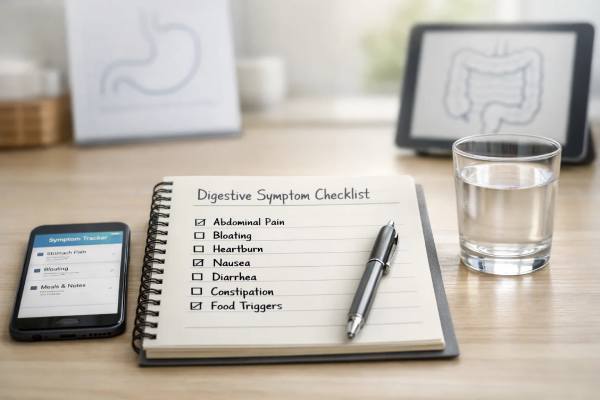
A good digestive appointment starts before you walk into the clinic. When symptoms are unpredictable—bloating one day, loose stools the next—it is easy to forget important details or describe the experience in broad strokes that are hard to act on. A simple, well-structured tracking plan turns “my stomach has been off” into a clear pattern: when it started, what makes it worse, what improves it, and which symptoms signal something more urgent. That clarity helps your clinician choose the right next step sooner—whether it is targeted testing, a focused diet trial, a medication adjustment, or reassurance that the pattern fits a functional disorder. This checklist is designed to be practical, not obsessive. You will learn what to record, how long to track it, and how to summarize your notes so your visit stays efficient and clinically useful.
Quick Overview
- Tracking symptom timing and stool patterns for 10–14 days often reveals triggers and reduces unnecessary repeat testing.
- A brief pain profile (location, intensity, and what changes it) helps clinicians separate reflux, gut sensitivity, constipation, and inflammation patterns.
- New bleeding, weight loss, persistent vomiting, or nighttime symptoms should not be managed with tracking alone and deserve prompt medical attention.
- Use a consistent daily log with the same 4–6 fields, then bring a one-page summary and your medication list to the appointment.
Table of Contents
- Start with your symptom timeline
- Define pain and discomfort clearly
- Track bowel habits and stool clues
- Log meals triggers and timing
- Note medications supplements and lifestyle factors
- Flag red symptoms and prep questions
Start with your symptom timeline
If you track only one thing, track time. Digestive conditions often look similar on a single day but very different over weeks. A clean timeline helps your clinician decide whether this is an acute issue (infection, medication side effect), a chronic pattern (constipation, reflux, irritable bowel symptoms), or a progressive change that needs faster investigation.
Write a simple timeline narrative
Aim for 6–10 lines. Think “headline plus receipts,” not a long story.
- First day you noticed symptoms (or best estimate).
- How the pattern evolved: steady, worsening, improving, or relapsing.
- Any obvious trigger in the 2–4 weeks before onset: stomach bug in the household, travel, new restaurant exposures, new job stress, a course of antibiotics, or a change in diet or supplements.
- How often symptoms occur: daily, 3 times per week, only after large meals, only during weekdays, or around your menstrual cycle.
- What your baseline was before this started: typical stool frequency, typical appetite, typical level of bloating or heartburn.
A useful phrase is: “Before this, my normal was ; since then, my normal has been .” That contrast gives your clinician a reference point.
Track duration with a realistic window
For most people, 10–14 days captures enough variation to be useful without becoming overwhelming. Consider 3–4 weeks if symptoms are intermittent (for example, once weekly episodes) or if you suspect cycle-related changes.
Keep it consistent: pick one tracking method (notes app, paper, spreadsheet) and one time you update it daily. If you record data in fragments, it becomes hard to interpret.
Include what you already tried
Clinicians will ask. Save time by listing:
- Changes you made (cutting dairy, skipping coffee, smaller meals).
- Medications used (antacids, laxatives, antidiarrheals) and whether they helped.
- What made symptoms worse (late meals, alcohol, high-fat foods, stress spikes).
This prevents repeating the same trial and helps refine the next step.
Define pain and discomfort clearly
“Stomach pain” can mean burning behind the breastbone, sharp cramps low in the abdomen, pressure from bloating, or nausea that feels like fullness. These differences matter because they point toward different organs and different testing strategies. Your goal is not to diagnose yourself, but to describe symptoms in a way that narrows the possibilities.
Use a three-part pain profile
For each distinct pain or discomfort type, capture:
- Location
Use simple landmarks: upper middle (below breastbone), upper right (under ribs), upper left, around the belly button, lower left, lower right, or pelvic/low midline. If it moves, say where it starts and where it goes. - Quality
Choose the best fit: burning, cramping, stabbing, dull ache, pressure, tightness, gurgling discomfort, or “fullness that makes me stop eating.” - Intensity and duration
Use a 0–10 scale (0 = none, 10 = worst imaginable) and the typical duration (minutes, hours, all day). If episodes come in waves, note the cycle (for example, “cramps peak for 20 minutes, then fade over an hour”).
Record what changes the symptom
Clinicians often diagnose by patterns of worsening and relief. Track:
- Meal relationship: within 15 minutes, 1–2 hours later, or the next morning.
- Position: worse lying down, better sitting upright.
- Bowel movement effect: improves after stooling, no change, or worse.
- Gas effect: improves after passing gas, or distention persists.
- Heat and movement: better with a heating pad, worse with exercise, or improved after walking.
If you have nausea, note whether it is linked to fullness, motion, or specific foods. If you have reflux symptoms, note whether the main issue is burning, sour taste, cough/hoarseness, or a sensation of food coming back up.
Capture associated symptoms once per day
You do not need to track everything every hour. A simple daily checklist can include:
- Appetite: normal, reduced, or avoiding food due to fear of symptoms
- Sleep disruption: yes or no
- Feverish feeling or chills: yes or no
- Energy: normal, somewhat reduced, significantly reduced
When pain is severe, sudden, or accompanied by fainting, rigid abdomen, or persistent vomiting, do not rely on tracking—seek urgent care.
Track bowel habits and stool clues
Stool patterns are one of the most valuable “data streams” in digestive care. They can suggest whether the main issue is constipation, diarrhea, malabsorption, inflammation, or pelvic floor dysfunction. The goal is to record stool details with enough precision that your clinician can interpret them without guesswork.
Track frequency and urgency
Each day, record:
- Number of bowel movements
- Timing (morning only, throughout the day, after meals, waking at night)
- Urgency (none, mild, “need to go soon,” or “must go now”)
- Incomplete evacuation (felt finished vs felt stool remained)
- Straining (none, mild, significant)
Nighttime bowel movements deserve special attention. Waking from sleep to stool repeatedly can be more concerning than daytime urgency alone.
Use the Bristol Stool Scale for consistency
This scale classifies stool form from Type 1 to Type 7:
- Type 1–2: hard, pellet-like or lumpy stools (often constipation)
- Type 3–4: formed stools (often closer to “typical”)
- Type 5–7: soft blobs to watery stools (often diarrhea spectrum)
You do not need to be perfect. The value comes from noting trends: “mostly Type 6 with occasional Type 4,” or “Type 1–2 for four days, then Type 6 after laxatives.”
Note stool features that change risk and next steps
Record “yes or no” for:
- Blood: bright red on paper, mixed in stool, or black/tarry stools
- Mucus: visible strands or coating
- Greasy or floating stool: especially if persistent
- Unusual color: pale/clay, very dark, or consistently yellow
- Incontinence: leakage or inability to hold stool
- Pain with stooling: burning, tearing, or cramping before and after
If you see blood repeatedly, have black stools, or develop persistent watery diarrhea with dehydration signs (dizziness, low urine output), do not wait for a routine visit.
Make it easy to summarize
At the end of your tracking period, write three lines:
- Average bowel movements per day
- Most common stool types (for example, Type 2 and Type 6)
- Biggest “pattern clue” (for example, urgency after breakfast, constipation during travel, diarrhea after fatty meals)
That summary is often more helpful than pages of raw notes.
Log meals triggers and timing
Food matters, but not always in the way people expect. Many digestive symptoms are influenced by meal size, fat content, speed of eating, and stress state, not just by a single “bad ingredient.” A useful food log focuses on patterns your clinician can act on, rather than an exhaustive list of everything you ate.
Track the details that most often change symptoms
For each main meal, record a short “meal fingerprint”:
- Time and approximate portion size (small, medium, large)
- Fat level (low, moderate, high) and fiber load (low, moderate, high)
- Common irritants if relevant: alcohol, caffeine, carbonated drinks, spicy foods
- Eating speed: relaxed, rushed, or eating while distracted
- Symptoms and timing: what started, and how long after eating (15 minutes, 1 hour, 4 hours, next morning)
This approach captures the most clinically useful signals without forcing you into perfectionism.
Consider a trigger shortlist instead of full elimination
If you suspect food triggers, pick one or two hypotheses for a 10–14 day log. Examples:
- Dairy-containing meals and symptoms within 6 hours
- Wheat-heavy meals and bloating the same day
- High-fat meals and loose stools the next morning
- Large dinners and reflux at night
Avoid stacking multiple major diet changes at once (gluten-free, dairy-free, low FODMAP, no coffee) right before your appointment unless medically necessary. When everything changes, it becomes hard to tell what mattered—and symptoms can temporarily improve simply because meals become simpler.
Track “non-food” meal modifiers
Two people can eat the same meal and feel different because of context. Record briefly:
- Stress level at the meal (0–10)
- Sleep quality the night before (good, average, poor)
- Exercise timing (within 2 hours of eating, later, none)
These notes help your clinician consider disorders of gut-brain interaction, reflux patterns, and constipation triggers without dismissing your symptoms as “just stress.”
A simple example log entry
- 12:30 pm, large meal, high fat, rushed eating
- Symptoms: upper abdominal pressure and nausea 30–60 minutes later, lasted 3 hours
- Stool next morning: Type 6, urgency moderate
A few entries like this often tell a clearer story than a long ingredient list.
Note medications supplements and lifestyle factors
Medication and supplement changes are among the most overlooked causes of digestive symptoms. Even when a product is not the root cause, it can shape the pattern—constipation, looser stools, nausea, reflux, or bloating. Lifestyle factors (sleep, hydration, movement) can amplify or reduce symptoms enough to change how your clinician interprets the picture.
Bring a clean, complete medication list
Write it in a format your clinician can scan:
- Medication or supplement name
- Dose and how often you take it
- When you started it
- Any dose changes in the last 3 months
Include non-prescription products. Common categories that influence digestion include acid reducers, anti-inflammatories, antibiotics, iron, magnesium, diabetes medications, weight-loss medications, and certain antidepressants. Do not stop prescribed medications on your own; your goal is to document the timeline so your clinician can assess plausibility and alternatives.
Track bowel-relevant habits that change week to week
You do not need to record these daily, but do note major shifts:
- Hydration: roughly how many cups of fluid per day, and whether you often feel dehydrated
- Fiber changes: new high-fiber diet, fiber supplements, or sudden reduction in fiber
- Physical activity: more sedentary than usual, travel days, or new intense exercise
- Alcohol and cannabis: frequency and whether symptoms cluster afterward
- Sleep: persistent insomnia, shift work, or poor sleep streaks
Constipation and bloating often worsen with reduced movement, low fluid intake, sudden fiber changes, and disrupted sleep. Tracking these helps your clinician decide whether lifestyle adjustment should be the first line or whether testing needs to come first.
Include personal and family history that changes risk
Write “yes or no” for:
- Prior abdominal surgeries
- Gallbladder removal
- History of ulcers, inflammatory bowel disease, celiac disease, or pancreatitis
- Family history of colon cancer, celiac disease, inflammatory bowel disease, or other major digestive diagnoses
Also note if symptoms correlate with your menstrual cycle, pregnancy, or postpartum period. Hormonal shifts can influence motility, nausea, reflux, and pain sensitivity, and that context can prevent unnecessary detours.
Flag red symptoms and prep questions
Tracking is powerful, but it is not a substitute for timely evaluation when symptoms suggest a higher-risk condition. The most helpful pre-visit preparation combines two things: recognizing red flags and arriving with focused questions that keep the visit efficient.
Red flags to write down immediately
If any of these are present, document them clearly and consider sooner evaluation:
- Unintentional weight loss or steadily worsening appetite
- Blood in stool, black stools, or repeated rectal bleeding
- Persistent vomiting, inability to keep fluids down, or dehydration
- Fever with ongoing diarrhea, severe abdominal pain, or symptoms after high-risk travel
- New symptoms that wake you from sleep repeatedly (pain or diarrhea)
- New anemia signs (unusual fatigue, shortness of breath with mild activity, dizziness)
- Progressive difficulty swallowing or persistent pain when swallowing
These do not automatically mean something serious, but they can shift the urgency and the choice of tests.
Prepare a one-page summary for your clinician
Use a simple structure:
- Main concern in one sentence (example: “Six weeks of post-meal bloating with alternating constipation and loose stools”).
- Top three symptoms and how often they occur.
- Stool pattern summary (frequency and typical Bristol types).
- What you tried and what happened.
- Red flags present or absent (example: “No bleeding, no weight loss”).
- Medication list (attach as a second page if needed).
This approach often saves time and reduces the risk that key details get lost.
Ask questions that lead to decisions
Consider bringing 5–7 questions such as:
- What are the most likely explanations for this pattern?
- Which signs in my log suggest constipation, reflux, intolerance, or inflammation?
- What tests, if any, are most important to do first, and why?
- What should I try for the next 2–4 weeks while we wait for results?
- What symptoms should prompt urgent care before my next appointment?
- Are there medications or supplements I should pause or adjust, and what is the safest way to do that?
- What does “success” look like—fewer symptoms, better stools, weight stability, or something else?
Leaving with a clear plan is the goal. Tracking supports that plan by making your symptoms visible, specific, and actionable.
References
- AGA Clinical Practice Update on Evaluation and Management of Belching, Abdominal Bloating, and Distention: Expert Review 2023 (Guideline)
- ACG Clinical Guideline: Management of Irritable Bowel Syndrome 2021 (Guideline)
- Evidence-Based Clinical Guidelines for Chronic Constipation 2023 2024 (Guideline)
- Evidence-Based Clinical Guidelines for Chronic Diarrhea 2023 2024 (Guideline)
- Stool form scale as a useful guide to intestinal transit time 1997 (Clinical Trial)
Disclaimer
This article is for educational purposes and does not provide medical advice, diagnosis, or treatment. Digestive symptoms can have many causes, and self-tracking should not delay care when symptoms are severe, persistent, or worsening. Seek urgent medical attention for black or bloody stools, severe or escalating abdominal pain, repeated vomiting, dehydration, fainting, or signs of allergic reaction. If you have unintentional weight loss, persistent diarrhea, ongoing fever, new difficulty swallowing, or symptoms that regularly wake you from sleep, contact a qualified clinician promptly.
If this checklist helped you feel more prepared, please share it on Facebook, X (formerly Twitter), or any platform you prefer so others can approach their visit with clearer, more useful symptom details.