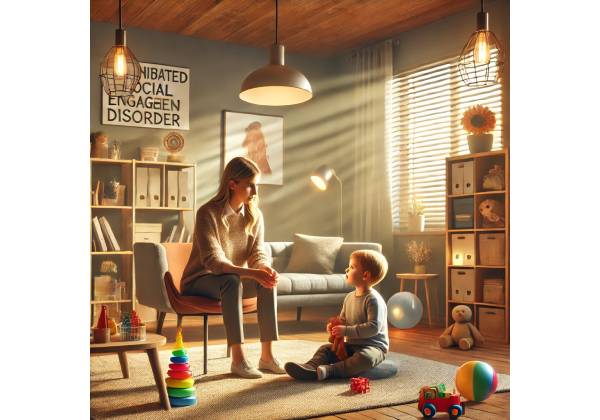
Disinhibited social engagement disorder can be deeply confusing for families and clinicians because the child may look friendly, outgoing, fearless, or unusually social at first glance. The real concern is not simple sociability. It is a pattern of unsafe, poorly selective attachment behavior, such as approaching unfamiliar adults too quickly, showing little hesitation around strangers, or wandering off without checking back with a caregiver. For caregivers, the most urgent questions are usually practical: how to keep the child safe, how to rebuild trust, what treatment actually helps, and whether the behavior can improve over time.
Effective care is usually broader than a single therapy hour. Treatment often depends on creating stable caregiving, reducing further relational disruption, helping the child learn safer social boundaries, and supporting the adults around the child so they can respond with consistency instead of alarm, anger, or punishment. Therapy can help, but it works best when it is matched to the child’s developmental level, trauma and neglect history, current placement, and day-to-day environment.
Table of Contents
- How treatment is planned
- The first priority is stable caregiving
- Therapy that helps child and caregiver
- Daily management at home
- School, community, and safety planning
- When other conditions overlap
- What recovery can look like
How treatment is planned
Treatment for disinhibited social engagement disorder starts with getting the picture right. A child who talks easily to strangers or seems socially bold does not automatically have DSED. The diagnosis depends on a persistent pattern of indiscriminate, unsafe social behavior together with a history of severe social neglect, repeated caregiver disruption, or other forms of grossly insufficient caregiving. That history matters because it shapes what treatment is trying to repair.
A proper evaluation usually looks at several questions at once:
- Does the child approach unfamiliar adults in a way that is clearly beyond age-expected curiosity?
- Do they fail to check back with a caregiver in unfamiliar settings?
- Would they willingly go off with someone they do not know well?
- Has the child had a caregiving history marked by neglect, institutional care, repeated placement changes, or severely inconsistent adult response?
- Are there other conditions that could explain part of the behavior more accurately?
That last question is especially important. Some children with ADHD, autism, trauma-related dysregulation, developmental delay, impulsivity, or limited social understanding may also seem socially unusual. A broader mental health evaluation can help organize the concerns, and in some cases a full autism diagnostic workup or developmental assessment is needed to avoid treating the wrong problem.
Good treatment planning also depends on age and placement. A toddler in a new foster placement needs a different approach from a school-age child who has lived through repeated caregiver changes and now shows little selectivity with adults. The younger the child and the more stable the caregiving can become, the better the odds of meaningful improvement. That does not mean older children cannot improve. It means treatment has to work with what the child has already learned about adults, safety, and attention.
In practice, clinicians often organize the plan around four goals:
- increase safety, especially around strangers and leaving with unfamiliar adults
- build selective attachment, so the child learns that some adults are “their” adults
- reduce caregiving instability, because treatment is weakened when relationships keep breaking
- treat overlapping problems, such as trauma symptoms, anxiety, impulsivity, speech delay, or school difficulties
One useful point for caregivers is that DSED treatment is not based on confronting the child about “bad behavior” or demanding emotional closeness on command. These children often learned early that adults may be unpredictable, temporary, or not reliably protective. Treatment works better when it creates predictable safety over time than when it tries to force a rapid emotional correction.
The first priority is stable caregiving
For many children with disinhibited social engagement disorder, the single most important treatment ingredient is not a particular technique. It is stable, consistent caregiving. If the child continues to move between adults, homes, or routines, therapy has much less to build on. That is because DSED is not mainly a problem of manners or overfriendliness. It reflects an early breakdown in the child’s experience of selective, protective caregiving.
Stable caregiving does not mean perfect parenting. It means the same few adults are reliably available, emotionally predictable, and physically protective. Over time, this helps the child learn a distinction that many children take for granted: not every adult is the same, and not every adult is equally safe. That lesson is central to recovery.
In practical terms, stable caregiving usually includes:
- consistent daily routines
- predictable responses to distress
- one or a few primary caregivers rather than a rotating cast of adults
- clear safety rules about public places and unfamiliar adults
- calm repetition instead of dramatic emotional reactions
- active supervision during high-risk situations such as parks, schools, stores, and family gatherings
Children with DSED may seek attention from anyone who offers it. This can be unsettling for caregivers, especially foster or adoptive parents who may already feel uncertain about the relationship. One of the hardest parts of management is not interpreting the child’s behavior as rejection. A child who climbs into a stranger’s lap or speaks to every adult as if they are equally familiar is not proving that they love their caregiver less. They are showing that selective attachment and social boundaries are still underdeveloped.
Caregivers often benefit from reframing the behavior. Instead of asking, “Why is this child acting attached to everyone except me?” it may be more useful to ask, “What does this child still need to learn about safety, belonging, and who protects them?” That shift keeps the adult grounded and reduces the temptation to respond with shame or withdrawal.
This is also the point where placement decisions matter. When possible, avoiding unnecessary changes in school, caregivers, caseworkers, and routines can support treatment. Even positive transitions can temporarily worsen behavior because children with DSED may respond to uncertainty by becoming more indiscriminately social, not less.
Stable caregiving is sometimes underestimated because it sounds simple. In reality, it is intensive work. It asks adults to provide structure without harshness, warmth without overexposure, and firmness without rejection. It also asks systems around the child to recognize that improvement is unlikely if the child keeps losing the very relationships treatment is trying to make meaningful.
Therapy that helps child and caregiver
Therapy for disinhibited social engagement disorder is usually most effective when it includes the caregiver, not just the child. That is because the treatment target is not merely the child’s behavior in isolation. It is the child’s way of relating to adults, seeking comfort, understanding safety, and managing closeness. Those patterns change best in the context of a real, stable caregiving relationship.
Several therapy approaches may be used depending on age, developmental level, trauma history, and placement stability. Common goals include:
- helping caregivers read and respond to the child’s needs more accurately
- increasing the child’s use of the caregiver as a secure base
- teaching safer social boundaries
- reducing anxiety, dysregulation, or attachment confusion
- strengthening the caregiver-child relationship through repeated, predictable interaction
For younger children, parent-child therapy or caregiver-child relational work is often central. Sessions may focus on coaching the adult in how to respond to distress, how to limit unsafe social behavior without shaming, and how to build repeated moments of regulation, play, and connection. In these treatments, the adult is not an add-on to therapy. The adult is part of the treatment itself.
Trauma-informed care is also important because many children with DSED have histories of neglect, deprivation, frightening caregiving, or repeated relational loss. That does not mean every child needs the same trauma therapy, but it does mean clinicians should keep trauma in the formulation rather than treat the behavior as simple noncompliance. A family may also be learning how trauma affects behavior and triggers through resources on how trauma can shape emotions and behavior.
Therapy may also include work on caregiver stress. Adults caring for a child with DSED often live with constant vigilance. They may feel embarrassed in public, frightened that the child could go off with someone, or hurt by the child’s lack of selectivity. If the caregiver becomes overwhelmed, angry, or emotionally distant, the child may become even less regulated. Supporting the caregiver is therefore not separate from child treatment. It is part of treatment.
Depending on the child’s needs, therapy may include:
- play-based work to build co-regulation and reciprocity
- psychoeducation about attachment and neglect
- trauma-focused interventions when the child is ready
- behavior planning around strangers and public settings
- social coaching about “safe adults” versus “friendly adults”
What usually does not help is forcing affection, using holding-based coercive methods, or treating the child’s disinhibition as evidence that they are manipulative or incapable of attachment. Those approaches misunderstand the disorder and can increase fear, confusion, or shame.
The most helpful therapy tends to be slow, repetitive, and relational. It does not assume one emotional breakthrough will fix the problem. It expects that the child will need many experiences of safe limits and dependable care before selective trust begins to deepen.
Daily management at home
Daily management matters because most of the real-world learning in DSED happens outside the therapy room. Caregivers are often the people who must translate treatment into everyday routines, public safety, and repeated relationship moments that show the child what safe closeness actually looks like.
A strong home plan usually does three things at once: increases safety, lowers chaos, and strengthens the child’s sense that specific adults are reliably theirs. This is often more effective than trying to “lecture” the child into appropriate boundaries.
Useful home strategies may include:
- using simple, repeated language about safe adults and unfamiliar adults
- practicing check-back routines in public places
- keeping transitions predictable whenever possible
- supervising closely in situations where the child is likely to approach strangers
- reinforcing proximity to the caregiver in age-appropriate ways
- responding calmly and immediately when the child crosses a social boundary
For example, if a child tries to leave with a familiar-looking but unknown adult at a playground, the most useful response is usually quick, calm, concrete correction: “You stay with me. We only go with your grown-ups.” Long emotional speeches tend to be less effective than repeated, consistent action.
Many caregivers also find it helpful to structure the day around attachment-building moments that are not only about discipline. That can include shared routines such as meals, bedtime, reading, transitions after school, and short periods of one-on-one play. These do not need to be elaborate. What matters is predictability and repetition. Children with DSED often need far more consistent evidence than other children that the caregiver remains available and engaged even when the child is dysregulated, distracted, or indiscriminately social.
Home management also works better when adults align with one another. Mixed messages can make the child’s behavior harder to shape. If one adult laughs off boundary-crossing as “cute” while another responds with fear or anger, the child is less likely to develop stable expectations.
A practical rule set is often better than a long list of warnings. Examples may include:
- We ask our adult before going anywhere.
- We do not sit on or hug people we do not know well.
- We stay where our adult can see us.
- We greet politely, then come back to our adult.
It can help to remember that the child may not feel the danger that the adults around them feel. That is part of why caregivers must often lend the child their judgment until the child can internalize safer patterns. This is not overprotection. It is treatment.
School, community, and safety planning
Children with disinhibited social engagement disorder may function differently at school or in public than they do at home. Some appear charming and socially confident, which can lead adults to underestimate the seriousness of the problem. Others become hard to supervise because they move toward any available adult, speak to strangers as if familiar, or fail to notice the ordinary caution most children show.
School planning is therefore part of treatment, not just an educational issue. Staff do not necessarily need a long psychiatric explanation, but they do need practical guidance. It can help when caregivers and clinicians communicate clearly about:
- who the child should check in with during transitions
- how pickup and dismissal will be handled
- what staff should do if the child approaches unfamiliar adults
- which behaviors reflect DSED-related safety risk rather than simple rule-breaking
- how to respond without shaming the child in front of peers
Some families also benefit from understanding how behavioral health screening in schools may fit into the broader support system, especially when teachers are noticing social boundary problems, impulsivity, attention issues, or trauma-related dysregulation.
Community safety planning is equally important. High-risk situations often include:
- busy public spaces
- drop-off and pickup points
- playgrounds
- family gatherings with many unfamiliar or semi-familiar adults
- stores, airports, or tourist settings
- sports or activity groups where multiple adults supervise
In these settings, treatment becomes very practical. Caregivers may need to use closer supervision than others expect, pre-teach rules before entering, assign the child a check-back point, and keep visual contact much more closely than they would with another child of the same age.
This can be tiring and sometimes socially awkward. Other adults may misread the child as extra friendly or accuse the caregiver of being too strict. But the safety issue is real. Children with DSED can be at increased risk because they may overestimate safety with adults they do not know and underestimate ordinary danger cues.
In rare situations, urgent safety assessment is needed, especially if the child repeatedly disappears with unfamiliar adults, shows escalating risky behavior, or if there are broader concerns about exploitation, abuse, or severe family instability. When behavior is placing a child in immediate danger, families may need guidance about when emergency mental health or safety evaluation is appropriate.
The more clearly school, caregivers, therapists, and child welfare systems communicate, the less likely the child is to receive mixed messages that slow progress.
When other conditions overlap
One reason DSED can be hard to treat is that it often does not arrive alone. Some children have trauma symptoms, language delays, attention problems, impulsivity, developmental differences, anxiety, or learning difficulties that complicate how the social behavior looks from the outside. If those overlapping issues are ignored, treatment may become too narrow.
For example, a child with DSED and ADHD may be both indiscriminately social and highly impulsive. A child with DSED and autism may struggle with social boundaries for more than one reason. A child with DSED and trauma-related hyperarousal may move rapidly toward adults in some settings and become dysregulated or avoidant in others. These combinations matter because each one changes how treatment is paced and explained.
This is why clinicians may recommend additional assessment when the picture is unclear. Depending on the child, that can include:
- developmental testing
- attention and executive-function assessment
- autism evaluation
- language assessment
- trauma and adversity screening
- school-based support review
When families are trying to make sense of social boundary problems, it can help to understand how ADHD testing in children works or how clinicians separate overlapping social and behavioral concerns in autism versus ADHD assessment. The point is not to keep adding labels. It is to avoid mistaking one problem for another.
Treatment also changes when trauma symptoms are prominent. Some children need a strong phase of stabilization first: predictable routines, caregiver coaching, sleep support, sensory regulation, and basic safety learning before trauma-focused work is introduced. Others may benefit from more direct trauma assessment if intrusive memories, fear, dissociation, or clear post-traumatic patterns are present.
A brief point on medication is helpful here. There is no medication that specifically treats DSED. However, medications may sometimes be used for overlapping conditions such as ADHD, severe anxiety, sleep disruption, or depression when those problems are clearly present and interfering with function. Medication should be seen as support for a broader treatment plan, not as the main therapy for DSED itself.
Children improve more reliably when the whole picture is being treated, not just the most visible behavior.
What recovery can look like
Recovery in disinhibited social engagement disorder is usually gradual and easier to see in real-life behavior than in dramatic emotional statements. Many children do not suddenly begin saying they feel securely attached. Instead, they start showing it in small but meaningful ways.
Improvement may look like:
- checking back with the caregiver in unfamiliar places
- showing more hesitation with strangers
- seeking comfort more selectively from known adults
- staying physically closer to caregivers in public
- needing less intense supervision than before
- responding better to safety rules and redirection
- becoming more predictable during transitions
- building deeper, more reciprocal relationships at home and school
That kind of progress matters because the core task in DSED treatment is not making a child less social. It is helping them become more selective, safer, and more relationally grounded.
The long-term outlook varies. Some children improve substantially when they enter stable caregiving early and receive good support. Others continue to show social boundary problems, impulsive relating, or vulnerability in peer and adult relationships for years, especially if neglect was severe or caregiving instability continues. Even in those cases, meaningful gains are possible. A child does not have to become perfectly typical to become much safer and more connected.
One of the most important signs of progress is when the caregiver-child relationship becomes a clearer home base. The child may still be friendly and outgoing, but the friendliness becomes less indiscriminate. They begin to act as though certain adults matter differently from all others. That shift is central to recovery.
Setbacks are also normal. A placement change, school transition, renewed contact with unsafe adults, or a major life disruption can temporarily worsen symptoms. That does not always mean treatment is failing. It may mean the child needs extra stability, tighter routines, and renewed caregiver support during that period.
Perhaps the most useful way to think about recovery is this: the child gradually learns that care is not random, strangers are not all the same, and safety comes from specific, dependable relationships. That learning takes time, but it is one of the most important developmental repairs treatment can support.
References
- Reactive Attachment Disorder and Disinhibited Social Engagement Disorder 2025 (Clinical Review)
- Reactive attachment disorder 2025 (Official Guidance)
- Disinhibited Social Engagement Disorder 2023 (Review)
Disclaimer
This article is for general educational purposes only and is not a substitute for professional medical, developmental, or mental health care. If a child has unsafe behavior around strangers, severe trauma symptoms, or immediate safety concerns, seek help promptly from a qualified clinician or emergency service.
If you found this article helpful, please consider sharing it on Facebook, X (formerly Twitter), or another platform you use.