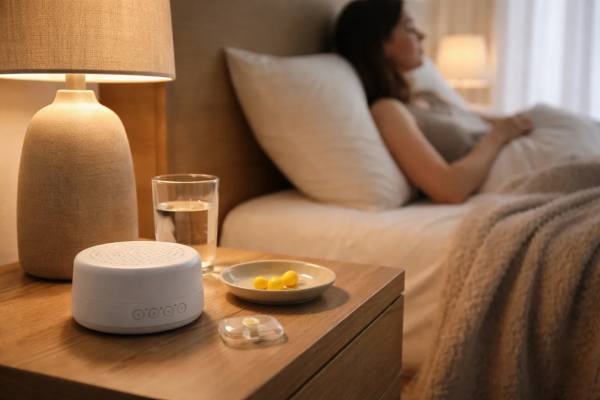
If you’re a light sleeper, “quiet” can feel like a moving target. A door latch clicks two rooms away. A neighbor’s footsteps ripple through the ceiling. A partner’s snore arrives in uneven bursts that your brain treats like a threat—not background. The result is often the same: shallow sleep, more awakenings, and that wired-but-tired feeling the next day.
Two tools dominate the search for relief: earplugs and white noise machines. Earplugs reduce what reaches your eardrum. White noise changes what your brain detects by smoothing sudden sound changes into a steady auditory blanket. Both can work, but they shine in different situations, and both have practical tradeoffs around comfort, safety, and consistency.
This guide compares them like a sleep professional would: by your noise pattern, your sensitivity, and what you can realistically use every night.
Core Points for Light Sleepers
- Choose earplugs when the problem is intermittent, sharp noise peaks (doors, footsteps, clanks) rather than a constant hum.
- Choose a white noise machine when the problem is variable background sound (street noise, roommates, distant traffic) and you need steadier masking.
- Keep sound masking at a comfortable low volume and stop if it worsens headaches, tinnitus, or irritability.
- Use a quick two-week trial with simple tracking (sleep onset time, awakenings, next-day alertness) before investing in upgrades.
Table of Contents
- Why light sleepers wake so easily
- Earplugs: strengths, limits, and fit
- White noise machines: masking done right
- Best choice for your noise profile
- Safety, comfort, and hearing protection
- How to use earplugs and white noise
- Decision guide and combination strategies
Why light sleepers wake so easily
“Light sleeper” usually means your brain is quick to notice change. Sleep is not a uniform off-switch—it cycles through stages, and even in deeper stages the brain still monitors the environment. For some people, that monitoring system is simply more reactive. A small sound change can trigger a micro-arousal (a brief shift toward wakefulness) even if you don’t remember fully waking. Enough micro-arousals can leave sleep feeling thin and unrefreshing.
Noise tends to disrupt sleep in two main ways:
- Peaks and surprises: A sudden sound (a dropped phone, a car horn, a snore that spikes) is more likely to cause an arousal than a steady sound at the same average volume. Your auditory system is built to prioritize “something changed” signals.
- Meaning and attention: Sounds with emotional or social meaning—your name, a baby cry, a partner’s breathing pattern—are harder to ignore. Even “quiet” snoring can be disruptive because it’s biologically relevant to your brain.
There’s also a feedback loop that keeps light sleepers stuck: one or two bad nights can increase vigilance. You go to bed scanning for noise, anticipating it, and that anticipation raises arousal. In that state, even normal sleep transitions can feel like wakefulness.
This is why the best tool is often the one that reduces change detection rather than chasing perfect silence. You’re trying to remove contrast: the difference between “baseline” and “peak.” Earplugs do it by turning down the whole soundscape. White noise does it by filling in the quiet gaps so the peaks don’t stand out as much.
A useful mental model: earplugs lower the volume of the world; white noise raises the floor of the room. For many light sleepers, either approach can be enough—if it matches the kind of noise you’re fighting and if it’s comfortable enough to use consistently.
Earplugs: strengths, limits, and fit
Earplugs are the simplest intervention: no power cord, no setup, no sound preferences. They’re also the most misunderstood, because effectiveness depends heavily on fit and on what kind of noise you’re trying to block.
What earplugs do well
- Reduce high-frequency and sudden noises: Clinks, voices, and sharper sounds often become less intrusive. This can be ideal in apartments with unpredictable peaks.
- Create a “private” sleep bubble: Many light sleepers relax faster when the environment feels controlled.
- Travel-friendly consistency: Hotels, planes, and unfamiliar rooms often have intermittent noise; earplugs can prevent a single peak from derailing the night.
Where earplugs disappoint
- Low-frequency energy travels: Bass-heavy noise—subwoofers, trucks, some snoring—can transmit through walls and even through your body. Earplugs may soften it but not erase it.
- Bone conduction remains: Vibrations can reach the inner ear through the skull. That’s one reason footsteps overhead can still feel loud.
- Bad fit equals “barely working”: A plug that isn’t fully sealed can reduce comfort and effectiveness at the same time.
Types that matter for sleepers
- Foam (roll-down): Often best for maximum reduction when inserted correctly. The downside is bulk and pressure if you sleep on your side.
- Silicone putty: Sits at the entrance of the ear canal and can be more comfortable for some side sleepers, but usually blocks less and can loosen overnight.
- Reusable flanged plugs: Easy insertion and predictable fit, but can press uncomfortably against the ear if you’re on your side.
- Custom-molded: Usually the best comfort-to-performance balance for long-term nightly use, especially for side sleepers. Higher upfront cost, but consistency is excellent.
A quick self-check: If you insert earplugs and your own breathing suddenly sounds louder, that’s a sign of a good seal. If one ear feels “open,” adjust—most people have asymmetrical ear canals and need different angles.
For light sleepers, the biggest win from earplugs is not total silence—it’s fewer abrupt awakenings. If your main issue is unpredictable peaks, earplugs often outperform white noise because they reduce the peak itself, not just the contrast.
White noise machines: masking done right
A white noise machine works by adding steady sound so that external noise changes are less noticeable. The goal is not “louder,” but “steadier.” When the brain hears a stable signal, smaller fluctuations in the environment are less likely to cross the threshold that triggers arousal.
White noise vs pink noise vs brown noise
- White noise has more high-frequency energy and can sound like “hiss.” It can mask speech well, but some people find it sharp.
- Pink noise reduces high frequencies and often feels softer, like steady rain.
- Brown noise is deeper and rumblier, which some people prefer for traffic or building hum.
For many light sleepers, the best choice is simply the sound you find neutral and boring. If you notice the masking sound, your brain may treat it as a stimulus rather than a buffer.
What good masking looks like
- It covers the gaps. The room stops having “quiet moments” where every creak is obvious.
- It doesn’t demand attention. You should be able to forget it’s on within minutes.
- It stays stable. Looping tracks or shifting patterns can backfire because the brain detects repetition changes.
Common reasons white noise fails
- Volume set too low: If peaks still pop out clearly, masking won’t happen.
- Volume set too high: Overly loud masking can irritate the nervous system, increase awakenings, or cause morning fatigue.
- Poor placement: A machine across the room may not mask a closer noise source. Distance and direction matter.
- Wrong sound profile: If you’re trying to mask low-frequency vibration with a thin high “hiss,” you may get little benefit.
White noise is often strongest when the environment is consistently noisy but not extreme—think traffic wash, a roommate moving occasionally, or a building that never fully quiets down. In that setting, earplugs may feel isolating or uncomfortable, while masking can create a predictable auditory backdrop that the brain learns to ignore.
One advantage many light sleepers don’t expect: masking can reduce the “listening for the next noise” habit. When the room has a steady sound, the brain has fewer cues to monitor. That shift—less vigilance—can be as valuable as the masking itself.
Best choice for your noise profile
The most practical way to choose is to match the tool to the noise pattern you’re experiencing. Ask a simple question: Is the problem the peak, or the contrast?
1) Partner snoring
- If snoring is irregular and spiky (quiet, then suddenly loud), earplugs often help because they reduce peaks directly.
- If snoring is continuous and mid-volume, a white noise machine can make it less distinct—especially if you place the machine closer to your head than the snorer.
- If snoring is low-frequency and powerful, neither tool is perfect. Many people do best with a combination: comfortable earplugs plus low-level masking to smooth what still gets through.
2) Footsteps, doors, and neighbor noise
- These are classic intermittent peaks, and earplugs often win. White noise can help, but only if the masking level is high enough to cover peaks—which can become annoying.
- If your building noise includes vibration (heavy steps), consider adding non-audio solutions too (rug pads, door dampers, bed repositioning). Sound tools can’t fully cancel vibration.
3) Street traffic and city wash
- White noise machines tend to perform well here because traffic is variable but patterned. Masking reduces the contrast of honks, distant sirens, and engine changes.
- Earplugs can work if you tolerate them, but some people wake more because they feel “sealed,” notice their heartbeat, or become anxious about missing alarms.
4) Voices and household activity
- White noise can mask speech surprisingly well, especially “hissier” profiles that cover consonants.
- Earplugs reduce voices too, but if you’re still detecting speech rhythm through walls, masking can remove the intelligibility that keeps your brain engaged.
5) Early-morning birds or sudden outdoor noise
- Earplugs often help more because these are sharp peaks.
- If birdsong is frequent, masking can reduce contrast—but it may take experimentation to find a sound profile that doesn’t become its own morning cue.
A short decision rule many light sleepers find accurate:
- Unpredictable peaks: start with earplugs.
- Variable background: start with white noise.
- Mixed environment: try a combo or choose the option you’ll actually use nightly.
Also consider your sleep style. If you’re a side sleeper who can’t tolerate pressure in the ear, white noise may be a better first step—even if earplugs would theoretically block more.
Safety, comfort, and hearing protection
Effectiveness is meaningless if the solution creates new problems. Light sleepers often abandon a tool because of discomfort, ear irritation, or a subtle sense of unease. The best option is the one that feels safe and easy at 2:00 a.m.
Earplug safety and comfort
- Skin irritation and earwax buildup: Wearing plugs nightly can trap moisture and wax. If you notice itching, soreness, discharge, or worsening ear fullness, pause and address it. Reusable plugs need regular cleaning; disposable foam plugs should be replaced frequently.
- Fit pressure: Side sleepers may feel aching where the plug presses against the pillow. Low-profile designs (or custom molds) reduce this.
- Occlusion effect: Your own breathing, swallowing, or heartbeat may sound louder. For some, it’s soothing; for others, it’s distracting. If it bothers you, try shallower-sealing options or a different material.
- Situational awareness: The biggest real-world concern is alarms. Many people can still hear smoke alarms, but lighter alarms (phone across the room) may not reliably wake you. If you use earplugs, consider layered safety: a louder alarm, a vibrating alarm, or placing the alarm closer.
White noise safety and comfort
- Volume matters: A masking sound that is too loud can be stimulating. Aim for the lowest level that reduces awakenings. If you wake with a headache, irritation, or “buzzing” ears, lower the volume or stop.
- Sound quality matters: Loops, crackles, or shifting tones can trigger micro-arousals. A dedicated machine or high-quality continuous track is often better than a glitchy speaker setup.
- Dependency concerns: Many people worry they’ll “need it forever.” In practice, dependency is often just consistency—like a pillow you like. If you want flexibility, use a timer or gradually reduce volume over weeks.
- Household impact: If you share a room, the sound that helps you may bother someone else. In that case, directionality helps: place the machine on your side, aimed toward you, or use a small speaker close to your bed at a lower volume.
Hearing protection
White noise used for sleep should be far below levels associated with hearing risk, but it can creep up over time as you habituate. A simple guardrail: if the masking sound feels like it competes with normal conversation at close distance, it’s probably too loud for an all-night exposure.
Finally, trust your nervous system. If either tool makes you feel tense—physically or emotionally—that matters. For light sleepers, a sense of control and safety is part of the intervention.
How to use earplugs and white noise
Most “it didn’t work” stories come down to setup. A small change in technique can turn a mediocre result into a meaningful one.
Earplugs: a reliable nightly method
- Choose the right style for your sleep position. Side sleepers usually do better with softer, low-profile plugs.
- Insert correctly (for foam). Roll the plug into a tight cylinder, reach over your head with the opposite hand to gently straighten the ear canal, insert, then hold in place 20–30 seconds as it expands.
- Confirm the seal. Your voice and breathing should sound noticeably different. If not, remove and reinsert—half-seals are common.
- Keep a hygiene routine. Wash hands before insertion. Store reusable plugs in a clean case. Replace foam plugs regularly; don’t “stretch” their lifespan when you’re using them nightly.
- Plan for waking needs. If you must hear a baby monitor or an alarm, test it intentionally during the day while wearing the plugs.
White noise: set it up like masking, not entertainment
- Pick a “boring” sound. Neutral and steady beats “beautiful” if you’re easily stimulated.
- Place it strategically. Put the machine closer to your head than the noise source when possible. Even a small distance advantage improves masking at lower volume.
- Set the volume by the loudest predictable peak. If your main disruption is a neighbor’s door at 1:00 a.m., set masking so that sound becomes dull and unremarkable—not necessarily invisible.
- Avoid obvious loops. If you can detect repetition, your brain can too. Use continuous-generation sounds when possible.
- Consider a timer with a long runway. Many light sleepers only need masking for sleep onset and the first sleep cycle (roughly 60–120 minutes). If awakenings are later, keep it running longer.
- Do a two-week trial. Track three things in a notes app: time to fall asleep, number of awakenings you remember, and next-day alertness (0–10). Adjust one variable at a time (sound profile or volume or placement) every 3–4 nights.
A smart hybrid setup
If you can tolerate earplugs, pairing them with a very low-level masking sound can be powerful: the plugs blunt peaks, and the masking reduces the contrast that still sneaks through. Done well, the masking can be quiet enough that it doesn’t bother a partner, yet still helps your brain stop scanning for changes.
Decision guide and combination strategies
If you want a clear answer, here it is: for most light sleepers, the “better” option is the one that fits your noise pattern and that you can tolerate nightly. Use this pathway to decide quickly and avoid endless tinkering.
Step 1: Identify your dominant disruptor
- Single sharp events (doors, footsteps, clatter, sporadic snoring) → start with earplugs.
- Changing background (traffic wash, roommates moving, HVAC cycles, distant noise) → start with white noise.
- A mix of both → consider combining or use the tool you’re more likely to keep using.
Step 2: Screen for deal-breakers
Choose white noise first if you:
- Get ear irritation easily, have frequent outer ear infections, or strongly dislike pressure in the ear.
- Need to reliably hear specific sounds (a child, medical device alerts) and can’t add alternative alarm methods.
Choose earplugs first if you:
- Share a bed and your partner dislikes added sound.
- Wake from sudden peaks more than from steady noise.
- Travel often and want a consistent, portable method.
Step 3: Upgrade only if the basics work
- If cheap foam earplugs help but comfort is the issue, the next move is better comfort, not necessarily “more blocking” (low-profile silicone or custom).
- If a basic white noise app helps but you notice loops or speaker artifacts, the next move is sound quality and stability (a dedicated machine or a better playback setup), not louder volume.
Combination strategies that make sense
- Earplugs + low masking: Best for mixed environments and snoring. Keep masking low; let plugs do most of the work.
- Masking + room tweaks: Add draft stoppers, soft-close pads, and a thick rug to reduce peaks. This can let you lower masking volume.
- Alternating nights during adaptation: Some light sleepers sleep worse for 2–4 nights when changing auditory conditions. If you’re sensitive, alternate (earplugs one night, masking the next) until your nervous system settles, then commit to one approach.
When to look beyond both
If you’re waking frequently without obvious noise, or you’re exhausted despite “quiet,” consider other contributors: insomnia patterns, anxiety, reflux, restless legs, medication timing, alcohol close to bedtime, or sleep apnea. In those cases, earplugs or masking may help symptoms, but addressing the root cause often brings the bigger win.
Your goal is not perfection—it’s fewer awakenings, faster return to sleep, and a bedroom soundscape that feels predictable. When you hit that, light sleep becomes less fragile.
References
- Effectiveness of sound and darkness interventions for critically ill patients’ sleep quality: A systematic review and component network meta-analysis – PubMed 2024 (Systematic Review)
- Noise as a sleep aid: A systematic review – PubMed 2021 (Systematic Review)
- Systematic review: auditory stimulation and sleep – PMC 2022 (Systematic Review)
- Impact of white noise on sleep quality across age groups and in critically ill/non-critically ill patients: A systematic review and meta-analysis of randomized controlled trials – PubMed 2025 (Systematic Review and Meta-Analysis)
- Environmental noise guidelines for the European Region 2018 (Guideline)
Disclaimer
This article is for general educational purposes and does not replace individualized medical advice, diagnosis, or treatment. If you have persistent insomnia, loud habitual snoring with choking or gasping, significant daytime sleepiness, worsening tinnitus, ear pain or discharge, or any concern about hearing or sleep safety, seek guidance from a qualified health professional. Use caution with any overnight sound exposure and prioritize safe, reliable wake-up methods if you use earplugs.
If you found this helpful, consider sharing it on Facebook, X (formerly Twitter), or any platform you prefer so others can sleep a little easier, too.