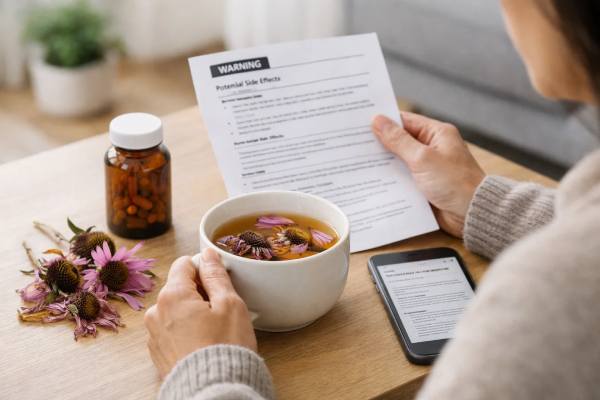
Echinacea sits in a unique space between folk remedy and modern supplement: it is widely used, heavily marketed, and genuinely studied—yet the answer to “does it work?” depends on which echinacea, how it is prepared, and when you take it. For some people, echinacea may offer modest, practical benefits—fewer respiratory infections over a season, slightly milder symptoms, or a shorter course when used early. For others, it is unlikely to change much, and in certain groups it may be a poor fit because of allergy risk, immune conditions, or medication complexity. This guide breaks down what echinacea is, what the research trend suggests (and where it remains uncertain), and how to use it thoughtfully without overpromising results. The goal is simple: help you decide whether echinacea belongs in your cold-care plan—and how to use it safely if it does.
Core Points for Smart Use
- Benefits, when present, are usually modest and depend strongly on the specific product and early timing.
- Higher-quality extracts appear more consistent than teas and “immune blend” gummies with unclear dosing.
- Avoid echinacea if you have a history of severe plant allergies, especially to ragweed and related plants.
- If you try it, start at the first clear cold signal and stop if you develop rash, wheeze, or facial swelling.
- Do not use echinacea as a substitute for medical care when fever is persistent, breathing is difficult, or symptoms rapidly worsen.
Table of Contents
- What echinacea is and why products vary
- How echinacea might help during a cold
- What studies suggest about cold prevention
- What studies suggest about treating a cold
- How to choose and use echinacea well
- Who should avoid echinacea and when to get care
What echinacea is and why products vary
Echinacea is not a single substance—it is a family of preparations made from several related coneflower species, most commonly Echinacea purpurea, Echinacea angustifolia, and Echinacea pallida. This matters because two bottles labeled “echinacea” can behave like different supplements. The plant species, the plant part used (root vs. above-ground parts), the extraction method, and the final dose all change what you are actually taking.
Species and plant parts: not interchangeable
- E. purpurea is the most commonly studied in modern clinical trials, often using a combination of herb and root.
- E. angustifolia is frequently used in traditional preparations and some supplements, but its chemical profile differs.
- Roots tend to be richer in certain lipophilic compounds, while aerial parts may contain different proportions of phenolic compounds.
When research results look “mixed,” product differences are a major reason. A study of one standardized extract cannot automatically be applied to an echinacea tea, a capsule made from powdered root, or a blended syrup.
What people mean by “active ingredients”
Echinacea contains multiple compound families that may influence immune signaling and inflammation. The most discussed include:
- Alkylamides (often associated with a tingling sensation in some preparations)
- Caffeic acid derivatives such as chicoric acid
- Polysaccharides and other complex plant constituents
These compounds vary with plant genetics, harvest timing, storage conditions, and extraction method. As a result, “standardization” (a consistent manufacturing target) is more than marketing—it is one of the few ways to make a supplement more predictable.
Why form matters: tea vs. tincture vs. tablets
- Tea is convenient but often delivers a lower and less consistent dose, especially if it is not standardized.
- Liquid extracts (including alcohol-based extracts) can deliver higher concentrations and may preserve certain compounds better.
- Tablets, capsules, and lozenges vary widely: some are standardized extracts, others are simply dried plant powder, and some contain small amounts of echinacea within large “immune blends.”
A practical takeaway: if you want results that resemble clinical studies, aim for a product that resembles what studies tested—a clearly labeled species, plant part, extraction method, and dose—rather than a vague blend with proprietary amounts.
How echinacea might help during a cold
A typical cold is a fast-moving immune event: symptoms rise as your body reacts to a virus, peak over a few days, then gradually resolve. Echinacea is often described as an “immune booster,” but a more accurate framing is immune modulation—nudging certain immune responses up or down depending on the context. This distinction matters, because the goal during a cold is not a bigger immune response at all costs. It is a well-matched response that clears virus while limiting unnecessary inflammation.
The cold timeline: why timing is everything
Most colds:
- Build over 24–48 hours from scratchy throat or fatigue to congestion and cough
- Peak around days 2–3
- Improve over 7–10 days, though cough can linger longer
If echinacea helps, it is most likely to help when it is introduced early, when viral replication and immune signaling are still ramping up. Starting after symptoms have fully peaked is less likely to change the overall course.
What “help” usually looks like in real life
Even in optimistic interpretations, echinacea is unlikely to erase a cold. More realistic outcomes include:
- A small reduction in the number of respiratory infections across a season in some people
- Symptoms that feel slightly less intense (for example, fewer “sick days” where you feel completely depleted)
- A cold that resolves a bit sooner, especially when taken early and at adequate doses
Because colds naturally improve on their own, the real question is whether the improvement is clinically meaningful—enough to justify cost, effort, and any risk.
Why results can feel inconsistent
People often report that echinacea “works sometimes.” That can happen for ordinary reasons:
- Not every “cold” is the same virus, and viruses differ in how your immune system responds.
- People vary: sleep debt, stress level, and baseline health can change symptom severity.
- The product may be under-dosed, poorly stored, or chemically different than what helped previously.
- Starting late can create the impression of failure even if early use might have helped.
If you choose to trial echinacea, treat it like a time-limited experiment: pick one well-labeled product, use it consistently at the first sign of illness, and judge it across more than one episode.
What studies suggest about cold prevention
Cold prevention is where echinacea’s evidence is often described as “promising but not definitive.” That phrasing is unsatisfying, so it helps to translate it into what it means for you: there are signals that certain echinacea extracts may reduce the frequency of respiratory infections or related complications, but the benefit is not guaranteed, and it depends heavily on preparation, dose, and population.
Prevention means different strategies
There are two common approaches:
- Seasonal prevention: daily use during high-exposure months
- Targeted prevention: short-term use during a high-risk window (travel, family exposure, intense work weeks)
Seasonal prevention is the approach most likely to show measurable differences in infection counts, but it also raises more questions about who should avoid longer use.
What tends to improve in prevention studies
When benefits appear, they commonly show up as:
- Fewer recurrent respiratory infections in people who tend to catch “everything”
- Fewer complications that drive clinic visits or antibiotic prescriptions
- In some settings, fewer overall infection days across a season
It is important to keep expectations realistic: a supplement that reduces your risk by a modest amount can still be worthwhile if your colds are frequent, disruptive, or trigger asthma flares or sinus trouble. But if you get one mild cold per year, prevention strategies may not be cost-effective.
Why prevention results are hard to compare
Prevention research is complicated by variables that are difficult to standardize:
- “Cold season” exposure differs by job, children in the home, and public contact.
- Some studies track “self-reported colds,” while others verify infections with lab tests.
- Extracts vary, and dosing schedules differ widely.
A useful way to think about prevention evidence is not “echinacea works” or “echinacea fails,” but rather: some preparations may modestly reduce respiratory infection burden for some people, especially those prone to recurrent illness.
Who is most likely to consider prevention
You might consider a prevention-style trial if you:
- Have repeated colds each season that derail work or caregiving
- Often develop prolonged cough or sinus symptoms after “ordinary” viral infections
- Work in a high-exposure environment and want an additional layer of support beyond hygiene and sleep
If you try prevention, make it measurable: track how many colds you get, how long they last, and how many days you feel significantly limited. Without tracking, prevention trials are easy to misread.
What studies suggest about treating a cold
Treatment studies ask a simpler question: once you are clearly getting sick, does echinacea shorten the cold or reduce symptom intensity? The honest answer is that results are mixed—but “mixed” does not mean “nothing.” It often means small effects that depend on dosing and formulation, alongside studies that show no meaningful difference.
What treatment benefits look like when they show up
In trials where echinacea appears helpful, effects commonly include:
- Symptom duration shortened by roughly about a day (not dramatic, but noticeable to some people)
- Faster improvement in “whole-body” symptoms like fatigue or malaise
- Possible reductions in the intensity of sore throat or nasal symptoms in certain preparations
These outcomes matter most when your baseline colds are severe or when your schedule makes a one-day difference meaningful.
The “early and enough” principle
Two patterns tend to separate stronger from weaker results:
- Earlier start: initiating at the first clear cold signal (not day 4)
- Adequate dose: using doses similar to what trials tested, rather than trace amounts in blends
People sometimes take echinacea sporadically (“a capsule when I remember”), then conclude it does not work. Many supplements fail under that kind of use—not because they are effective, but because they were never given a fair test.
Why some studies show no benefit
Null results can occur for several reasons:
- The product is a dried powder with lower active compound availability than an extract.
- The dose is too low to plausibly change immune signaling.
- Participants start after symptoms are already established.
- Study populations vary (children vs. adults; high-stress vs. low-stress; recurrent infections vs. occasional colds).
This is not a justification to keep trying random products. It is a reason to be selective: if you try echinacea, try it in a way that gives it the best chance to show a benefit.
A balanced treatment plan
Even if you use echinacea, it should be one part of sensible cold care:
- Hydration and rest (they change symptom tolerance more than people expect)
- Symptom relief (saline rinses, humidified air, lozenges, and appropriate over-the-counter options)
- Avoiding unnecessary antibiotics for viral illness
If echinacea helps you, it typically helps at the margins—making the cold somewhat more manageable—not replacing the basics.
How to choose and use echinacea well
If you decide to try echinacea, the biggest mistake is treating all products as equivalent. Your best odds come from choosing a product that is clear, consistent, and used with a defined plan. Think of this as “supplement hygiene”—the same logic you would use for any intervention you want to evaluate honestly.
A label checklist that actually matters
Look for these features on the label (or in the product monograph if provided):
- Species named (for example, Echinacea purpurea rather than just “echinacea”)
- Plant part listed (root, herb, or a combination)
- Extract information (not only “powder,” and ideally a drug-to-extract ratio or equivalent detail)
- Dose per day that is easy to calculate without guesswork
- Single-herb product if you are trying to judge echinacea specifically (blends obscure cause and effect)
Also consider quality signals such as third-party testing for identity and contaminants. This is especially relevant for botanicals, where mislabeling and variability are well-documented concerns in the supplement world.
Practical dosing approaches used in real-world trials
Because products differ, a single universal dose is not realistic. Instead, use dosing principles:
- For acute treatment: start at first symptoms and follow a higher, front-loaded regimen as directed for that standardized extract, typically used for up to about 7–10 days during an episode.
- For prevention trials: daily dosing may be used in cycles across higher-risk months, often for weeks to a few months, then reassessed.
Do not exceed label directions to “make it work.” If a product requires excessive dosing to feel meaningful, it may not be the right product.
How to run a clean personal trial
If you want a clear answer for your body:
- Pick one well-labeled product.
- Decide your goal: prevention vs. early treatment.
- Track outcomes for two to three comparable cold seasons or episodes if possible:
- Number of colds
- Days of significant impairment
- Total symptom days
- Any side effects
If you cannot tell a difference after fair use, that is useful information. You can stop without feeling you “missed the right brand.”
Common mistakes to avoid
- Starting late (“I took it once I was already miserable”)
- Using teas or low-dose gummies and expecting trial-level effects
- Mixing multiple new supplements at once, making it impossible to know what helped
- Ignoring early allergic symptoms such as itching, hives, or new wheeze
Used thoughtfully, echinacea can be tested without drama. Used haphazardly, it becomes a confusing and expensive habit.
Who should avoid echinacea and when to get care
For many healthy adults, short-term echinacea use is tolerated. The key word is many, not all. The most important safety issues involve allergy risk, immune-related conditions, pregnancy and breastfeeding uncertainty, and medication complexity. If any of these apply to you, echinacea deserves a more cautious approach—or avoidance.
People who should generally avoid echinacea
Consider avoiding echinacea unless a clinician who knows your history recommends otherwise:
- History of severe allergies to ragweed, daisies, marigolds, or similar plants (echinacea is in the same botanical family as several common allergens)
- Prior anaphylaxis or severe urticaria (hives) to any supplement or herb
- Autoimmune diseases where immune modulation could complicate symptom control (for example, if you flare with immune-stimulating supplements)
- Organ transplant recipients or anyone taking immunosuppressant therapy
- People on complex regimens with narrow-therapeutic-index drugs, where even small interaction risks deserve caution
Children, pregnancy, and breastfeeding
- Children: Short-term use may be tolerated in some cases, but rash and allergic reactions are a known concern, and dosing should not be improvised. Discuss with a pediatric clinician, especially for children with asthma, eczema, or multiple allergies.
- Pregnancy: Safety data are limited and not strong enough to treat as “proven safe.” If pregnant, avoid self-prescribing echinacea without professional guidance.
- Breastfeeding: Evidence is limited. If you want to use echinacea while breastfeeding, discuss it first—especially if the infant has eczema or allergy risk.
Possible side effects and what to do
Common, usually mild effects can include stomach upset, nausea, and headache. Stop echinacea and seek urgent help if you have:
- Trouble breathing, wheeze, or chest tightness
- Swelling of lips, tongue, or face
- Rapidly spreading hives
- Severe dizziness or faintness
Even if you have taken echinacea before without problems, allergic reactions can occur unexpectedly, particularly with higher doses or different formulations.
When cold symptoms are not “just a cold”
Seek medical evaluation promptly if you have:
- Fever that is high or lasts more than 3 days
- Shortness of breath, chest pain, or bluish lips
- Severe sore throat with difficulty swallowing, drooling, or dehydration
- Worsening symptoms after initial improvement (a “double-sickening” pattern)
- Underlying lung disease, significant immune suppression, or frequent pneumonia history
Echinacea is not a safety net for serious illness. It is, at most, an optional supportive tool for uncomplicated viral respiratory infections in appropriate individuals.
References
- Echinacea Reduces Antibiotics by Preventing Respiratory Infections: A Meta-Analysis (ERA-PRIMA) – PMC 2024 (Systematic Review and Meta-Analysis)
- Novel Echinacea formulations for the treatment of acute respiratory tract infections in adults—A randomized blinded controlled trial – PMC 2023 (RCT)
- Echinacea Purpurea For the Long-Term Prevention of Viral Respiratory Tract Infections During Covid-19 Pandemic: A Randomized, Open, Controlled, Exploratory Clinical Study – PMC 2022 (Clinical Study)
- Echinacea: Usefulness and Safety | NCCIH 2024 (Government Fact Sheet)
Disclaimer
This article is for general educational purposes and does not provide medical diagnosis or personal treatment advice. Supplements can affect people differently and may pose risks for individuals with allergies, autoimmune disease, immune suppression, pregnancy, breastfeeding, or complex medication regimens. If you have chronic health conditions, take prescription medicines, or are unsure whether echinacea is appropriate for you, speak with a qualified health professional before using it. Seek urgent care for severe allergic symptoms, difficulty breathing, chest pain, confusion, dehydration, or rapidly worsening illness.
If you found this guide helpful, consider sharing it on Facebook, X (formerly Twitter), or any platform you prefer so others can make safer, better-informed choices.